Strategic Planning - Its Not That Complicated
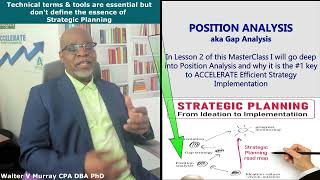
In this recorded Accelerate Strategy Roundtable, Dr. Walter V. Murray welcomes a global audience of business owners, executives, and strategy professionals and addresses eight frequently asked questions about strategic planning and its implementation. He frames three recurring themes emerging from the questions: (1) the need for clarity on what strategic planning actually is, (2) how to improve execution of a strategy, and (3) the risks and pitfalls to avoid. Murray demystifies strategic planning by stripping away jargon and presenting a core definition: a roadmap that moves an organization from its current (present) position to a desired (preferred) position. He illustrates this with everyday analogies (e.g., traveling from Atlanta to Grenada) and a Yoda‑style simplification. He then introduces his 5‑Phase Functional Approach, emphasizing that the most critical element for successful execution is a rigorous position (gap) analysis, which he warns can prevent “Strategic Plan Implementation Disorder” (SPID). Throughout, he encourages participants to engage, submit questions, and consult his book “Strategic Planning: From Ideation to Implementation” for deeper guidance.
Chapters
Alright, welcome to the Accelerate Strategy Roundtable. You are at the table. You are at the roundtable. The Accelerate Strategy Roundtable. So here's where business owners, senior leaders, executives, senior managers, people who are responsible for driving implementing strategy in the organization, anyone who has an interest in making sure that organizational and business strategy gets executed at a high level, this is the table you'll find them at, right? This is the Accelerate Strategy Roundtable. We talk about stuff that will help accelerate your strategy implementation to help you get to your strategic objectives faster, more efficiently, more productively. So if that's you, then you are at the table. Welcome to the roundtable. I see so many people online, folks from as far away as Zimbabwe. Harriet, how you doing? South Africa. I'm in Atlanta. I'm trying to think which is further away, Zimbabwe or South Africa. I got to study up on my geography here. We got folks from Canada. Hi, Cheryl. Must be cold up there this time of the year, right? Okay. Grenada. Samantha from Grenada. A couple other people here from Grenada. I believe you guys are all part of a board of directors for one of the local colleges. I think I spoke with one of your directors and he mentioned that you were going to be, or at least try to be online together, which is a great idea. Great idea. I also see another board, Dr. Laria, some of her board members on here as well. Fantastic. From Indiana, North Carolina, we got folks from Texas, right here in Atlanta. CFO, Charles, CFO, Chief Financial Officer. Oh, hey, just put in the chat box there, what is your leadership role, right? What are you? C-level exec, CEO, CFO, business owner, senior manager, director of strategy, just whatever it is you do that impacts the strategy implementation for your team or your organization. Just kind of Shoot me a line in the chat box. I'll see what the group is made of, you know, a profile of how the group is made up. Okay, yeah, we got people who are directors of strategy, HR director, senior executive directors, owners, consultants. Yeah, good, good place to be. Exactly, great, fantastic. Now, if you're watching this on the recording, we will also make available a way for you to interact. So you could also, if you're watching the recording, enter in where you're from, where you're watching from. You could also enter in what your role, your role in strategy implementation is. You know, if you have a question or something like that, you want to put it in there, you can. And it's not real time, but we'll definitely get back to you within 1 to 2 days. But yeah, I'd love to see your comments if you're watching this on a recording. Just love to see where you're watching it from. Alright, so in this session of the roundtable, we're going to focus on answering some of your questions about strategy. Remember when you registered, we invited you to submit your questions about strategy and strategy implementation, pre-submit them so that By the time we get to the roundtable session, we'll have some really well-researched responses to share with you. And so I want to say thank you for your question. We had quite a few questions. So what I did, I went through and found the 8 most frequently asked questions that were submitted. The questions were quite extensive. In terms of the scope of the questions, they were quite extensive and comprehensive questions. So here are the questions, the 8 most frequently asked questions.
The first question was, we keep running into roadblocks trying to follow our strategic plan even though we think we did a well-researched and rigorous strategic plan. How do we deal with these unexpected hiccups in the execution phase? Question number 2 was, how do we set prices for the services we offer? We want to make our services affordable and accessible to our customers., but still want to make a decent profit. What strategy should we use to do this? This next question was from someone who is in charge of strategy for their organization. It asks, I'm the strategy director for my company, but I can't seem to get people to take strategy seriously. Senior leadership is always too busy. How can I get them more involved in strategy execution? Next question is: We just did a review of last year's strategy. We were not happy with how we achieved our strategic goals. What can we do differently in 2023 to be better at achieving our strategic objectives? Question number 5: We have a fairly comprehensive business plan. Do you recommend we also do a strategic plan? Is there a difference between a strategic plan versus a business plan? Someone else asked, "I listened to one of your YouTube videos and you said that department managers should also have a strategic plan for their department, whether it's a department of 1 or 100. My department is only 2 people, wouldn't it be more cost-effective to follow the company's strategic plan?" Next question: "How often should we do a strategic plan?" And the final question is, well, This is more of a comment. It says, I'm trying to learn as much as I can about strategy so I can improve my value to my company and so I can help our management team develop and execute a competitive strategy.
And again, if you're watching this on a recording, you can still submit your questions, um, and I will respond. It's not real time, but I will respond usually in a day or two. Now, as I looked at the questions, I saw that there were 3 recurring themes in these questions, 3 recurring themes. So what are these themes? What are these 3 recurring themes? So the first theme was clarity, just some clarity on what is strategic planning, right? There's a lot of misconceptions out there. Could you give us some clarity on what exactly is strategic planning? So we'll cover that. The second theme in the questioning was "How do we improve the implementation of strategy?" It's interesting that this question wasn't a focus on— it wasn't so much a focus on the creation of a strategy or strategic plan, but it was a focus on the implementation, which is very insightful because strategy implementation is 10 times more challenging than strategy creation. Although strategy creation, the creating of a strategy, is very rigorous, just imagine how much more rigorous and challenging implementation could be. And then the third theme in the questions was what are some of the risks that we should watch out for in strategy creation and implementation. Some things to avoid, some common pitfalls that I've seen in my years, 35+ years of practice. What are some of the things that I've seen that I could warn you to avoid, right? So the 3 themes: clarity on what strategic planning is, how to improve the implementation of strategy, And third, what are some of the risks that we should look out for? So let's dive right into the first question. What is strategic planning?
See Dr. Murray's responses to these specific questions below. You can pause the recording, review these responses, and then resume the recording as Dr. Murray addresses the first issue of clarity regarding strategic planning.
The fact that you're listening to this episode already tells me that you already know a lot about strategic planning. You understand the importance or else you wouldn't be listening to this, right? Strategic planning has become shrouded in mystery, myth, a misconception. And part of the reason for that is because of people like me. We use a bunch of techno-babble and techno-jargon, probably too much, when we talk about strategic planning. And so that has created this aura of complexity. And so I kind of want to pull back some of that complex aura, pull back that a little bit. On the opposite side of the techno-babble and techno-jargon, people that talk about strategic planning almost as if it's motivational speaking, right? Oh, get a dream and get a vision and pump you up and go for it and be disciplined. You know, strategic planning is a lot more technical than motivational speaking Although you require motivation to execute strategic planning, right? Especially in those days when it seems like nothing is going according to strategy, nothing's going according to plan. You got to find something deep within you to motivate yourself and your team to kind of keep pushing. But strategic planning, strategy implementation is a whole lot more technical than just motivation., but at the same time, it is not as technical. It's really not that complicated. We sometimes just make it sound complicated. In fact, you know, I don't know if you guys remember this, but I think it was about 2012, 2013, AT&T had a commercial, AT&T, and the commercial was about, "It's not that complicated." You remember that? And the scene was there was an adult sitting on a kiddie chair surrounded by kindergartners, and he would ask them a question about life or something, and they would give him some really strange answers. I think it was comical, right? Why is it better to get what you want now instead of later? Because you don't want to wait to eat your raisins. You don't want to wait to eat your raisins? No.
Why not?
Because they'll turn into grapes? Not sure that's the way it works. Yes. Are you competing for cutest kid right now? Yes. And what place are you in? Kindergarten. That's adorable. It's not complicated. It wasn't so much the answers they gave, but the way they gave it. They kind of exuded this vibe like, you don't know that and you're an adult? Come on now, it's not that complicated. So it was like that kind of attitude. And at the end of the commercial, you guys remember this, and at the end of the commercial, the voiceover comes on and says, "It's not that complicated." Well, same thing applies to strategic planning. It really isn't that complicated.
I still think it is complicated.
So I don't know how many of you are Star Wars fans, right? You know, Darth Vader and Yoda. The whole crew. Well, Yoda is my favorite, favorite guy on that show. I don't think it's on anymore, but you know, back when it was popular, Yoda. And the reason I like Yoda right now, Yoda's the little green, the little green guy, remember? And you know, he was pretty profound and deep. He had these big ears and he would take the— he had this ability, right? To take the most profound philosophical point of view and perspective and break it down to like one sentence. And the way he would speak his sentences, the syntax was off, right? Like, there was this one quote where he was trying to tell a young person, a young soldier, to have patience. So he said, "Patience you must have, my young friend." Right? Instead of saying, "You must have patience," he said, "Patience you must have." So he had this ability to take these really profound concepts and paradigms and just break them down to a sentence. Talking to one of the soldiers on how to deal with fear, he said, "Named must your fear be before banish it you can." Now think about that. That's pretty deep, right? But the syntax was kind of way off. So I figured, you know, here's a person who has the ability to take complex concepts and break them down to a sentence, so why not ask him about strategic planning, right? So if I were to ask Yoda, what is strategic planning? He would say something like this: set goal, find path, Reach goal, my young friend. Yeah, set goal, find path, reach goal. Your path you must decide. Your path you must decide. That's what strategic planning is all about— having a goal, finding a path to reach that goal. All right, but you didn't come here to the roundtable to get a Yoda definition of strategic planning. I'm pretty sure, right? So let me give you a little bit more meat, a little bit more substance to what strategic planning is. So in the introduction to my book, Strategic Planning: From Ideation to Implementation— by the way, the book is available on Amazon. At the end of the session, I'll give you some links where you can go grab any of the books that I mentioned in this session. But in that book, in the introduction, I give a core-level definition of strategic planning. And when I say core-level, I mean if you were to strip away all the techno-jargon, techno-babble, what exactly is strategic planning? So in my introduction, I give a very core-level concise definition of strategic planning, but then later on in Chapter 4, I sort of expand on that in what I call the 5 Functional Phase Approach. Right? It's a framework for strategic planning that I've developed and used with clients over the last 35+ years or so. But what is this core-level definition of strategic planning? Well, strategic planning is a process of creating a roadmap to get from where your organization currently is to where you want to be. To get from where you are to where you want to be. Like Yoda would say, "From here to there, get there." Yeah, that's a good one. That's a good Yodaism right there, but anyway. How do you get from where you are, which I call the present position, to where you want to be, which is what I call the preferred position? And so I've developed a roadmap. The roadmap begins with ideation, and ideation is really that part of the map where you do vision casting, mission, value alignment. Ideation, that's the start of the roadmap. Then you go to your position analysis, which we'll talk about more later on in this session. Then you do your gap strategies or tactical approaches. Then you do implementation and monitoring of progress, progress monitoring. But what I want to focus on here is the core level definition. It's the process of getting from where you are to where you want to be. That's it. Simple. Every day we do strategic planning. You get up in the morning and you've got to get to the office by 9 o'clock or else you get fired. I don't know. You're the boss, so you can't fire yourself. But anyway, so at home, in bed, under the covers, is your present position. Your preferred position is in the office at your desk taking care of business. That's your preferred position. In your mind, you begin to do strategic planning. How do I get from here to there? That's what you call closing the gap, right? We'll talk about that too. That's strategic planning, getting from here to there. Family vacation, you haven't had one in 10 years. So you and the family get together and you decide to go on a family vacation. You live in Atlanta, Georgia. You want to go to, let's say, Grenada, right? Yeah, we got some folks from Grenada on here. Beautiful island, by the way. Been there several times. So you want to go from Atlanta to Grenada. Atlanta, present position. Grenada, preferred position. What's the roadmap from Atlanta to Grenada? Strategic planning. Simple. But sometimes we get carried away with the techno-babble, balance scorecard and PESTLE and SWOT and all that kind of techno-babble stuff. But when you strip that away, at the core level, it's a roadmap from here to there. So that's the first theme that ran through the questions. Give me some clarity on strategic planning. The second theme, the second thematic question was, what's a key to improving strategic plan implementation? Like, if you were to give us one thing that would really make a big difference in strategic plan implementation, what would that be? And so that thing would be gap analysis, or what I call position analysis. And even though it's a key to effective and profitable implementation, it actually begins in the strategic plan creation phase. If it's created well, it's going to run well, generally speaking. So in the creation phase, it's important that you get a really good handle on position analysis if you want to sort of guarantee that your implementation would go effective, or if you want to avoid what I call strategic plan implementation disorder. I use an acronym called SPID. You'll hear me talk about that in one of my little video clips later. But SPID sounds like a disease, right? Very well might be when it comes to strategic plan implementation. SPID, Strategic Plan Implementation Disorder. The one key that will help you avoid strategic plan implementation disorder is having a strong, rigorous, comprehensive position analysis. So what is this position analysis?
More from Walter








All You Do Is Win ! https://acceleratestrategyleadership.training/saltresources/


