Win Consumers With Trust, Not Tokens | Icebreaker: Mined with CoinFund Ep. 5
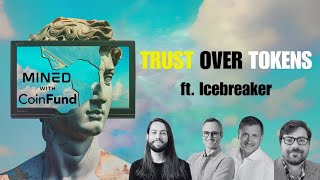
Dan Stone and Jack Delay of Icebreaker argue that tokens can buy attention but not lasting user retention. Their platform uses verified work-email attestations and selective data sharing instead of putting personal data fully on-chain, and works with Farcaster, Lens, and POAP.
Chapters
This is going to elicit one of my other maybe spicy takes, which is that the normal answer of a crypto native is to say put it all on chain. I think that is the wrong answer, particularly in the realm of personal data. And unfortunately, we have a lot of blockchains who are always excited about putting stuff on chain because that's good for the blockchain, but that's not necessarily good for building consumer grade apps.
Hello, everyone. Welcome back to another episode of Mind with Coin Fund. Coming at you from our beautiful Coin Fund office in Bryant park in New York City. I hope you're all having a great week so far. My name is Jake Brookman. I'm the founder and CEO and managing partner at Coin Fund. And today we have a new host from Coin Fund joining us. Please welcome my partner, co founder and Coin Fund's Chief Investment Officer, Alex Felix. Welcome, Alex.
Thank you, Jake. Great to be here. I've been listening to the podcast and I've been excited to jump on at some point and this feels like a great inauguration.
Amazing. It's going to be a fun one. All right, Alex, since it's your first time joining us, I'm just going to go ahead and ask you the core question of our show, which is what is the one thing in crypto you are most interested in that keeps you up at night and that you think more people should be paying attention to?
Great question, Jake. And something that you kind of have to keep triangulating coming back to, because I think it's really simple. Most people complain about the lack of use cases, and we tend to hear that as a question, what are the use cases for blockchains? And so I keep coming back to at night and in the morning and trying to constantly reframe what are blockchains good for? A lot of people have tried and experimented with a lot of different things, but we still have not hit a tipping point in some of the areas that we would consider mainstream and we would consider to converge with how things are done in traditional tech and what users are using the Internet for today. So I constantly try to put together a list of pros and cons and dissect those and think about what could come out of those. And some you guys might agree with, some you might disagree with. I'd love to get your take, but so far where I'm at is blockchains are faster and more efficient in moving money. We tend to shy away from the efficiency argument because it feels not as sexy and exciting and that is novel and new and People on blockchain like to put out really big visions about how something's completely new. But you and I have spent many years talking about how if we don't get this convergence, if we don't get mainstream adoption and crypto is a parallel universe, it's going to be very difficult to install. So while they might be faster and more efficient at moving money, are they really better at storing it? I don't know. Questions out there. We see a lot of hacks, we see a lot of people falling for phishing and other nefarious activities. We know that blockchains are great at the ability to transact with unknown counterparties and other applications because the code is open, but how many people can really read the code? Right? Like, we love saying, just go use it. All the code's open source, but we still need to help people understand what that code is doing. And this ubiquitous vision of blockchains becoming a platform really requires people to be able to trust and use these applications. Even though it is exciting that we can start to interact with new counterparties without knowing them, without having to trust them. That's some of the Cliff notes on what I think everyone's missing here is what are blockchains good for?
Awesome. Alex, thank you for letting us know your point of view there. And let's keep this thread going and introduce the guests on our show. That's right, we have two guests today. They are co founders of Icebreaker, a decentralized social networking platform and a company we recently invested in. Fun fact, they both met while working at Google and both decided to leave big tech for roles in Web3 at Coinbase and the NFT platform, Seasons ultimately coming together to found their company. Please welcome Icebreaker co founders Dan Stone and Jack delay to the show. Welcome, guys.
Thank you. Nice to be here.
Happy to be here.
Awesome. Maybe we can jump right in and straight to the heart of the discussion. What is something in crypto that nobody is talking about from your point of view?
We have a lot.
Nice.
So you both know, part of the origin story of Icebreaker was when we started looking at the new tech around decentralized identity and zero knowledge cryptography, and thinking, what if you had the opportunity to take the largest market on the Internet, which is advertising, and break it and rebuild it in a new way, because you have the opportunity to basically deliver ads in a totally different way without using cookies where users can choose to opt in. And for those who don't know, most of the advertising market works today because it's based on Closed data. Google makes a ton of money because you can only target based on certain criteria, certain keywords or certain audiences that are only available on Google networks. And similar with Meta and similar with Amazon. And they all keep that data locked down. But what if you had a way to pry it open and put it in the hands of users? Then you could do something very different. So we started with the thesis that the way you motivate users, of course, coming from crypto is you use tokens to do this. And we came to the conclusion, painfully over doing 16 different prototypes, that that actually you cannot motivate people at a mass scale to do stuff with tokens. Now, maybe this is going to create some interesting conversation, but from the perspective of creating consumer apps, I don't think you can create consumer apps that are powered by tokens as the main incentive mechanism.
Can I just pause you there? Because that seems to be like a polemical contrarian view, since a lot of crypto companies actually say the opposite. They say we can use token incentives. I mean, you have sweatcoin out there, you have more recently it was like people getting paid for vaping. Right. So there does seem to be a lot of companies like at least making the claim that tokens are a core primitive crypto. And you seem to be saying, I have data to show that's not exactly right. Or can you say more?
Yeah, I'm thinking about how, how pointedly I want to put this. It would have been very convenient if we could simply pay users in exchange for doing things like seeing good ads, even if they're great ads. If two high value users have the choice between seeing a good ad and getting paid a dollar versus seeing truly something that is serendipitous, that they wish they knew existed, but they don't know existed and they don't get paid at all for that, they're going to choose serendipity every single time, because that is so rare. And so I think part of consumer crypto misses the cart for the horse by thinking that you can token your way into PMF when tokens can create and help start the flywheel, but they are not the flywheel themselves. And to the extent that becomes the flywheel, that is the only reason people are using your product. And eventually somebody's going to come along with a better product and then they can do the exact same token design on top of it. And now all of your users have just been mercenary users for you. And the other downside with tokens is once you launch them, they're hard to change. And you're attracting the people who are there for the tokens and not necessarily for the product that you're trying to build. Not to say that you can't use tokens at all, but I think that we can't mistake them for the actual reason that people use the product.
So would you agree with the following slogan that tokens can buy attention but not retention necessarily? Is that sort of the point you're making?
Yes, and there are creative ways you can try to use tokens to drive retention, but I don't think we've seen a single use case where you can do this sustainably for high value users. And early on we talked with some early people at Brave who had explored this thesis pretty extensively and they're really successful at attracting a lot of users. But when you then try to do something advertising related, a lot of users who are just there for the token incentives are not interesting at all to advertisers. So I think even if you don't have an advertising use case, if you actually want to build a useful product, you at some point have to flip your model and start asking how many of my users are here because they actually want to use the product versus they just want the tokens.
Dan, is that what you consider to be a truth in advertising, where that's really all that matters is discovering the undiscovered or finding something you didn't expect to find on the Internet because it's such a big, vast place? Or are there many kind of competing forces at play today in the social media landscape where advertising's also had to reinvent itself in terms of how it connects with people. We obviously moved from print to digital. We are constantly trying to figure out the platforms that have the most rich user data so you can more accurately target folks like. Like what else is changing behind the scenes as far as the social media landscape?
That's a big question. Let me attempt to try to take a stab at that. And by way of context, before Coinbase, I was building this at Google as part of Google Analytics and their cross device measurement and remarketing product. So there's a lot of different types of advertising mentioned. There are a variety of different types of offline advertising. Online advertising is what most of us are used to. There are a variety of different formats I'm sure you've all seen, like the advertisements that follow you around the Internet after you go and visit a website often called remarketing or retargeting. That is part of what I helped create at Google And I'm sorry if you've gotten some of those annoying ads. The challenge is it works really well, and it worked really well. But I think it's changing too, and it's causing the industry to change a lot. And part of why we wanted to build Icebreaker was to create a new model where ultimately people are in charge of their data and how that data is used. So to go back to your question, though, of what is changing and what is not, at its essence, advertising is about connecting people with brands and other people and products that they didn't know existed, but wish they did. And it can be in two models. One is where it's pull, where you might be searching the Internet or using an AI assistant for best florists in Brooklyn, or the most knowledgeable people about the newest version of Zero knowledge cryptography. That allows me to do some membership proofs. Right. That's a sort of example where you're trying to pull the data to you. And advertising has a role to play in that where, like Google, for example, will serve you sponsored results. Pretty much every single platform where we do these searches. And soon AI assistants, too will have versions of sponsored in their results. But there's also push advertising, and that's when you're just browsing the Internet. You could be on Facebook, or you could be on TikTok, or you could be on a news site, and then you're getting advertisements, and that still has a role to play. Like my wife, for example, once told me that she doesn't mind that Instagram is probably spying on her because she likes the ads that she gets, so it's the only place where she actually likes the ads that she gets. And that was what tipped me off that actually, if you can deliver serendipity, then everything else doesn't really matter. You could be spying on people, they could even believe that you're spying on them, and still they will like the ads. And so that really made us think about, like, in its best case, advertising isn't bad in its nature when it is connecting you with people and places and things that you want to hear about. It's just that advertising online right now is so bad that we have come to expect that all advertising is bad by nature. But that doesn't need to be true because we know it exists in the real world where it's called word of mouth.
Thanks, Dan. And maybe this would be a good point to turn to Jack and say, jack, can you tell us about Icebreaker? And as a decentralized social networking platform, like, what exactly does it do and how does it connect to some of these ideas about advertising that Dan was just telling us about?
Yeah. So Icebreaker is a great place to meet exceptional people online, basically like a web3 LinkedIn. We are right now building out a hyper network, including a graph of everybody on Forecaster as well as on Icebreaker. We allow you to really easily meet people online or IRL as well, because we realized that when we started the company in the deep bear market in late 2022, that anybody who was around was going to be valuable to me. So that was another one of our key insights, is that anybody showing up during these times is probably worth meeting and that you. As another example of serendipity, IRL like Dan is talking about online people go to events to experience serendipity. And COIN Fund has hosted several happy hours here in New York that have been very valuable for us in meeting people that are actually beneficial to our, our efforts at Icebreaker. And I always get to connect with them and show them Icebreaker and I'd like to see their. Basically, this is something you can't do easily with tools right now. Right? Like at a crypto social event, you're generally like, oh, give me your telegram. And there's really no information there. Usually it's like some weird username, a weird picture, and maybe you send a note and maybe you send a picture to them and you try to remember. Three months later you're like, who is that guy that I met? I think it was a Coin Fund event and I think it was one of the four guys in this picture. So that's like, really a frustrating problem and is actually where we started. We're like, okay, we know that these serendipitous events are like, meetings are happening. RL let's start there. And that's where we built the nfc. So when I connect with somebody, they immediately get my online pfp. They see that I'm a designer, they see that I'm open to networking, they get my work experience, they can see who I work directly with in a way that I've actually said that online cryptographically through EAS attestations, they can see a whole set of credentials about events that I've been to, NFTs that I hold clubs that I'm a part of, and then they can actually collect an NFT because they met me. So that's just a much more rich experience that we started with there. Serendipity for me is when somebody comes up to me and goes, let's connect on Icebreaker. That's. That still is very exciting to me. And if they have a really nice profile, it's great. Like, I develop instant rapport. I understand a lot more about that person in the moment and I'm really excited now that we started at the hardest place. Like, doing that IRL is really hard because people are like, just give me your telegram link. And I'm like, no, I'm going to make you tap this thing on my phone. I'm like, you have to tap this. So driving that new behavior is definitely challenging. But as we're getting through it and more people are hearing about it, I find myself wanting that experience every time I connect. So I'm looking forward to getting more of that out there.
I was going to add the choice to focus on in person IRL mobile first was a very deliberate, albeit painful one from a product perspective, because we knew that this is one place that someone like LinkedIn is never going to really go because it's so hard, because there's so much happening in these moments. Internet can be poor. There's a lot of pressure to get it right, to not lose the connection. So we figured if we can make this experience really seamless, then it's going to be very difficult for somebody like LinkedIn to then go and recreate.
So it sounds like, based on both your responses and correct me if I'm wrong, it sounds like you, you feel like the IRL in real life experience of the product is actually like really, really important to adoption. Whereas, for example, you know, when I think about Twitter, I don't really think of Twitter as a place where I'm connecting with people from real life as a primary thing thing, necessarily. Right. I actually, it's quite the opposite. It's more like a digital community that leads to real life interactions later. Whereas, I don't know, maybe like in the NFT world, there's a network called poap. And POAP starts with a physical, in real life kind of experience. And they've built quite a following over the years where the founder, Patrick, has literally since 2017 been standing outside every crypto conference and giving people pops in physical meet space. Right. So is that, am I correct? You guys feel like IRL is, is just like a key component here?
I would say you don't have to be doing stuff IRL to be able to use and get value out of Icebreaker. Just like you don't have to be going to physical networking events to be able to use LinkedIn today. Not that we would say, we want to stop at LinkedIn. There are a lot of things that we think can be done a lot better. But in reflecting on, is IRL important to be able to help support as a networking model? We thought, yes, it is super important, because where you go with your body is actually the most limited resource that you have. More limited than attention, because attention can be in many places simultaneously, but your body, at least for the time being, can only be in one. And so that says a lot about who you are. And when you think about the people that you are connecting with on a weekly basis, the strongest connections tend to be the ones that you are meeting in person. And even if you know somebody from the Internet, like, we're all deep in crypto here, there are a lot of people that we probably know of or have had interactions with on the Internet. But it becomes a lot more real when we actually meet them in person and we can connect that person, that PfP, with an actual face. Even if we continue to associate them with that pfp, we at least know next time we see them on the Internet. Yeah, that's a real person. And I had a good conversation with that person in Lisbon or wherever. And that's one really fascinating thing about crypto, that it's managed to help blend the digital as well as IRL worlds really well. And we think that there's a lot of richness there when you can start overlaying them. Like, show me all the people on Twitter that I follow who I've also met in person is a valid type of network slice that we think you should be able to do. And yet there wasn't a way to do that before we started Icebreaker.
I think one thing that has come out of this conversation for me is I'm just thinking back in terms of where meaningful connections have come from more recently. And LinkedIn is not it. Right. It is constantly bombarding me with people I haven't met in real life, people asking for something that's vague and elusive just to try to get the engagement. So I feel like there's a real defense here. You know, okay, if I put myself out there, I have to constantly defend against this barrage of information that's trying to suck up my attention. And then there's an offense where, yeah, don't get off LinkedIn, because Margaret Gabriel, Coin Funds chief people Officer, is going to be reaching out to you, trying to find you and track you down and see if you want to work for us. So it does have these very serendipitous and strong value propositions to it, but it's just so overloaded with the stuff that tries to pull your attention away that it feels like a daunting task. From you guys, I'd like to hear, let's hit the elephant in the room. If you're starting LinkedIn again from the bottom up, you need to figure out onboarding. Quick onboarding, which it sounds like IRL in combo with referrals and word of mouth, are the best way to build a network. You need to figure out how to make that network permanent and forever. I've moved on from seven different social networks because your concentric circles of who you want to be connected to change throughout your life. And that's usually the reason social networks fail. It's all my high school friends and it's all my college friends and my early work friends, and now it's something different. But how do you tackle this huge problem? And what, what does it mean to reach out on icebreaker with attestations versus reach out on LinkedIn where there's four fake coin fund employees on LinkedIn right now and we can't get rid of them. We don't know what to do. But it is what it is. So how do we reboot this?
I can just chip in with, we're verifying accounts. Like, that's the first thing that comes to mind for me when you're saying I have fake Coin Fund deploys. When you sign up for Icebreaker, we actually prompt you to log in with a work email. And at that moment we run an attestation and say, hey, this person actually owns at Coinfund I.O. and we append that to your profile. And then we also put a blue check mark next to your email to say, we see that this is a real email, this person verified it, and we're actually giving them a credential on chain that says, so that at this point in time, on this day, they had access to a legitimate coinfund IO email. That's something that you cannot do on LinkedIn. And we've actually found this ourselves. Like, people have been reaching out to us, especially after the funding announcement, we had a lot of inbound, which was a varying quality, and we said, hey, why don't you send us your Icebreaker profile? If you'd like to speak to us, send us your Icebreaker profile and let's connect on Icebreaker. And a lot of the times they would not be able to send it through with linked information. We did have one instance where the person's like, no, it's legit. And Dan is like, I don't believe you.
Yeah, they sent me a picture of them holding a backpack with the company's logo on it. And it was a great backpack, but that doesn't prove that you work at the company. So then they like sent me another article showing that they were sourced in like an article of this company. And it was another company that was one of our co investors. But in the blog post they had linked to a different Twitter handle because they since changed their Twitter handle. So although it seemed legitimate they were reaching out, they had information. They referenced talking with Jack in person at another crypto event. We've also had people reach out and pretend to be like other people whose profiles have been compromised on multiple occasions. And I'm sure everybody who works in crypto has this all the time. And so we ended up saying, this is great, but can you please share your Icebreaker profile? And then they shared it and it had all of their information with the blue checks that indicate that it's been verified. And it was like the most beautiful profile that I've seen. And it allowed us to conclusively validate. Yes, in fact, this person is legit and they are who I thought they were. But before now I wasn't able to verify that. It was like mind blowing to me that we needed to use our own product to do that because there wasn't like a generally accepted way of doing that already. And this is also not to say that we are the only way that can be done. But that's part of what I'm excited about with interoperability is that unlike when you verify on LinkedIn, when you verify on Icebreaker, you get that credential as an attestation that you could then leave Icebreaker. And as long as you can control the same wallet address, you can show up somewhere else and prove that credential has been made about you and now use that status in a different way, which I think is really cool. And that's the opportunity in crypto that I get really excited about. Is that data interoperability? And that's I think, how we start building things at Web2 scale that are real applications in crypto.
So is this a social graph of all your data, all your friends data? Like, how do you envision this reaching web 2 scale or if successful, what does it look like in the future?
Yeah, so this is going to elicit one of my other maybe spicy takes, which is that the normal answer of a crypto native is to say put it all on chain. I think that is the wrong answer, particularly in the realm of personal data. And unfortunately we have a lot of blockchains who are always excited about putting stuff on chain because that's good for the blockchain, but that's not necessarily good for building consumer grade apps. So there's two aspects to how do you build at web2scale using cryptographically verifiable primitives. One is sort of how do you do it in a cost efficient manner, given that to truly put everything on chain you need gas in some way. And consumer grade, we need to make sure it can scale to hundreds of millions or billions of users that are generating potentially thousands of events per user per day. If it's like a successful mobile game, that's what crashed Google Analytics when I joined and I spent three years of my life helping them rebuild their platform to support the massive traffic around apps. So how do you deal with this scale of data is 1, and then the other question is how do you handle the user privacy and control of that data? And that's another reason why you don't want to just put your entire network on chain, because there are some people that you may not want to reveal that network to. And as you get more and more detailed with data about that network or those connections, you might want to be even more selective about how you reveal that.
Yeah. One of the things that really drew my attention to Icebreaker in the early days was how you can have the data organized, but you can share it at different levels with different people. So if I'm walking around a conference and only want them to add my email, here's a profile I can share with them. If it's a very close contact, I want to make sure they can call myself. Something's going on. I could share a different profile, but it's all built off the same infrastructure and should be fairly seamless in terms of how I provision that data.
Yeah, it just makes me think about how it's just such a different time. Like we have completely new access to new tools and the interoperability is what is super exciting to me. Right. Like we're building on Ethereum with our addresses using Privy and we're pulling in farcaster data, lens data, POAP data. Like all of that social data that's on chain is accessible. That was not the case prior. So far people have really just been like, cool, what's your nft? What's your token balance, Blah, blah, blah. I feel like there hasn't been a like deep take on Actual just like core identity. There's a few. Don't get me wrong, there's some of the partners that we work with, gitcoin passport coordinate poap. Like it's there and people are keeping like, I can see it. Right. And it's just very hard to compose the pieces. There's a lot of people composing pieces in a way that actually gets you something useful and valuable. And I think that is the path we're on. And it's really hard to do. Right. Like, I've seen people talking about this a little bit and they're like, why doesn't this exist? Why does this. It's challenging. It's like actually really challenging to build. Like, the data is there, but pulling it together in a way that makes sense, is usable and has like an actual value prop to it is just really challenging. So I think we'll be seeing more of this as more data comes online, becomes more open, gets pushed into, either on chain or into like private off chain attestations as well that data is accessible and can be used in new ways. So I think, like, we're pretty deep out in a fractal. We've been told this, like, by a few partners as well. They're like, you guys are at the edge. Nobody else is asking for this. So that's exciting to me. That's a good sign. Like when people that I think that we respect are telling us you guys are pushing us, that's good to me. But it also means there's a lot of communication we have to do because it's. Yeah, this isn't like the normal social network. And we're actually, in some ways, like, we're intentionally not doing things like regular social networks because we don't have to do them.
Again, if we can simply let you bring your own algorithm to the existing ones and surface the data from all these other ones. Nobody wants another place to post what they've been thinking about or what they've been eating or cooking over the last day. Right. Like, we have those already. We just need the right ways to use them and interact with them and be able to surface the good content from all the other noise.
What do you think some of the challenges you'll face? Going back to the beginning of the show, we talked about what are people not thinking about. And as we have this deep intellectual discussion around how to bring a network like this to life, there's still those questions out there. But why is it crypto? Why is it Web3? What's so important to other Web3 projects to adopt Icebreaker versus you know, do we need to go out there and, you know, onboard mainstream and teach them about the value of their data privacy, interoperability, a whole bunch of things that are a little bit of an educational curve around versus people who are already down at the bottom of the rabbit hole. And just to throw one stat out there, when Jake and I did a guest lecture up at your alma mater, mit, we asked people what they would input when signing up to a new platform and the outcome was they'd sell their entire, you know, data profile for a free pizza. So there's this cognitive dissonance around how valuable is data? How do people even start to think about putting their arms around it? Like my data is just everywhere now and we need to put our arms around it and take it with us going forward. Yeah. So a pretty open ended question and just curious for any takes you guys have on how to get people in the right mind frame to think, oh wow, this is what crypto is supposed to be doing. It's supposed to be helping us deliver, verify and provision our most valuable asset, which is our life and our data. But it's just, it's not clicking with a lot of folks on crypto.
Twitter for sure. Yeah. We were just having a similar conversation with Alexander Dr. Chopin because we basically went down all of these paths and maybe somebody else will find something that we overlooked. But our conclusions were that people will say they care about privacy and the ownership of their data, but when it comes to actually making day to day choices, they will choose convenience over privacy pretty much every single time. So you can't really sell a product based on the idea that, oh, you're owning your data or you are claiming your data, you're taking your data down. That is nice to have, but nobody really makes repeated decisions on what products to use. And I think Dan Romero from Farcaster has reflected on this on his podcast, how early on they thought that they were going to get a lot of these web three natives from Twitter coming over. And then they realized that actually they were not coming over unless Forecaster created a sufficiently good or better experience for the people who already had followings to come over. Even if they could own their data here and not on Twitter, didn't really matter. So we don't think you can really get people to change their behavior by offering them privacy or data sovereignty in and of itself. It ideally is a byproduct. So then the next question of course is can you pay people to do it? Can you motivate them to share their data in exchange for money. And unfortunately, there's a mismatch between the perceived value of our data and its actual value for the vast majority of people. And so that leads you down a rabbit hole. For most people, it's not really worth that much. And now you have to tell them, I'm sorry, your data is only worth $5. And now they're disappointed. And for the people whose data is really worth a lot, they may not be that motivated by $50 or $100. So we concluded you can't pay them to use data as well. So that's not a viable strategy. So then what's left? The only thing that's left is, at least in our conclusion, to build something that's actually useful, that causes people to want to use it for its own sake. And then as a byproduct, we can help them take ownership of their data and make it useful in other ways. But that's like the insane mode of building. But it's the one we're most excited about because we think that's the most durable model for the future.
Maybe to round out the attestation discussion and also in the interest of a little bit of futurism on our show, like, I feel like we're seeing AI just make incredible progress here. Like we've seen presidential candidate deep fakes that are pretty convincing giving speeches. We've seen maybe alarmingly the fact that someone can take 10, 15 seconds of audio of someone's voice and clone that voice and then call you up and it sounds like you're talking to someone, your friend or to a family member. We've also seen there's some like Twitter theater going on around some accounts. There's participants in the spaces where the folks in the spaces don't know if they're like bots or real people. And it's really hard to tell. Everyone's like trying to analyze them and nobody really knows. And so it feels like we're rapidly into this world where if you don't have a cryptographic at the station while transacting online or socially, or in a social media platform or in the context of a job interview or something, then your counterparty just can't trust anything that you're putting across. I guess the question that I'm coming to is inevitably for this world to be safe, you're going to have a platform for these attestations. Now do you guys think that comes from a bunch of different solutions, or do you think like Icebreaker, for example, could Become like a login with Icebreaker and if you do that, then you know that all your interactions are going to be cryptographically verified. Like how do you think about the opportunity there? Because it sounds like really big.
Yeah, I think it's a yes end answer. We actually have login with Icebreaker right now, so that's not a future thing. But you can actually go to Icebreaker, sign in with an email address which when you use like a Coin Fund email, it auto generates a private off chain verifiable Ethereum attestation service attestation saying that you control an email on the Coin fund domain, then you could show up to another app and click. If they have the sign in with Icebreaker through Privy, which has this cross app sign in system and we have it open. So any app could turn this on today if they wanted to. You could allow that user to click sign in with Icebreaker and it'll then return the stealth wallet address that we've basically generated when you logged in with your email address on Privy on our site and the attestation associated with that wallet address from Icebreaker saying this user controls a Coin Fund email and you can tack on arbitrary numbers of attestations and ultimately the user is in control of what attestations they expose. So all of a sudden you have a way of selectively revealing whatever information you want about yourself in a cryptographically verifiable way. Now back to your question. Is it Icebreaker that would do all of this or is it many different pieces? I think this is one of the fundamental challenges with embracing interoperability for applications in crypto that we as crypto builders have to grapple with is that the last generation of crypto builders that were building more infrastructure and primitives would often go very, very deep and build really beautiful technical solutions. But in some ways, if you're building in an identity app or another app that embraces interoperability, you almost have to forget about the fancy technical solutions and intentionally do simpler because you want to interoperate with all the things that matter. And so instead you need to basically integrate with all these different sources and just make those easily usable. And that's been our approach, is that if you're going to try to do identity well, you need to focus on interoperability before you try to go really deep on some grand technical innovation. Because if you don't have the data there to begin with, then it doesn't matter how many times you0 knowledge proof it, it's still not usable. It's still not useful and so forth. First you have to make the data available in order to then build useful experiences on top of it. So we expect there'll be many people who are pulling together different versions of identity. And you could imagine there's Icebreaker that's focused on professional networking. There could be somebody that's really focused on loyalty, that builds. There could be another niche oriented around dating. Right. There are many different uses. It can still be using the same underlying data and it actually unlocks a lot of use cases when you have the same underlying data that you can pull from with the user's permission. Because what we've realized is that some of the most interesting conversation starters in a professional context are not what we would traditionally think to present like on our resume when we first meet somebody. So many people comment about how Jack is the founder of DJ Dao when we're otherwise talking business, and I think part of it helps humanize you and part of it creates this serendipity because you get to see parts of people that you otherwise wouldn't get to see. And we get that with interoperability.
Thank you so much for joining us today, Jack and Dan, we really appreciate having you on the show. We're excited about the next steps for Icebreaker. It's going to be an exciting one to watch. I'm sure a lot of people have left this with some questions and hopefully we can direct them to you guys to chat and think more about Icebreaker. So if anyone feels passionately that we got something right or wrong today, let's keep the conversation going. We have Jake on Twitter @jbrook J B R U K H myself at FlexThought Flex T H O u g H t Make sure you subscribe to our podcast and we'll get you guys in touch with Jack and Dan. Really appreciate everyone's time today and great conversation. Look forward to the next one.