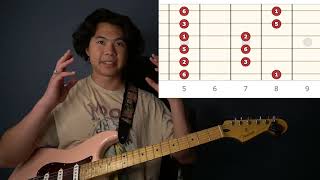
Jojo teaches a scale-degree approach to the minor pentatonic, numbering its five notes as 6-1-2-3-4-5 instead of 1-2-3-4-5. This connects the shape to major and minor contexts, lets you add back the missing 4th and 7th degrees, and transpose without thinking of note names.
Chapters
Yo, what's going on, guys? Jojo here. Welcome to my channel, where I teach guitarists like you how to improvise and compose with freedom, which means with numbers. Today we're going to be talking about the famous minor pentatonic scale. Old reliable, by far the most used scale by guitarist, and for good reason. It lays on the fretboard. Great. And it just feels good to play. Today, I want to talk about a way of looking at your minor pentatonic that's going to get you a lot more bang for your buck. Once you start being able to look at the pentatonic and music in general in this way, a lot of things are going to start clicking together and you're going to start being able to see the whole matrix of music. So, first of all, if you're for some reason not acquainted with what the minor pentatonic or the pentatonic scale, they're pretty much the same. Thing is it's basically just your major scale without notes 4 and without note 7. If you're unfamiliar with the major scale, you can just. Just check the video in the description on YouTube. There's plenty of videos. The most common version of the scale, the minor pentatonic, is just your major scale without 4 and 7, starting on note 6. So what I'm proposing here is really very simple. It's just looking at your minor pentatonic based on scale degrees instead of note names. For some of you, this is going to be a concept that you've heard before, but I have a very specific way that I want you to number it. And it's like I mentioned before, I want you to look at the first note of your minor pentatonic as six, not as one, even if you're in a minor key. So as opposed to I'll be in the key of a minor here, as opposed to looking at it as like 1, flat, 3rd, 4th, 5th, flat 7, back to 1, I want you to look at it as 6, 1, 2, 3, 4, 5, 6, on, and so forth. The reason for that is if you play a song in major, for example, if we were in C major and you wanted to go down to that scale shape, if one part of your brain is dedicated to seeing that as 1, flat 3, 4, 5, 7, 1, then you're not going to be as fluent in using that when it's in a major key. Now, this is really mostly at the beginning. Optimally, we want to be able to see both sides of this coin. But what I found most musicians are missing is this perspective of seeing it starting on six. So when you're jamming along to your favorite songs, all you have to do is use the same scale shape that you've been using. But now you have a name or a number to put to the face or the sound, right? And using letter names for this is not really a great solution because the key could be anything. So just memorizing this series of no names is not really going to help us get a system and a way of looking at the fretboard. So while you're improvising around, you know, you're thinking in your head, you know, six, one, three, two, five, six, two.
You know, better yet, singing like I did. But as long as you're just aware of where you are, things are going to be much clearer for you going forward. The most important thing, though, is that you stop seeing this scale shape as just a shape, a geometric shape on the fretboard. You know, those are things that we can use to help us. But ultimately, if we're not putting names to the sounds of what we're hearing, we're never going to develop the ability to really improvise with freedom. When you're relying on just hitting buttons and not really knowing what sound is going to come out because you haven't built an association. That's how you become, you know, in your 60s, playing guitar for 35 years. And like, you still can only use the minor pentatonic, and you just have a couple of things, and you can't really play all the way up and down the neck at any key that you want. If you don't work out, if you don't exercise this muscle, it will never grow. Another great benefit of this is now that you have everything labeled. The other two notes, notes four and seven that we took out earlier are very easy to add. You know, if I'm on 3, 4, 3, 1, 6, 7, 1, 3, 4, 6, 5, 7.
1, 2, 3, 4, 3, 2, 1, 3, 2, 1, 6.
And all the training that you've done just developing these sounds is going to go into this. Another benefit is that if you're on another area of the neck and you realize that, say that you're on a note six, you know, in my A minor pentatonic. So let's say I kind of switch positions and. And I see that I'm now on note six again on my D string seventh fret. Well, I can copy and paste that pattern of like I saw earlier. It's like 6, 1, 2, 3 and see that it looks the same as 6 1, 2, 3. Oftentimes, when you're just using note names, or especially if you're just seeing it as a pattern, a lot of this stuff can go right over your head. Cool. So short one for today, but I hope that this was helpful for you guys. Let me know if you have any other questions, and best of luck.