How to Write Chords Like Rex Orange County
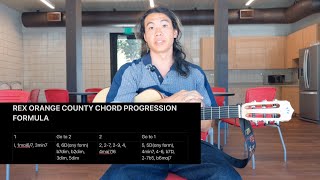
Jaden Kim breaks down Rex Orange County's chord-writing style, focusing on the 1-6-2-5 progression and techniques like diminished substitutions and four-minor resolutions. Examples come from "Untitled," "Corduroy Dreams," and "Apricot Princess."
Chapters
Hi, beautiful people. Wouldn't it be great if you could write progressions like this? Or maybe something like this? Or maybe something like this? Or something like this. Cool. If you were unfamiliar, the first three songs I played were Untitled, Corduroy Dreams, and then the beginning of Apricot Princess. And the last song I played is a progression that I came up with based on the principles I'm about to share with you guys. If you're on the journey seeking improvisational and compositional mastery on the guitar, you're in the right place. Hi, My name is JoJo. I am a humongous Rex Orange county fan. And his harmony in specific is something that has shaped a lot of my own songwriting. Today. We're going to hone in on some of his most used songwriting techniques. The formula that Rex used to write the first three songs can basically be boiled down to this. One, go to two. Two go back to one, right? Those are like our four categories of chords. Here is a valuable chart showing some of the possibilities that you have for each of those categories. All right, so step one, you can start in two places. In this formula, you can either start on the one part or you can start on the two part. Untitled and Corduroy Dreams both start on the one part of it, right? So Untitled, we've got 1 6, 6 dominant, which will lead us to 2 to lead us to 2 half diminished, which is a form of going back to 1. Corduroy Dreams is 1 go to 2 to 2 to go back to 1. This 5 chord, this specific voicing is like a dominant 7 flat 13 chord, which leads us back to the 1. But in the case of the beginning of Apricot Princess, he actually starts on the two. It's a little weird for me to use this as an example because it actually starts in the four chord. But for the purposes of what we're doing here, it's basically the same thing, right? So we're in the key of D and he starts on 4. So this is G to 5. So 4 is like our 2 here, 5 is our go to 1 and then goes to 1, and then we have our go to 2 in this case this sharp 1 diminished chord, which then leads us to, like the 2 to the 5 to the 1. In my example, I also started on the 1. I went 1, 2, 3 diminished to 2. And then I copied the move from Untitled where you go from two to the two half diminished. Very beautiful, very melancholy. So the quintessential example of this starting on the I chord is basically the 162-5progression and Untitled is basically this just with one of the chords switched out. So I'll be in the key of D. Again, I've got my one chord. And then depending on whether you do minor or dominant for your six, you're going to get a slightly different flavor. But basically the same effect. We go to 6, could lead us to 2, could lead us to 5. In this case, an A6 7 chord back to 1, right? If I wanted to make a little jazzy or a little bit more tension, I could go one to the sixth dominant, which has more of a dramatic pull. To take us to 2. You can then take us to the 5 to the 1. So 1625 is kind of like the archetypal progression for this formula that we're doing when we're starting on the one side. Additionally, and something really important to note is if you want to use this jazzy flavor of the sixth dominant chord, right, we have one. So that's D major 7 to 6, which is B dominant 7. So if this is our 6, we actually can substitute this chord for four different diminished chords. And those are basically the diminished chords built off of the chord tones of this six chord, right? And so if that's confusing, don't worry about it. Basically, I'm saying this all relative to the key, but I'm also going to give you no names. So to substitute our 6 chord, we can use our flat 7 diminished. So the flat 9, you can use our sharp 1 diminished chord, which in this case is like our E flat or our D sharp. And then you can also use three diminished. And then the last one we have is five diminished. Basically the chord tones of our six dominant chord. So all of this is to say Instead of going 16 dominant to 2, I could go 1 sharp 1 diminished to 2. I could also sub that dominant chord out for any of those four that I just named, right? So one sharp one diminished. This is the three diminished. This is the one that I used in my move to the 2. I could go 15 diminished to 2. That was a little unusual. 1 flat 7 diminished to 2. All of those are basically the same principle that are just going to push us towards that two chord. After we arrive at our two chord, what we're going to do is basically our go back to I chord is either going to be a V chord or it's going to be a form of four minor. If you saw my Daniel Caesar video, you're going to be more familiar with these forms of four minor that take us Back home. But we're basically going to use that same principle here, right? So if our two chords here, E minor. So I have my basic five chord, right? A seven takes us back to D, right? I could use any form of an A7 really. So two A7 flat, A7 flat 13. This is like the, the corduroy dreams chord back to one. Beautiful. You can also use a form of four minor, right? Which if you look at the chart, we have a whole bunch of different options. One of the ones that Rex uses that's actually a form of four minor is two half diminished, right? So we can go two, two half diminished, right? E minor, E half diminished to one. Beautiful. Another form of four minor could. So if I'm in the key of G, my fours, or if I'm in the key of D, my G is going to be my four. So I'm going to go two to four minor, G minor six, right? That, that's really beautiful as well. Technically, flat seven dominant is also a form of four minor, right? So here you go two down to like a form of C seven up to my one, right? So the whole point of the chart is that you just mix and match and you, you combine things because it's all the same principle. Just lead yourself to the one chord, lead yourself to the two chord and play the one and the two chords in between. And of course the four chord can sometimes substitute for, for the two chord as well. So these progressions work so well because we're basically alternating between our two destinations. One go to two, two go to one. And so it's just this dance of leading us to where we want to go, taking a second and then immediately pushing us to our next destination. You finding this helpful? What are some other artists that I should do? Some more harmonic analyses, deep dives, formula videos on. Let me know in the comments. I'm happy to do them. This concept of the 1625 was not invented by Rest Orange county, believe it or not. This is a progression that's been used in jazz music for many, many years now. So now that you're aware of this structure, try to keep your ears open for it in the music that you hear around you. You're going to be surprised at how often it comes up. Want a step by step guide on how to build up your harmony knowledge on the fretboard? You can click the link in my bio for a free PDF and mini course to get you guys started. Great. So I hope that this is super helpful for you guys and that you know, you have lots of beautiful progressions that you make with these little pathways. And, yes, let me know if you guys have any questions. Peace.










