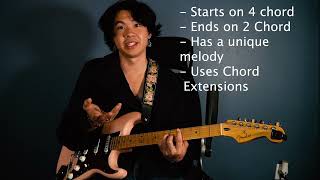
Jaden Kim breaks down Steve Lacy's chord approach through five principles: start on IV, end on II, use extensions like 7ths and 9ths, create two different endings, and focus on the top-note melody. He walks through songs like "Bad Habit" and "Ride" to show how these rules work in practice.
Chapters
Ever wanted to know how to write progressions like this? Or maybe something like this? Or maybe something like this? Or about. Yeah. So those were some Seed Lacey songs at the beginning. And I played another progression that I use, sharing what's not exactly a formula like my previous Daniel Caesar video, but some helpful pointers to get your progressions to sound like Steve Lacy. Another example of a chord progression that I came up with based on some of these principles is. Now you can hear Steve spitting over that. The last one I came up with is Sounds like this. And it's like an A5 progression piece like that. Okay? So I came up with these progressions using five guiding principles. Before we get too into this, I'm going to be referring to these chords as their numbers, their tonal numbers, as opposed to their absolute note names. If this is a concept that's unfamiliar to you, I'd recommend going back and watching the Daniel Caesar video where I do a quick breakdown of it. I also have a free course that will be in the description that will take you through and show you everything that you need to know about that. So the first principle that I use in some of the progressions is end your progression on the II chord. So just in case any of you guys were lazy, basically, if we're in the key of C, that would make C the I chord and d the 2 chord, e the 3 chord, so on and so forth. So what Steve does in a lot of his songs, including Inside, Unless We Trust and Bad Habit, kind of is he ends the progression on the II chord. So in the example of Inside, it also starts on the II chord. It goes 2, 5, 6, 1, 2. In this case, it's a two minor nine, which is another sound that he uses very commonly, Bad Habit. I don't know if this is the actual key, but it goes 4, 1, 2. And then he does a quick pivot to 3, but he kind of ends the statement on 2. Once again, that's 4, 1, 2. I was playing that in the key of C. He also does this in Lust We Trust. In this case, I'm in the key of D. It's a 1, 6, 2, 1, 6, 2. So as you can see, Steve likes ending on the II chord, a progression that I made based on this principle. And the second principle, which is Start on the IV chord, sounds like this. It goes 4, 3, 1, 2, 4, 3, 1, 2. I ended on a II minor 11 chord. This is a chord that Steve likes to use. He uses it in Bad Habit, for example, which brings us to Our third principle, I know we're going kind of fast here, which is use chord extensions. Basically what that means is that don't just play a regular D major chord. Play a D major 7 chord. Or maybe in the case of, like in let's We Trust, use a D major 9 chord, you know, don't play a B minor chord, play a B minor 7. Or even better, B minor 9. Or even better, better a B minor 11. Like I just used. Or, you know, in the case of the song that I was just doing a 2 minor 11. Any minor chord, you can apply these principles to. To backtrack a little bit. The second principle is start on the IV chord. He does this in Bad Habit, in youn, in Give youe the World and in Helmet. Those are all songs that start on the IV chord. Once again, if we were in the key of G, for example, all you have to do is just start on the first note and count up four. So if we're in the key of G, it's G, A, B, C. We're gonna start on a C chord. That's our IV chord. The third principle that you can use when trying to make a song like Steve Lacy is to make two different endings. So he does this, for example, in the song Ride, the. The first part goes like this, and they're very similar. It's just the last part that's different. That's the first ending, That's the second ending, and it's back to the top. So basically, what you have is you have a sequence of. It's almost the same the whole time, and then there's two different endings that are slightly different for the endings of it. Ride also makes use of the fifth principle of writing a progression like Steve Lacy, which is pay special attention to the melody. Now, when I say the melody, I mean the top note of your progression, but I also mean any flares. So in the example of. Right, it goes. So whenever you're playing a chord, a progression, especially when you're on the eighth string, you have the option, if you're playing a C major 7 chord, for example, here, you know, you can have that your B string be the top note of your chord, but you can also, if you bar completely, you can have this high E string be part of it. So whatever your progression is going to be, make sure that you're paying attention, special attention to the melody that it's creating. Great. So now I'm going to show you guys three sample progressions that I came up with and what principles I use to construct it. First one sounds like this. So that progression was a 4, 3, 4, 1, 2 in the key of A. So the principles that I used to make this one was start on the four chord, end on the two chord, pay attention to the melody. And I used chord extensions. My first chord was a D major 7 chord. My second chord was a C sharp SUS. So I was paying attention to the melody because I had this little. And I wanted to keep it the same for the first two chords. And then I play my one chord, and I have this note that's a. A major seven chord. And I kept that note the same for the next for my two chord, right? So it's like these two common tones for each chord. That was my melody. It goes. And then I use that minor 11 chord that we talked about earlier with. With Bad Habit. Okay? So the second progression I came up with sounds like this. All right, I'm in the qb. All right, so this one is very simple, and it follows a lot of the same principles that the last one did. Firstly, since I'm in the key of B, I started on the four chord, which in this case is A E major seven. And then I kind of did the same common tone move that I did, but this time slightly differently. Then I played an F sharp sus, but they both have this. And then I went to the three chord, which in this case is an e flat minor 7. And then I adhere to the other principle of ending on the 2 chord. I did a 2 minor 9 chord. So this is a C sharp minor 9 chord. And that was my first ending. Remember how I talked about the ending? So I also, the second time around, it goes like this. Goes 4, 5, 3, and instead of going to 2, it goes to VI. In this case, an AB minor 9 chord. Right? And this, it also has all the chord extensions. One more time. Right? I could totally hear Steve going on that. The last one I have for you guys doesn't follow as many of the rules, but it also kind of does. But I feel like it's very sneaky Steve esque. And I feel like it's fitting because unlike the Daniel Caesar video that I found, where he has a ton of songs that fit very neatly into this little box, Steve Lacey, he's just not on that. A lot of his songs are just so different, and it's really hard to lock down exactly what he's doing. In a formulaic way, this is my best attempt. But really it comes down to you guys exploring chords and sounds on your own. And Placing them together in a way that you like and reminds you of Steve. Learning songs and stealing his voicings is a great way to get started. And then you just start mixing and matching. Anyways, the third one sounds like this. And it'll just repeat like that. In that case, it's an eight bar progression. It could technically be maybe like the first four gets repeated for a while and the second four gets repeated for a while as well. So what did I do for this one? So this is in the key of D. It is a 1, 6, 2 and a 3 dominant chord. This is one that you guys might not be as familiar with. 3.3 dominant is a great chord that can take us down to six. And then I went to. This is kind of a funky chord. If you saw my Daniel Caesar video, you might be a little bit familiar with this. I did a sharp 4 minor 7 flat 5 chord followed by a 7 altered followed by a 3 dominant. So the, the little move where I went from six down to. It reminds me of something that he does and I think like me or something like that. It just sounded like a move that I heard him do. Anyway, I hope that this video was helpful for you guys. I would be very happy to hear what kind of progressions that you're able to come up with. Let's just do a quick recap before we do a final recap. I have a question for you. Are you a song player? Are you a riff player? Do you know how to operate the guitar but not really have any idea how to play the guitar or create anything of your own? I may have a solution for you. I am currently running a free community with a also free guitar course inside, teaching people just like you, song players, riff players that don't really understand the music that's around them or understand or know how to improvise the melodies inside of them. And I would love if you guys would join us links in the bio. Once again, it's completely free. You don't need to sign up, make any new accounts or anything like that. And right now we're so small that it's basically free private lessons from me because I'm personally reviewing all the submissions. Come learn, take a look around and I look forward to seeing you guys there. Now onto the weekend. So our five guidelines are going to end on the II chord, start on the IV chord, use chord extensions, nine sevens, elevens, suspensions, make two endings, and finally pay special attention to the melody of your progression.










