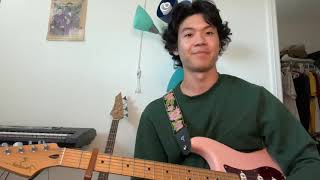
Jaden Kim teaches Steve Lacy's "I Think I Should" with a capo on the 2nd fret, breaking down open-position chords like Amaj7 and Abm7, then showing a non-capo version using G-related voicings. He emphasizes muting the A string, looping sections to lock in timing, and learning by ear against the original recording.
Chapters
Hey guys, today we're going to be learning I Think I Should by Steve Lacy. I'll play it once and then I'll show you guys how. And then it'll just repeat like that. Okay, so if you've noticed, I do have a capo on the second fret right now, and that's how he plays it in the original. And it's pretty necessary if you want to play it in the original key. If you do not have a capo, however, stick around because at the end I will show you how to play it without the capo. So the first two chords are actually really easy. You're gonna need your fingers on the fifth fret of your A string and the fourth fret of your D string. And by the way, these fret numbers are not relative to the capo but to the neck. So you have these two and you're just gonna strum the whole thing. And then for the next chord, all you're gonna have to do is slow that up two frets. Get it? So the strumming rhythm for these is going to be. So I would probably practice looping that just to make sure that you're comfortable with the rhythm there before you move on to the next step. Alright, so after you're comfortable with those two chords, we're going to move on to the third chord, which is going to be an A major seven played like this, Which is then going to be followed by a a flat minor 7. So I choose to play it like this, kind of with these two fingers here. Another way that you can play it is with you just bar the whole fret and then you'll have your. Your ring finger like this. But I prefer this just because it sounds easier for me. Just make sure that this string, your A string, is not ringing out. It should be muted by the underside of your A index finger. So that second part is going to go. So up until that point, here's where we have. And so the first time you're going to go down to that AB minor chord. And then the next one you're going to go to A sharp or B flat, however you want to think about it. Basically you have your A major. The first time you're going to go down, the second time you're going to go up. So I'll play the first time and then the second time. Got it? Guess what? We're almost done. Because the third time is the exact same as the first time. So basically the sequence is you're going to go here and then you're going to go down second time, go up third time down. And then the fourth time is where things get different. Then we're going to come up to this D flat major 7 or C sharp major 7. And then you're going to go to a B minor 7. Make sure you don't ring this, this top one, because you want to save it for the next chord, which is. It's basically the same. So you're going to go from playing that B minor to this E Sus voicing with. With this string. So it's going to sound like this. You see how the second time it gets. It gets emphasized. Even though the string rang a little bit on the first time, it wasn't too big of a deal. But you want to make sure that it's emphasized once you switch chords. And then you're just back to the top just to refresh. I'll play it for you guys really slowly. Now we're going to go up. Now it's going to change. Okay, and there you have it. You can already play it. If you guys have any questions, please leave me a comment and I will respond to all of them. Additionally, if you're having trouble on the rhythm, because Honestly, I'm not 100% certain that I got it correctly. So reference the recording. The best way to learn anything is honestly to learn it by ear. Tutorials like this are fine. And actually I was able to learn this by looking at another guy's YouTube video, but there wasn't an actual tutorial. So I wanted to do this for you guys. Anyways, if you have any questions, leave me a comment. Listen to the recording. Have a nice day. Okay, non capo, people. Here's what we're gonna do. Put your fingers here and here, and we're just gonna strum the entire thing. And then you're gonna move those up two frets, and those are your first two chords. Here's the rh. Okay, so your third chord is going to be this G major, G major 7, which is going to go down to an F sharp minor 7. Now make sure that you're not playing this string, and if you are, make sure that you have it covered by your ring finger. I prefer it like this, though. So this third and fourth chords are going to sound like this. Dun dun dun dun dun dun dun dun dun dun dun. I would recommend you guys that you loop these first two parts just to make sure that you can get the rhythms. And then after that, I'll play it all together. Well, actually, so after you. The first time you're going to go down, and the second time you're going to go up. Exact same chord shape as that F sharp minor, but now it's going to be a G sharp minor. So the first and second time together will sound like this. By the way, the rhythm is going to be the same on both times. Okay, so I'll go through the first through third time for you guys. They're all really similar. G major seven, down, up. Third time down. Fourth time, different. So let me teach you guys that. Fourth time, you're going to start with an E major 7 on the seventh fret, followed by an A minor 7 on the fifth fret. You can use the same shape as you used earlier for, you know, when we were doing the other endings. But then you're going to go. Then you're going to play a D sus and make sure that you emphasize this top string because you want to get this effect or so the last time is going to sound like this, And then it'll just repeat. So I'll play the whole thing for you guys right now, slowly. Fourth time, And then it'll just repeat. Okay, everybody, thank you so much for watching. I hope you enjoyed and tell me if anything was unclear or request another song that you would like to see. I love artists such as Steve Lacy, Jacob Ogawa, Daniel Caesar, Rex, Orange County. So if there's any songs of theirs that you guys would like to see a tutorial for, or another artist you could put me on and I'll try my best. Bye, guys.