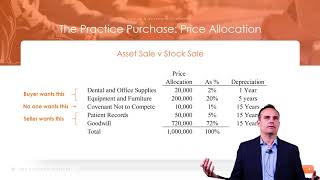
A short presentation (YouTube video) explaining the difference between stock (share) purchases and asset sales, with a focus on dental practice acquisitions. The speaker argues asset sales are preferred for private businesses because buyers acquire only selected assets (not historical liabilities), outlines tangible (supplies, furniture) vs intangible assets (non-compete covenants, patient records, goodwill), and summarizes opposing tax incentives: buyers prefer allocations to tangible assets for faster depreciation, sellers prefer allocations to intangibles to access lower capital gains tax rates.
Chapters
When we talk about practice purchases, we need to be clear about what we're buying. You often hear about companies being bought or sold in the media, and typically those are publicly traded companies. And what's being purchased is the stock or shares or equity all mean the same thing of the company. It's the ownership percentage that equity. And when you buy the shares of that company, you own all of its assets and all of its debt. Everything in the kitchen sink now is yours. But there is a different way to buy a business which is called an asset sale. And that's the preferred method with private businesses. And it's much more elegant because you are only buying the good things, the assets and the liabilities stay with the seller. Now you may wonder, why would the seller want to keep those liabilities? Well, the truth is with the proceeds that you give the the seller for the purchase of the assets, they should more than be able to pay off whatever remaining debts they've got and have a tidy profit net of tax after that. So dental practices are almost exclusively done as asset sales. They're just cleaner. And you don't bring with you all the liabilities, including the legal liability of buying another practice. So for example, there was malpractice that occurred before you bought the practice that goes with the seller. So you're just buying the assets. So there are two categories of assets, those you can touch, those you can't. So supplies and furniture are tangible assets that you can touch. And the last three on my list here, Covenant, patient records and goodwill, we consider intangible assets are kind of like the unspoken.
Value of the business in the marketplace that you can't touch. And there's a value on both the buyer and seller side. How this asset sale is, the asset mixture is formulated and they're often an opposing size. So the buyer usually wants more of the asset purchase price to be skewed towards supplies and furniture. And the reason for that is it depreciates or expenses out faster and acts like a tax reduction. Now they're going to get, you know, no matter how fast their purchase price depreciates, they're going to eventually get all of it. It's just a matter of how fast. Compare that to the intangible items like Covenant, not to compete, Patient, records and goodwill, you can see they depreciate much more slowly. So the tax benefit or write off happens over a much slower pace. So buyers aren't as hot on that. Now the seller is faced with taxation most times and so.
They'Re looking to minimize tax. And the tax on gains related to tangible items is at ordinary tax rates. But there's another lower form of tax rate based on what are called capital gains. Capital gains are gains on investments that you've made, not material items like stock in a company or dental business. And so when you've made a gain on this investment, it's you've rewarded through the tax code by, through a lower capital gains tax rate. And it can be a very significant savings. So the seller is pushing in the opposite direction, wanting more of the intangibles.
In as a part of the mixture, because they're taxed at the capital gains rate. But usually it's it's if you have good advisors, it's easy to come to an objective allocation based on how recent or how new or how depreciated the physical assets are in the office.