Hygiene Superstar: Quadrupling the Production of Your Hygienist—with Steve Sperry - DBR EP55
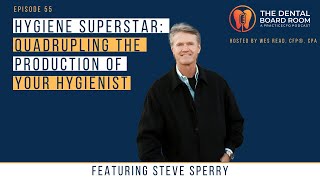
Podcast episode (Dental Boardroom) featuring Wes Read and Steve Sperry discussing dental practice leadership, management, and the strategic role of hygienists. Sperry argues hygienists should be treated as ‘treatment coordinators licensed to clean teeth,’ emphasizes transformational leadership, vision-setting, and tracking both direct and indirect hygienist production (including revenue influenced from restorative cases). He recommends incentive models (e.g., 1% of restorative case starts) and a hygiene-first, subscription-style practice focus to increase predictability and value.
Chapters
Welcome everybody, to a new episode of the Dental Boardroom. It's been a busy period here at Practice CFO lately. We apologize for maybe a fewer episodes than we normally do. We're going to pick that back up. We have a lot of great episodes coming up. And today I'm excited because we have someone who has referred us over here at Practice CFO some clients over time with very successful practices. And so I reached out to this referral source, his name is Steve Sperry. To say and ask and have him share. How are you doing this, Steve, with all of these dental offices that you've referred over to us, they are some of the best practices we work with. So welcome Steve Sperry on the Dental Boardroom podcast.
Thank you, Wes. I actually appreciate being here and would love to share my stories. I do have a few.
Great. Well, I'm going to give a little background to you, if you don't mind. You own a company called Inventive Dental Solutions. Now, you've been in the dental coaching management business for a while, 1987, is that right, Steve?
Yeah, that's a while. I'm an older guy.
Your experience, 1987, you grew what sounds like a very successful practice management company called Pinnacles Practices Inc. And you sold that back in 2004 and since then have sort of repurposed your branding as Inventive Dental Solutions, which you've had for a number of years now. So you've got a lot of experience. This is like working with dental offices is essentially what you've been doing your entire career. This isn't something you pivoted into later in life. This is your thing. So I think you're gonna have a lot of wisdom to impart. And for everybody listening, what I'm hoping to do today on this podcast is really have Steve kind of distill down some of the basic building blocks of effective business management. And I think it's just really important that dentists and I really try to encourage our clients here at Prague CFO to think of themselves first as business owners and second as dentists, because that mindset is usually what dictates really successful businesses or practices. So let's start off. I want to ask you to really break down this concept of leadership versus management. Let's think about those two things, because I think for a long time I thought they were the same. And I've come to learn in my own kind of efforts as a business owner and in our leadership program, we use a program called eos. What is the difference between leadership and management. Kick off that conversation, Steve, if you don't mind.
Yeah, Wes, thank you. I love talking about this subject because it can be so confusing. Dentists certainly don't have a lot of management training in school, and they have zero leadership training. And so being able to talk about leadership as something you can grow and you can get better at is fun for me. And so there's key small things. You know, leaders lead people, managers manage things. There's three big components to leadership for me. One is leadership. You're not a great leader if you don't manage, so don't confuse one with the other. You have to have them bold and then teaming. And if you don't have a good team, we all know life is not going to be good. So for me, as a leadership coach, I feel like 70% of the battle is finding, attracting, and keeping good people. That's like pixie dust. And I am. Yeah, I'll snap and I'll clap and I'll be like, you know, my favorite quote is, I have to catch up to my team so I can follow them. So leaders attract good people. Leaders have a very strong vision of where they are, where they want to go. Leaders will constantly be looking at the future. I always talk about when you're running, you don't look down at your feet. When you're riding a bike, you don't look down at your tire. You're always looking ahead. And it's that future casting that is motivational for people. It's, where are we going to be a year from now? Where are we going to be three years from now? Where do you see yourself? So, you know, I'm not a huge Arnold Schwarzenegger fan, but I'm gonna drop his name and I'm gonna bring it up. There is a Netflix series. I don't know if you've seen it, Wes. You have. Okay, go ahead.
I've watched it twice. Once on my own and once with my dad, who is literally three months off in age from Arnold and actually just watched that over the Thanksgiving break. To be honest, that man inspires me. But go out, go on. I wanna hear about this.
So, you know, here's an Australian, right? If he's your dad's age. I think he's like 76 now, you know, Australian. He can't speak English, right? And he wants to be a bodybuilder, and he becomes the best bodybuilder in the world. And then he says, you know, I'm going to become an actor. And it's like how do you go from bodybuilding to acting? You know, and of course, you know, he's one of the most famous, most loved, most successful actors ever. And that's not why I bring up Arnold Schwarzenegger. It's he was the governor of California. How does an Austrian become the governor of California? So for me, you know, if you watch the series, you will get one huge thing out of it, and that is vision and where do you want to go? And then just be tenacious on getting there. You know, don't worry so much about, like, this year was over probably middle of October for me and my clients. You know, everything that we've done through the year, we had in place to have our best month ever in November, our best month ever in December. And now we're planning our best future, our best lives. And so, you know, leadership, you know, at the core is planning, and Lotus is a planning seminar. And it's funny because we don't call it leadership training. No one wants to go to that, because leadership is about you. It's about looking at yourself, you know, in the mirror. And, you know, when we talk about leaders and we write business plans and life plans, and anybody who's gone through my training knows the biggest restraining factor in your life is you. You're the biggest restraining factor. And so when I'm hired, typically I'm hired to fix the team, you know, hey, Steve, you need to come in, you need to train. Everybody else, you know, is broken. And I laugh because typically the doctor has no idea the difference between, you know, leading, managing, and teaming. Those are kind of the. The three big elements. So I have a Ralph Nader coach, which I like. You know, I start with the premise that the function of leadership is to produce more leaders and not more followers. And so the specific leadership style that I teach, because there's so many, is called transformational leadership. So write that down. Google it. Transformational leadership. It's a very specific leadership style, in my opinion, that fits dentistry to the T. And, you know, coming out of Stephen Covey's the 7 Habits of Highly Successful People, if you do any kind of study of transformational leadership, you're going to be like, oh, okay, this works for me. This is the style that I need to be using in my practice. That's just a little bit about leadership.
Great. Yeah. Going back to Arnold. Sorry to want to talk about Arnold more. His man just fascinates me. He phrased probably five to seven times in those three episodes.
He.
He said visualization. He said, if I can Visualize it. I know I can do it. It starts with visualization. And he could just like. I think he had this uncanny ability to see himself in the future, standing up on the stage, winning, you know, Mr. Universe or winning that political victory or being in that box office hit movie. And the thing about him was when he was young and you look at him, he was scrawny like every, you know, 12, 13 year old boy. When you see his first acting, he was terrible. It was really bad.
So bad I can't even tell.
No facial expressions, totally monotone. I'm sure everybody who saw him was like, this guy is completely hopeless. But he just doesn't give up because he could see it. And if he could see it, he pulls it up. That doesn't mean that he doesn't have to work hard. That guy was up at like 5, 5:30 every morning. I mean, he put in the work. But when you have that vision, I find for me, if I can crystallize in my head what this needs to look like, what the outcome is going to be, and all the benefits and joy and fun of having that state of arriving there, it makes me so much more motivated during the day to get something done. Let me give an example. For me, sometimes I like to share my own experiences because I'm a practice owner, you know, you're a practice owner, we're running these practices. You're a practice management consulting practice, I'm a CPA financial advisory practice. We're all businesses and so we have these similarities with dentists. I would say, although we deliver a different service, that's it for me. One of the things that I've had to envision is I've really wanted to create a benchmark study for the dental industry, financially speaking. For example, what are average collections of a general dental practice in California? What's the average pay to hygienists? What is the average overall labor costs for a oral surgeon or a general dentist and have a benchmark study? Well, we've been using this accounting software called accounting CS since I started 15 years ago. And it's a great software. It's institutional, but it doesn't play with other technologies. It doesn't have an open API. I had to envision and point. One of the things I think leaders do that I always want to do better at is I want to be able to point to everybody in my company and say, see there, over there off the horizon, that's where we need to go. And everybody turns their vision and they turn their head and they see it and you help help them visualize where that destination is so that it has clarity for them. And it's amazing. I think when people have clarity of destination, let them use their own sort of innovativeness, let them use their own thinking skills and be leaders themselves to navigate toward that end goal and don't necessarily micromanage everything they do. But for us in this case with me is I realized we had to move to an open API accounting system, so we decided to go to the infamous QuickBooks. So we're moving everything to QuickBooks and with a third party reporting software called Reach Reporting that pulls the data from QuickBooks into a technology that allows us to do two things, create these beautiful detailed custom financial reports that we call the CFO analysis that go with the P and L and balance sheet and then to be able to consolidate all of our practices into a report which will then give us industry benchmark data. Now this is a huge project. If you're not in the accounting space, you may not understand why that's such a big project, but I would say for a dental office, it honestly would be like lifting up out of one building and moving on the other side of town to another building and getting everything unplugged and then replugged in and maybe even moving your practice management software while you're at it and converting data, which is a huge thing. So big project. And it's taken a lot of commitment just to get everybody seeing the same vision and then rolling this out. And the second part I think of not only pointing to where we need to go, is to then be a great play coach and helping everybody run their routes effectively and creating accountability, meeting cadence reviews, things like that to be successful. And it's not easy. It's an entirely different skill set than for me learning how to read a balance sheet or understand equity accounts, which was, you know, my space of accounting or for a dentist knowing how to do a restoration or whatnot. It's just an entirely different skill set to lead and manage and it doesn't always come naturally. And for me I have to be very deliberate in studying and researching and trying and learning and making mistakes and, and that's the only way that I found is the pattern of getting better in this space.
You know, thanks for sharing that. I love using my own journey as well. And I call myself a top line coach and sometimes top line coaches and bottom line coaches are not in alignment. And you just said to me what I needed to hear in order to continue to refer to you confidently. So my clients need real time data. Well, what kind of real time data do they need? The. I have a practice in Santa Clarita, swear to Buddha, pays $100 an hour to his hygienist. I just covered my eyes and I go, you're ruining dentistry. You know, and he goes, what do you mean? He goes, she's awesome. And I'm like, yeah, she's a superstar. But you know, overpaying people doesn't mean you're going to get a better result. You know, let's pay fair market value. And so having someone like you to tell me or my clients, better yet, what is low fair market value, what's real holistic fair market value and what's high fair market value in your, in your market? And what's weird is I was born in la, alright? So Southern California and Northern California are two different countries. I don't know if you knew that or not. And in dentistry, they're two different countries. You know, I have clients in San Jose and San Francisco and I can't actually coach them the same. I can coach them the same way, but the advice is slightly different. And so thank you for sharing your actionable data metrics. That's what I want and my clients need from a bottom line coach. You know, my journey is kind of fun because it's, I want to be the best coach I can be. How can I be the best Steve I can be? And I got to be honest, I'm probably a great leadership coach, but I'm probably an average management coach. And when it comes to the team, the team love, they love me. I found that, you know, not making people cry every day, you don't need to do that. Which is my, my mentor literally said, if you're not making, you know, the team cry every day, you know, you're, you're not doing your job as a coach. And what I've learned is just the opposite is true, is we can be more empowering, we can work with the team to actually get to where we're going. So, yeah, thanks for sharing your journey. Thanks for sharing that incredible drop the MIC data analytics that my clients will receive. Now, you know this hygienist, so I wanted to talk about Hygiene Superstar. It's a book that I wrote, co authored with Mike Zubiak. And you know what is a Hygiene Superstar? How come I call myself a Hygiene First Coach and I'm a Hygiene first coach? Because dentistry is, I think, one of the first, first subscription model businesses. Only 10% of new patients are going to accept everything that they're told that they need to bring their mouth to optimum oral health. 90% want to come back and they'll get healthy. Who doesn't want to get healthy? Everybody wants to get healthy. You know, this. This longevity, health and wellness thing that's going on in America right now is real. It's not going away. And people want you to look in their eyes and say, hey, you know, I'm not just going to be here one time. I'm going to be here for your lifetime. I'm going to care for you. So one of the metrics that I track in all my offices with hygienists is indirect income that they generate for the practice. So as an example, you know, most hygienists full time will do around 20,000amonth. And that's good, you know, and most hygienists, plus or minus 10%, are going to average around the same dollars per patient. It's how many new patients they get, how full did the hygiene coordinator keep their treatment room? Those are the things that will change what they do per day. But I don't look at a hygienist as a hygienist who cleans teeth. You know, she has more influence on patients than a primary care physician. And so I want her to influence patients on their total health and wellness. So we track dollars scheduled coming out of the room. So a hygiene superstar. I quantify if they do 20,000 individually and they sell $40,000 worth of restorative treatment coming out of their room, they're a superstar. Now, a lot of hygienists don't really want to be a superstar. All they want to do is clean teeth. And maybe they should be in accelerated hygiene, seeing two patients and leaving their mask on and not really educating and motivating patients. But for me, a hygiene superstar is a hygienist who cares about me to the point I have about five practices that actually look at blood work, and we don't need a physician to actually get blood work. And we can look at it in, you know, in data management softwares like Trend Tracker and Function. And I want a hygienist to influence me on how I can live healthier longer, which obviously starts with periodontal disease. But all hygienists are going to talk about the mouth. How many hygienists are going to talk about restorative dentistry, about my blood markers, about how to stay healthy for a lifetime. So my book is in the background. Hygiene Superstar. I love the book, it's, you know, systemic, you know, oral link. And it's an awesome book.
But, yeah, I'm gonna write that down. That could be a great read for my CFO advisory team, who is, you know, meeting every day with clients and talking about profitability. The hygiene element in the profit anatomy of a dental practice is just so important. Not in. Just in what they produce, but how they team up with the doctor to message to patients what their clinical needs are. And you made me think about something I've never, I guess, deliberately thought about, which is the amount of time that the patient has with the hygienist. There's a lot of conversational time there, especially from the hygienist to the patient. And more so I would think, than between the dentist and the patient. And so I never really thought about how much are doctors working with their hygienists to be really effective communicators, not just to talk about real housewives or whatever, but to talk about their body, their health, their more broader oral needs, and to be able to really connect with the dentist in a way that feels very synergized. That's one thing that I find in my case very valuable when we have our advisors have an associate advisor who supports them. When those two approach the dentist in these advisory meetings, what we call these CFO board meetings, really effectively on the same page, they've clearly discussed the client together. There's so much more power in that communication than when they're either not on the same page or one is quiet the whole time and the other one does all the talking. So I never thought about this in this way. You're making me think about it now. The hygienist and the doctor coming at the patient together as this team on the same page, giving this vision for the patient.
So, Wes, here's the deal with hygienists. Hygienists, our treatment coordinators, licensed to clean teeth. If you don't write that down because it'll change your perspective, it'll change your life. So hygienists are treatment coordinators licensed to clean teeth, and they will produce way more in indirect dentistry than they will in direct dentistry. Last month, I had a hygienist do $36,000 directly as a hygienist, and she did $70,000 in indirect dentistry. I call her my $100,000 club. But she was over $100,000, you know, last month. She's a hygiene superstar. So hygienists that get it understand that their Value isn't just in directly doing what it is that they were trained to do. It's the direct. So the indirect is far outweighs the direct. So, you know, I would love for you with my clients to have those conversations. I'll give you an example. So the client I just referred you, I think he has eight hygienists. Two of the hygienists, I'm going to use their first name, Lauren and Vivian, they were dental assistants before they went to hygiene school. Of the eight hygienists, I'm going to say the two that were dental assistants prior to going to hygiene school outperform the other six by 100%. And so Vivian and Lauren get it when they're talking to a patient, you know, and it's pretty simple to actually do this, because I'll ask a hygienist, have you ever had a $5,000 day? And a hygienist will say, no, if I did scaling and root planning all day long, I could never have a $5,000 day. And I laugh and I go, you have $5,000 days all the time. You sell. Or you influence a patient to say yes to one invisalign case just to get their occlusion where it needs to be so that, you know, the teeth are in a happy place. There's so many ways that a hygienist can talk about that. You know, just by a patient saying, I'm going to get that done, they have a $5,000 day. Now I am moving my clients from directly compensating my hygienist based on, you know, how many fluorides they do, how much scaling and root planing they do. I'm moving them away from that to total health and wellness. I don't want to look at a hygienist as just direct income. I want to look at direct and indirect. So when we track numbers in my practices, I tell my hygienist, who did $100,000, hey, you had $100,000 a month. And she'll look at me and say, I did. And I'm like, yeah, you did 100 grand last month. It's very empowering. It. It speaks well to hygienists when you tell them how important they are, how critical they are, in my opinion, to health care. You know, not just dentistry, but. But health care. And for a hygienist to do $40,000, not a big deal for me anymore. But I look at them holistically. That way. I don't. I Don't look at indirect, indirect. I look holistically. So I'll tell my Manny story. You know, I have a practice in Gardena. I love the demographics there. And people are like Gardena. And I'm like, yeah, they are rock stars. They hired a brand new hygienist male. His name's Manny. And he goes, Steve, I'm going to be your guy. I'm going to, it's going to be tough for me. You know, I just, you know, I wasn't a dental assistant before I became a hygienist. And I go, listen, I sometimes just having no filter, having less filter is good. And so I said it's your job to make sure that every patient, every time is talked to about any remaining treatment. And not just talk to, but let's show a video, let's talk about why it's important long term. So there's four hygienists in this practice. One is, is a dental assistant. Jennifer. Yeah, she's awesome and she's consistently highly performing. But Manny, his first two months as a hygienist has outperformed Jennifer. She's doing about, about 40, $50,000. So pretty cool. I'm hoping this trend moves our industry towards a stronger hygiene philosophy where it's not just, you know, we're not just teeth cleaners, but educators. And had you heard the subscription model statement before, like Netflix, had you heard that dentistry is a subscription model? Is that, is that something common?
I, I have heard it. I wouldn't say it's common, but the recall system converts it a little bit into a subscription model.
Yeah, yeah. I, so for me, I actually don't look at my feet, my practices because it's all about future hygiene appointments. So I use a very simple winning formula. Hygiene patients seen plus new patients will equal your best and worst month ever. And it's not new patients first. It's kind of funny. It's hygiene patients first. We'll find way more treatment and do much more work out of our current active patients than we will do our new patients. So, you know, one hygienist has about 130 appointments a month. If she works four days, she typically sees between 100 and 110. And so a winning formula might be 200 hygiene patients seen plus 34 new patients equals $120,000 a month. If we're eliminating restraining factors in the Los Angeles market, it's a simple formula. So instead of focusing on fill my schedule, it's fill hygiene, hygiene patient scene. It's the most critical position in the practice is that hygiene coordinator. And let's make sure that we're hitting goal there. And then of course, marketing, you know, if you're not Marketing anything under 20 is honestly slow decline, if not unhealthy. 34 is kind of that, maybe green and growing, but probably just status quo. And we really need to be getting into the, you know, into 40, 50 new patients for the, for the one doctor.
So there's a lot of rich content there. The way dental practices are valued would validate what you're saying in terms of this subscription model. People listening on this podcast might know that the businesses that are valued the most are the ones that have a predictable and sticky income stream over time. This is why technology companies with subscription models are valued just so much more than a per unit pay type of business. And that isn't as predictable. This is why a GP dental practice will typically be worth more, typically more than say, an endodontic practice, because the hygiene has this recall program that has this element of continuity and predictability to it. And so a dental practice that has a stronger recall program, a stronger hygiene program, where the hygienist production as a percentage of the entire practice production is higher, that practice is typically going to be valued more than a practice that either has a low or small recall program or one that doesn't have hygiene at all. And there are some cases where we have some dentists who are just like these implant shops, very little hygiene, ton of implants, a little bit like a pross almost. But they're a GP practice who do implants in house. And sometimes it's harder to sell a GP practice that has virtually no hygiene program. They just have a doctor who really markets well for doing implants. We struggle to find buyers for those types of practices, understandably, because the buyer is concerned. Am I going to be able to replicate this style of business where when you have a very fixed hygiene program and you step into that hygiene program which stays that assembly line continues after closing on that practice, there's a lot more security there and banks are more willing to lend when there's a security and predictability of cash flow. So just to validate what you're saying on the importance of the hygiene program, one of the questions I have for you on this subject is I love this idea of somehow compensating hygienists for the more global outcome of their impact on patients. So not just the cleaning, the scaling, root planning, but also the restorative work that they are helping the Patient sort of incubate their mind to be willing to take that treatment. Because it is very, very true in human nature that we will say no to a lot of things at first. But then when you're educated on the value of that thing, suddenly our mind changes, and it will change way more than we ever thought it would, because you now see why the substance, the reasoning, the value, and what this is going to do to your life. And suddenly you want quality. Suddenly you want this outcome. You want that smile. You've seen the vision. It's like going back to Arnold Schwarzenegger. The hygienist and doctor can help the patient visualize these benefits and impact in their life. Suddenly and amazingly, they will move that from no to yes. So then how do you, practically speaking, though, have a system or a way of determining what is that $40,000 you're talking about? What is that $5,000 day you're talking about? How do you calculate that and attach that to hygiene one versus hygiene two? And then how do you adjust the compensation model to reward them appropriately? Why don't you put some words behind. Oh, an answer on that one.
So, so, Wes, you're going to call me because my clients are going to come to you with these outrageous, you know, compensation plans, and you're going to go, what are you doing? Why are you paying these hygienists money? So, you know, when performance is measured and improves, when performance is measured, reported back, the rate of improvement accelerates. So let's say a practice is introducing, you know, laser assisted therapy, lbr, lbt. So it's laser. Well, all of a sudden, our laser procedures jump huge. And now what we do is we pay them 10 bucks or 5 bucks or 15 bucks for laser periodontal therapy. And our laser stuff is off the roof. You know, we pay five bucks for fluoride. Well, what happens to fluoride? Our fluoride jumps. Hygienists are trained to look for the things that they're trained to look for. I want to shift their paradigm. I want to pay them to do something. I'm going to call it sexy. Something more fun for them. Because I meet a lot of hygienists that are like, my job's boring. There hasn't been anything new for so long, I'm bored. And I'm like, well, guess what? I got something new for you. It's called being a hygiene superstar. So the first thing I tell hygienists, I say, life isn't fair. But we are going to stop the way that we're incentivizing you as a hygienist and we're going to start to pay you for being a healthcare provider. Total health and wellness. The good news is that hygienists love this. They want to be viewed as more. And so what I do is this. They have to start same day. So let's say they talk about Invisalign and they say, God, you really need it. You know, let me show you the straight talk video. Let me, let me get a scan of your teeth, which, it's kind of funny. I want scanning to be done in the hygiene department. Most of my offices will scan annually. You know, it's going to be standard of care. But here's where hygienists are like here's another thing that I have to do. And they're all complaining. But getting that itero or getting that scan to show a patient what their mouth looks like leads to more invisalign, leads to more restorative work. And so now they're motivated to do it. They like to do it. It's super sexy for them to do it and show a patient. So I will pay a hygienist when they start 1%. And this is where you'll track my offices. You'll tell me whether this is working or not. I want to stop the focus on, you know, there's an old saying, I step over dollars to pick up pennies. And what I want to do is I want to start focusing on total health and wellness. Hundred thousand dollar hygienists, you know, hygienists that consist that are treatment coordinators licensed to clean teeth. So if a patient starts, let's say an all on four case hygiene coordinator calls a patient who came in for a consult, they didn't move forward, they come back a year later, they see the hygienist even, you know, they have very few teeth and they sell an all on four case. I want them to get 1% of that case. They sell an Invisalign case, I want them to get 1%. Now 3% is way too much in my opinion. But I think that's going to be the model 1 to 3% and it's going to shift their, it is shifting their focus from, from hygiene to being a holistic provider. Almost like a pa, a physician's assistant. I don't know about you, but my primary care physician, she's for when I'm sick, you know, I want someone who can talk to me to prevent me from Getting sick. And for me, that's the hygienist. So I want to elevate the role. I want to be a hygiene first coach. I don't want to worry about November. I want to worry about six months from now or three months or four months from now. Every patient leaves with a hygiene appointment, including endontulous patients, which are our best opportunities for implants. All on four snap ons, those kinds of things. So it's fun for me. This is my journey. But I've never liked hygienists. When they say I'm not a teeth cleaner. And I'm like, well, step into your power. Step into the opportunity you have right now to make a difference in this industry. And what I mean by that is become this total health and wellness person who actually cares about me. My oral systemic link to heart attack, stroke, low birth, weight loss, diabetes, you know, how do I prevent those things? Well, I want patients to start asking their hygienists. I want hygienists to start evolving their position to a much greater degree. I have offices right now who have two hour appointments for existing patients that want to go through blood work. They charge for it. You know, I mean the average hygienist does about 160, $170 per patient. You just double that. There's patients out there that have no problem pay for a two hour appointment to go through blood testing, total health and wellness DNA markers. This inside tracker. And not to get sidetracked, but you know, my biological age is six and a half years younger than my actual age. And the algorithm that they use with all, you know, all my blood factors are pretty cool. Like I don't think I'm a very stressful person. But last time I did my blood work, I had five blood markers that were, that were red. Number one was cortisol. I have no stress. I think it was sleep related. I've since kind of figured it out. I'm green now. You know, two was my B12. So my hygienist literally said, Steve, you know, are you taking a supplement? I'm like, yeah. And she recommended that I take a liquid B12. So I take it transcutaneously. My vitamin D. I live in Las Vegas. I golf, I mountain bike ride, I hike, I canyoneer. My wife and I are crazy people. Like follow us on Facebook, you will laugh because we do crazy stuff. My vitamin D was low. And so my hygienist is like, same thing with vitamin D, Steve. Take it liquid, don't take a capsule. So this inside tracker wants you to do it every three months. It's a little bit expensive, so I just do it twice a year instead of once a year. Like my primary care physician, I get to choose what blood markers I want to track, not my primary care physician. I am taking control of my health by making sure that I am educated on what I need to do in order to bring my inner age down. So there's this guy, his name's Brian Johnson, super rich. He has this thing called Blueprint online. He tests weekly and he publishes his tests free. And so I think he's 52, but his inner age is like 32. You know, being a CPA, you know, you change one thing, you look at the values. You change one thing, you look at the values. Your job is, is to analyze that data. That's, that's what you're great at. And so that's published now online. So. And not everybody's going to get this, but I hope it touches one practice. I hope one office says, you know, we're a hygiene driven practice. We own two businesses. We own a hygiene business first, we own a restorative business. Second, 70% of our work comes from our hygiene business. If our hygiene business is healthy, our restorative practice will be healthy. We're sustainable, we're predictable, and we can be scalable in this model. But it requires leadership more than anything because you got to look out, you can't look down. Because where you are right now is hygienists clean teeth. That's all they do. They clean teeth and you reward them for cleaning teeth. You incentivize them for doing that, which is crazy for me now, now that I've been doing this for three, five years, I'm like, why did I ever reward a hygienist to do her job? It's like paying someone to show up on time. You know, I'm not going to pay you because you're on time to work every day. I want to pay you because you're extraordinary. I want to pay you because you're awesome. I want to pay a hygienist pixie dust money, because that's who she is. You know, I don't know if you know this, but Aspen Dentalone is clear choice. I'm going to say 20% of their treatment coordinators are hygienists. You know, hygienists make the best treatment coordinators on the planet, especially the ones that were dental assistants before they went to hygiene school. They just have tons of knowledge, tons of belief and they can influence people. So people don't like the word selling. I do. Just switch selling to influence. Your patients want to get healthy, you know, all we want to do is give our hygienists the ability to influence our patients to define what that means. Not just gum health or mouth health, but total health and wellness.
I'd probably call this an extreme example, but it really proves the point. I think my client, he's got to be in the top three of all of our clients with the most profitable hygiene program. This is the only doctor that I know does this. His hygienists are paid 100% on commission. 100%. How rare is that he pays them in order to maintain that? Roughly, I think two and a half times, three times.
Don't say that too loud. You understand, 30 years ago when I was a coach, my dentist would say, I love commission. I want to pay 40, 50% commission. And I would just look at them and say, oh my gosh, we're screwed. For a better term, I don't want my clients, clients paying 100% commission. Because you know what? Hygiene superstars win all day long. If a hygienist have any skill at all, if they're influential, if they love what they do, you're going to pay way more in a commission model than you would in just monetizing fair market value and then incentivizing them for what they want to do. It doesn't surprise me, by the way, that your highest profiting, you know, and I'm not going to say I actually have a question for you. My best practices that have. I call them Perio Nazis, you know, I know that's a bad word. But you know, my best practices that do say 30, 35% of their revenues in hygiene are not my most profitable overall practices. They do well in hygiene, but they, the restorative side doesn't do as well. They're not the most profitable, in fact. And I saw you had Mark Costas on, on the air recently. And, and it'd be interesting because doing 35% in Perio and having perio Nazis that just talk about scaling and replaying and health and gum disease. Don't talk about everything else that patients need to get healthy. And so my most profitable practices, and this isn't actually, this should be a number you should research. My most profitable practices have about a 15 to 20% of their revenue comes from hygiene. I have dental offices that see a thousand patients a month in hygiene. Dr. Mike Subiak, the guy who co authored this book in Camarillo. I think he's a client of yours. He sees a thousand patients a month in hygiene, and he does. I think he's at about 20%. He might be 22, 23. Jill Taylor. Love her to death. She is a hygiene rock star. You know, she's up here in Vegas at lvi. And, you know, if we want to focus on a perio practice, you're not necessarily going to generate the profitability of a holistic practice.
And so that's a great point. That is a. That's an excellent point, because if you. If you theoretically paid 100% of commission with the basic hygiene work, they're going to try to do that more profitable hygiene work, and they're going to forget about the restorative work, which at the end of the day is the more profitable for a practice. So that's a. That's a really, really valid, great point. You know, one thing we could do is we could entirely geek out, you and me, on these clients with this new technology I use called Reach Reporting, where it has a way where you could fill in, or the front office can fill in on a Google Sheets, document how many, say, new patients or some detail around the hygiene. The hygiene numbers, and we could create a report that is provided monthly or quarterly that exactly shows what you're looking to get out of that hygiene, and then you can, you know, create a compensation structure accordingly. That could be a really fun project, Steve, that you and I get into on some of these shared clients with this new reporting technology. If we want to grab some data from the office itself via Google Sheets, which then I can sink into this technology and correlate it back to the financial statements and have some really nice graphs and goals to actual kind of metrics. So that could be really exciting. Well, Steve, this has been an awesome experience to have you on. I didn't think we would talk about hygiene so much, but I love that we did. It's so critical in a practice. I think I'm going to title this podcast episode something around the potential power and profitability of a great and I would say dynamic or unconventional way to motivate your hygienists. I think this is really a new way to look at your hygiene department and their role. So thank you very much for joining the program, Steve. We'll have to have you on for another time. I think there's so many different subjects you and I could banter about and just have a great time doing so.
Thanks for having me, Wes. I actually would love to geek out with you. I love numbers and I can't wait, wait to start getting some specific formulas and some incentive vehicles. You know, it's funny, Dennis, think that you can have the same vehicle for everyone. And I'm like, no, talk to your bottom line coach. That's Wes's job. My job is to come up with the areas we can incentivize that make sense for the long term value of the practice. But practice cfo, that's what a CFO does. A CFO tells you, here's your parameters, here's what you can do. This is inbounds, this is out of bounds. Which as a top line coach, I'm not the profit guy, I'm the revenue guy. I have a practice doing $1.5 million a month. You know, it's an all on four practice that has some hygiene. But I have a practice in Beverly Hills that's a cosmetic practice that does between 4 and 500 veneers a month. I have some guys, you know, doing really well, but they don't look to me like they look to you. You're the coach. You're the bottom line coach. You're the guy that has to make sure that my clients are not doing something stupid. And stupid typically is paying a hygienist $100 an hour or incentivizing them in a way that makes no sense. Right? I want to pay my hygienist more money, I got to be honest. And they're worth it if they're holistic and they get it.
And I think for any dentist, a general advice would be if you could create great correlation between your practice management consultant, assuming you have one, and your dental cpa and you create this team effort. I think that's going to create an all around better X ray of the financial ecosystem of your practice. I always say that our job isn't really growth of revenue. We're just not in the practice. We don't talk about management at an operational level. We are a cfo and so we're more strategic financially. Our job starts when the dollar hits the bank account and from there we traffic control it down through the P and L. And we will provide clarity on your labor cost structure, on your lab supplies, facility, marketing and admin, and you get down to what's called your operating income. That's the punchline of the P and L is your operating income. That's not your profit. Your profit is after amortization and depreciation and interest on your debt and paying you and all your slush expenses like your trip to Hawaii and your car and your meals and your dinner out with your spouse and all that stuff. That stuff I sift down below operating income. Operating income therefore allows us to, to compare apples to apples across practices to say how are you stacking up against your peers and what the industry health levels are and everything below that is really tax management, budgeting, 401k and retirement plan savings financing, new equipment, things like that. That's an entirely different discussion. And our job as the CFO is to help give information above that operating income line so you understand the health of your operating, of your operations. And then two, to try to do everything we can with taxes, debt, savings and these perk expenses in order to keep as much as you can for yourself today and yourself in the future. And that's what our CFO function ultimately is trying to do so that our doctors can get that life that gives them the most joy possible. So much of your goals oftentimes have a dollar sign attached to, to them. And so we try to pair all that up together. Steve, thanks again for being on the program. Such an honor. We'll have you on again. For those who want to know about Steve, go to Inventive Dental Solutions. You can just Google either Steve Sperry. That's S, P E R R Y. Go to Inventive Dental Solutions. Just Google that. And then where can they buy Hygiene Superstar? Literally, I'm going to buy that book for me and my advisors. Where do we get that?
So our goal when we wrote the book was to actually give away 50,000 books. We've made a huge dent in that. Wes, you can go on Amazon and buy the book. Don't buy the book. Just tell me how many copies you want, I'll send them to you. You know, for us it's a passion, something that we do because we love it. Love of the game. And those of you who are listening, if, if you reach out to me, send me a text on my cell or send me a message via my website. It's kind of, I get so much spam on my website, it's kind of hard. But you know, reach out and you know, I'll send you a book or go to Amazon and that's another way you can do it. Great.
Ten copies. That's my request. Steve, thank you very much for being on the program.










