PPP2 for Dentists (And other COVID 19 Updates)
Wes Read, a CPA and financial planner, breaks down the second round of PPP loans for dental practices: who qualifies (under 300 employees, 25% revenue drop), how much you can borrow (2.5 times monthly payroll), and what counts toward forgiveness, plus tax treatment and California-specific relief.
Chapters
You.
Happy New Year, everybody, and welcome to this podcast screencast. We here at Practice CFO have been getting a lot of questions about the new regulations or the new legislation that was just signed into law on December 27 by President Trump and is now being rolled out as we speak. And we here at Practice CFO recently sent out a pretty comprehensive newsletter to our clients and global email list to try to address a lot of those questions. Well, this is a follow up to that to verbally and visually for those of you who are on the webcast and can see our PowerPoint slides. For me, just to walk through that email or really to walk through the provisions of this legislation and how it impacts the dental community and dentists and practice owners. So let me jump into this. This bill, which is called the Consolidated Appropriations act of 2021, amends a few items, or should I say clarifies a few items from the CARES act and then sort of extends a few items and then adds extra couple new stimulus provisions as well. Since many states, especially here in California, are very much in.
Affected period and there are still restrictions on people moving about in the economy. Dental practices at some level are still affected. And so more stimulus is now available. So let's talk about these first off. So Today is.
Today'S January.
7Th, which is Thursday. And as of right now, one of the main provisions that so many dentists are asking about is the new installment of PPP or PPP2, as we're calling it, the Paychecks Protection Program.
And that's one of the main things we're going to talk about here. If you're on my screen. For those of you that are watching the webcast, there's a We're going to talk about the new paychecks protection program. We're going to talk about what to do with employees who get the virus. We're seeing a lot more of that right now among our dentists. And then for those of you who live in California, stay on at the very end. We have a few updates for California law that will affect you that many of you in California have had questions about. Those of you not living in California, you can stand listen if you want. I think a lot of the states have similar they've rolled out similar stimulus as well as California. But you know, California is California. They're always a little bit different. So you can potentially drop off if you like to after we get through the PPP2. And then what do you do about some of the Federal Regulations around COVID 19 if your staff get that also. What if you get that, I'll talk about that briefly as well.
Just to reiterate, those of you listening watching our podcast program here at Practice CFO is a part of our Associates on Fire program. Our Associates on Fire is an education platform, free for dentists, particularly early stage dentists who are in dental school, coming out of dental school, aspire to be practice owners, want to succeed in the private practice space, and need to get education that really was never taught to them about being a practice owner, owner, or the business side of dentistry. Now, this is also many of the items in this program, Associates on Fire, are also relevant to practice owners, such as this webinar and this podcast that we're on right now. So go to associatesonfire.com, you'll see all these videos, podcasts, downloadable resources, a lot of great content. I spent 18 months putting that together with our team here, and it's very professional and hopefully clear to give great education to you early stage dentists and practice owners who really want to be successful in the private space of dentistry. All right, let's go on to kind of the biggest provision here that everybody's asking about is PPP Round Two, we're calling it. I think technically it's called the second draw. Now, the first draw, or the first round of PPP came out way back in April of last year, and it was sort of funded or rolled out right around that time period, and it ran out pretty quickly. And then they restocked the gunpowder in a second installment sometime around, I think, May, June. This is a whole separate addition to what was already issued during the CARES act or under the CARES Act. So let's talk about this. Congress allocated an additional 284 billion to the SBA for additional forgivable PPP small business loans. Now, they made it a little bit more restrictive, but for you dentists, most of you are still going to be eligible for this new round. Should you apply for it or not. That's up to you. There's the letter of the law, which is are you eligible for it? And then there's sort of, I guess I'll say the spirit of the law. Do you need it? Because there's plenty of businesses who need it. And the 284 billion could go out to businesses such as restaurants.
And the travel industry and, you know, things like that, companies like that that are severely more impacted than dentists are. But that's, that's your call. I'm just going to listen. What are the, what's the Letter of the law here. And the letter of the law is that you have to have under 300 employees and suffered a decline of 25% or more in any quarter, which I believe is calendar quarter of 2020 compared to the same quarter in 2019. Now, the amount that you can qualify for is effectively the same as under PPP1. So whatever you got there, I'm pretty sure you can expect to get the same because it's 2.5 times your average monthly payroll costs, it says in the prior year or 2019. So you could use your average monthly payroll costs in 2019, or if 20 or 2019 is higher, then you could use 2019 is my understanding, and it's 2.5 times that amount. Again, remember, this is the paychecks protection program. Its whole design is that you are protecting the paychecks or keeping employed those that are.
In your practice.
Now, there's a couple differences. Number one is qualifying expenses. The same expenses under PPP1 are qualified to use this PPP2 money for, and that included your payroll, your rent, your utilities, your mortgage interest. But now under PPP2, they're saying you can also use it for PPE supplies, software and any expenses to modify the facility to comply with COVID 19 health and safety laws. So getting forgiveness was easy under PPP 1. Getting forgiveness under PPP 2 is even easier. Now keep in mind, to get forgiveness under PPP 2, you still have to allocate, just like PPP 1, 60% of the PPP 2 funds that you receive to be used for payroll over a 24 week period. Now, I don't think that's going to be very hard under PPP2. Same as under PPP1, we're expecting virtually all of our clients to get 100% forgiveness of their PPP1. And for those that apply for PPP2, less likely would get that as well.
Now, there was a simplified forgiveness program under PPP 1 for those that received $50,000 or less. It was unbelievably easy. It was basically a signature that the bank would have you sign a document with DocuSign or some other way. They're increasing that limit to 150,000, which most of our clients, I'd say 80% of them, had a PPP less than 150,000 under PPP1. So I suspect that'll be the case under PPP2. And therefore there should be a very easy way to get simplification under PPP 2. Hold on one quick sec.
Close down something. Let's make some Sound here. All right.
So, and what I would also say here, you can see on the slide number four, apply. Really you want to apply with the same bank as PPP1? Because really, they already have all your data. So I suspect it'll be a much more streamlined process to apply for PPP2, assuming you apply using the same bank as PPP1. A lot of our clients are asking, will a practice CFO apply for PPP2? Well, as many of you know, we helped you or assisted you apply for PPP1 and helped you determine the amount that you are eligible for under PPP 2. We need to see the application first. And right now the SBA has not rolled out what the application requirements are going to be. They had 10 days, I believe business days from the date it was signed into law, which would put it end of this week, early next week, that we should see that. So second week of January 2021. At that point in time, we'll send out an announcement, let you know whether we are going to be doing that or not. If not, we may send you a recording of how to simply apply for this on your own because I believe it'll be perfect. Pretty straightforward. It's during tax season for us. Our resources already stretched extremely thin given that fact. But we may, we will circle back with you once we see what that application looks like. Okay, let's go on to other business provisions of this new act. Number one is that previously many of you received the EID grant, the Economic Injury Disaster Grant.
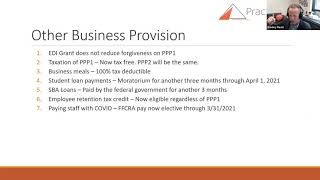
And then the Economic Injury Disaster Loan. Well, the grant was the advance that you received up to $1,000 per employee, maxed out at $10,000. And under the CARES act, the amount of forgiven PPP1 was reduced by that grant. So if you got, let's say $8,000 because you had eight employees, then $8,000 of your PPP one would not have been forgiven. Well, this new act basically overrode that and said all of PPP1 is forgivable, regardless of the grant. So the grant is forgivable, meaning you don't have to pay that back and the full PPP is forgivable. You do have to pay. You don't have to pay that back. However, if you got the Economic Injury Disaster Loan, that portion is not forgiven. That's 3.75% interest rate over a 30 year period. You do need to pay that back. Many of you are asking, should I pay it back since I'm sitting on a bunch of cash right now. Maybe many of our clients are and that's talk with your CFO advisor on that here at Practice cfo. So we understand your full context, but if you're sitting on a large pile of cash, it might not be a bad idea to pay some of that back. Knowing that you can't use it to distribute out of your practice for personal use. You can't use it to be buying another practice or buying equipment or doing a build out or expanding an op, things like that. Technically, the Eidl is not supposed to be used for that. It's supposed to be used for working capital. And if you have plenty of other cash, and heck, if you're going to be getting the PPP too, might as well avoid paying 3.75% interest on that Eidl loan. But again, talk with your advisor. What's the best situation for you? Okay, the next item is taxation of PPP1. Now, in prior webinars we've done, this was so back and forth. We knew that under the law it said that it was not in CARES Act, PPP 1 was not included in taxable income. The SBA made that clear. However, the IRS, playing tug of war, wants to get their sticky paws on more tax revenue. So they said, fine, it's not taxable, but any expenses you use PPP funds on, such as payroll and rent, et cetera, is not deductible. Which in essence makes that exactly the same thing as it being taxable virtually. And so the IRS made that taxable and, and I was always optimistic and cautiously would state that I believed that was going to be overridden and that it would become tax free. Well, that has now happened under this new act. All of PPP1, regardless of every, regardless of your financial situation, how impacted you were, your taxable income personally, regardless of all of that, it's all now tax free. PPP1 for those of you that are practice CFO clients. As you know, we meet with you a few times during the year. We do a comprehensive, what we call board meeting where we look at end to end everything in your finances. Well, we were planning on the letter of the law, which is PPP1 is taxable. And so if we did that and we withheld taxes accordingly, some of you may be seeing a decent sized refund now that we know here, beginning of January, that the PPP one is no longer included in taxable income. So that's great news for everybody. It's probably a good idea too, if you're going to get a big refund, to apply it to 2021 taxes rather than take the refund, I think it'll get less scrutiny from the IRS. If you're going to get a $50,000 refund, you know, you become a flag a little bit on the radar of the irs. They may look at that. So you may just apply to 2021 and your CFO advisor here, a practice CFO, will plan accordingly around that in our cash flow and tax planning. Okay, the next item is business meals. In order to motivate companies to start paying restaurants again who have been impacted probably the most out of all this, they are now giving 100% tax deductibility for business meals. And previously it was 50%. What are business meals? Business meals are meals a representative of your company has with current or potential business customer, customers, clients, consultants or similar business contacts. Entertainment expenses, keep in mind, are not tax deductible as they weren't previously. This is only business mills. Whether you're out at a restaurant, sitting, you know, outdoors now here in California, that's temporarily not available, but or if you order food in to the office, that is now 100% tax deductible. So that's pretty awesome as well. Going on to the next item. Student loan payments. As you know, there's been a moratorium that was through the end of the year on student loan payments, which was great because student loans, students borrowers did not need to pay that and it didn't, it didn't capitalize their loan, meaning they weren't going to pay interest on the unpaid interest. So now this has been extended for another three months through April 1, 2021. Also extended were the SBA loans that the federal government was paying. Certain SBA loans that were already in place before COVID hit, and they've now been extended longer. Now I'm going to read some additional details on this just to be real clear. For SBA 78504 and microloans that were made prior to the enactment of the CARES act, the SBA will resume its payments of principal and interest for an additional three months, eight months for certain small businesses hardest hit by the pandemic. Now it's capped at $9,000 per borrower per month for these loans. For loans made within six months of the enactment of the CARES act or approved between February 1st and September 30th of actually this year, 2021, the SBA will pay the first six months of principal and interest capped at $9,000 per month. Please contact your lender if you think you qualify. Going on to the next one. The employee Retention tax credit. This one's been, this one's been a little bit of a challenge, understanding it, how you apply for it, who gets it, etc.
Let me talk about this one for a sec. This was an incentive or via a tax credit, FICA tax credit or payroll tax credit for those employers who continued to pay their staff when they were forced to close down. Now, most of I saw most dentists when they closed down did not pay their staff or their staff used, they went on unemployment, they were furloughed, government had great unemployment benefits during that period of time, et cetera. For some of you dentists who continue to pay your staff as a show of goodwill, this becomes, I think more relevant for you now, could be relevant for others. You'll need to work with your payroll provider on that, which I'll talk about. But the employee retention tax credit.
Is for those part those, those specific dentists who paid their, their staff even when they were forced to close down back in April, March, April, May time period. Now, before, if you got the PPP one, you were not eligible for this tax credit. It's a pretty good tax credit. They just changed that under this new law. So even if you got PPP1, you can still apply and receive a tax credit and it is retroactive back to March 12, 2020.
Now, in order to get that, your practice must have been forced closed, which for most of you it was. And you saw a reduction in gross receipts of 20% or more when compared to the same quarter in 2019. So let's assume Q2 2020. If you saw a 20% or more reduction in collections than Q2 2019 again, and you paid your staff on payroll while your office was closed, then you could receive this, which is basically up to $5,000 per employee during 2020 and then 7,000 if you end up paying them this quarter. But none of your offices are closed, I mean this year, none of your offices are closed this year. So I don't see that being applicable, even though it is available for the first 2/4 of 2021. If you're a practice CFO client, your payroll company is MyPay Solutions. I wouldn't haul off and start emailing them, asking them for guidance. We're working with them right now to find out exactly how to apply and we'll provide more details later. But it is a credit against your FICA and payroll taxes, so it will be done through payroll on the quarterly payroll tax filings. This isn't something your tax CPA or general accountant is going to do. In other words, practice CFO is not filing for this because this needs to run through the payroll company now. We'll provide information and help as needed. Okay, let's go on to the next one. Paying staff with COVID We're seeing surprisingly a lot more staff of our clients getting Covid right now. We're also seeing a number of our doctors getting Covid as well.
Prior to the start of the new year, it was on a hand, I could count the number that came through. But now it's every day. I'm getting some word on this.
What do you do if your staff get the virus and they of course can't come into the office? Are you required to pay them? Well, under the Family First Coronavirus Response act, the ffcra.
You could pay them. You were required to pay them. Now there's some debate whether you were exempted from that as a healthcare provider. I won't get into that, but I'll just assume that you're required to pay them. And the government is saying, hey, we'll basically reimburse you dollar for dollar for that. And what you have to pay them is up to two weeks of their normal.
Work schedule. So let's say they work 30 hours a week. Two weeks gonna be 60 hours and you have to pay them their full pay up to $511 per day max. And the way you do that is you contact my pay Solutions.
For most of you it's ginger over at MyPay Solutions. If you're a practice CFO client or, or if you're not, contact your payroll company and make sure that they show you specifically what row when you're making that pay up to $511 per day for that staff up to a two week pay that it goes in a certain row that is then marked as eligible for a credit offset. Dollar for dollar credit offset that will reduce your payroll taxes that you pay. Remember, you pay employer taxes, Social Security and Medicare of 6.2%, 1.45% of every dollar that you pay your staff up to about $140,000. And that's quite a bit. So why not have that eliminated from what you have to pay.
By doing this the right way?
So definitely, and here's the change with the new law is that it's now applicable or continues through March 2021, March 31st. Now it's elective where before it was mandated. Now it's elective. And I'd say why not do it? Your staff are getting the virus, the vaccine isn't out quite yet. You want to have goodwill with your staff. That's really important. I'm a believer in that. You want to go to bat for them and the government's going to end up paying you're out of pocket for a few months for what you pay them. So I'd say I'd recommend to do that. Okay, let's go into some of the personal, the individual provisions. Really there's just a couple simple ones here. There's another stimulus check coming out for $600 per adult I think is rolling out as we speak. However, most of our clients are not going to get this because the threshold of phase out is so low for I mean relative to what a dental salary is. If you're single that's $87,000. If you're married filing joint that's 174,000. If you're married filing separate, it's going to be more closer to the single side. So that's $174,000. If you make more than that taxable income, you're not eligible for this. Also keep in mind now that the Democrats have won Georgia and basically control Congress, the Senate, so all of Congress, both the House and the Senate and of course the White House, they are probably going to bump this up to maybe $2,000 TBD. But that's, that's what I expect is going to happen since that's what they were really pushing for before and it was only held up because there was a Republican controlled Senate on that. Unemployment is expend is extended to 50 weeks through March 14th, 2021. And prior as you know, the government had at federal government had layered on $600 per month of unemployment to the whatever the state unemployment is provided that somebody was eligible for the state unemployment. Now so in California that ended up being over $1,000 a month for many people if not most people who went on unemployment. Well now they've decided to keep this in place past December 31st except they're lowering the amount of the federal add on from $600 down to $300.
Okay, let's now go on to if an employee gets COVID 19. Now I spoke a little bit about this from the tax credit standpoint. Let me talk about this from what you're required to do.
Legally per the guidelines. Now I will say we are not a law firm. I'm just laying out a couple basic provisions. We here at practice CFO have had two people test positive for the virus. So we've had to follow this on our own ground here. Number one is you alert any staff or patients who may have been exposed by the employee to immediately get tested. And thankfully our two staff who got it have been at home for the past three or four months. Exposed staff can only return to work if they test negative.
And in certain states like California, you may need to alert your workers comp provider. This is important if you're in California, alert your workers comp provider and possibly your local health department. And if you're looking at our screen that we have or got our newsletter, there was a link to California's versions of those rules. And lastly, pay any Covid sick pay or presumptively sick employees using the COVID sick pay line item I described above in getting that tax credit for those that have it after the two week period, then it's really on the employees. They have to use their normal sick pay or their vacation pay or be not uncompensated unless you want to continue to pay them on your own dimensions. All right, if you are not a California resident, you are welcome to drop off at this point, although some of this may be applied in different formats in your own state. Let me talk to California residents for a minute. California has a couple Governor Newsom has put in place a couple programs to help small businesses. Now these aren't I'm not terribly excited about these. I'm not even sure if you're going to qualify. I doubt you will. But I'm just going to go over these because we get tons of questions on these anyways. The California Grant program.
Was recently announced and if you look on our screen and I'll verbally say this for our podcast listeners, the amount that you would be eligible for if you had under $100,000 in collections in 2019, you'd be eligible for 5,000. If you had between 100,000 and a million in collections, you'd be eligible for five $15,000 grant. And if you had collections between 1 million and 2.5 million, you'd be eligible for a $25,000 grant. If you had collections greater than 2.5 million, you're not eligible for it. Now on the care the carreliefgrant.com carreliefgrant.com there's a ton of information on this and they've actually done a good job at organizing that information. And I'm just looking at a PDF you can get on there when you go to apply. It's 475 million that they're funding on this. It's not a first come serve first serve basis. Instead, what's going to happen is they're going to have two rounds. Round one, they're going to distribute approximately 237.5 million and then round two the same amount. The deadline is January 13th, which I believe is a Wednesday a week from yesterday. Today's Thursday, January 7th. And the way it's going to work is.
Eligibility isn't really defined by a certain percentage of reduction in revenue or any other way. It's going to be more subjective and there's going to be individuals who the government appoints that will vet applicants to find out who they believe was most affected by COVID 19 and determine that way. Now, they're going to put an emphasis on underserved small businesses as they they list that off as being underserved small business groups, meaning.
Minority persons of color owned small businesses, low to moderate income, individual low to moderate income and rural areas. Also women owned small businesses. So that's how they define that. And.
Once all applications are in, then they sort of go through that vetting process. And that's pretty much all I want to say on that one. So I'll let you use that criteria, your collections, how badly you are affected by it and whether you are in an underserved small business group to determine whether you want to spend the time to apply for that or not. Practice CFO is not applying for this. For our clients, however, we can provide information as needed. Remember, we have an online paperless way of getting all your financials month by month or for the year or tax returns payroll reports through MyPay Solutions, our strategic payroll partner. It's all there online in a pretty accessible way. Number two, Main Street Business Tax Credit is a second initiative from California's government and this one is more easily deter eligibility is more easily determined. If you had a loss of 50% of revenue in 2020 Q2 compared to the same quarter of 2019 and you increase the total number of your employees from Q2.
In 2020.
To the months of July through November 2020. Now, I don't know exactly how to interpret this. I don't know if you have staff that are furloughed that they're off payroll for a period of time. Are they not counted in Q2? Assuming they're not counted well, in many of you will see an increase in your employee count. But I assume a lot of those employees maybe came back or were hired in a portion of Q2. So my hunch is that most of my clients are not going to be eligible for this that the amount of increase in their employees from Q2 last year to July through November of last year won't be significant. And some of them may not even have seen a loss of 50% revenue during that period of time, Q2 of that period relative to Q2 of the prior period. Partially because you're a cash based business and you still had money coming in from inch from insurance companies in AR that leaked into Q2 2020. Also, it's $1,000 per added employee. I mean you might be looking at a few thousand bucks at most and you're going to spend a bunch of time on it. So again, I'm not thrilled about this. In some ways I think it's government trying to look pretty by saying we've got a small Main street business tax credit for some companies. I think that may become more relevant. For dentists, I think perhaps not so much so. And if you do apply for that application is due January 15th also okay, California dentists can now administer COVID 19 vaccines. I'm sure a lot of you have seen this in some email or newsletter you get really interesting point here and I'm going to pull up from the California Department of Consumer affairs their notice on this and just read a couple important items. They say pursuant to the Governor's Executive Order N3920 during the state of Emergency, the Director of the California Department of Consumer affairs may waive any statutory or regulatory professional licensing requirements and immense scopes of practice pertaining to individuals licensed pursuant to Division 2 of the Business and Professional Code, including including dentists. And then later on down it says, pursuant to this Executive Ordered the Directive, the Director waives. So using this order, using this provision, the Director waives Business and professions code section 1625 to the extent it prohibits licensed dentists from independently initiating and administering COVID 19 vaccines that are approved or authorized by the Federal Food and Drug Administration subject to the following conditions. Number one, they have to have been trained on programs available through the center for Disease Control. Actually, all of them are under that sort of title. And those trainings are the COVID 19 vaccine training. Number two, what every clinician should know about COVID 19 vaccine safety. Number three, what clinicians need to know about the Pfizer BioNTech and Moderna COVID19 vaccines and Pfizer BioNTech COVID19 vaccine what healthcare professionals need to know. So they just got a bunch of training that you have to do and then it says the dentist complies with all applicable federal and state record keeping and reporting requirements including providing documentation to the patient's primary care provider as applicable, and enters information in the appropriate immunization registry designated by the immunization branch of the State Department of Public Health. The subject vaccine is administered in accordance with any applicable FDA emergency and authorization. Lastly, dentists acting within the scope of this order may independently initiate and administer to persons 16 years of age or older any COVID 19 vaccines that are approved or authorized by the FDA as specified, and may also initiate and administer epinephrine and diphenhydramine by injection for the treatment of a severe allergic reaction. This order is effective immediately, dated January 4, 2020. Now, in order to do this for some of these vaccines, you're gonna have to have cold storage that can handle up to 60 degrees Celsius, negative 60 degrees Celsius. Keep that in mind. Now, if we talk practically speaking or logistically, I'm sure there would. I don't know how it would be administered. That's something that I'm sure we'll find out details and for you to decide if you want to do this. I suspect though that if you market this definitely to your patients and just generally speaking, you could have a significant amount of traffic requesting this. I have a client who has urgent care facilities and the amount of traffic and correspondingly collections has been about four times as high per month as what this individual was doing before now they were doing testing, not administering the vaccines, although I suspect there will be a similar case when they are administering vaccines, which they're doing now. But you got to deal through with the logistical questions of how do you do it. From what I understand is the patient has to remain on site for 15 minutes in case there's an allergic reaction. You got to set aside time, resources, billing for this. That's outside of my scope. I'll let you figure that out. But I thought that was a relevant item so I wanted to include that in our newsletter as well and in here in this podcast and webcast. So that's the end of the provisions. We'll probably do an update as more details roll out over the next month or two on this. So stay tuned. I hope this was helpful. I will upload a copy of our PowerPoint or even better really, the newsletter which has all the details to our Associates on Fire website as well if you would like to get that or be added to our email list for these sorts of education events that we put on for dentists with that. Have a great start to the new year. Let's see. Great collections. It's tax season. Get your tax documents organized. Be organized. We are really grateful for our clients who do that for us. We try to do as much of the heavy lifting as we can. We love working with you. It's a busy time. Bear with us as we get through this, and good luck as you continue on in success in your. In your practice.










