3D Printed Footwear at Scale: What Breaks After the Hype
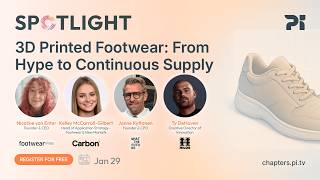
In this January 30, 2026 PYE Spotlight webinar, host Michael and panel chair Nico convene a panel of industry practitioners—Kelly McCarroll Gilbert (Carbon), Ty DeHaven (Hylos), and Janne (What The Future)—to dissect the practical realities of moving 3D‑printed footwear from prototype‑only hype to continuous, revenue‑relevant production. The conversation covers the spectrum of additive technologies (FDM, DLS, resin, powder, robotic), material considerations (elastomers, TPU, color‑integrated resins), and the trade‑offs between full‑print versus hybrid manufacturing (printing molds, combining with traditional processes). Participants discuss scaling bottlenecks such as cost, yield, print‑farm logistics, and the need for a partner network to achieve high‑volume, repeatable output. Consumer perception of printed shoes (feel, aesthetics, sustainability) and the role of education in bridging design‑to‑manufacturing gaps are examined. The panel also explores how AI and automation can streamline design validation, print preparation, and performance prediction, and how emerging business models (local, on‑demand, semi‑custom) might reshape footwear supply chains. The session ends with a call to action for continued dialogue at upcoming Footrise and Stride events.
Chapters
Hello everyone and welcome to another PYE Spotlight, our first of 2026. Today we're going to be talking about 3D printing. 3D printing is often framed through limited drops, prototypes, and headline-grabbing launches. But the real question facing brands now is far more practical. What actually changes when printing moves from experimentation into continuous revenue-relevant supply? Today we're cutting through the buzz to look at 3D printing as a true production model. We'll unpack what breaks as volumes increase, what must change in product design and operations, and what it really takes to run printed footwear as an always-on supply system, from PLM and pricing to quality, durability, and returns. And this is not a conversation about what could happen in the future. It's about what has to change for 3D printed footwear to work at scale sustainably and profitably today. I am joined by a fantastic group of speakers who are actively working through these challenges in the real world, and I'll hand it over to them shortly to introduce themselves and to begin the discussion. But first, a huge thank you to all of them and of course all of you for tuning in today. We're thrilled to have all of you here with us. A couple of quick housekeeping rules. If you have any questions, please feel free to pop them in the chat box on your screen. These will be sent directly to our panel chair, Nico, who will do her very best our best to get to all of them in the time that we have. And please don't be shy, this is meant to be interactive, so the more the merrier. If you miss anything or want to revisit the discussion later, this session will be available on demand via Seamless and on the Pi YouTube channel very, very soon. And lastly, I want to flag that today's panel is a teaser of what's to come across our platform in 2026. So for more information about what we have planned and how you can get involved both online and in person, you can visit pi. TV. So with all of that, I'm going to hand over the, um, over to the panel. Enjoy.
Thank you, Michael. Let's first do maybe a little round of introductions, uh, quickly. Kelly, do you want to start?
Yes, happy to. Uh, my name is Kelly McCarroll Gilbert, and I, uh, lead our application strategy team here at Carbon. Um, Carbon is a 3D printing company we'll talk more about today, where we have our own technology, our own materials, and really the process to help customers go from a design through full-scale production. I work across footwear being a huge part of what we've done, and specifically with Adidas and now some others, as well as some of our new markets. So what our elastomers and our materials can unlock in the apparel world, in the wheelchair and seating world, in the protection and padding gear, really helping customers see the value of 3D printing and break down those barriers of using it for just R&D, but ultimately what is it going to take to help get it to market at scale.
Perfect. Ty, how about you?
Yeah. Hi, great to be here. My name is Ty DeHaven. I'm currently the creative director of innovation at Hylos, and I lead advanced product development working at the intersection of footwear design, additive manufacturing, and scalable production systems. My background is actually in concept development and design of performance footwear, and much of my work now centers on translating new technologies light carbon into manufacturing products, as well as software tools for footwear designers to use.
Perfect.
Janne.
Yes. Hi, everybody. Great to be here as well. I'm the founder of What The Future. We have developed a new high-velocity manufacturing technology, primarily using natural rubber as a source material for making footwear and its components. So we're using 3D printing as a tool in order to power our thermoforming lines for high-velocity footwear production. So we're not really there to make the one-off products, but more like the custom enough and large-scale, high-velocity and very cost-effective manufacturing of footwear.
Yeah.
So from another angle yet again. Different angle. So yeah, for those of you who haven't met me yet, my name's Nico. I am the founder of Footmorology. We are an innovation platform for footwear development. Development and manufacturing. We do a lot of printing, basically all different types of printing, from FDM, from what you see behind me. I'm actually in a print lab here from Aretto in India. I see already Jit waving in the chat. To doing indeed printing with resin, with powders, for molds. We give training about 3D printing for those who actually want to print, but also for those who want to prepare themselves for industrial 3D printing. And every year we organize Footwearise. I already see very many names in the chat here, people who were also there, which is not only a 3D printing event but where actually everybody comes who does any 3D printing for footwear. So that's, that's my angle. And that brings me also a little bit to the introduction of today because I wanted to make a few remarks before we start because often we talk about 3D printing in general. I see that everybody here in the audience that I see, many of you are very experienced in printing, but not everybody might be. And so in general, I always hear, yeah, can printing do this, can printing do that? And I think it's important that when we talk about printing, that we do understand that not all methods of printing are created equal. So each has their pros and cons. It's also not necessarily so, this is always better than that, this is always better than that. It really depends on what you're trying to do. So please keep that in mind also when we are talking to all the different speakers, that each of them will have a different approach and a different type of audience that they are servicing. So also price-wise, you basically have a big distinction still, and I think both Tine and Janne can also comment on that, between, let's say, what I see behind me, the FDM simple machines, all the way up to much more expensive machines with resins, with powders, even more expensive. And then in between, depending on what you're trying to do, the different options for, for molding. So I was also wondering from all of you guys how you, how you would talk about that to your partners, advising them what type of technology they might need or might not need for certain situations. Anybody have any idea on that? I know, Janne, you are usually thinking, do the printing for the moulds and don't print any of the rest. But maybe for Ty and Kelly, I can imagine there's a lot of people coming towards you for printing. Is it always possible to say, okay, we start right with resin if I want, for instance, a single shoe on demand? Or are we also talking here different quantities that we need to make?
I think it's a good— go ahead.
Okay, uh, I'm gonna try and answer this like as agnostically as possible and maybe more from a personal experience, but I started with 3D printing for the purpose of prototyping footwear. And I think to your earlier point, there's a lot of different materials, a lot of different fabrications for that. And a prototype for me was just a physical representation of something that I was eventually actually going to move into tooling. And so I was very agnostic to the material, to its function, because what it represented was a shape and a form, not the final performance piece. And through the last couple of years, uh, printing has gotten excellent in so many different places where it actually can be as not just a direct substitute but a performance enhancement. But I would say in a hybridized way, you have to be really intentional about what it is you want from the product. And if printing can not only subsidize but enhance that, that's kind of what I would say is an important thing to consider.
Well, anything to add there, maybe Kelly, on how you guys would approach that?
I think it's a good question because not everything is a good fit for printing and not everything is a good fit for resin printing. I mean, it's really to step back and say, what are you trying to solve for? I think We often tell the brands and the customers that come to us, you can, you can usually print anything once, but you can print anything once by putting a bunch of supports on it and by sacrificing some of the different maybe aesthetic finishes. But I think the goal is really to understand what is it that you're trying to solve for? Why are you trying to use printing? Is it a performance benefit? Is it an aesthetic benefit? Are you trying to ease your assembly process? Whatever it might be. And then understanding, you know, is this something that can be designed for the type of technology you're working with? And so for carbon specifically, we talk about a lot about DLS, which is the carbon technology, but, you know, how do we look at a file and make the changes necessary to make it successful? How do— on our print technology, how do we ensure a high yield? How do we ensure that the parts coming off the platform are repeatable? And so again, you can print anything once, and for R&D purposes, that's great, but Ultimately, what we're trying to do is help brands break down those barriers and bring this to the forefront of their manufacturing process and help them understand what is it going to take to do that.
Yeah, because I think that's also probably the question that a lot of people have that start with printing. I see that Rohit just entered here from New Print Farm Drugs in Bangalore in India doing FDM, where indeed you can do one model per one model per one model. If you wish, of course. There we also strive for quantity. But I think it's good for people to understand that when we talk about printing, a lot of times it's about, okay, we don't have molds, and that's correct. That does lead to a very different planning also in how you print, because, okay, the time that you save on not having to make the molds, you might have to make later in the printing process, where printing individual pairs actually takes a longer time than molding does once you have the mold. So So that's often something for people to understand. I do think when we look at it from the customization perspective, I can imagine I get that question a lot from people who are not in the industry. Why do we see so little customization in printing? Because technically this is possible, but financially maybe not always, or in terms of the quantity that you're trying to make, maybe not always. And there we definitely see a big difference between one method versus the other. So that could be maybe a good bridge also to talk a bit further about: are we indeed seeing brands making serious quantities, starting to make serious quantities in printing overall, or do we still stay a little bit more in the hype, smaller quantities outside of some of the people that we've already seen that have done launches?
Also, one thing which is maybe good to understand is also the communication, education, you know, so our— yeah, Production lines are anywhere between 3 and 15 meters. You know, these are big, big machines. And, um, but still people would come to me and go like, can we, can we come and see your printer? You know, yeah, yeah, sure. So I don't even bother correcting.
There's a printer somewhere in that.
Come see our 10-meter printer. Sure, printer, whatever works.
Yeah, yeah. It's also often indeed lack of communication, people not really understanding what is What is the rest? But it's also up to us to then educate them because indeed in the end people want to have a certain solution to something that they are trying to make. And I think that also counts maybe for people that want to do combinations of production methods where we now still see a lot of the times that when we look at the printing companies or at print farms or people that really come at it from the printing side, they can be really like, purists, I always call it, where the vision is you just need the printer and only the printer and you're only printing. And that's how you make that shoe because that is the fastest way, the best way, you don't need anything else. But of course, that also leads to a specific aesthetic, a specific look that maybe not everybody is after. So how do we see the options, for instance, for combining? How do we put printing, any kind of printing, maybe in combination with more traditional footwear making involving other constructions and materials? Who wants to shoot at that one?
I'm happy to go. I think we have this conversation a lot, actually, not just in footwear, but in consumer goods more broadly. Customers come and some people want to replace an entire part. Others want to focus on one specific area of a product and replace that for a defined performance reason or a defined reason more broadly. I think when we think about from a full shoe perspective, often what we're seeing, kind of the driving factor between bringing that to market, is really the ease of assembly and the time to market, right? If you're working with one technology and one component, you have the ability to control it all, to iterate quite quickly, and to ultimately shorten your design cycle from, you know, 12+ months to a matter of months, right? It can It can happen really quickly. You can have different performance with one material across one single part, and you no longer have to think about how is this going to fit with the next part. In footwear, how is it going to fit with an outsole? With a saddle, how is it going to fit onto the base, right? And so I think we see a lot of people who are starting to realize these materials and the design tools give them enough flexibility that they can print with one material, they can print with one technology, but they have the ability to still change every single area to have a very different feel or a very or an aesthetic that, you know, keeps the performance intact but allows them to do something that they might not be able to do with traditional manufacturing. On the flip side of that, I would say we still see a ton of interest in just printing one component. So only printing a midsole or even only printing the heel component of a midsole. And I would say what drives that is really, it is less about, you know, we're not optimizing for ease of assembly, right? We're optimizing for— we need a specific type of performance in a specific area, and we think 3D printing is the way to do that. And right, and so whether it's being able to control the way the part performs, whether it's adding a custom element, or a— we talk a lot about personalization at Carbon where you have now the ability to have multiple SKUs by only changing the design. We still see quite a lot of interest in what is the component we want to focus on And the first question we ask is why, right? What is it that you're trying to solve for and why are you limited by traditional manufacturing? We do, we'll talk a ton, I'm sure, about cost today. It's always the first step of the conversation. It's, you know, what is the cost you're trying to hit? Because if you're not replacing the entire part, you are not, you know, being as efficient with cost, right? You do still have mold costs, you do still have tooling costs. And so really looking at the whole picture to say, What can we replace and ultimately why are we replacing it?
And where would the consumer come in in that conversation? Because indeed one of the hurdles that I think we all face in this industry still is also, of course, the perception of a consumer, of an average consumer towards a printed shoe. I still see a lot of responses, whether it is an FDM powder resin, doesn't really matter because the consumer doesn't know that printing is printing for them. They don't really know the background. Of course, of it being fairly limited in how it feels. Even with— we had the great shoes for Alexander Wang that Hilos made at our last Footrise event, one that I already think is really diverse in how it feels, the different parts. And then still you had people in the audience, for instance, coming from more traditional footwear brands that were there, Spanish manufacturers, for instance, who are still asking, and rightly so, like, Why does it feel so rubbery? Or why does it feel a little bit sticky? Or why does it feel plasticky? You know, so it is a good question because that is something that I do think when we simply look at the average consumer that doesn't know about cost or whatever, trying to solve for tooling or whichever. How do you guys see that thinking about what a consumer wants?
I would say, Jan, you want to jump in?
No, you go ahead. Be my guest.
I think that the fact that, like, you bring up a Spanish factory saying it feels like rubber or it feels like plastic, that's because it's rubber and it's plastic. And like being authentic with the consumer about what the material is and not trying to mask that, oh, this rubber is actually going to feel exactly like a synthetic suede. Yeah, we can try and get to that point, but being authentic that the material is supposed to be a certain thing. And as long as the consumer is brought into that conversation earlier, they can understand, okay, yeah, this whole shoe is printed in some foaming TPU. It's going to have some benefits. It's also not going to perform the same way that my performance running shoe might, but they get to make that choice.
Yeah. Yeah, whether they want it.
Yeah, it's funny because I mean the consumer will kind of give you the most honest answer and the weirdest question that you don't probably expect, especially if you come from the knowledge base of the technology and the materials and so forth. You know, it's kind of— this reminds me of a conversation that I had in LA when I was, uh, I had a studio in LA many, many years ago. There were some high-level people coming to the studio and they will indeed feel the materials that I had there, and I happened to have shoes there at that time as well. And of course they were still hard plastic. And the question was, you know, can you print this in leather?
I get that question almost every day.
It makes perfect sense if you have no clue where these things come from. You're like, well, I'm wearing leather shoes, so can you print this in leather? And I'm like, huh? You know, it's like, it's a good question, you know.
Well, you have to understand that most people also have no idea how leather is made. So I mean, it's not strange that we get those questions.
You start from a tactile feel, like this is what I this is what I'm used to, this is what I like, can you make this? And then I would have to kind of tell them like, I had to pause a bit and like, maybe 10 years, you know. But for them, like when, you know, fast-moving consumer goods, like, no, can you, can we like make it next week? Like, no, material development is really difficult, you know. So, and it's really difficult to kind of communicate that to consumer and they don't care and they shouldn't care.
Yeah, but then are you like catering to or facilitating all of you, because I'm relating also to some questions that I see coming in from the audience, indeed just to help brands think about how can we combine indeed printing with other methods. So I see Luis here asking what we think about printing, will it disrupt or replace traditional manufacturing. I from my side don't think that it will, I think it will be a combination. I see Ray asking Do print farms have multiple methods in need, or is it only single? So I think there will be a lot of questions from people to understand, like, where does printing sit in, in the bigger picture of footwear manufacturing? Where do we see it now, and where do we see it, say, 10 years from now?
It's an innovation. I think it's a performance material innovation exercise. I mean, if that would be like saying that EVA monocoque shoes are going to replace all footwear. Right. Like, we know that that's a huge segment of the footwear market and it's highly scalable and it's very affordable. And so that's why these are made. So I actually do see, you know, in the next 10 years, the cost of 3D printing going down significantly. And there will be then the opportunity for consumers to buy fully printed resin and FDM shoes, say, on the open market. Is it going to replace performance products anytime soon. I think in componentized ways, it can start.
It might also be a bit of a pity that initially from the promotion side, from various types of printing companies, it has also been promoted like that. This will be the disruption, this will be the replacement, this will be like the next level. And I personally, from my personal experience, find that a bit of a pity because I see a lot of fantastic opportunities these in the combinations, whether it's what Janne does where you use the printing for the tooling and then do other technologies, or whether you combine a multitude of different manufacturing options with printing. Because like you say, we have had molding already since several decades and nobody's saying, oh, now everything needs to be molded because we can do that. So, but there is still quite this, this like wall almost between And I think it's purely in thought between printing and, um, and other methods of, of manufacturing.
If I were to jump on the—
go ahead, it's good—
on the print farm topic, you know, because again, like this, uh, let's go back 20 years, you know, when there was some hype, the initial hype going on in the, the 3D printing space, you know. So the communication towards a consumer was very much geared towards, yeah, just Ctrl+P and magically the thing, the organ and the hamburger comes out of the printer, right? But when it comes down to these print farms, for example, I'm still quite, let's say, surprised, but I'm positively surprised that you have these massive volumes of FDM printers in a row and things are moving, that it's working. And it's definitely going to get even better. But if you wanted to add a mega print farm of all these different technologies together, that's kind of where it starts getting a little bit more tricky, you know. So the focus there is absolutely, you know, very important, you know. So if you're running resin printers or your powders or your FDM, you need totally different kind of space and, you know, they're totally different kinds of technologies. Setting up these print farms from various technologies, then it more starts gearing towards a prototyping facilities that are being really focused on this particular material, even just one color and the same printers in a row, when you start changing things, it's kind of where things go a bit left.
Is that so though? Because I'm not sure if I would agree. For instance, if we look at the Nike application on the summer felt tubes that was recently released, where they kind of have this liquid, I think it's TPU, that they really quickly kind of put over the finished shoe as a, as a color accent, where I could easily imagine that you can combine pros and cons of different methods of printing, where you might have the better surface texture of a resin printer that has a much better surface quality, but you might not necessarily always find it suitable to do full-on custom and one-on-one because also quantities that you're trying to make. And you could do some— add some other methods of printing. We haven't even talked about robotic printing yet, which is also coming with that as an example.
Sure. I mean, of course you can combine. It's not just— I'm always looking at efficiency, you know, the way that we're building our production, let's say factories and machines. We're all the way down to the door handle, you know, so what direction is the door open, you know? So you've got to be so specific if you want to make high volume and then high margin products. But once you start adding all different kinds of colors and, you know, technologies and SKUs and all that, you know, you're The challenges exponentially go sky high. So that's more just what I'm trying to address.
Yeah, exactly. Ty, was there anything you wanted to pitch in? Because we've been going a little bit back and forth.
Yeah, I would say that to kind of complement what Jan was talking about, like, I think 3D printed footwear is scalable up to a certain amount right now. It's the change in mindset from the prototyping logic to a production logic is what the, what like businesses need to get their mind around, right? So prototyping is proving something can be made. Production is about providing like it can be made reliably, repeatedly, and like without like the heroics involved. And so like early concepts and like small-scale runs can tolerate manual fixes. Loose assumptions and decisions, like small decisions. But when you like scale immediately breaks that illusion and like volume will do that. So yeah, every undocumented assumption become like massive bottlenecks. And I know like Kelly's team is so diligently working on it, Carbon, making sure that like, is this the right product and how are we going to make it repeatable for you?
Yeah, exactly.
I think it goes back to your question, Nico, of, yeah, should everything be printed? And I think— I wish— I would love to say yes, every footwear in the world should be printed, but that's not— that's not the right answer, right?
And when—
if there is not a reason— traditional manufacturing and, you know, these high-performance foams are really good at what they do. They are very, very cheap, and they, they provide value for very certain instances. I think when you turn to 3D printing carbon or other, it's really important to understand what is driving that. Is it something that can't be achieved from a performance standpoint? And performance, I mean, can be such a range of things, right? It can be actual data points. Is it providing a better cushioning, better comfort, whatever it might be? It can also be, does it provide more breathability or an aesthetic that you can otherwise achieve? But I think really understanding how do we, how do we compete with what we're good at? How do we ultimately get to focus on the areas where we're providing a value that traditional manufacturing can't, and then work to make sure that there's a network in place to scale that? And I think that is a very different mindset even, you know, from 5 years ago when people, everything was about this hype. It was, oh, it's 3D printing, it's so cool. I feel like that factor has kind of gone away and now it's if you're going to do 3D printing, why are you doing it? Because to your point, the consumer doesn't always know it's 3D printed and they often don't care, right? They care about what the final part looks like, what it feels like, and what the value is it's offering. And so that should be the end goal. It should be, are we creating something and scaling something that is ultimately providing a value in some form or another?
Yeah. So what would we see as main bottlenecks towards that scaling? Because that is so something that has not happened all that much within footwear. We see on the FDM side, of course, bigger brands jumping in, but then we are also still talking about, say, 1,000 pairs at once, which is, for footwear compared to other methods, still really small quantities. So how far are we with scaling? And this is mainly then to both Ty and Kelly. When we're looking at printing, which footwear has the best options? Maybe what are the big bottlenecks? How do we look at scale?
I would say Kelly can probably answer on the, like, how are they approaching the scale aspect. I can talk about, like, the footwear mindset. And business units still see shoes as SKUs and printers see files as envelopes, general forms. And if we can start to get into the mindset from a, like, like a product line management that how many types of these units can we start to see and does it still hit the brief? Does it still look right? That's where scale can start to impact for a positive way in the footwear space.
Yeah, I would say just a couple of things to add to that and putting cost aside because that still remains a bottleneck. I think it's something that we're seeing come down. As Ty said, it's moving in the right direction.
It's—
it still is a premium to traditional manufacturing. But I think the first step to getting to scale, I think, is first helping these, you know, teams in these underlying brands understand you can approach design and development very differently than you're used to. You don't have to go and run, you know, a 10-week full wear test. If you start to see things that you want changed, it's a quick change. It's a quick digital change where you can say, okay, you know, this part's already bottoming out. Let's fix it. Let's get it back. Onto the shoe and let's test it again, right? We have the ability to run these really little changes really quickly through the process. And in a matter of, you know, 2 to 3 days, you have another print that you can test and assemble into your part. And so I think really showing the benefit, one of the benefits of additive, there's a ton, but one of the benefits is it gives you the tools to make really quick changes to really quickly see, you know, if I change this area versus this area, what does this do to my end performance? So working with these brands to say, change the mindset of how design and development works. I think the, the flip side of it is on the scale side, and this is our underlying mission at Carbon, right? And we talk about it quite openly as we are creating a network of partners to help us do that, right? We need partners who are good at all different types of programs. So we need people who are good at footwear, we need people who are good with our elastomer materials versus with our rigid materials. We need people who are really good at these, you know, quick custom requests where you're dropshipping to a customer and you need to have really quick turnaround times. And we need customers or printers who are, or print farms who are set up for millions of pairs per year, right? And I think creating a network where when a customer comes to us, we ask a series of questions to say, you know, what does scale mean to you? What are you looking for? Is it custom? Is it scale from a, you know, hundreds of thousands of pieces? Is it you want the ability to switch between SKUs really quickly? I think it is extremely important to have a network of partners in Europe, in Asia, across the US who can help get you to exactly what you want. And so we have— I think that is the biggest thing we need to do is just keep creating this network of people who know how to use our technology, who know how to scale quickly, who know how to print with all the different materials. That is, I think, you know, cost aside, a huge bottleneck to say we have to have a home for these applications. A lot of people, you know, they, they'll say, okay, this design looks great, can we start printing it tomorrow? Right. And there is still a ramp up that needs to happen. Right. We need to make sure the yield is going to be what it needs to be. We need to make sure the material is in place. But, you know, once you have that network of manufacturing partners, it's a lot easier to say, yes, you know, you can start printing quite quickly. And I think giving our customers the tool to get their product when they need their product is going to be what allows them to validate and believe in the supply chain.
Yeah, well, also, of course, then makes it necessary for, from the side of the companies, to, to be that quick and to be that flexible. I heard from, from one of the companies in printing indeed that they ran into issues with, for instance, larger companies where they had developed the the model to print, you start printing, and then indeed, as the process improves, they of course wanted to say, okay, now we improve this, improve this. But then in the rigid structure of this big company, it was like, no, we signed off on the model as it was according to spec, blah, blah, blah, and that's how you're going to print it, even though we now have, you know, a better option. Because indeed, this is developing technology, so it goes quite, quite quickly. So you are from the business side, it also means is that people who are making and selling the larger quantities should maybe have a different level of flexibility towards the development process than what they might usually have. So anybody else who wanted to comment on this, on scaling, other things, how you see to solve for scaling? I see a lot of questions also coming in that I can jump into. I was trying to find a bit of a logical, logical order. One question that I see coming in here from Pratik, I think I know this Pratik, is indeed about whether we feel, and it's definitely a question for Daj, how we see AI, the AI area, and what era and how this will impact printing. Is there a lot of the design work and development work that can be taken over by AI and automation. And I know you guys work exactly in this field. So how would you answer?
From a design side, I mean, I have a lot of thoughts on how AI is impacting the design side, but from a manufacturing side, pattern recognition, print prep, orientation optimization, anomaly detection, like correlating design parameters to performance at scale is absolutely something that artificial intelligence will help us do. There is a lot of manual pre-prep work for printing right now and a lot of post-processing applications that happen in all different printing forms. And so being able to predict how a design not only looks but the implications before and after, I think AI is going to be a dramatic help in that area.
Yeah.
Well, I'll also add to that. Yeah, because Ty and I, I mean, have, have worked on this exact thing directly. It's to say, I think it allows us to work with brands or to work with, you know, customers and companies like ILOs to say, before we go down and you start creating files and really start with the printing process, AI allows us to to look at what is the vision and is that vision printable? Is it printable on what this technology versus another technology? And so we'll spend, you know, a couple hours with Ty's team to say, okay, what's the concept? What are you— what are the vision? If you could see this through a couple different ways, what would it look like? And it allows our designers and the team of designers we have to say, you know, right away, I see a problem with this overhang here in a room with automatic lights that keep going off. But, uh, it allows us to say, you know, we have a— we expect there to be a print issue with this. If you can reduce this overhang, or if you can reduce the complexity in this area, it allows us to do a lot of quick iterating without actually doing any design or printing work, right? It's almost like a tool that gives us the ability to brainstorm with Ty and his team, with other customers, to say, how do we think this will work? Let's think about it a little more before we go and put all the the efforts behind actually moving it forward. Let's have a few concepting ideas. Let's think about how it fits onto the platform. Do we have a material? What types of materials? It really allows us to step back and look at the full picture.
If I were to chime in on from the, let's say, the younger generation designer's perspective, there's a bit of a danger I see in the AI world. You know, it's— I also see that in my LinkedIn kind of feed as well. Is that there is this— in some areas I feel this disconnect from the tangible to the concept, right? Now all of a sudden you have the ability to make a— hey, I can make a million concepts, I can tweak this one pixel here and then the other pixel on the other side, which at the end of the day for the real product doesn't really add much. You know, if I just take a classic Converse Chuck Taylor that they've been making since 1905, and they sold billions of those, and the archetype has not changed, you know. So it's like the peer, I think, from a— especially from the younger generation perspective, is you're able to give this dopamine rush constant every second. You can make a new thing, you know, so you can kind of run around in circles without then actually connecting in something tangible and making something real.
Well, I might— can I jump in there actually from— because I I would contradict that very strongly because actually I find printing the way that breaks that cycle. Because indeed, if you make— if you've never seen a footwear factory up close, and many young designers haven't had the chance to travel, haven't been able, maybe were trained during COVID were not able to travel at all to factories, but the printers, and especially the FDM printers, of course, made it fully possible for somebody to directly make where they are. A shoe. So I'm here at the Design Center. We literally went from a concept as we had a sketch this morning. We made several renditions in AI and they were literally that same afternoon had a physical shoe there that we could make the first protos with. I mean, that's amazingly fast and that's actually very, very tangible.
No, no, I don't mean that it doesn't add value. Absolutely does. My only point here is that you might— some might get trapped into this cycle of, you know, develop and develop and concept, new thing, and you may be able to make thousands of prototypes, but you don't really put anything into production, into people's feet at scale.
Well, that kind of depends. In this case, it was like it's for a fully molded shoe, so that's actually fairly close that you get to to, to, um, with, um, with a print. Um, so, but yeah, I, I personally think that it can help also with the business model. There's a good remark from, from Sean, but this is actually where I think the big issue is. Sean's saying, so I think we need to be careful about chasing scale for the existing model. With additive manufacturing, we are in a position to create a different supply chain model— fast, local, and on demand. Yes, in theory, this is the case. But in reality, I believe, and that's also why my next Footrise event is going to be all about this business model side, that most of the larger brands that want to do printing also to remain relevant are not in a position to offer fast, local, and on-demand. This is what I keep hearing, but then people don't get enthused apparently about the method until they see a Nike jumping in it. And are they doing this fast local and on demand? No.
And also I would even add to that, like, it's, you know, they're also not working in silos, right? You might be able to get local fastest with one technique, but at the same time, you know, I get something made by Shane or Temu and it's going to get drop shipped by a drone to whatever my island next morning and they're producing at scale, you know, so It's not just also either or.
No, I mean, that's a very interesting point where also a lot of brands, I think, could think about, oh, you talk to scale where maybe you need certain parts might be traditionally manufactured in large quantities, shipped to another place, finished maybe with printing and be, you know, customized closer to the consumer, whether this is in-store or in local factories. And I think we don't even look enough at these types of mixed models because there's always sometimes such a one-way vision of either we print the whole thing or we do non-printed footwear. And I think it's a shame because there's a lot. So for instance, Tai, are you guys thinking inside HiLOS to combine different types of methods or to say, okay, this is— this we're going to do in quantity and then that we're going to update or kind of tweak more to the consumer?
Yeah, there's kind of two parts to that answer. I would say the design software that we are building should be able to allow a designer to explore any idea and have any possibility of material come out of that. From the Concept Studio standpoint, I'm very much into new systems, and so I think the opportunity to work with Carbon most recently on two different resins for a brand new silhouette. We, we built a stiletto with a very firm resin and an upper with a very soft, rubbery, comfortable resin. And it was a very traditional footwear build, actually, but using a new prototype kind of process. And I think those are the things that, like, I would say are just moving, moving the needle. It's just thinking about how to build something the same way but using a different material, and then you can think about building it differently.
Yeah, that's it. Because that's, that's because that was my, my point, uh, because I really— we had the, uh, unexpected opportunity that we had for the previous Footrise factory tour. We didn't know, but we were actually at the factory where the shoe was assembled, and I think it's the most brilliant system that you guys developed, also really showing that you can do 3D printing for high heels. But that also brings me to a point that I know, for instance, you guys are making the design platform, the design software. And I personally am one to think, that's what I often use in my training, people really need to understand manufacturing and how they can think creatively about that and how they can collaborate with suppliers of technology to change the way we manufacture. Because there's a lot of focus always on very fancy hip design, but very little on how do we manufacture it. That shoe, most people when they have it in their hands will not know what actually this really smart construction is, and it will be fantastic for people to also through a platform like that kind of be educated. Is that an option? So that they can understand, because of course as a designer, the issue is of course we get a lot of people in who draw anything they like, and then go like, can you print that? Where often the answer could be, can, yes, but should might be another question. So how, how would you, how do you guys look at that from a design perspective?
That's a really great question. There's a number of kind of talking points in there. One, I think that designers, the best ones are the ones who actually do understand the end-to-end build process. And the more experience you have in the industry, the more you understand constraints and manufacturing and engineering principles. And a good designer just inherently will be able to draw that line that will perform. They will select the material because they've used that in past use cases. The challenge, I think— I'm going to go back to AI, but also the opportunity with it— is that if you have an industry that's a black box of knowledge and you you have AI that's also this black box of information getting fed to you. Those two things lead to like very opaque outcomes. And it often is not very inclusive of the concept or the designer, and it can actually be quite the turnoff. And so when it comes to education, the goal of like the Interplay platform that we're building is that it would be a codex of information based off of like industry standards. And industry experts giving the LLM the information that you can trust and not just go to your typical chat system for footwear Wikipedia, if that makes sense.
So would there be something like that, that I upload something, an idea, it could even be just a sketch and the LLM already starts giving me comments, for instance, like with the heel, have you thought about the weight distribution? Have you thought about that there might have to to be a shank in there or a screw in the heel to make this thing strong enough? How would I have to see this maybe more in a practical sense?
The answer to that is all yes. When is a better question. Specifically, we're focusing on sneakers and lifestyle running product right now. We build into the future on concepts like the stiletto. We know that that's an area that we want to like be able to offer our consumers. Consumers and users at some point. But yeah, the idea is that you would be able to not only concept but get live, live information about dimensions, widths, densities, the performance characteristics, simulation of how like your design or that, I don't know, logo placement might actually impact performance. The idea is that like you can work in a 3-dimensional space while working 2-dimensionally as well.
Yes.
Yeah.
So you have to have this direction.
I think that the education piece, you know, this is also something Ty and I talk about quite regularly, but the education piece is huge, right? It is always the hardest to design the first product you're using with the new technology, whether it's your first time with 3D printing, whether it's your first time with resin 3D printing, there's always the learning curve to say, you know, how do you go from something that you print once to something that's scalable? How do you design to optimize for yield? How do you design to limit the manual labor needed at the end, right? How do you design for scale? And I think once our designers, the more designers we get familiar with 3D printing, the more designers we get familiar in this instance with carbon 3D printing is the next product is that much easier. And I will say, you know, Adidas did a fabulous job with that, right? They've had the midsole that everyone's aware of, the 4D Forward midsole. And recently over the past year have launched the full shoe. And they had an eye to say, you know, we know what Carbon is good at. We know how to design for scale. We know how to design to optimize for cost. We know how to design to optimize for yield and reduce any final manual labor required. And so that's why they're seeing the scale that they're seeing. That's why they're seeing the prices that they're seeing. They've learned how to design for the process and for the technology. And I think And once you kind of get over that, we always say, you know, there's this learning curve. And once you start to get over that learning curve, you make decisions that are different from the way you would typically make your decisions to manufacture. You're actually making the decisions based on the technology you're using and you're optimizing to do something that is good for that technology, for that material. And as soon as those wheels start to turn, all of a sudden, you know, in the time that it took to get one product to market, you can get 3 or 4 products to market because it's really quick changes that won't have a negative impact on things, right? We have the conversation from the first day to say, hey, when you make a change like this, this is the direct impact to cost. Or when you make a change like this, this is the direct impact to the underfoot feeling, whatever it might be. You know, that, that learning curve then gets so much easier as you start to bring more and more products to market using the same technology.
Yeah, I think it's a really good, good point. I mean, I changed my mind several years ago where I always thought if people want to do 3D printing, they first have to learn 3D modeling. So I always advised students who came to my institute, first do Rhino or Blender or whatever, and then you start printing. And now since a few years, I've changed my mind completely. And if people cannot model yet, even better, I first get them into a printing course to understand how the technology works so that they understand how they can best make the shoe. Because otherwise you get a lot of designs that you are not able to print. And I know from most of the companies indeed involved in printing how much time and money it also takes within the company to be able to manage that process. So Zellerfeldt has a whole system also to check the shoes. Is that, you know, you hear a lot of designers then complain it didn't make the check. But yeah, the check is there for a reason, because otherwise you might have a really beautiful looking design, but when it comes out of the printer, very different, very different story. So I think that's going to be really important. So, Janne, how do you see that? You also have, of course, again, a different way of applying the printing and also different type of technology related to that. When you work with customers, how do you solve for that to make sure that they can design stuff that you can make? Or do you— would you rather design for them?
Oh, you're on mute.
Sorry. So currently, I mean, the tech is still very new and not enough people know about it. So it's quite difficult still for them to design for it. So we are doing all the design work for now. And so it's also in our goals to create more educational programs and packagings. And Nicole, maybe this is where you can help us. You know, to get it into the eyes and the hands of designers. But it's, it just takes time. I mean, any new technology, you have to educate people and create them the tools, but you have to also kind of show them the ropes, you know. So that's why we're creating our own products first and showing them what works, what doesn't work, showing them the limitations and whatnot, you know. Because it's, we have a, yeah, it's a big thing. We make the chemistry to the designs, the factories, all the processes, you know. So it's not a quick thing for someone to learn.
No, no. That gets me to another subject, which is important indeed for all the brands that want to produce, especially at scale. If you want to have things that are repeatable, how do we go about having consistent quality, for instance, at scale? How do we— how do you guys solve for that within your process?
Who's first?
Who wants to?
You go ahead.
Well, for us, it's really about simplification, and making things simple is incredibly difficult. So we just reduce, reduce, reduce. We don't add anything. So our, you know, primarily the footwear that we make, it comes from just two parts. There's an upper And that's all, that's it. So because we directly inject our shoes and so the chemistry will wick into the fibers of the materials. So even there we have enough, you know, things to perfect, but just trying to keep things really simple.
Yeah. So that it remains more manageable.
Correct. That's what I'm saying. Like different SKUs. Okay, how many colors can you have? XYZ. How many? I mean, footwear is tricky in a sense because you have so many SKUs and you have so many sizes, you have so many— every shoe is a different size and a different volume of material and all that. So to kind of get those being produced effectively and efficiently, I mean, the Asians have done a tremendous job on that. I mean, it's phenomenal what they're doing. I mean, I'm astonished how they're able to do that quality for that kind of low pricing. And also in order for us to compete, we can't add anything. We really can't. We have to reduce, reduce. That's where we are.
I would give a little bit of a slightly different answer. I agree with you in that to start, I think there is an element of simplicity to get things going, but I think the benefit of 3D printing and additive manufacturing as a platform is actually It allows you to have that level of complexity. It allows you to have different SKUs without having to go and open up a new mold and go through an entire design cycle. It allows you to, you know, we talk a lot, we mentioned this earlier, you know, there's customization, right? There's the full, how do you go from a scan to a print? That's one angle, but there's also the angle of personalization. How do you have a number of different SKUs? So if you have a, you know, a runner that is, you know, a woman of, you know, X weight versus a male of X weight in the same size shoe. How do you address that for what that individual runner needs? And so I think 3D printing allows you to have that complexity. It allows you to have a bunch of different SKUs. It allows you to have color. I mean, not all platforms, but I would say that's a huge thing. We heard from the footwear industry, we heard from the consumer goods world at Carbon, color is key. Color unlocks volume. What we're trying to do is unlock volume. And so color, making it so that customers can get color, so that they can have multiple colors per season, multiple colors per SKU, I think that is the end goal. And I think that is what we have set out and are doing successfully across multiple brands in footwear and in, you know, helmets, bike saddles, across the board. Um, we want— if we, if we scale it back too much to the simplicity side of things, we're edging on the lines of why are you not using traditional manufacturing?
No, I absolutely 100% agree. It's just we have an entirely different process. So for you, it makes absolutely perfect sense. And for us, it doesn't, you know. So for us, it's really about the cost and the speed and how to bring manufacturing. We're more custom enough. We're not custom per se, you know, so it's more how to bring manufacturing to the Western world in a highly effective and highly cost-effective way. So, and it will fundamentally create a very simple product that might resemble something that somebody might make in Asia, but now we can make it locally, we can make it from fully natural materials. It's just a totally different ethos.
I actually have a question on what Kelly just said because it's one of my main question points always working with printing companies and with brands. The colors, for instance, that you, that you mentioned, are you guys then working on that the color is made inside the process, or is it an after-processing? Because I think with a lot of the printing, the fact that we keep trying to push color as part of the process could be a big limitation, as opposed to saying, I don't know, give me one color of resin and I do all the coloration afterwards, which would allow me more freedom technically, to have more colors on the shoes. Because I mean, now we see that in FDM, we see the bamboo printers, okay, now we could do 4 or 5 materials. But for a lot of ways that you want to place the color, that's still very limiting. I see that same thing in resin and other methods. And it's a really important thing to be able to actually both collaborate as well as compete with with more, with other methods of making. So how do we see that, that, that coloring finishing, how will that be improved?
I think it's a good question. Um, we, the short answer is you can do both, right? You can have it in the front end of the process, you can have it in the back end of the process. We are typically trying to get costs down to be competitive, right? And to eliminate any unnecessary pull processing steps. And so what we've created at Carbon is a resin that allows— we call it our color-based material— that allows the direct resin to be colored. And so you want us to match a Pantone color, you want it to be red, you want it to be blue, it allows you to make that direct coloration in the material. That part is then printed in that, in that color. And so what that allows you to do is, one, you don't have the the color is not going to change over time, right? We have a lot of people who are concerned about different coatings that they'll chip over time, the color fastness across the board, just kind of concerned about how they adhere to these different 3D printed parts. And so direct coloration allows us to have that be, you know, not an additional cost to our customers. There are schemes and things like that that are considered, right? But allows it to be not an additional cost to our customers and gives them yet another design tool to compete with traditional manufacturing. And so In the world of consumer goods, which is the world we are focused on today and talking about in this, this panel, is color is key. And so I think we need to give people the option of color. And that's what we've created at Carbon, right, is to get our material to a place where we can color match, where we can say, hey, you, you know, your brand is this blue. Well, here's a shoe in this blue. You can also do coating. I will say, like, we have different parts that are on the market where there's different designs and, you know, you may want a spray coat finish or different designs that can be done to the materials that adhere well to different coatings. But I think if we can take one step out of the process, go back to direct coloration, have one less step, if you can solve the finish with a digital texture, if you can solve the color in the direct coloration, you're taking advantage of what additive has to offer. You are in the design. You are taking into consideration what you want the final part to look like.
Do you agree on that, Ty? Is that also what you were aiming for? Oh, for instance, because I can imagine in design platform that you will get people, of course, beyond drawing the shape, or you see Rowett asking how far along the software is, that people are like, I want to have a print on my shoe. I want to have this whatever camouflage or whatnot. How do I do that?
I think that how Carbon has been approaching like impregnating color into the resin itself is a durability that most printers have not been able to offer. Post-processing, I don't care if it's an incredible adhesive paint, it's not going to be as durable as a color that is a part of the actual material. And that just is across all parts of manufacturing. You can spray foam and that logo is going to wear off over time. And so just having color in the material itself only gives more validation to the printed material. So I'm all for color and like organized color systems that designers can understand. Like if a new material comes online and it's offered in white and black for right now, and the road to scalability in, uh, is in a year from now, we know that, oh, this new material will have this color option. But yeah, color for me over the last, you know, half a decade has been the hardest thing to talk with new brands and designers about because, look at this amazing thing that I designed, can I get it in green? And they ask it too late and then the product goes to crap after that. So yeah, finishes are super important.
Yeah, yeah. But that might be another reason for indeed looking at the finishes closer to market. I mean, I see a lot of similar comments repeating, and this is a lot of times when you speak to people about printing where everybody says, yeah, yeah, but smaller scale, one-offs, fully custom, And reality is that we don't see it happening at this moment. And it has very little, if anything, in my opinion, to do with the technology as such, whether that would not be possible. It has everything to do with those companies not working that way. I mean, there's also not in other methods which you technically can also do. I mean, Janis' method would also make it possible to do to a certain extent the molding on demand. Because it's a faster process and it allows for smaller quantities of moulds and cheaper moulds. And there also, we don't see all that many brands unless they maybe start from that perspective, but the larger brands not doing this type of business model. I'd be interested to hear from all of you how you feel about that or where you see that going, because I think it's one of the most essential questions for how well the printing or how much it will be used or to what consumers it gets. I see people commenting we have to convince consumers that it's better for the environment, better fit, better comfort. And at this moment, for many of the shoes, you can also question whether that is actually true, because a lot of the options that in theory might be there are not necessarily used by the companies for non-technical reasons. So how do we see that future going for local on-demand customized footwear.
Customized footwear at an established enterprise is always going to be a challenge. You know, you're planning 18 to 24 months in the future. You're floating a tanker of an organization. And like the idea, I think everyone individually on a product line team would say, yes, let's do customized, like small drop product. But the reality is they need to sell many shoes at a certain FOB to make a certain profit margin off of that.
So, and I totally agree on that. It's challenging, not just necessarily from a technology perspective. Can we do it? Sure. But how do you integrate it into these organizations? It gets a bit more more challenging. But here's my kind of personal view on customization in general. You know, of course, you know, in a way, hey, could I have a perfectly custom fit shoes on my feet? Sure. But, you know, let's say I'm 10, but if I'm gonna buy shoes that are 9.5, I'll wear them for a week. I mean, they're kind of customized to my feet, you know. So when do we go overboard on trying to make a product that is not really necessary in a sense. You know, I understand when it comes out, you know, custom orthotics and if your foot is 5 centimeters shorter than the other or you have some medical challenges. Yes, absolutely. But, you know, do we need to make 8 billion custom shoes on the planet? That's kind of my question. So we kind of address it from a different perspective. We have a very cost-effective way of making and making things and we can make 50 tools and they can sit on the shelf. We can make the narrow foot and a wide foot and a short foot and whatever, but how many do we really need? That's kind of my question.
Well, the interesting thing is we see, uh, I'm just, uh, in this later this week, for those of you interested, I'm releasing a big forecast for the next 20 years for people to download. And one of the big topics obviously is the aging population, silver wave, uh, where we do see a much larger quantity suddenly of people that do require, whether this is custom-to-size or other semi-medical solutions, where there's quite a large quantity. And I also see a lot of opportunities. I saw that indeed Ray was commenting from the perspective of the orthopedic industry, where I think they actually have a lot better options from how they run their business to start making steps into the, say, regular or semi-orthopedic footwear realm with the way they run their business model now, uh, which is also what we need because we will need printed shoes or custom shoes outside of the insurance system that are affordable also for markets that don't have this type of system. So I see the options, but maybe not so much that people focus on indeed the Adidas and Nikes of this world to take it to that level of customization and maybe to say, hey, this is going to be the orthopedic industry that already has that whole infrastructure that's based on custom, uh, to say we make another step into maybe less full custom footwear, semi-custom, and use our system to create for those customers that do actually require a level of customization. There's where we are in agreement. I wonder if there's any final questions because I know some speakers also have to jump off soon. Let me see quickly in any other, uh, last call questions. Yeah, last call. So let's see, Rowit has a question. Last call is, um, how will the mult— yeah, Rowit just asking, it's a practical question, how multicolor printing will be solved in, uh, in resin. I think you just said that it can be indeed inside the process. Uh, is that indeed like part per part, or are we indeed talking all of sample to gradients or prints or anything. How far along is that process on your side?
It's, it's being done at scale today, right? We have— if— and I'm happy to talk— I don't see who asked the question, but happy to talk about it offline with, with whoever is welcome to reach out. But we have, um, a material— our EPU-46 material comes in a color base that allows you to directly color that material. Um, you can then color match, you know, whatever Pantone color you're looking for, and we have people doing this at scale. We have customers, our partners around the world doing this at scale.
Yeah, okay. So yeah, Diego finally have a slightly lower level of complexity with interchangeable charms. I mean, that could also be, yeah, interchangeable parts. Again, I see a lot of options for combining different methods of printing, but these are all things that we discussed already a little bit. I think we had a great conversation. Of course, this is continually evolving area of of expertise and of technology. So I greatly look forward also to see all of you guys in the Stride conferences. I'll also be there. And yeah, I know, Ro, you mean multicolor in one shoe. I think also that's what Kelly meant. But I can connect you guys offline if you want to have some more specific questions because I have both of y'all's email addresses. So I can do that. Anyway, I wish everybody a fantastic evening. Michael, was there something you wanted to say to close off?
Yes, very, very fast because I know you guys have got to jump. Thank you so much to the panel. That was really, really great. And thank you for everyone's energy in the chat box as well. As many of the speakers mentioned, they are on LinkedIn, so feel free to reach out and continue your conversations there. We'll be continuing these conversations and pushing them much further across our 2026 events, specifically at our upcoming footwear-focused events called Stride, one in Portland in March and another in Venice in April. And as Nika mentioned, Footwearise will be returning in early December of this year as well. So to find out more information about our events, please go to pi.tv and footwearology.com to find out more. But until then, thank you so much again, and we hope to see you soon.
Cheers.










