AI x Fashion Design: Collaboration or Collision?
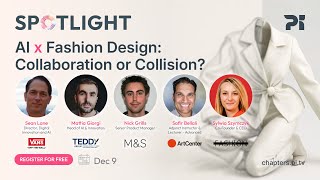
The panel, hosted by Michael and moderated by Safir Belhally, brings together industry practitioners from Vans, Fashionista, Marks & Spencer, and Teddy to explore how generative AI is reshaping fashion design, product development, and business operations. Participants discuss AI’s value in accelerating ideation, visualizing concepts, and automating repetitive tasks, while also highlighting friction points such as hallucinations, legal traceability, and the risk of overwhelming designers with too many options. A recurring theme is the need for curation tools and constraints that link AI‑generated imagery to real‑world DXF patterns, ensuring feasibility, cost, and brand consistency. The conversation moves to preserving brand DNA through custom models and constraint‑based workflows, measuring AI’s impact via tech‑pack turnaround time and designer productivity, and balancing sustainability concerns with the energy cost of AI. Human‑centered design is emphasized as the antidote to AI‑driven homogenization, with speakers urging continuous learning, prompt engineering, and internal best‑practice sharing. The panel concludes with practical advice for newcomers: start simple, treat AI as a complementary tool, and focus on the unique human story that adds value beyond algorithmic output.
Chapters
Hi everyone and welcome to another PIE Spotlight and our final get-together of 2025. Today we're talking AI, so the conversation is no longer about whether AI belongs in design, but how it actually integrates into the realities of creative culture, development workflows, brand identity, and cross-functional decision-making. AI isn't just a shortcut for speed or a way to generate endless variations. Instead, it gives teams new ways to think, explore, and express themselves. But it also raises new tensions over things like authorship, originality, feasibility, and the risk of losing the very human stamp that defines great product creation. And in today's panel, we'll be unpacking all of this with our brilliant group of speakers who are all working with AI in the real world, and I'll hand over to them in just a moment. But first, I wanted to say from myself and the team, a huge thank you to all of our speakers for joining and for all of you for tuning in today. We're thrilled to have you all here. A couple of quick housekeeping notes. So if you have questions during the panel, please feel free to pop them in the chat box on your screen. These will be sent directly to our panel chair, Sophia, who will do his best to get to all of them during the next hour. And please don't be shy. This really is meant to be interactive, so feel free to ask anything you'd like. And if you miss anything or want to revisit the discussion later on, this session will be available on demand on Seamless and on the Pi YouTube channel very, very soon. Lastly, I want to flag that today's panel is a teaser of what's to come across our platform in 2024. 2026. So for more information about what we have planned and how you can get involved, you can visit pi.tv. But for now, let's get into it. Sophia and the panel, over to you.
Thank you, Michael. Thank you so much for the introduction. Hi everyone. I'm really excited about this, this conversation we're going to have in the next hour. And the topic is a really good one. I think we can, we can all feel the tension. We're all exposed to these social media posts that want us to think that creativity is democratized, that everyone can be a creator, that design is effortless, and factories and finished products are just one prompt away. This illusion of simplicity, however, hides an important truth, and it's that the faster the tools get, the more important taste, craft, and technical rigor become important, right? AI can generate countless ideas, but only a designer can choose the ones worth making. So to unpack this tension between speed and substance, we have an incredible panel of designers, technologists, and DPE specialists who are going to share their feedback, their input, and their thoughts over the next hour. My name is Safir Belhally. I led digital innovation, design and digital innovation, for a number of years in the fashion industry, mainly with VF Corporation, and now teach at ArtCenter College of Design. Actually, one of the classes that I teach is AI-powered creative workflows, and I'm in the process of building an educational program in Morocco to serve the African continent. I will let everyone introduce themselves, starting with Sean. Sean, take it away.
Thanks, Safir, and thanks everyone for joining. Sean Lane, I work at Vans, been in industry for a long time, but right now at Vans I focus on generative AI and digital innovation and also work with our innovation center. I mean, I've been doing digital product creation, I'd say, for a little bit over a decade. And so it's really interesting to kind of have this conversation about where AI and digital product creation are kind of the traditional CAD approach. Kind of intersect. I'll leave it to the next.
Sure. Sylvia.
Hello everyone, thank you Safia for invite. So I am Sylvia Suntuk. I work for more than 15 years in product development in fashion industry with different fashion companies, just to mention some: VF Corporation or Max Mara. But right now I am founding Fashionista. And Fashionista is meant to be an AI tool that connects all those nice images we really love with hard data, so with DXF pattern, to allow us to generate images that actually can be produced.
All right, thank you, Sylvia. Nick?
Hi, I'm Nick Grills. I am a senior product manager at Marks Spencer, which is a large British retailer. My role is a senior product manager, so I work in product design, trying to find ways to use technology to improve the design process, be it 3D or AI. And I came to AI when we had a hackathon a few years ago. I worked with a designer to see what could we do with AI, and now I'm lucky enough to actually be in the role of trying to actually get it out and make it happen for the company. Pleased to be here.
Thank you, Nick. Mattia.
Hi everyone, I work at Teddy, an Italian fashion retailer, and my focus is on generative AI and innovation. I'm not a designer, but one of our main focus has been on product design. So I, during 2025, I helped our product design team to implement generative AI in their workflow.
Excellent. What a great group of professionals and subject matter experts. Okay, let's dive into the first question. And the first question is actually going to be for Sean. Sean, where does AI add the most value today and where do you feel it creates friction?
I think we're still figuring some of that out, but the success that we've been able to find is, I think, when design is trying to get their intent across and they're making compromises, you know, throughout the process because of time. I think this allows design to go a little bit faster upfront and visualize something that maybe they're trying to draw and articulate through, you know, language. It allows them to take that, visualize it, and make it look real. For example, take that 2D CAD to 3D CAD, if we're going to simplify that. And through that process, they can have different conversations. And I think that's part of what's shifting and where friction gets created too, because now you're having conversations about something that looks real, whereas before they knew it wasn't real, and now they're kind of seeing it. And so depending on the person you're talking to, they're going to have a different perspective on how it should look in a, in a, um, you know, more photorealistic format. So I think it's a little bit of a double-edged sword, but it's it's important to start that conversation earlier because then you can get your design intent. You can start to tell stories about the product that you couldn't tell before. Um, you can start to articulate more concepts and ideas. And then I'd say the other part too is it just allows a designer to really get in and like create tons of variations very quickly and kind of iterate on very specific variations that they might want to make to a product. Whereas before, drawing it traditionally and then turning that into a Illustrator CAD, you know, takes a lot of time. So now they have the opportunity to go a little bit faster there.
Thank you, Sean. Nick, do you have any thoughts on this topic?
Yeah, I was nodding there because it's the ideation stage that we're finding is most helpful. And I hear designers complain that certain people can't read a CAD. So actually what then if you just have a CAD, just a sort of simple 2D image, actually it takes some imagination to bring it to life in your mind. And leadership teams may not always have the same perception of what it really is. But with AI and that kind of move, as Sean was saying, to photorealism so much earlier in the journey, you can have a much better conversation and a much better shared understanding between everyone, from the designers, from the leadership teams, of what the actual product will look like. Ideation stage, it's really, really valuable there. And you can also have more productive meetings as well because you could make changes there and then, just make those edits on the fly in a photorealistic way. But then the friction then comes from the legal side of things, which I'm sure we'll get into. But yeah, not being able to kind of trace the source of an image in the same way that— or an inspiration that we used to be able to back when the world was a bit simpler. But yeah, it's that ideation stage I think it adds a huge amount of value to.
One thing I'd add to that too, Nick, is the hallucinations are still a big— you know, it still happens quite a bit where you can't have, you know, total control. I think there's some software that does that for designers a little bit better, but having that level of total control to be able to make small changes is sometimes more challenging. And so there's a part of frustration where designers, I think, will reach a point where they're like, okay, I need to go back to my traditional because I know how to do that and this isn't getting me where I want. So, it's a little bit of that back and forth too.
It's interesting, Sean, that you mentioned that. I was in an event a few weeks ago during LA Tech Week and I was talking to another designer. We were talking about AI and we were saying, well, for designers in the early part of the design process, maybe it's not a bad thing that AI actually hallucinates. You know, we used to take stuff to think outside the box and, you know, maybe that's— in that case, it's not a bad thing, but there's definitely a time and place for those to leverage those.
Yeah, you can have good hallucinations.
Yeah.
But I think having so many iterations and so many potential possibilities can also bring us to the moment where we are not able to choose anymore. Because if we have too much to choose from, we are not able to take the decision. I think we also have to understand how to use those technologies to really be able to generate thousands of images, but then to help us also to choose from those images.
Yeah, the topic of curation I think is one that I feel we need to talk a little bit about because, you know, with all the data, with all the content that's being pumped into our space, you know, I think we've established now that, there in this world on the internet, more than 50% of the content is actually generated, is artificial, right? It feels like that we will need a lot of help, maybe even with AI to help us kind of decide and sift through all that content and make decisions that are informed, you know, informed by data, informed by facts. You know, there's, there's something to be said about historical sales data, having access to cultural information, having access to kind of a pool of information that can help us very quickly go through all the possible concepts and select which ones ultimately we really want to be focusing on. I wonder how you all feel about this.
Yeah, I think, I mean, automation for sure is something that we need to be constantly looking at. And I think AI does give us a lot of opportunity for automation, especially around data and insights and feeding that into your designs and to your briefing process and all of that. But I also think that, you know, I had a conversation with one of our leaders, which I thought was an interesting conversation. It was really like, Okay, so if we create something that's kind of a bad design and for whatever reason, and then we create, I don't know, 10,000 iterations of that, we didn't get ourselves any closer. We got ourselves further away from, you know, curating the right product for the consumer, right? So, um, or building the right product. And, and, but I also, uh, to your point, like some of those iterations might be there might be just nuggets within there. And so it does take time to sift through. And if we leave that open to an AI, you know, agent of some sort to do it, we may miss the boat there too. So I do think we have to be careful about how we deploy that and how we deploy automation. And there still has to be people involved. But ultimately, it does allow us to do a lot more faster with greater visuals. And we're still learning how best to operate those processes and make them repeatable season over season.
Thanks, Sean. Mattia, with, um, we're obviously looking at a volume of output that is becoming increasingly unmanageable if you think about it, right? We have the possibility of creating so much stuff where, you know, as we just said, the biggest challenge is making the right decision. We had in the past, way before AI, we had different approaches. One of the approaches, one of these approaches was the spray and pray, trying to create a bunch of stuff and see what sticks. Or you could have really much more targeted decision-making that is enabled by these technologies. Where does this leave the designer's job though? How is the designer's role shifting?
Uh, I think designers need to develop some new technical skills because, again, automation is really important for me because you can, um, automate some of the, let's say, boring stuff like batch recolor all your garments. You can apply prints on garments automatically. So if you learn how to properly use automation it can help you a lot in working faster and save time for more creative tasks. Yeah, again, at the same time, you need to learn how to evaluate your design properly because you might fall in love with all your generations. That's a problem. You have to make choices. And yeah, I think AI can help you a lot because, for example, you can use AI to simulate focus group So you can set up an AI and ask the AI to behave like, for example, a Gen Z female streetwear style person, and ask the AI to help you evaluate all your design. Then you need your own opinion again. AI can be seen as like an expert colleague that gives its point of view on your design. So that's a way you can use AI from a technical point of view to help you evaluate all your design. And writing proper prompt is important because sometimes you keep on iterating your variation, maybe because your prompt is not really that good. So AI need to add something on top of it to generate the final visual. And so technical skills are, these new technical skills I think are really important and also storytelling. So learn how to push your design when you really believe in something you just created. Because let's say that with generative AI, a designer probably can transition faster to the creative director role if that's the path he wants to follow for sure. Like not everyone want to be a, creative director, but you cannot have too many creative directors in the same company because it's gonna be a big mess otherwise. And so I think technical skills are really important, and I agree that automation is important, and you have to learn how to master automation.
I see a question— there are a couple of questions in the audience. There's one that that's related specifically to this, and then the other one that I will bring in as we discuss our next question. Emilien said, AI gives us extraordinary rendering capabilities faster than ever before, but the real challenge isn't the image, it's the journey from concept to product. How do we reinvest the time saved in creation to reduce physical samples, strengthen cross-team alignment, and accelerate manufacturing? Manufacturing decisions? What needs to change in organizations to turn AI from a creative booster into a true transformation engine? So that's obviously a fairly complex question and it's kind of the key to a lot of our challenges. But in the context of the designer's role, we talked about using digital technologies and specifically artificial intelligence to automate the non-value-adding tasks for designers, right? Let designers design instead of, you know, as we all know, up until not too long ago, designers were spending a lot of time entering information, entering material information, entering, you know, building tech packs, working with developers to really work through a lot of that information. How does, how do we enable designers through the use of AI to be able to obviously spend the time that they need, right, to be on that creative journey? It's not about taking shortcuts. It's about making sure that the timelines that are given are optimized so that designers have enough time to go through that whole creative process, which, you know, if— and happy to be proven otherwise, but is very often a challenge, right? So how do we use AI to shift that balance, making sure that we can allow designers to design, but also further downstream, streamline the process that happens between the time the design has been finalized or is being prototyped to the, to the final production? This, this might be a question for Silvia, I think, given that—
Yeah, happy to answer. So, um, I believe, I believe what is missing, um, is this link that is connecting the real product with beautiful image. Uh, because, uh, what most AI, uh, tools used in fashion today can do is to generate infinite quantity of images where a big part of them are not feasible at all. Uh, the other part are feasible, but most likely will be dropped along the way because they will cost too much. And then there is, there is another part that could be done and could be done within the right price range, but then we have to choose which one we want to make. So this is something that, um, that my, my colleagues were talking about before. I would like to connect to this first part, so understand if the image is feasible. Um, I believe the best way is to connect directly this image to DXF pattern, because every garment that have been ever produced, especially in industrial way, had DXF pattern. You can't cut and produce garment without that. So if we have the direct connection between the image and between DXF pattern, we are able to understand if it is feasible, how much it will cost, how, how hard is to, to create it physically. And this is something that we are doing in Fashionista, but I know that there are also other tools that are trying to reach this goal. And this is something that can give directly to image generation constraints. So you are now no longer generate images that can't be produced. You can give it the constraints like, I want to produce it within this price range. I want to produce it. I don't know, any other thing like the slim fit garments, the oversized fit garments. You can give it any request which is directly related to what physical garment will be. And if you have this connection between digital and physical, this is where you are able to make things really fast and much faster than they were done even before the AI era. And here you can, you can start to generate images that then you can choose from using, using any other tools, using connections to the market demand and everything you want. But at least you know that what you are generating can be done, which is really the missing links in almost everything that is generated today with AI for fashion industry.
The right tools to be able to, to make decisions or create kind of guardrails and constraints that, that can be designed into. And that's going to save time further down, down, downstream because you don't— you're not going to have to deal with the back and forth with the factories on feasibility, on pricing, all that's going to be baked in much earlier in the process, right?
Exactly. You simply don't generate anything that can't be done.
Yeah.
So at the very beginning, you already start with something that you know that you can work on further.
Yeah. All right. Let's talk a little bit about brand DNA. I've seen a few questions. We have a lot of questions coming in. I think we're gonna need a second hour for this, but let's talk a little bit about brand DNA and identity. So how can designers use AI without losing that brand DNA or that brand identity? Nick, do you wanna take this?
Yeah, it's a really interesting question. And I think in the last few years we've got used to knowing that something's produced by AI. You know when something just looks too perfect and you just— now we just look at it and go, I'm kind of going to disregard that because it doesn't look real. We've all kind of trained ourselves to spot it. And I think, yeah, the worst case scenario, kind of off the back of your question around losing brand identity, would be where everyone's producing the same stuff and it just looks the same. It's got that sheen. And I think we worry about it now because AI is just a tool, but it's such a powerful tool. It's such a sort of limitless tool that it can produce anything. Like in the past, we would all be constrained by our own abilities, like our ability to draw or imagine. So I think that in terms of ensuring that there's that sort of human stamp and there's brand identity, we can add in constraints. So perhaps AI can produce anything, but in that design process we could say, well, you can only use these colors or you have to start with this image. So AI can produce anything, but the risk there is everyone will produce the same thing. So I think kind of ensuring that brand identity, ensuring that human stamp, ensuring that you produce something that people don't look at and just disregard because it just looks too perfect is we add in constraints. And organizations, individuals can come up with their own constraints, what's going to be most useful, most appropriate. And I think the other thing is obviously never take the first output. The first output should just be the starting point. You should then think about, okay, how can I take this further and further and further and further and further? So you go down that road through so many iterations that you end up with something that is truly unique. So I think constraints and not getting off the bus too early. You keep editing, you keep designing, you keep iterating to see what you can come up with that nobody else possibly could have.
I think that's a really good point. I think treating the brand DNA as a dataset, I think there was a question from Matt asking if, if anyone had explored custom models, fine-tuning a model on, on a brand's own product IP, brand DNA. This is definitely something that's important. That reminds me of some conversations we were having with the team at LVMH as we were talking about, um, you know, this, uh, this 3D factory. At that point, it was really focusing on, on 3D, uh, you know, before even talking about AI, you know, with brands that have such an amazing heritage, you know, such a human touch, an important component to their brand identity, how do you codify that? How do you build that into your creative process, your digitized creative process so that you don't lose that and you don't dilute that as you, you know, as you leverage tools like DPC or tools like, like artificial intelligence. That's definitely a big challenge. Anybody else have any thoughts on this?
Oh, from a technical point of view, yeah, you can integrate your brand guidelines in the tool you are using unless you are using like Gemini or ChatGPT directly from their chat interface. So you need to choose also wisely the tool you are going to implement in your organization. But from a pure technical point of view, if you implement your brand guidelines, yeah, you can set constraints and because you have to avoid to generate designs that are not in line with your brand, of course.
Yeah. All right. Next question. Beyond concepts, how can AI support technical development? So we talked about it a little bit. Sylvia, I don't know if you wanted to add an additional perspective to this or if anyone wants to take this question as well.
I believe that for product development, it's strictly connected also to preserving brand DNA, because if you train your custom AI with your brand DNA, that can be photos from a photos from photo shootings, DXF patterns, your tech packs, which are really a wealth of data that brands have. And every brand have a huge amount of information that really contain the brand DNA and that really can help with better and faster product development. And this is where AI can help a lot because it is able also to spot the bottlenecks. When I started to work with fashion companies around the concept of what I am working on, I have seen that we discovered a lot of bottlenecks. Some fashion brands, for example, are developing twice a lot of patterns because they don't know, they are not able to know that maybe 5 years ago they developed almost the same garment because maybe the It's, it's not that easy to spot from the image, but it's super easy to spot from the pattern because the construction was almost the same. We had a brand that discovered that 30% of what they were developing in latest collection was already developed across previous years. So they don't have to develop it twice. It is also the way to make it faster and to make it more streamlined because you are not going to do twice or three or even five times the same thing. So I believe that design is a huge thing for, for AI in fashion, but I strongly believe that product development is really where, where it really unlocks because it's hard data. It's not just pixels. It's, it's really the information about what we are doing later.
Has anyone— and I'm seeing a lot of questions here— has anyone implemented any of this? And is anyone able to share some of the early impacts that you're seeing or some of the early unlocks that you're seeing in your organization?
I mean, just to kind of go— there's a couple of questions on there and then also to talk to kind of what Sylvie was saying. I think, you know, there was questions around, does this— how does this impact digital product creation? And I think what I've kind of gone back to is that digital product creation is built off of— it should be either built using your pattern or generating your pattern, right? And so depending on how— where you're starting, if you're starting from the 2D DXF pattern or if you're starting from 3D into— from design. But I think it allows DPC and that whole CAD space to focus on what it does best, and that's quality and accuracy, and really kind of feed in that back and forth with your factories to ensure that the factories understand what you're communicating to them clearly and that they can make modifications based off of what information you provide throughout your prototyping process. The part where I think AI enables is it allows you to iterate a little bit more upfront to get to that point. And then you could, like Sylvia was saying, kind of then marry those images up to something that already exists. Is there a DXF pattern that we've done in the past that could— or a block that's available that we could start from to make modifications to, to then, you know, go through our prototyping process with our factories? And getting that quality and accuracy is really important. AI today, I think, does part of that, but it doesn't do all of it. That's where I think digital product creation still has play. Will AI at some point start to consume more of that? I think so. Or will it automate more of that? Yeah, I hope so. But I still think they work together. It's just we, we, we, we tend to think of things in silos in a lot of cases. And what digital does is it breaks down all those silos and allows you to think more, you know, I can, I can generate something as a 2D and I can go all the way down and I can start building my catalog and my lookbook with it now because of AI, for for example, whereas digital product creation, it took a while to build those assets and then, you know, go through the iterations of prototyping and then, you know, now maybe that asset gets used. So it does allow some faster opportunities up front that kind of leapfrog a little bit of prototyping, but ultimately you have to come back and make sure that you're accurate and that what you're putting into the market or you're selling into your accounts matches what you're actually creating physically.
Um, and I would echo the points around DPC, digital product creation, working very well with AI. Um, so we're seeing kind of workflows where you might start off with an AI kind of as an initial idea, and then you develop it in 3D, but then you take the 3D and you put it back into AI in order to put it onto a model perhaps. To really bring it to life. And I think a lot of the questions are asking the same thing, which is kind of what provable benefits are we seeing? Because AI is one of those things where there's a lot of— it's really obvious what it does, it's really amazing what it does, but actually, how do you measure it? How do you write a business case? How do you prove that the time saving or the extra money making And actually, it's really, really difficult. And I was talking to one of our designers about this, and she was saying, I know this saves me time. I feel it every day. But it's not like it saves me 2 hours a week or 4 hours a week. It's more like it saves me a few seconds or a few minutes from the task. And that's really hard to measure. So I sympathize with all those questions asking around, like, what are the kind of provable, provable use cases? Where have you seen the benefits? And actually, it's really difficult. It's a bit like when the internet came along. Like, the internet has changed the way we work, but actually, if you were to measure what impact it's made, it's really, really difficult. And AI is a bit like that too. So yeah, it's still in the process, but Techpacks is a good, good place. So we are seeing that the process of creating a tech pack that's been informed by 3D and AI, actually, our designers can do that about twice as fast than if they weren't using AI or DPC. If it was just like hand-drawn CADs, it would take twice as long, and you'd probably end up with a less accurate first sample in the first place. So that is an area that's well worth going into, looking at the tech pack process. Yes.
Nick, you're making a really good point. You know, there's this narrative that seems to be quite prevalent where with these levels of automation and the ability to design more, designers don't necessarily get more time to do things. They actually, the expectations rise as well. As opposed to, "Hey, you know what? You can now spend more time designing." Very often, you're faced with, "Well, good. Now, we can design and develop a lot more products in the exact same amount of time." And when you talk about this idea of metrics for design, how do you quantify? That is the biggest challenge, right? How do you quantify quantify a designer's productivity, the quality of their design, the, you know, yes, you can maybe tie it to the sales numbers and to the commercial success of specific designs, but there's so many components that go into that. It's really hard to trace it to a specific designer or specific process and things like that. So, I would like to dig a little bit deeper into this idea of metrics, This was actually one of our next questions. How do you justify the benefits that AI brings to an organization? How can you really pinpoint those and quantify those?
It is really hard. I think what you focus on, what you can measure. So if you were to take a group of designers and measure how long it takes them to do a tech pack versus an AI-assisted tech pack, how long it takes them to do a few different iterations. If you can measure that, that gives you a good starting point that's really kind of specific and accurate. And then the rest of it is kind of like, how do you— there's a lot of kind of self-reported metrics that you can rely on, like how long it took you to do this. So hours spent And in terms of, yeah, complexity building on complexity is the risk that, yeah, if you can, if it's so quick to produce all these iterations, then you're going to be asked for more iterations just to fill that time. And then it becomes, there's an opportunity, I think, with AI where you can say, you can have this tool, but you have to agree to these constraints. And those constraints might be, you're only allowed 10 options. In a previous AI, 'What, before AI you only had— designers only created 10 options? We're still going to stick to those 10 options. Yes, they could take 1,000, but you know, you have to agree that teams can have AI, but it doesn't mean more complexity and more work because you have to kind of agree up front to these constraints.' So that's another way of trying to sort of prevent kind of extra work on top of extra work.
I wonder if the use of AI should factor in, and if it does, I'd love to see the results, should factor in into a product's LCA, Life Cycle Assessment. You know, obviously, now we're talking about the impact, the environmental impact of the use of AI, the energy used, the use of natural resources. But as we talk about metrics, you know, it's good to identify the positive metrics, but also to see, okay, are we introducing more challenging as we're introducing more, more these new technologies? You know, this, especially for brands that are really focused on sustainability, you know, it becomes quite a challenging balancing act, right? Do we leverage? Do we become more efficient? Do we design better? Better product knowing that, you know, there's quite a heavy price to pay from an environmental point of view. Have, has anyone, you know, faced these conversations?
You know, I see, I don't know if someone else started to talk.
No, go, go. You can go, Silvia.
Thank you. So I see a lot of questions about which are the real use cases you are working and this is connected to environmental, um, like the, the carbon footprint. Because if there is no clear use case, you are just kind of rambling around, and that may end up that you are having higher carbon footprint than you had before. But we have also to think that, uh, digital product creation itself. So 3D renders, for example, weren't without any carbon footprint because anyway, they, they needed a lot of energy. Um, computers needed a lot of energy to be able to render, uh, realistic, uh, realistic garments in 3D. So I, I believe that the most important thing is to understand how those images connect real products. Like, it's, it's great that you can now have a lot of choices. It's amazing. It helps to be more creative. It helps to find maybe some, some new ideas that, you know, the great thing with AI is that it doesn't have the, the constraints we have as human beings, so it doesn't care. And this is something that can really boost creativity of designers. But if we generate 10,000 images and we are not able to choose the right ones to move forward, or we just, we just create a kind of noise, we just create a kind of digital waste, which internet is already full of that. So we need to set constraints at the very beginning of the process. Like Nick said, you can, you can potentially you can produce even millions of images a day, but which is the point to producing them? So we have to understand how we want to use those images. For example, a great use case, and it's not from product development, but from, from the marketing side, is using AI as a kind of virtual try-ons for e-commerce images where you already have your 3D garment or your real product or whatever, whatever, you know, that can be produced or is already produced and you just can make inclusive photo shooting. So you can make, you can have different digital models for different markets you are working on. You can, you can work on this kind of use cases because this is something that I believe can bring a very fast return on investment. Because you don't have to do these photo shootings everywhere you sell. If you sell in India, you don't want to showcase those garments on Americans because it is not something that can resonate with, with the market. So I believe, I believe honestly that it, it probably has much higher return on investment today, later on the stage, than at the very beginning of the stage. But the reason is because we not yet set the real constraints at the beginning because we are still exploring. Like every fashion company today is still exploring the technology, is still trying to understand where it can really bring the value.
I know, Mattia, I want to give you a chance. I just want to Tan on here has quite a few questions about what fashion, what is the problem you're trying to solve? And I will just kind of state this very high and be quick, is that we have a tremendous amount of waste in our industry. Probably, you know, I would say one, number two wasteful industry on the planet. So anywhere where we can go in and create better product without producing it physically, shipping it, and then getting it to a consumer and then finding out it's the wrong product and getting it returned, and then it goes into a, you know, landfill. All of that waste, I think, is something that we're trying to attack, and I think we're doing it, and AI is the method for us to do that. There's a ton of micro problems that we have to solve to actually make that happen, and, and the only way that we can do that is, I think, through getting better up front, getting more accurate, and making sure we understand our consumer so that we deliver a product that they can and will be delighted by and want to use for a long period of time. So I'm gonna— that's, that's my quick rant anyway. Mattia, sorry.
Oh no, I agree with what you just said. And AI can help you a lot also in data analysis, because for example, if you properly understand, um, the market trend, what your customer want— because sometimes your customer doesn't follow the trend, so you have to adapt and balance both the what the market wants, what your user wants. You can combine these data with your customer feedback for past collection, for new collection, because you can use the digital product and run surveys with your own community. And you are faster in analyzing these data because if anyone have ever tried to read a market report, trend market report, there are really 8 to 10 pages PDF long data, like long report with high-level data. It takes a lot of time to make sense of all this data. AI can help you a lot. And with all these data, uh, I think you can create better products. So what you just said, so if you create better product, you don't create, uh, you just create what you can sell, basically. Okay, it's idealistic to say that, but that's one of the goals. So understand what you really need to do, do it properly, and that saves you from samples and from overstock and so on.
I'd like to, um, talk a little bit about an aspect of this conversation that I feel is not discussed enough, which is the human, the human component of this, right? We talked about this a few questions, um, Thank you for bringing it up. Tan shared the mention of the MIT report that stated that 95% of enterprise AI initiatives fail. My personal opinion is that a lot of these initiatives fail because they omit to focus on the human aspect of transformation. Understanding that ultimately if we lead with this premise that AI is going to replace human beings, there's not going to be adoption. There should not be logically, you know, any incentive to adopt these transformational initiatives, right? But if we instead flip that narrative and say, okay, how can we keep the human in charge and how can we leverage these technologies to augment and empower and multiply what human beings can actually do, right? You know, in my— in the classes that I teach at ArtCenter USC, a lot of— I lead a lot with a human-centered design approach. No matter what, no matter whether it's a project that is meant to leverage digital technologies you know, adopting, keeping in mind that why we do things and who we do things for is really important, whether we're a designer or whether we're in charge of a transformational, corporate transformation effort. And so, you know, staying with this educational angle a little bit, by the way, I had the big privilege of being invited to the Venice Biennale a few weeks ago and the topic, the theme of the Venice Biennale, the 2025 Biennale was intelligence, natural, artificial and collective. There are many, there are several levels of intelligence that we need to incorporate in anything we do. I would even argue, and some might argue that it's included in one of those three, but there's a new version of AI that I'm really eager to push, which is the ancestral intelligence. There's so much knowledge in the way our ancestors did things, built things, a lot of methods of a lot of materials that were developed in ways that we can certainly learn from, you know, and being able to use technologies to not only preserve them, but also unearth them is really important. So my question for the group here is, if AI eventually can be seen as leveling the playing field, where is the new competitive edge? Where do we as human beings, how do we ensure that we make the most of AI on a personal level, but also on an organizational level? How do we stand out from the lot and ensure make sure that that human component, the strength of our human condition actually makes the difference between us and all the slop that's out there.
Do we have another hour? It's a huge topic. I'll just say a couple of things real quick. One, I think, you know, if you look at industries, many industries are being impacted. You look at music, for example. I was thinking about this the other day because I watched a video that was all created 100% AI. The video's AI, the music was AI, and I was like, wow, this is really actually really good. But then I start thinking about it and I'm like, you know, there's that human element of music that helps connect with what we are as humans. And sometimes you just feel it more than you you know, understand why you're feeling it. And then I don't think AI is quite capable of that yet. It's good at mimicking, but it's not good. So I think it's not necessarily intelligent in that way. The other part too is the experience and the community that we want to be a part of, and that is the human element. Like, we want to be able to go to a concert and be, you know, around people who enjoy the same music and watch the artist and interact with the crowd and that type type of thing. Could that maybe be a video of a person doing it in the future? Maybe. I don't know. But I think that's generations away, um, where it's adopted and accepted. I, I do think though, as an organization, as a company and a corporation, you have to be very smart about how you implement it so that you are considering the human element of everything. To your point, human-centered design, and making sure that from a transformational perspective, your organization's not looking at this as a way to just cut costs and save, you know, job— or to reduce jobs. It's looking at it as a way to actually build better product, be better to your consumer, understand your, you know, um, ultimately what you're trying to do as a company while balancing the other side of it with shareholders and, you know, trying to, you know, ensure that you're being efficient as well. So there's a lot of different angles I can take there, but I'll pass it off.
I think this is an absolutely fascinating question, and I'm gonna start my answer with a slightly kind of— it's gonna sound off topic, but you know when you go to an art gallery and actually people probably spend longer looking at the description that's next to the painting than they do the actual painting. It's just something that I've observed. And I think it's because as human beings, we're actually quite interested in who made it and what the story was. And my prediction is that at the minute, we're kind of in the sort of AI slop growth. So the market is becoming— the internet, as was mentioned earlier, so much content is created by AI. It's going up and up and up and up. But actually, we're going to reach a point where people are hungry for the human story. And actually, that's where organizations can prove their value and prove their uniqueness by telling the story of how this was designed, how was this made. So it wouldn't surprise me if in a few years' time or maybe less time, actually, when you buy something, there'll be a little story on the ticket, on the price tag, and the instructions. It's not just how was this washed, but what's the little story about how it was made or who made it? That my guess, and this is not anything my organization is thinking about, this is just what I think. I think we're going to get to that world where actually it's the human story that becomes part of the marketing and what people are hungry for. Because people want that reassurance that, as Sean said, it wasn't kind of this song might make me weep, but I'd only want to cry if a human being has written it. And that kind of reassurance, I think, will become a marketing strategy.
I love that, Nick. We were having a conversation with my good friend Joshua Young about this not too long ago. There's one thing that clearly separates us from the machines, from the algorithms, algorithms as human beings, it's our provenance. You know, you were born at a certain point in a certain place. You've lived a life that is absolutely unique to you. You've had experiences, you had setbacks, you had successes, you had friendships, and all that makes you who you are as a human being. You cannot program that. You cannot program that. You can synthesize it, but, you know, that authenticity is built into the human condition. Nobody can take that away. And that is, and I agree with you wholeheartedly, that is going to be the unique value proposition of products, of experiences that are created by humans as opposed to just created, you know, where the focus is not on the outcome. It's not, the focus is not on the output. The focus is on what it took to get there. And I think that's really, really important.
People buy from people. This is the main thing. So we can't connect mentally to the machine. We can make things faster, but I think for people with very, very vertical knowledge into one field, it doesn't have to be fashion, it can be anything. Today with AI, they can really augment their capabilities because they have this deep knowledge and they can expand it, which is something that wasn't, wasn't possible a few years ago. Because anyway, dig deeper into one topic give you much less time to, to go broader because we have only this amount of time to do the things. Right now we can, we can with AI help ourselves to have our horizons broader. And then also AI allows on the other side, from, from the brand side, to hyper-personalization because we have a lot of information about our customers because they are publicly available information. We can, we can find everything about our customers on on social media, for example. So we can personalize their experiences and connect them even better with our brand, with our storytelling, with our heritage that we were talking about before. So we can, we can help ourselves to make our products somehow personalized. It doesn't have to be made to order or made to measure because Fashion industry is unfortunately still far away from made-to-order or made-to-measure at scale, but we can help ourselves to connect with our customers in much more personal way.
Yeah, I think you need to establish a very strong brand identity through storytelling, original design, personalization. It depends on your brand level, because yeah, technically speaking, you can automate the whole process, but then it becomes a question of speed of execution and price, and there will always be someone faster and cheaper than you. So that's when creativity is important, and that's when you need the human touch, because you— no one wants to compete on speed of execution and price. Just on that. And if you want to properly use AI, you need to focus a lot on training, because when you first start, uh, the team is working slower than before because it takes time to learn how to master the whole process. It takes a little bit of time to use it properly and to realize that you can really— you can work really better faster. Again, if you work faster, you have more time to be creative. That's my view at least. And so it's very important that every single company focus a lot on internal training. And I think someone asked before, you have to establish some internal guidelines. So you have to share all your prompt to share the best practice. And at the same time, it's also good that Anyone can set up his own workflow if he wants, but focus on training and share all the best practices, especially in the beginning. It's really, really important.
Thank you, Mattia, for this. I was intending to close with some advice for those who are new to the space, for the young learners who are coming into the professional world. And I was wondering if, you know, Sylvia, Nick, Sean also had some advice, maybe a short advice for anyone who's new to the space or who's just stepping into the space.
Help us to understand it better? Because you probably do already. No, I think honestly just getting in and not being afraid of it and seeing how— I have a few team members who are very— I'd say one that's really new to the industry. And I literally get to watch and see how they approach things from a totally different perspective and how native and comfortable they are with new tools. Advancement. And so I oftentimes just kind of let them run and, and see where they end up, and then go like maybe redirect, like, oh, that's, that's awesome, but maybe here's where it can help solve a problem. So maybe focus some more attention here. That's really good though, because I hadn't thought about it that way. So I think it goes both ways, like be open on the side where you're, you know, when you bring new people in, but also, you know, be willing if you're those new people to kind of step into AI and Even if it's not part of your curriculum in education, you know, make it a part of, you know, your learning process through life.
Thanks, Sean. Sylvia, Nick?
I would say keep it really, really simple. So if you go into using an AI tool to solve a problem and you expect your first prompt to give you what you need, it won't. Lower your expectations. It's gonna take time. It's gonna take a lot of trial and error and start with a simple problem and think of AI as a tool. So it might be that your normal workflow might involve Adobe Illustrator and Photoshop and all kinds of things. Actually, AI might just be a tool that you use after Illustrator or before Illustrator. So it's not there to sort of take over and to be a completely new workflow. It's actually a tool. It's just another tool. That can fit in and help out. So start simple, see where it will work for you, and but be prepared to kind of have to put some time in and just see it as just another tool.
I would say the same, start simple and understand what problem you want to solve first because there is so many tools that it's really overwhelming. And a lot of them are solving similar problems or are kind of create problems in other place. Like they solve one and they create another somewhere else. So don't be surprised about that. And just think that it's, it's the very beginning of AI in fashion. Really, we have long, long way to go, but we can just enjoy the journey because it's, it's really amazing. We are living times that are, are game changers for the whole industry. So just enjoy it, learn, uh, try things and see where it fits.
I love that. I think, um, you know, one of the things that I tell my students and, and, um, the young creatives that I mentor is that the most important thing to do in this case is just to get started. Just get started because you're not behind. You know, it feels like the world is— this world is evolving, is changing, mutating almost weekly. There's no point at which you are behind because everyone's trying to catch up. And those technologies are evolving. So it's important to not be afraid to experiment, not be afraid to learn. You know, I think we have to get into this mentality in which we, even though we we have experience, we have established professionals, we still have to learn. If we stop learning, you know, it's game over. And so, you know, remembering this and remembering as human beings to really think about what it is that we bring to the process that cannot be replaced by an algorithm. This is a fundamentally existential self-reflection process that I think would benefit all of us. But it's important to think about, you know, our role as human beings in this whole equation. So I wanted to thank all of you for this great conversation. You know, my biggest takeaway is that, you know, remembering that technology only multiplies what we bring to it. You know, AI is a technology, is a tool. What we end up doing with it should really be up to us. And, you know, leading with curiosity, leading with empathy, this human-centered approach, taste, and really intent. Intent is incredibly important in the process of creating new things. And eventually, I think we all agree that that's what's gonna be rewarding. So thank you so much for spending this hour with us. And I think Michael is going to join the feed right now, right?
I am. Hello, hello. Wow, thank you so, so much to all of you. What a way to end the year. I think you could just tell from all of the interaction in the chat box how huge a topic this is, which isn't surprising. It's a really exciting, albeit challenging space. But yeah, as Sylvia said, have fun with it. Uh, you know, there's a lot that's going to change in a very, very short amount of time. It's amazing to see how far the industry has come so far. So thank you to all of you on the panel for your, of your time. I know you could have talked about this for ages more, but we only had an hour unfortunately today. But thank you also to everyone in the crowd for tuning in today. Um, all of our panelists are on LinkedIn. Uh, if you go back to the event page, you'll be able to click through to their LinkedIn page there and connect with them. I'm sure they wouldn't mind if you reach out if you have anything further that you'd like to ask. Um, and ultimately, I guess we hope that this conversation has helped, uh, reframe how we think about AI not as a creative shortcut, uh, or a threat, but as a tool that can sharpen intuition and creativity. So again, thank you all so, so much. Um, we will be continuing these conversations, as I said, uh, and pushing them even further across our 2026 conversations. So if, if today inspired you, please jump onto pi.tv and have a look at what we've got planned for the new year. And this panel and video will be available on demand on Seamless and on our YouTube channel very, very soon. But until then, have an amazing break and see you in 2026. Thank you very much.










