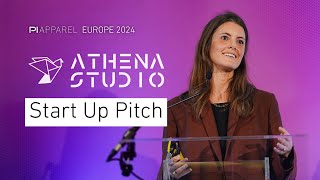
Heidi Van Dyck pitches Athena Studio, which uses machine learning to optimize fashion margins and environmental impact during product development. Over 80% of a garment's cost and environmental footprint is locked in at the design stage, yet brands lack data to measure or improve it. McKinsey forecasts a $275 billion AI opportunity in fashion over the next 3-5 years, but existing design tools ignore this gap.
Chapters
So our next speaker is Heidi van Dyck. She's a CEO of Athena Studio, passionate about changing fashion design and making it more data-driven and sustainable using AI. Welcome on stage.
So about a month ago, when asked if design had a role— if AI had a role in design, Wes Gordon from Carolina Herrera answered, "Well, if there's one thing that history has taught us, it's not to be afraid of newness." Now I think our fashion industry has been a little bit afraid historically since we've been a bit slower than other industries in adopting technology and technological advancements. But I think if you look into this room today, I think in recent years we've started to catch up. Brands are adopting digital product creation, AI, stores in the metaverse, etc. So that's quite exciting. Now, however, beyond the excitement of technological acceleration, um, brands still face quite a few challenges. So for instance, with economic volatility and inflation, there's margin pressure. And as mentioned in previous talks, The growing demand for sustainability makes that it's very slowly but surely regulations are coming into the designer studio. Now, my name is Heidi, and I'm the founder and CEO of Athena Studio, a fashion tech company where design meets data. And in the next couple of minutes, I want to talk about a new and overlooked aspect of AI that we believe can be a real game changer in the industry. But let's start with the basics. So I'm the third person to refer McKinsey, but McKinsey forecasted that over the next 3 to 5 years, AI would have the potential of $275 billion contribution to the fashion industry, with applications in supply chain logistics, retail, marketing, and design. Now, if we double-click on design, When we say that AI in design, we often think about image generation solutions like Midjourney that have massively accelerated the design process for some brands. Now, our previous talker also mentioned Purple AI. I'll also highlight Raspberry AI, which is another specialized solution that essentially does the same thing as Midjourney, but trains these algorithms on your own brand DNA and that bridges it with sales and trend data. So currently in the space of design, we have AI that helps us with creating better products faster. But if we think back about the two challenges of our industry— margin pressure, the need to reduce environmental footprints— they are currently not solved with AI. And if we double-click on product development, it's actually very interesting because over 80% of a garment's financial and environmental impact comes from decisions made during this process. The material choice, the trim selection, the supplier you work with. And yet this impact is not measured nor optimized for at this early stage. So I see that many people that I speak to confirm that. And the question is why? And I think we all know it's because the data is often not available to calculate these dimensions. And we also know that product development is a high-paced process, and nobody has extra time to go collect data or to run additional analysis. So the result of that is that brands are often developing collections without a view on how their styles perform versus their company targets. And I've seen in numerous cases that brands, after collection sign-off, have to discard styles because they're in the end not financially feasible. And I've also seen that there's always missed opportunities for improved gross margins or reduced product footprints. Now, this is an area that we believe that AI, and especially machine learning, could really make a difference. Because imagine a fashion industry where your product's margin and footprint are not just afterthoughts, but are optimized for from inception. Now, machine learning has the capacity to fill the typical data gaps, navigate its way through, and allow for a more informed and efficient product— product development process. Machine learning models can also, if they're well trained, automatically forecast the impact both financially and environmentally, thereby letting product developers immediately see the impact of the choices they make. But let's take it a bit further. Because that doesn't get us excited yet. So I think what is really cool about and really powerful about Midjourney is that based on one input, the platform can generate design after design, thereby speeding up, you know, the brainstorming and the integration phase. So what if we married that integrate— that generative capacity from Midjourney with those smart machine learning models that help us with early impact estimates? And that is exactly what we sought out to do with Athena Studio. So we develop software solutions targeted at product developers that enable them to develop collections that meet their financial and sustainability targets. Now, how do we do that? Our platform analyzes each sample created and generates instant recommendations on smarter material and supplier choices that will bring you closer to your goals. Now, this helps product developers with adding more samples to consider, iterating over them, and going back to the supplier to have a discussion on this. Now, we know, of course, that— we mentioned it already— product developers don't have any time to waste. So that's why we use machine learning to make this entire journey from sketch to sample fully automated. And we smartly address any data gaps in the process. So overall, it's really our mission to make data-driven early-stage product optimization the new norm, and we thereby help brands to improve their product gross margins without sacrificing their brand DNA and their sustainability efforts. Now, I'll be around today and tomorrow, so if anybody wants to talk further about, you know, product development, the future of it, and the role of AI, Come find me over a coffee or a drink tonight at the reception. Thank you.