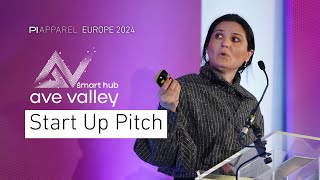
Marta Carvalho pitches Ave Valley Smart Hubs, a platform that cuts fashion waste by moving to made-to-order production. The industry wastes 8% of output. Her system connects designers with supply chains, maps traceability, and uses data to make small batches on demand, helping brands meet new EU sustainability rules.
Chapters
So with no further ado, I would want to invite our first speaker on stage, which is going to be Marta. Marta is the CEO of A. Valle Smart Hubs, and she works to completely change the way that designers, brands, ateliers, and manufacturers collaborate. Welcome on stage.
Thank you and good morning everyone. First of all, I would like to thank Joshua. He made my job much, much easier because many things that I bring here with Ave Valley, he already explained where the problems are and which problems we are trying to solve. So we are based in Portugal. I come from a family of textile a company, a factory actually, in the north of Portugal. I understand that many of you that work in the textile industry probably know this area for manufacturing high-quality clothing. So I would like to start with an applause to this fashion icon that passed away on the 1st of March, my birthday. That's why I bring her with me. And she is actually a big fashion icon. And for me, she— this date marks, I want it to be for me, the beginning of what I call the Greenessence era. This is a term that comes more or less in the opposition of the Renaissance. And we are in this beautiful room that resembles the Renaissance era with all its too much decoration, although beautiful. So this is what we have to go to, to the Green-naissance era, where we are more worried into collaboration for a more sustainable world. So these numbers, if you have all seen the McKinsey survey, you know what I'm talking about. So this is the, the, the, the estimations for production into in 2023, the amount of waste generated by this production, and the footprint of our industry, that it's around 3 or 80— 8%. So these numbers come to us and say that we should do something, and all the companies, all the brands are now coming late to do something. So we need to speed up and do the best we can so we can also comply with the EU regulations that are coming into force. This is in the Europe, but I know for sure that this will go into other countries in the world. So we need to be aware of the waste regulation, we need to be aware of digital passport, and we need to be aware of the extended responsibility on everything we produce. So the shifting of the essential value for brands, for customers, is now how fast manufacturers can deliver. Then comes the price, compliance, and then at the last position, quality. So what can we do about this? Right now, fashion has to deal with these four areas when thinking about a collection. We have the price, we have quality and compliance, sustainability, and the time to market. This is our paradigm. And when the quantities come there, and Joshua mentioned that, the MOQs, most of the time are not compatible with what the brands really need to buy and sell. We need to get to technology so quantities become a no problem. And with technology, we get efficiency, we get fast time to market, We get precise quantities and waste prevention, not waste reduction. We want to prevent the waste, and there are ways to do it. And as Joshua also mentioned about the ideas of being sustainable and the organic cotton and all these buzzwords about being sustainable, in our view, sustainability doesn't come from materials. It comes from the the process we use and the quantity we use. So we have reached what I call a gestalt moment where everything is gathered together to make this happen and for, uh, App Valley Smart Hub to be a valuable option for us to work with you. So we are already into what the environment needs from us social, and the narratives are pointing out for consuming less. Governance and politics are already aware what we need to do when imposing some regulations. We have technology and we are in the digitalization area. Everything that can be digitalized will be digitalized. So we have this gestalt moment and the ESG requirements that most of you are probably aware of and how important this is for all your companies. So what we do in our platform. So the step one is to— and I'm there. Step one is to connect designers with the development departments inside the supply chain using eco-design suggestions involving all the supply chain for to make an impact assessment. Then the step 2 is to mapping the supply chain net and the materials for traceability and transparency. Then we get to conscious production. So it's step 3 or phase 2 that we call precision production. Here we involve all these big data that Joshua mentioned. So So we can have market trends analytics, production schemes on demand, made to order, drop by drop, so the quantities that you really need integrated with the e-commerce stores, for instance, helping the factories to implement these production schemes on the Smart Hubs so we can have the small batches, customization, high quality standards, and speed and efficiency. So our solution benefits: we have an holistic approach, we want to establish and we are establishing smart hubs in Europe to achieve precision fashion. So agile go-to-market, the design and development process, sourcing and production impactment assessments, made-to-order production schemes, eco-modulation reports, and so on and so on, based on efficiency. So this is our beta version that we are already using with onboarding brands, onboarding manufacturers, agents, and the supply chain. We have our first implementation of the Smart Hub at Hap Valley in Portugal. That's why we are called Hap Valley, because that's exactly where we are, and we want to honor our origins. and we are into making a protocol with Fashion Techs that involves all these European countries and their design schools so we can start mapping in these countries the smart hubs we want the brands to work with for the nearshoring production and to have the genuinely made in. So thank you very much, and if you want to discuss more about these The way to achieve precision fashion, the made-to-order. I will be hosting a roundtable in this same room tomorrow at half past— oh, 11:15, sorry. So thank you very much for your attention.