Building a Digital-Ready Workforce: Talent Strategies for Fashion’s Future | PI Apparel
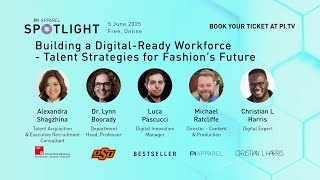
Four fashion industry experts discuss how brands attract and keep digitally skilled workers. They cover remote work flexibility, upskilling through university partnerships, new roles like digital fit technician, and using AI to lower creative barriers. Leadership buy-in and cross-generational learning are key.
Chapters
Everyone, and welcome to another Py Apparel Spotlight event. We apologize for the delay. There was a bit of a technical issue our side, but we should now be up and running and looking forward to the discussion today. I'm Michael, the Director of Content here at Py Apparel, and I will be your chair today. Our opening panel is going to focus on how HR leaders, recruiters, and educators are evolving their strategies to attract, train, and retain Hire Talent, and then our second, a fireside chat, um, is going to discuss how AI and automation are reshaping hiring, development, and the future of work. Very quickly before we jump into that, a little bit of housekeeping from our side. If you have questions during either of the talks, please feel free to use the chat box, which you should be able to see in front of you, or email me directly at mkr@pi.tv. We will try our best to make sure that we have a little bit of time to look at your questions. You can also connect with our speakers via the platform should you wish to continue the conversation and/or reach out to them on LinkedIn. I'm sure they'd be thrilled to get a connection request from you guys. Also, these sessions are going to be made available on demand, so they will be added to our Py Apparel YouTube channel and also shared via our seamless platform as well. So with all that said, let's get going with panel 1. I'd like to welcome Alexandra, Lynn, Luca, and Christian. Um, as we are running a little bit late, we're going to keep intros very, very short. Christian, uh, please intro yourself and let us know how you're related to the topic today.
Hi everyone, Christian Alharris. I am— this is my living room, guys. I'm a— kind of making is what I'm obsessed with, and a friend of everyone involved in garment making. I have a background in education, software, and working on the brand side, so happy to join the conversation.
Thank you. Luca?
Yeah, so hi everyone, I'm Luca Pascucci. I'm the digital sales innovation manager at Bestseller. Essentially, I'm responsible for all the digital platforms that we are currently using in the country for all the brands. And essentially, I'm trying to lead the digital transformation of our company.
Thank you very much. Aleksandra?
Hi everyone, I'm Aleksandra Szczaczyna. I am an executive search consultant. Specializing in fashion and supply chain industry. Over the last 15 years, I was placing mid to senior level executives across Asia and globally for companies like Lululemon, Adidas, Burberry, etc. And I organized tech conferences and I'm currently a research assistant at Hamburg University in Germany.
Thank you very much. And Linh, over to you.
Hi, I'm Lynn Brady. I'm a department head of design and merchandising at Oklahoma State University, educating our future of the industry.
Thank you so much, everyone, for joining us today. So, Lynn, whilst we're with you, let's kick off with the first angle. So in your opinion, how can brands better position themselves to attract tech-savvy talent and compete with other industries like gaming and big tech?
I really think that companies nowadays have to leverage their social media, connect with potential talent, and really do a lot of employer branding, really highlight your company's culture, your values and opportunities for digital talent. A lot of the digital talent we're seeing now coming from the fashion side of it, they love the companies, but they want to know that these companies will accept them. And help them grow as digital pioneers or digital employees. Using current testimonials from your employees, building online communities, really showing that the company will embrace them and their skills. I think we also need to talk about retention because just because you've got them there, you really have to make sure that they're comfortable there. So creating a culture of learning and growth, a culture of acceptance to these new ideas sometimes really goes a long way.
Thank you, Alexandra, because you're coming from the recruitment side. Do you have anything to add on this? How have you seen brands kind of do a good job at better attracting this kind of new talent and skill set that we need?
That's great. Exactly what Lynn mentioned. And I just wanted to add there the agility and speed of decision-making that also helps candidates to choose brands and also making your brand, employer branding visible on platforms like GitHub and LinkedIn in open source community showcasing your CSR efforts, your tech leadership, and also streamlined recruitment process that is important and also the support of the wellbeing and flexibility. With work. That is especially important for younger professionals. And recently I had an interview with a digital development manager and she joined a fashion brand from a gaming industry in LA. And her motivation was the reputation and employer brand and also an opportunity to actually make a difference to innovate this fashion brand. And also some companies are hiring PhDs and data scientists to join their companies. As an opportunity to disrupt our very traditional industry.
Thank you. Luca and Christian, on a related note, you know, you both work in brands. What are you seeing as being very important nowadays for new talent that is coming in? Is it salary, flexibility, values, something else entirely? What are you seeing? Luca, should we kick off with you?
Sure. I think it's a combination of all of them, but I have to say that Probably when you're, you know, trying to make an impression as a company, as an employer, then definitely the culture comes into play. Of course, you have to offer a fair salary, but something Aleksandr also mentioned is the flexibility. I think that's a key value that the companies can offer nowadays to attract the talent, but also the importance of showing that, you know, they can really bring a true impact on the company's trajectory. In shaping the future of its digital transformation. So right now you want to offer like an opportunity to learn, but also to really give value of their impact in the business and give them also a voice. Because obviously when we hire people sometimes from outside, they bring that fresh, you know, insight, those fresh eyes into something that we might be looking after for some time. But, you know, having some inputs from outside is also helping to shape the journey of the company. So I think that's really, really important.
100%. Yeah. Anything you'd like to add? Yeah.
Yeah, agree 100%. I think you can't narrow it down to just one thing that people are looking for that you can focus on because if as a leader or any, for your brand, you are being intentional about having thought diversity on your team, then what your team needs to be, needs to succeed and what they need to be fulfilled in the role is going to be different. So that is a great thing. If your team all has a different idea of what they need to succeed, it's your responsibility then as a leader to make sure you're setting them up for success and you understand who your team is and where they want to go so that you can facilitate that, but also so that you can have a purpose-built team to actually execute against the goals that you have outlined and the things that you have yet to even think Christian, let's stay with you.
When it comes to actually upskilling teams for particular tools or technologies, be that 3D, AI, or something else, what strategies do you see actually working when it comes to that?
Oh, goodness. Well, when we look at the work that the universities are doing and like Oklahoma State, Lynn and her team, Once we get folks out of university, very often that education just becomes cliff and it drops right off, right? If you, as a brand or whatever your business model is in today's world, if you do not have a plan or understand how you are actively working to create the talent that your company needs to win in the marketplace and to whatever you set your goals to, if you don't have a plan for how you are creating that talent, not just going out and looking for it. Yes, recruit, go to all the best places and talk to everyone and figure out who's doing work or who's creating the kind of talent that you want. But if your business is unique and has sustainable competitive advantages, you also need to be prepared and ready to educate against those so that not only can you get the people up to speed and where you would like them to be, but also so that becomes sustainable. If you don't know how to create the talent you want, or at least how to support people in getting there, then you're never going to be able to make sure you have that consistency. And that breakdown in consistency will ripple out to your product-culottes. If you're not creating consistently, if you're not doing things consistently, that consistency will not be available to you on the sales rack either.
Absolutely.
Luca, from another brand standpoint, do you agree with that? Is there anything else you'd like to add that you've seen work?
100%. Actually, what we are trying to do internally, obviously, as a large organization as Bestseller, we already have some internal training program and courses on, you know, different aspects of the business. But also an approach that we have specifically for digital is that what we're trying to do is to find these digital champions. We call them digital ambassadors in Italy. And these are, it could be your local sales rep, you know, that's focused on products and sales, but particularly has performed particularly well in adopting the new tools. And sometimes we utilize them as a sort of like catalyst in our digital adoption and essentially training, you know, train the trainer and they will be helping us in training the sales teams as well. And I think that this is something that's sometimes overlooked because you might think as a company, you know, the experience with digital only resides in a digital team and, you know, the salesperson's only focusing on product. But you'll be surprised of, especially nowadays, how many sales reps, regardless of the age range, you'll be surprised regardless, completely also culturally and countries, somebody that will just like, you know, I really like this, I'm actually interested, can you show me a little bit more? So I think this is really, really useful for brands.
Yeah, 100%. And Lynn, kind of the other side of this is not only, of course, continuously upskilling people once they're in roles, but also preparing them for industry too. So can you talk us through a little bit about how you work within industry to ensure that the way that you teach and prep your students is good enough so that they're not surprised and they're ready to go?
Yeah, absolutely. I do work with the 3DRC Education Subcommittee, and we work to talk with brands and actually find out what are the skills that people coming right out of college need to be able to do 3D product development, digital product creation right out of school? What are those entry jobs? And we came up with 4 entry jobs: tech designer, apparel designer, artist, and materials that would be suitable for students right out of college. And we figured out what the job skills were for those different areas. And then basically industry handed it back to us and we're like, okay, how do we get all of these skills into the classes that the students need? And not take anything else away from them as we prepare them for the industry. It's been a challenge. It's been wonderful. We've graduated now 3 years of students with the technical skills that industry is telling us that they need. We also work with industry because we teach these courses online as well. And if I can just add a little bit, what we've found is that the people in industry, if they can incorporate their new skill immediately into their workflow, it's so much better than having them sit there and take it for 8 hours and then suddenly go back and say, okay, implement it. Uh, so taking the classes— we've got 4 classes to take to reach that level— and so taking the classes and slowly integrating it into the workflow has worked the best for our professional members in our class.
Amazing. Thank you very much. Yeah, the work that you guys are doing is amazing. And as you've said, it's amazing that it's also available to people that aren't just students at your school too. It really opens the door to a lot of people. Alexandra, again, from a recruitment standpoint, you know, I imagine that kind of the skill sets that people are looking for nowadays have evolved quite a lot. What does kind of— what does digitally savvy enough look like from a skill set? Standpoint? What are brands really looking for nowadays?
Yes, so one core deep expertise, for example, a fashion designer and a general skill set of wide variety from language skills, business skills, digital skills, and your personal interests that will now create this all-rounder talent And companies are hiring, as I mentioned, data scientists to work with departments like Shein and Amazon. And Reid Hoffman, actually the co-founder of LinkedIn, he mentioned that the traditional jobs will be obsolete by 2034 and there will be shift towards more flexible employment and gig work. And actually I see that as a good way to explore your talent and create like portfolio of skills. Because for example, one of my clients, a sports company, hired a talent with a core expertise in business, but also had a sport training certification and was passionate about sport. So my point is that yes, in my survey that we have done in preparation for our event at Exile, Definitely 80% of companies stating that they're looking for digital talent. They have this talent gap and a lack of training is leading cause of transformation project failure. So training is important, but also people need to reskill. People really need to build up that portfolio resume with addition to their core expertise, having— it's like a letter T almost, your core expertise. And then, as I mentioned, yeah, wide variety of different skills from creativity and communication skill and others.
Thank you. And Luca, obviously you're a digital champion at your brand. Like, what are you looking for nowadays as far as skill sets go when you're looking to bring people into your a brand team and company?
Yeah, so I think that Aleksandra mentioned something that's extremely important in this case, which is the training. You know that if you don't have a good enough training, then obviously the digital adoption and transformation of your company, brand, whatever the case might be, just falls apart. So what I've noticed throughout the years that obviously when we're looking for somebody in a digital team, obviously the digital savviness that helps, but to find that sweet spot and that's something that really puts you 2, 3 steps ahead of the crowd is to have the ability to essentially bridge the gap between a digital slash tech savvy team and in our case, sales product heavy team. Because when we are driving the digital transformation, we're doing so through the sales reps. And if I, I've done it myself, I've noticed it on my own skin when I started to do the first trainings on our platforms that I was talking way too technical and then I realized, okay, I need to bridge that gap and essentially explain this tech product in a, let's say, salesy terminology. Classic example, going from a grid of pack shots to a merchandising set or an outfit. Exactly the same thing, but I've said it in a salesy terminology that they're using on a daily basis. So having this ability to bridge that gap, I think right now is an invaluable skill set that, you know, brands in the fashion industry are looking for.
Thank you.
What Lucas did there is so important because he's highlighting how much in a classroom, in any training setting, the person who does the most learning usually is the teacher. So he's able to take those learnings of understanding, oh, this is the wrong language for this audience, and we need to modify that to make sure that they get the understanding that they need. And this is also why whatever your business is, you really, really, really, really, really need to make sure that you have someone at your organization who is passionate about learning. It doesn't have to be someone who is already an educator, but just someone who is excited about learning and helping others build and grow so that not only you upskill the people within your organization already, but you also capture what it is they're missing, what the unlocks were. And when we only allow like external training providers who are great, but when we only allow them to lead the training and we're not facilitating or not doing it, at least in partnership with them, So much of that information that you need to continue to build your learning opportunities and get your people where you would like them to be will get lost because you haven't captured it.
Absolutely. And from your guys' experience too, how much have your companies or organizations made people kind of go back to the old way of going into an office every day? Is there remote? Is it hybrid, what does that look like? And also, how do you actually then maintain the momentum and collaboration when working in different ways? Don't know who wants to kickstart with that one.
Uh, I can start. I think I'm a fairly, uh, strange case, I would say, uh, because I was working in our headquarters in Denmark, and then for personal reasons I had to move back home, and I was able to keep my digital manager position at the time, to name it. Remotely. We were able to do this because as a team we were very much aligned, both in terms of our specialties, you know, our areas of responsibility, but also the vision was very crystal clear and we had already developed our human relation within us. So even though I was not physically there, the team relations were actually very, very good and we were performing surprisingly even better, I should say, even better than before because we were even more job-focused on what we had to do when we were, you know, even remotely set up. Right now I'm essentially working remote because we don't have an office where I'm located in Milan. We have a headquarter obviously in Italy. But as long as you are very precisely aligned with what the team needs and what the business wants your team to deliver on, then if you're able to just adjust the way you're working from physical to remote, essentially you're good to go. And a key ingredient in this is to keep that relationship with your teammates, sort of camaraderie, if you will. And you can maintain this by frequently having check-ins. And this is not about micromanaging in the sense of business check-ins. Obviously, business is part of the talk, but also just, you know, how personally, how is it going? You know, how are you? Just a casual chit-chat because that helps. It might be also from a Danish cultural expert, but that's really, really important to maintain those relationships. And obviously, even though remote, we do still take the time to physically meet with each other when we need to do so. And, you know, business meetings or whatever the case might be. So if you're able to kind of like find the balance in all of these elements, then, you know, you can perform at a high level even in a remote setting.
100%. I agree with that. I mean, I'm, I'm remote too, so I'm biased, but I have seen a lot of companies go back the other way. Where they're making people go into an office at least 3 or 4 times a week. And I think it, I think if anything, it does companies a disservice because it shows kind of a lack of trust with their employees and the fact that they don't trust them to do the job in the first place, which I think is a shame. And kind of talking of trust, culture, values, Alexandra, from a recruitment standpoint, do you have any good examples of where you've seen a a brand or company do a good job of showing their values and what they really stand for to candidates? And how important do you think that that is nowadays for people considering a new job?
Oh, it's absolutely important, especially for Gen Z, that, you know, they are very— feel strongly about brand and also product quality indirectly. Also can, you know, influence the choice of starting the application process. And going back to values, yes, ethical, sustainable choices, sustainability, and also, yeah, employer branding is very, very important because Any examples, I would say, yeah, if smaller companies, they tend to, we advise them to pay a bit more because yes, companies with a good brand, strong fashion brand, they can attract talent for giving this not just tangible part of the package, which is your salary and benefits and also intangible like purpose, like feeling of working on something meaningful, having meaningful work, and also, yeah, the opportunity to do something that will create, yeah, a really meaningful project within the company. And what else? I was just want to follow up on the hybrid work that I think is what from my experience is important is to really clearly define role responsibilities and processes and ensuring that each team member, they understand what they expected to do. And also that there is structured documentation to preserve the company's know-how and knowledge.
Yeah. Christian, I want to come back to you. You know, I think that continuous learning and upskilling is obviously important for team members, but it's also very important for leadership too. And I think that, you know, we see at our events that a lot of brands, it's often the leadership teams that are slowing things down when it comes to the adoption of tech. How do you go about that? Because, you know, obviously, you know, some brands or some leaders aren't going to be are going to be open to it. Some will be. How do you think brands can successfully approach having that perhaps awkward conversation that a leader needs to open themselves up to that?
Oh, well, leaders have a hard job to do, so don't be too hard on them. It is a difficult situation, especially when you have a team of people who are so excited about moving forward and have all these ideas and things that they want to bring forward. But this, again, The first thing that leaders can do is really understand the people on their team and have a clear vision for where you want to go. If you, one, just step one as a leader, if you can provide clarity, what a gift, my gosh. And it's not as, it's not always as easy to do that as we think with shifting priorities because, you know, a leader is still can be middle manager or someone who doesn't have a lot of say in ultimately where things are going. But the more you have a fine-tuned vision of where you're going, the better you can sort of set yourself up to, one, say yes to the correct opportunities and maybe learn how to not— it's not a no or providing resistance against new ways of working, but facilitate new ways of working in a way that will be productive. Like, you know, set up little projects, get teams together who can create the documentation so that whatever new thing they're looking into, you have a system to go through and evaluate it. Like, those are little things that you can do that maybe don't expand as quickly or, you know, sometimes as recklessly as sometimes your teammates want to do, or the folks working for you because they're just excited about it. But find a way to funnel that into some productive work. Okay, you're excited about this new tool, great. "Set up an evaluation based on our experience with other tools and then run it through this tool." And maybe, so it's not about adopting that tool and bringing that into the company right away, but still you set up something that can be incredibly productive and it allows that teammate to fully vet and have more experience explaining why they think this avenue or that avenue would be great for the company, right? So just find great ways to provide clarity and then productive work so that people are able to connect with the reason that they wanted to be in your brand in the first place.
Okay, would anyone like to add to that or should I move on? All right.
I mean, I will love, absolutely, like if we're able to achieve what Christian mentioned, obviously that would be much easier also for like us trying to convince, 'cause I'm one of these excited guys trying to convince management, hey, I like this very shiny, cool tool, can I have this? You know, but the thing is, I think what Kristin is saying is absolutely spot on because what I'm trying to do is that also, like, I'm the expert in my particular case when it comes to digital technology. So I'm trying, you know, to kind of like divide what is the need to have against the nice to have, you know, because then otherwise everything becomes a shiny new technology that everyone wants to test out. So if you're also able to facilitate from like a bottom up approach your leaders into making the right decision as the expert in your field, then I think you might be in better chances of getting a yes rather than a no, or perhaps let's do this later. Easier said than done, obviously, but, you know.
It's good to try. Lynn, I'm going to put you on the spot a little bit. Obviously, with the speed at which AI is evolving, how are you, if at all yet, preparing your students for having an understanding of the kinds of AI tools or AI functionality that they would need to have going into this industry, and especially at a time when the industry itself doesn't even yet know how they're going to use it or, you know, how it's going to evolve?
Sure. Actually, I feel very lucky because I've got some forward-thinking faculty. I laugh and say that they all live in 2050, and we've been using virtual reality mixed reality, and they've gotten into AI very early, and we've started implementing it into our classes right away. Some classes it's just teaching the ethics of AI and how to use it properly. In other classes, it's a tool to help us generate more creativity, more excitement. We analyze ads to figure out if it's AI or if it's real. It's right now, it's really a training process to get the students to identify and use it in a way that is positive and forward-thinking. But I'm seeing some wonderful things happening in the classrooms right now using AI. We're not scared of it. We're embracing it.
I love that. Would anyone else like to tackle that? That's too— AI and how it's changing perhaps the skill sets that you're looking for or what people want from candidates?
Sure. I just wanted to add to conversation. Yes. That already mentioned Luca and Christian and Lynn that yes, first of all, identify what is your organization strategy and then what is the skills that are needed to be upskilled or what is lacking, what is the gap. And then obviously right now, as we were doing, um, uh, this, uh, interviews. We see the cost is a big question in current market and as, as usual, and then the partnership with universities and local manufacturers that can improve the cost and also impact the sustainability. And that leads to, yeah, then seeing what skills are needed. But general emerging roles that are right now emerging in the industry are Digital fit technician. The problem of fit is still in demand. It's still a big problem of the 3D images. And as Lynn mentioned, the VR and creators, data, data is a big, big job market for data specialists, product marketing, product management. That roles require strong understanding of technology. And hybrid professionals with that combined digital fashion and business backgrounds are in demand. And obviously also that AI is not going to replace all the designers, but it will help with a lot of tasks. And now there are already roles in AI and marker making, digital twins. And also I just want to finish that World Economic Forum Future of Jobs report states that AI will create 19 million jobs by 2030. So it will definitely lead to shift in skills required and tech skills becoming more and more important.
Nice.
Thank you for that. We are coming up to the end. So for the crowd, this is your time now to submit any Q&A that you've got into the chat box. Luca and Christian, as you're in brands at the moment, I'd love to ask, you know, there's, I would guess, between 4 or 5 different generations at the moment that could be are working across one workforce. How do we better support cross-generational learning and sharing? And what are the pros and cons? I mean, I see it as a big pro, but the pros and cons of that mixture of people.
Oh, if you have some of— and I don't mean this in a bad way, I hope to become one— but if you are lucky enough to have some of the dinosaurs of industry at your brand, the folks who have been here since the last globalization revolution in our industry, you definitely need to make sure, as sometimes I know they can be curmudgeonly and grouchy. I love, love, love those people. And they are the ones who will help your newer talent develop intuitive judgment when it comes to being able to solve issues, understanding what they're seeing from AI. AI can produce But we're seeing right now with Gen AI in its use in like in spaces and design and creativity is it can create images that don't necessarily connect back to a product that you can cut and sew in a pattern. So having those folks with that intuitive judgment who can sort of look at something and say, yeah, that sort of has the lines of a raglan sleeve, but a raglan sleeve is not going to fit quite that way, especially not as this image has presented it. So you wanna make sure you're developing that intuitive judgment and your tenured employees, I will say, instead of dinosaurs, are probably gonna be a good little fast track. It is difficult to connect them with younger generations, 'cause again, that's where having that sort of clarity as a leader and having those purpose-built teams can help you break through some of that. 'Cause we have some Gen Zers come in and they're a little grouchy and curmudgeonly too. So It could, you know, like we have those things, you will find these connections in personalities and in interests, right? They may not be people who would hang out and watch a game together or something like that, but they may both be extremely excited about learning a certain thing or, you know, certain topics. So make sure you're bringing things into the discussion. And when you provide learning opportunities and you have someone from your company facilitating it, a lot of those connection points you'll find in the classes, like what were people talking about? What parts were they excited about? Oh, these people got together over this point. Follow up with them on those things. You can't chase every one of those little nuggets. I know, I have tried to do it, but it still gives you insight that is so valuable that you can move forward. So definitely, definitely, definitely make sure you're providing opportunities for people to learn together and connect on those things.
We actually saw at our event Stride in March, we had a session where people from all different ages from brands sat down with students or people that had just gone into industry and just kind of creating that space where they could share. And funnily enough, it was the people who'd been in industry for all, like for many years that were most inspired by it. They were like, wow, we had to sit down with these young people people more, they're our consumers too. So, like, really important to kind of like carve out that space to learn from one another. I don't know if anyone else had anything to add on that. Lynn?
I just want to say that to me, the most important role is an informal role. And I think Christian spoke to that as well. Finding those people who love new software, who get out there and play with their computers all the time, and they keep up to date on what's going on. What I have to say, 15 years ago, it was actually a student who brought me the first 3D software that we started using in the classroom because they had started playing around with it. They love computers. They found the software and we integrated a whole program around it when she brought it to us. So I listen to my students all the time to find out what they're using, what they're liking, what they're doing. And every once in a while you're going to find that one who just thinks a little bit bigger. And being accepting of those new ideas and embracing them, I think it's really important.
Amazing. Thank you. Well, just before we end, Lynn, a quick question has come in that I'm going to direct to you with regards to how students are reacting to AI. What are you finding that they particularly like? But on the flip side, aren't aren't enjoying or aren't liking about its introduction into the design workflow or fashion workflow in general?
They like the creativity of it, but they haven't— it's really hard for them to understand because they're not trained professionals. They look at something, they think, oh my God, that's so cool. And then, you know, the fact they come over and say, okay, well, this isn't going to work, that's not going to work, and where the heck's your zipper? Um, yeah, it's— I mean, we actually, we just got a 6-foot-tall hologram box and we animated the students' sketches so they can see what they look like and how it was interpreted for real life. And the designs were not what they were thinking of all, so they really saw the limitations with that. But it was really fun to— and students love fun and new and different. And so I think they that encourages them to learn.
100%. I also— I was talking to Nico Van Enter from Footwearize, who's based over here in Europe, and she was saying that specifically with AI, the barrier to access is so much lower compared to, for example, 3D or programs like that. And so she was finding that she was being invited into brands to actually give a workshop to a designer. But in fact, in the end, there were all sorts of people from all different teams that wanted to come in and sit in. And perhaps, you know, they've not perhaps got the technical crack craft of being able to sit down with a pencil and piece of paper and sketch something. But the majority of us have the ability to put a prompt into AI, and it's just a completely new and empowering way for people that perhaps wouldn't necessarily consider themselves creative normally to be able to bring an eye an idea out, which I think is a very, very powerful pro to AI. I know there's a lot of other downsides too, but I'm a big fan.
Yeah. Cool.
All right. Well, guys, we're out of time. Thank you all so, so much for joining us today. For those who are watching in the audience, we will be back in a few minutes with our fireside chat on how AI is being used in the recruitment process. So see you again in a moment. Thanks very much.










