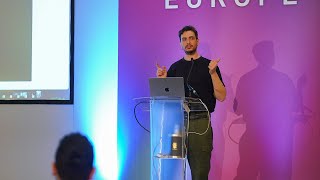
In this presentation Daniele, co‑founder of The Archive, introduces the project’s mission to digitally preserve fashion heritage by creating high‑fidelity 3D replicas of historic garments. He outlines a three‑step reverse‑engineering pipeline—manual measurement of physical pieces, digital craftsmanship using CLO, Blender and Substance to reconstruct the garments in 3D, and storytelling through immersive environments, renders and holograms. The talk showcases several case studies: a workshop with CLO Virtual Fashion and MoMu Antwerp; the Centenary Silhouette project that reconstructed a 100‑year‑old Amazon suit and displayed it as a large hologram with Future Front Row and Bakermat; a paper‑garment collection created with Atopos, Professor Daphne Mohair van Peseren and co‑founder Martina; and a latex‑decay project with Museum Boijmans Van Beuningen illustrating material deterioration. Daniele explains the educational and accessibility benefits of 3D archives, the importance of stable file formats (SVG, PDF) for long‑term museum use, and the team behind the work (Martina, Virgil, Arisa). He answers audience questions about surprising findings in reverse engineering, the limits of preservation accuracy, and the future efficiency of the workflow, noting that while much of the process remains manual due to bespoke garments, automation is gradually improving. The presentation concludes with a preview of an upcoming booth at Kingpin Amsterdam and an invitation for further collaboration.
Questions this video answers
Daniele explains that they discovered hidden details such as pleats embroidered with the owner's initials, asymmetrical tailor‑made garments, unique pocket placements, and adaptive features like removable pleats that allowed the garment to change with the wearer’s body. These findings sparked discussions about sustainability and design longevity.
Daniele says the process has already improved over the past year and a half, but much of it remains manual because of the bespoke nature of historic garments. The team has automated everything possible within their pipeline, yet broader automation will likely emerge as the field gains popularity.
Daniele states that photographs are the most reliable preservation tool because they capture the garment at a specific moment. While 3D reconstruction can model the visible structure, it cannot fully recreate deteriorated or missing parts, so high‑quality images remain essential.
Chapters
Hi, thanks for coming today. I'm Daniele, I'm a co-founder of The Archive, and today I will show you a bit, I will introduce you a bit to the project, and I will walk you through about some projects that we have done so far and also what will happen next. So first of all, I would like to start from the question that We ask ourselves when we started this project is, what if we could bring a historical object back to life? And this is just a tiny video that I would like to show you. [NOISE] And I will give you a bit more context about this specific project later. So our purpose is to preserve fashion heritage and make it accessible digitally. And we do that by building 3D replicas, and we established a— we created a process of reverse engineering garments. In order to extract all the information from the artifact. I would like to invite you to scan this code so you can go directly to our website, where there are a lot of information. I will talk about some projects here, but actually that will be your main source of information because we have written everything there and you can find everything. Um, this is just a, a quick introduction about our reverse engineering process. So you can see that, uh, this is, uh, a camisette that belongs to, uh, Mod Museum Antwerpen. Um, we have reverse engineered this camisette and we created a 3D replica, but also we were able to create additional information like, for instance, the text sketches. And this is in a nutshell what we, we, we do. Uh, we have 3 main pillars. The first one is the actually reverse engineering process. And it's a manual process, um, that we use different tools, traditional tools, in order to be able to get all the measurements and position of buttons and everything. The second step is what we call digital craftsmanship because it's a detailed 3D work. So we get— like, put all this information that we were able to gather in a 3D space, and we actually reconstruct the garment. And the third step is more related to storytelling. So we create, for instance, an immersive environment to enhance the artifact. Or we create very high-detailed renders. It depends from the purpose, but the reason is really to enhance the accessibility to the artifact. And we saw that there are benefits of this. First of all, the first one is the education, the possibility to access to garment that are usually in a depot or in an archive and to access to it in a safer way because you don't need to touch them, you don't need to take them out from their boxes, you don't need to do anything that could potentially harm the garment, but you can use still to study, to learn more about the silhouette, to learn more about the cut lines, the materials, so on. By using 3D replicas, we can offer a chance to navigate the garment. So to see the side, for instance, usually through pictures is not that easy to do. And then, as you already know, when you have a 3D file, then there is just a landscape of possibility that you can adopt. In order to use that file. So the usability is another aspect, but you can put in immersive spaces, or you can also try to put it in an immersive space for a museum in order to enhance and to give the museums the option to, you know, expand their audience worldwide. I wanna drive you through now to some practical example of what we do. So talking about education, we organize workshops using our 3D replicas, and that will allow the audience really to play around with what we extract. This is an example. We did it in November last year, and this is a workshop that we have done in collaboration with CLO Virtual Fashion and MoMu Antwerp. So we gathered around 12 participants and we organized this workshop. We gave access to our website, the one that you just scanned, and we asked them to download our patterns and to play around. Of course, this was a very specific audience because those were all digital designers with some proficiency in CLO. So they were already accustomed to use the tools. But this is a very nice output. This is one of my favorite, for instance. You have a garment from MOMU, which is around 100 years old. And then you have on the right side, the products, the design that Susa in this case made. Underneath you see the garment's pattern that we extract. I think this is a very nice example that showcase how when we translate this into a brand identity, let's say, environment, you can really see if you give these tools in the hand of designers how they can keep the brand's DNA intact, 'cause if you see only one of the two, maybe you, for sure not me, I wouldn't see the connection, but close, you can see that there was a sort of evolution to it. Of course, students apparently like it a lot, and this is another example. She have created a total outfit. What I really love about this personally is that First of all, she really felt creative because the top is the chemisette, 1840. The bottom are military pants, probably '60, 1960. But she puts tattoos on it, she, on the avatar, and she brought very old styles into contemporary times. And then this part is more related to the project that we have worked with. This is related to the video that we saw at the very beginning, and this project we call the Centenary Silhouette. The purpose of this project was to showcase a 100-year-old Amazon suite that was, that still is, in MoMu Depot in Antwerpen. And this is one of the first example of functional wear because it was an Amazon suit. It was made, tailor-made for the person that was wearing it back then. And the story is very fascinating about this garment. So we went there. We have recreated the patterns. For the sake of accuracy, this time we also made a mockup of the garment in order to really make sure that it was as close as possible to the original one. And of course, by working in 3D, we spotted some mistakes here and there, which we were able to correct right away, so like we built, one mockup, basically. We extracted all the tech sketches, the patterns that are in PDF format, and then we enhanced the quality of it by creating high-quality replicas of the garment. And this whole project, you saw it that it was working And there was not so many motion is because it was showed as a hologram. It was 12 meters long and 3 meters high. We collaborated with Future Front Row. And we showcased this as a hologram. So the first part was the garment that was being reconstructed. And the second part, this one that you can see here, is because we collaborated as well with Bakermat, which is an Antwerp-based company that they work with digitized fabric. And we recreate, we put some creativity into it, and we made it into a dance using their fabric. So it was a nice project that we work on. Another, that you can also find in our website is the paper collection. So what we did is to— actually, the idea comes from Martina, our co-founder. And she said, what if we make— we curate our own collection? And she really like paper. And she noticed that there are some paper garments that are scattered all over the world. She's based in Melbourne, and so she digitized one garment there. But then we got in contact with Atopos. Atopos is a nonprofit cultural organization that is based in Athens, Greece, and they hold the, I think, the biggest archive in Europe of paper garments. So as many, maybe I'll give you a bit of context, paper Throughout the centuries has also been used as a material to make clothes, but you need to put some, like to treat it in a way that it becomes like a fabric. So we collaborate with Professor Daphne Mohair van Peseren, which she is specialized in paper garments. And we created, co-created this workshop where she was teaching how to make manually the paper in order to use it as a fabric. And we, on the other side, we were teaching how to reverse engineering a garment. So the output is actually a piece of paper fabric and a kimono that you see there on the left. We were able to digitize 10 pieces, and we created 6 3D replicas. Here you can see also some— sorry, what happened? Okay, some details. So this is an amazing kimono, and also I like these details, like it's ruined, you can learn a lot by these little details. We have recreated everything piece by piece, and this is just a tiny video to show you how we usually handle these very old artifacts. So it's also the old, it's kind of a ritual. You need to wear gloves, you need to pay respect to the heritage. And here are the picture about the first pillar, like the garment reconstruction. And then talking about digital craftsmanship, I thought it was funny to condense 6 hours and a half of working into a 46-second video. It was challenging, but they made it. So you can actually see how we work in, you know, 30 seconds. So we use Substance, for instance, for that. And we start from the picture, and we try to recreate everything for the sake of preservation. Yeah, this is a lot of work. Also, these are the maps that we were able to create. Also, this is a kimono that was made from ledgers, and you see, like, everything you see here is accurate. So we work with measurement, and we create these maps following exactly what, you know, it's supposed to be. So the accuracy is about 95%. Here are some images, but you can also see it in our website. This is the quality that we aim. This is the Ledger kimono. And this is the last project that I want to show you. I would like to ask you to not take picture here because it's not in the museums yet. So if you can just put your phones away, please. Thank you. Yeah, it's very important. Thanks. So we were able to work with Museum Boijmans Van Beuningen on a Walter Weyraendock and Stephen Jones artifact from 2008. If you go on Google, if you Google it, you can find the same video. I just put it there because I think it's very, it's very nice to see. So this is the artifact that is at the Boijmans Museum, and it's called the Bee, and this was the setup when we started the reverse engineering process. The purpose of this project was to showcase the latex decay. So unlike old materials that are used for clothing, like cottons, wool, silk, and whatever, new materials like latex, like Gore-Tex, like polyester, decay faster than the old one. So actually, the latex suit was made maybe 3 or 4 times, and the purpose was to create an interactive experience to put close to the restoration room in order to allow the audience to see the decay, deterioration process, and to see, you know, what is the actual work of people that restore that. So we went there, we recreate the garment, we take photogrammetry of the hard part, and we have recreated the latex suit, both new and old. And we were really focused on also on the details, like actually the way that the latex is welded here is 100% accurate, is how it should be. The reason why we know is that we got in contact with Linda van de Velde, and she was the one who created that, the original piece that collaborated with Walter. And she was teaching us how to— actually, she made that. She has an enormous experience in working with latex. So yeah, I think we might do a documentary about it. And I would like to show you this, for instance. Yeah. This is very simple, but it's very effective and efficient. So this is the application that is going to be at Boyman's. You see that you can click around, you can navigate the garment, you can zoom in, zoom out. And most important, you have— the switch between the old suit and the new suit. And for— this is purely for educational purposes. And here you have more information about the history, about who created it, and most important, the credits. This is an ensemble. I forgot to say before that it's part of the Sex Clown collection, and it's very, very interesting. So yeah, it's totally fine to think that the mask resembles something else. Yeah, these are some renders, like high-quality renders that we made. And what's next? Literally next week, we will be at Kingpin. We will be there with a booth. We collaborate with Endrime, which is an amazing project about archiving denim pieces, and we will talk about digital restoration in this case. We will be there with a booth, with a hologram, like very small this time, and a book. So if any of you is in Amsterdam or pass by, please feel free to come and you will see. Some partnership and collaboration so far that we were so lucky to to be part of it. And this is the team. So Martina is based in Melbourne. She's a teacher— sorry, lecturer at MIT in Melbourne. We have Virgil that is our art director. We have Arisa that she's a fashion lecturer at NABA, Marangoni, and so on. And it's me, that's Daniele. So thank you so much. If you have any question, feel free to ask. Alright. Alright. Yes, please. Just—
Maybe one question. I mean, you have years of experience in fashion industry. When you reverse engineer these old fashion pieces, is there anything different or anything surprising that you found?
Yes, a lot. Like, one time we were reverse engineering a garment, and there were some pleats here. And we just moved the pleats because we need really to understand the measurement. And they were the initials of the owner embroidered. Or this also, I keep talking about this skirt because for me it's, well actually, the whole, the two pieces. The chemisette is asymmetrical because it was tailor-made. So also dealing with this kind of garments is very interesting because you see that is a garment that is made for someone and is not made for the industry. So the fact that it's not symmetrical, to me, it's very precious to learn. The skirt, actually you don't see it here. Yeah, maybe you can see there. So there are a lot of pleats here and there is a big folder here. First of all, it has pockets. Also, this is a big conversation in fashion industry where where did the pockets go through the years. Secondly, it's a garment that is made to accommodate changes. So in this case, if the body of the owner was changing in shape and form, you can always unstitch some pleats and the garment will always adapt. And the big folder is to extend it. So it's, I think, like by studying this garment, you can talk a lot about things that happening now from a lot of different perspective, like sustainability, for instance, but also from a designer perspective is how can I design something that is made to last? I don't know if it's possible right now, like on a scale, but at least maybe we should talk about it. So this is my biggest learning on that. Thanks. All right. Yes. Oh, thanks. Yeah, this is a good question. So from a preservation standpoint, there is nothing better than a picture. For instance, if you want to do— to translate this in 3D environment, that you need to do photogrammetry. In that case, you kind of crystallize the garment at the point that the garment is. We create the ruined part, but it's very clear that this is our interpretation. So we can't guarantee that from a preservation standpoint this is correct. While for garments and position of prints and everything, yes. The ruined part is not something that we can recreate. We can guess it. To preserve it, you need to take a picture because sometimes the ruined part also tells you how the garment was worn and tells you a lot about the habits of the owner of the garment. Did I answer? Okay. That's for you. Do you think reverse engineering will become more efficient in the future? Yeah, it already is making some improvements. Like, we started a bit more than 1 year and a half ago. And I mean, we also improved by doing stuff. So there are certain limitations that we are aware of. But yeah, my, like, the only thing is that now I hardly see application of automation as we think we use it in the industry, the fashion industry, because our, like, bespoke garments. But I'm sure that, like, personally, like, as a company, we already automatize everything that we could. In our process, but a lot of it is manual work. So yeah, I think as every topic, the more it gets popular, the more there will be people interested in kind of improve it and enhance the output. We use 3 softwares. We use CLO, we use Blender, and we use Substance. We have our own pipeline with these 3 software. There is a very specific reason why we are using these 3 softwares. It's because, oh, I see now that we have a question there, okay. The reason is that what also we learn working with museums is that you need to have a stable output that you need to, you can use it in 20, 30, 40, 50 years. Museums, for preservation standpoint, they still use SVG and PDF because they are file that you can always open, you can always update, you can always save, you can always reuse it. We try to keep things simple just because first of all, I think, yeah, this is, everything that you need as a 3D designer. When you have one tool that serves the purpose of modeling, when you have one tool that serves the purpose of enhancing or creating video, create storytelling, and you have one tool that is specifically for creating textures, that, I mean, is everything that you need. And secondly, because we need to create something that is stable. And this is the reason why. And yes, we are able to recreate all the workmanship because when we are recreating the pattern, this, like, we use CLO and like the pattern function there is pretty good. We can grade it, we can do whatever we want with there. No, honestly. I mean, it's nothing new. Everything is out there already. So fast fashion is already using all the software that we are using. And this is also a very interesting topic, like what kind of garment does fast fashion company or wants to preserve. I mean, are we talking about heritage H&M style? I don't know. So this is also a good conversation. Physical fabric parameters, we use CLO, and we are, yeah, when we can measure, we will. When we can use preset, we do. But it's a lot of manual tweaking in order to recreate the fabric. And there was last question, but I was able to show— oh, sorry. So thank you so much.