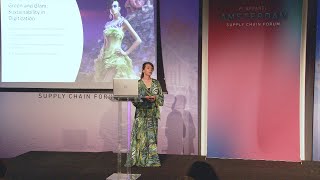
Silvia Šemčuk, 3D Apparel Specialist at Timberland, delivers a comprehensive presentation on how digital transformation reshapes the fashion supply chain. She begins with a personal anecdote about early 3D experiences, then outlines the accelerating pace of fashion and the interdependence of emerging technologies—3D modeling, artificial intelligence, predictive analytics, personalization, data management, blockchain, and IoT. She explains how 3D can be used from raw sample creation to digital twins for B2B/B2C applications, enabling rapid fit iteration, virtual fitting rooms, and customized experiences. AI is positioned as a tool for trend forecasting, design inspiration, and personalized customer journeys, while emphasizing that designers must retain brand DNA. Data is framed as the most valuable asset, with privacy, security, and traceability addressed through blockchain and IoT. Sustainability is linked to reduced waste, over‑production prevention, and transparent ethical sourcing via blockchain. Implementation challenges are discussed, including supplier readiness, cultural mindset shifts, employee training, cybersecurity, and the need for flexible, non‑one‑size‑fits solutions. A strategic roadmap suggests starting with product development and vendor onboarding, leveraging startups and universities for innovation. The future of make‑to‑order, body‑scanning, and AI‑driven pattern generation is highlighted. The talk concludes with quantified benefits (up to 50% faster time‑to‑market, 8% price premium, 20% manufacturing cost reduction) and a Q&A covering blockchain energy concerns and the role of physical samples. The overall message is that technology, when embraced by people, can dramatically accelerate, personalize, and green the fashion supply chain.
Questions this video answers
Silvia does not work directly with blockchain at Timberland, so she cannot specify the type. She notes that blockchain can be energy‑intensive, but the overall energy savings from reduced over‑production and waste can offset this. She emphasizes the importance of clean energy investments (solar, geothermal) to mitigate impact.
Silvia confirms that at least one physical sample is still required for final validation and manufacturing checks. She stresses that 3D reduces the number of physical iterations, but a final sample remains essential for sales and production confirmation.
Chapters
Good morning, everyone. I am Silvia Šemčuk. I work as 3D Apparel Specialist for Timberland, and I will present today for Fashion Forward: Embracing Digital Transformation in Supply Chain. I would like to introduce myself a little bit. So basically, first time I used 3D, it was when I was around 10 years old. I played the video game called The Sims, and I just wanted to change the color of the garment. So I found the files that now I know are called textures. But then I decided to work in fashion industry, which was always my passion. But I am also a kind of nerd. So that's why when I discovered 3D, for me it was a game changer, and I go for that. Later, I had the possibility to have my proof of concept in 3D, and I understood that it really works because I worked as freelancer for a long time. And in 2018, I had a client from Australia that wanted to have garments made in Italy. It wasn't very easy because it was a small company, so they really didn't have the proper tech packs, and it was— they were a little bit confused. It was quite difficult to understand what they want, and considering the distance of 20,000 kilometers, it wasn't really easy to send them and show them samples. So I used 3D, and it really works. After 5 months, they came to Italy and they were able to see the garment exactly they wanted it. So it was a great thing for both of us because basically in 5 months we were able to create a whole collection. I did it all by myself, which is not easy, and Fridi helped with that. As for today's presentation, what I wanted to say at the beginning is that the fashion is moving very fast now. What is happening now and in the next 10 years, it's more or less what happened in the last 100 years. So consider that we really can't imagine how fashion will be in the next 10 years. We really can't say how we will work in the next 10 years because technologies are moving so fast that really changes are happening from today to tomorrow. Here I listed some technologies. That I feel are the most important now in, in changes in fashion industry. And I want to say that all the technologies are connected between them, so it's not like you use artificial intelligence and you don't use 3D or you don't use Internet of Things. They all have greatest added value when used together. And considering that the complexity of global supply chain is increasing day by day. Like, let's think, 50 years ago we had supplier of the fabric and of accessories in one place, then we had manufacturer which were close by, and we sell in the market close our warehouse. Now it doesn't look like that. We have supplier in India, then another one in China, then we produce in Bangladesh and sell in America. So it's very complex, and technologies help in optimization of, of that supply chain. One of the first technologies I wanted to talk about a little bit more in deep is 3D. So it's my daily job. And what I want to tell about 3D is that it can be used from the beginning till the end. We can start with creation of raw samples in 3D. So check the fit. And we really don't need them at the beginning to be exactly the copy of the real garment. So we really don't need to use nice 3D trims. We really don't need to use nice stitches or whole colorways. We just have to change the fit, to check the fit. And the important thing is that it's much faster than creating samples, because if you already have the library of your materials with the right physical properties, if you already have your block garments, It's 5 minutes, it's 10 minutes, it's half an hour if the garment is really complicated. And you can have your iteration in real time. You don't have to create samples, show it to manufacturers, show it to pattern makers, show it to product developers. You do it in real time till you find the right fit. And once you do that, just in this moment, you can go for your digital twin. And with your digital twin once done, you can optimize this asset using another 3D tools and use it for selling, use it for B2B, and use it for B2C. You can use it for virtual fitting rooms. You can use it for nice-looking apps. You can customize these garments for your customers, which is quite important now because customers want experiences together with garment. It's not enough anymore to sell the garment. You have to sell experience together with that. And with this, experiences can help also artificial intelligence, which is the next technology I want to talk about. And we are all a little bit afraid about artificial intelligence. A lot of people are saying that it will take our jobs, but it's not true. Anyway, someone who is able to use it can take our job. If we are not able. So it can be used for both predictive analytics, which is a great thing because in this way we can spot trends and we can create our collection that will sell. So we don't have overproduction, we don't have garments that are not sold, we just create something that is requested by the market. Then having this predicted trends, we can also boost creativity of our designers because then they can prompt these trends and, for example, use Midjourney to just find some ideas and then elaborate them. But we always have to think that this is the tool, it's not the final thing. We still need our designers to be able to use this tool and to be able to create designs that have DNA of our brands. Because Midjourney now is not able to do that. Then we have also personalization. We can use AI to personalize experiences of our customers. Our customers, each of them can see in the app their homepage. So not the same for our customers. If we know that someone is looking often for, I don't know, red dresses, we show them in homepage red dresses and accessories that are matching these red dresses. We can show them some articles about how, which kind of red is better for their skin, for example. We can give them content, content which is interesting for them and make them stay inside our app and then make us collect the data. Because the next topic I want to talk about is data, which is super precious for us. Now, we are producing garments, we are producing accessories, we are producing footwear. But the most important asset for us now are data. Because without data, we are not able to say what we should produce and what we are able to sell. Now, data privacy policies and laws don't give us possibility to collect data from everywhere. So we have to think about that. And these data are even more precious, so they have to be secured. And this is where blockchain and Internet of Things technologies are coming to. They help us with securing data. They help us with tracing data. They help us with automating data collection. The next topic which is important to talk about is also sustainability. Our customers now want to have sustainable garments. Let's say that fashion industry is the one of most polluting ones. We produce a lot of waste. We are not able, not yet, to optimize our production in the way we sell everything we produce. And we have to change that because it's not sustainable anymore. Then another thing is that fashion production is not always ethical. We all know that there are some companies that use child labor. We all know that there are some companies that make work their workers 20 hours a day. So with blockchain, we can transparently track all that information, and there is no any more greenwashing. A lot of companies are doing that, and it's not okay. We have to say, oh, that it's not okay and we have to finish this thing. So tracing data and being able to trace it in transparent way, it's very important thing today. Then using artificial intelligence, using 3D, using predictive analytics help us with less waste and optimization and overproduction prevention. And this is another way we can be more sustainable. and we can really say to our customers, "Guys, these garments are sustainable," and we earn on that. Now, of course, all the technologies are not easy to implement and are coming with a lot of risks. It's not like today we can wake up and say, "Okay guys, we are sustainable and we use all the technologies." It's not easy. For sure, the first risk I can see is data breaches and supply chain disruption. If we are ready as a company and we are saying, okay, we want to use 3D for whole production chain, but our suppliers are not ready with that, we have to help them somehow. We can't say, okay, you don't want to use 3D, so we don't work with you anymore. It doesn't work in this way. Maybe we had a great deal with them, but we have to help them and we have to listen to them. To understand which are the pains in this kind of change. Then, of course, the culture change, mindset change. We can't say, "We always did in this way, it worked, and we want to continue like that," because the world is changing. It's not like we can decide what our customers want. It's us to have to understand what they want and it's us to do what they want to be able to sell. And of course, employee training, because you can't go to your employer and say, from tomorrow you will use this tool, if they never seen it. And then you can't even try to change your employees, hire new people, because for example, I work in 3D, and the big problem in, in 3D is that there are people that understand pattern making and garment production but have no idea about CGI. And then there are guys that are working in gaming industry, are great in 3D, but have no idea about fashion industry. We have to teach our employers how to work in 3D, or we have to teach people from CGI industry how fashion industry works. I think the first one is easier because anyway, pattern making or garment production is not something that you can learn in one day, as well as CGI is not. But it's easier. At least I did it in this way. I worked already in fashion industry, and then I had a master in CGI. And believe me, it wasn't so hard. It is something that can be done. The next thing is that digital transformation is not a one-size-fits-all solution. It's not like all companies can use the same tools. It's not like all companies can use the same solutions because we are all different. There is someone who focus on footwear, there is someone else who focus on accessories, and someone else who wholesale Bridle. So it's not everything for everyone. That's why business have to be flexible, because these technologies are changing so fast that you can't program your changes for next 5 years. You can say, okay, I want to use 3D in 5 years, I, I want to be fully 3D, but you can't say this is my workflow. Because maybe in 2 years there will be another software which is faster, which is cheaper, which is better, and you have to be able to switch to it because otherwise your competitors will do and you will be in back. Then cybersecurity. I said before, data is precious, is really precious, and we have to save it for us. You don't want your competitors to use your data. And then another thing is that data of your competitors may not work for you. So you have to collect it, you have to use it, you have to do it in scalable way, and you have to be very fast and secure it well. And as said before, employers' development, this is the key, flexibility and development. We have to change our mindset because otherwise we will be on behind. Technology is moving fast, and it will in fashion industry. If we don't, there will be someone else who will do. So if we won't be flexible, if we won't be agile, if we don't want to invest our money in technologies and in our employers, we won't be able to go anywhere. And this is the last thing I wanted to say in this presentation. Basically, as said before, this, this slide is connected to the previous one. We have to embrace tech advancement. We don't have to be afraid about that. And also another thing, that technology is worth only if used by people. So we don't have to be afraid that technology will take our jobs. If we will be able to use it, we will be able to embrace it. Fully. And as the last thing, I wanted to say that from, from studies coming out that once supply chain will be fully digital, it will be able to reduce by 50% time to market, which is extremely important because it's not sustainable anymore to work on collection 2 years or even 1 year and a half. Trends are changing so fast People are showing things on TikTok and the day after they have to— they want to have it. So they can't wait 2 years for that. We have to be much faster than we are now, and technology can help with that. Then being faster to market, we can raise our price for around 8%. At least this is what experts say. And also cost of manufacturing should be less than around 20%, which is not bad. And also considering price rise, it's a good deal, I think. Now, I am not sure if there are any questions, but we have still a lot of time for that. I was quite fast. What type of blockchain do you use? Are there concerns about its energy usage? So honestly, I am not able to answer this question because I don't work with blockchain in my company. I work in 3D, but I will be happy to answer it later. I will just check on that. Anyway, if we talk about energy usage in general, consider that not only for blockchain, but also if you produce less, if you don't do overproduction, if you waste less, you already saved a lot of energy. Then blockchain is a kind of technology that really It takes a lot of energy. So also investment in clean energy is important for fashion companies. We have to think about clean energy. We have to think about solar energy, about geothermal energy. For example, the great thing in the office I am working in Sabyo in Switzerland is that it's zero impact. It has energy for itself. We have solar panels. We have geothermal energy. And we really don't have any impact on the environment around us. Okay, I am not sure. Yeah, please.
Maybe a general question. Perfect. A bit more of a general question. So we've been also on this journey for quite some time in terms of implementing 3D tools in, let's say, the product creation process. And I think what we've seen is also that not only from within, let's say, design, merchandising, PD, you have a lot of this back and forth of, yes, great in terms of accelerating speed, less samples, et cetera. But at the same time, I still want to touch and feel and have that physical interaction. On the other hand, I think also that request or that question comes towards us very much from, let's say, sales and country organizations to say, hey, digital, all great, but I still have to have something physical in my, in my hand. Is that something you experience in your role, in your environment as well? And maybe have an example of how you tackle that or how you approach that?
Yes, we do. And I think the best approach for that— of course, so for sales, we really think also that one physical sample is important. But it's important not only for sales. You have to check how the garment is manufactured. You can't launch the production without seeing the last sample, the last before the production. But if we talk about concerns from design team or product development team, it's important to talk with them. Like, it's important to talk with your vendors to understand which are their pains, what they are afraid about, to show them technology and to stay with them, sit together and say, guys, this is the technology, this is possibilities we have, what do you want us to do with that? Which, which thing will be for you interesting? How you want to use it. Because we have somehow work in these departments like startups. In fact, companies should too connect with startups, should connect with universities, because there is where innovation is starting. And we have to work as startup. We have to spot the pain and find the solution for that. Using technologies we are able to use. So only in this way you are able to go to product developers, show them something, and hear from them, "Yes, we want it." Hope I answer your question. 3D prototyping is fully implemented in communication between departments at VF. So we are still on the way. We are still on the way. We are working hard with our design team, with our product development team, with our sales team to implement it fully. But yeah, it's still on the way. We can't say we are completely done with that. Where and how to start for 3D process conversion in the company? I think the best way is product development. It's the first thing because it's the first part where you really can earn on that because you create less samples. You really don't need this back and forward. I don't know if all companies you are working for have the same, but for example, in VF, we work with manufacturers based in Asia and we create samples there. Sending them back and forward between Switzerland and Asia costs and needs a lot of time. So use 3D prototypes for sample making saves a lot of time, saves a lot of money too, saves a lot of, a lot of waste we had before. So I think this is, this is the first stage, and this is the easiest one to implement because at the end it doesn't need so many people involved. It's much more difficult in sales, but it is the next step, I think. Thoughts about make-to-order? Oh, I think make-to-order, it's the future of fashion. I really— it's my opinion, but I really feel it's the future of fashion because it's custom-made garment, and custom-made is what our customers want. It gives an added value. It creates the garment that will be used for much longer because they are made to order. So I— customer feel like he created this garment somehow. Also, if it can be solution made not from scratch, but like modular solution, we can give them some ideas how you can put together the garment. And it can be made in the way that for the company, it's not the real made-to-order. I mean, you have, let's say, 50 different variations of the garment, but the customer feels that it's made-to-order. Then with technology, which is going ahead, I think it will be also possible to to make-to-order garments which are fitting exactly our customers. Because now we already have solutions that are scanning the body. We have, and we will be able to have in the future, solutions that are able, using artificial intelligence, to create a pattern which fits that body, using also 3D. And then we will be able to product it— produce it on demand. So I really think that made-to-order, it's the future. Yes, we interact with vendor, we onboard our vendors, and we feel that this is very important because you can't think to have a huge digital product creation team internally. It's not sustainable. Your digital product creation team should be few people that are interacting with vendors and that are teaching and constantly are in contact with vendors on how to create 3D, how to use it, and help them also to use 3D in their internal processes. Because using 3D is important for us as a company that is selling and producing the garments, but can be important also for vendors because they can use it internally to make for us better products and better patterns. I think it's all, so I hope answer your questions, and thank you very much for your attention.