Digital Twin Technologies, Smart Cities & Indigenous Futurism 2025 | Miras3D | PI Apparel
A PI Apparel leader traces 15 years of digital twin technology, from 3D product design to immersive VR experiences for smart cities. The talk showcases real projects like Virtual Singapore and a Yanomami village twin that visualizes climate impacts, and introduces Nature Verse, an upcoming Meta VR platform hosting digital twins of parks for education and climate exploration.
Chapters
So thank you so much, everyone, for being here today. I know it's the end of the day. It's been an incredible conference. I'm so honored to be here. I've been speaking for PI Apparel since 2014, actually, when we were first talking about 3D digital product creation. And along my career and my journey, I've been involved in digital product creation. But now, 15 years later, I'm building virtual reality experiences and digital twin experiences. So my talk today is about digital twin technologies for smart cities and Indigenous futurism for a sustainable world. So smart cities will be part of our daily, daily lives in the next 5 to 10 years, creating a sustainable future for humanity, for Industry 5.0. In this talk, I will be highlighting the key concepts of smart cities, digital twin technologies, and the movement of Indigenous futurism to identify solutions for climate change. And one of the key reasons why I'm highlighting Indigenous futurism is Indigenous peoples really have learned and know and have the deep knowledge of living off the land, which will be so important to us as we experience so much climate change. So one of my favorite quotes is from Steve Jobs, is, and he predicts, and it's already happening today in Industry 4.0, that the biggest innovations in the 21st century will be at the intersection of biology and technology. A new era is beginning. This is concurrent with what we're seeing with AI, 3D, digital twin technology, and all the emerging tech buzzwords, but I truly believe that biology and technology, biomimicry, is going to be part of the future where what we have on planet Earth will merge together with technologies. But the big question is, are we there yet? The digital revolution as it stands today is bringing a lot of changes to technologies that have traditionally been employed in manufacturing, product development, over the past decades. But as we approach these new emerging technologies, what are our values to create a community, an environment, a city, a brand, a factory where we have diversity and inclusion and impact to humanity, building community, corporate citizenship, and true sustainability values? Sustainable development is one of the biggest worldwide issues that we need to address, especially when we look at the impact of manufactured products. As you've heard in many talks earlier today, offshoring, manufacturing, waste, fit, these are all day-to-day problems that we have to deal with and look at within our industries. But what about the the global population. How are brands, how are consumers going to be part of the world 5 to 10, 20 years from now? The current world population is 7.6 billion and is expected to reach 8.5 billion in 2030, 9.8 billion in 2050, and 11.2 billion in 2100. But what is our part in that? And how are we going to accommodate so many people? How are we going to manufacture goods? Where are brands going to be part of this big picture? And that's why I'm so interested and passionate about this topic, and I've been involved in a lot of environmental engineering projects, smart city development, and digital twins of those cities. So one of my favorite heroes is Buckminster Fuller. He was a 20th century inventor, and in, in 1895 was thinking about the impact of a designer as not only an artist and an inventor, but a mechanic, an economist, and an evolutionary strategist. What types of products are we going to decide in the design in the future? Where are factories going to live in these big mega cities, you know, 10 to 20 years from now? And how are those cities going to really be connected with all of these new technologies? And on a global level, in 2023, the United Nations is already thinking about smart cities and digital twin technologies. I'm not sure if you're all aware of this, but there has been a huge push on smart cities and digital twins behind the scenes in a lot of infrastructure projects. So just to kind of ground us in the UN Sustainability Goals, you can see there's the top 17 here, and really trying to understand how brands can connect to these goals, because they impact our daily lives on a global level. But first, let's define a smart city. A smart city is a city that uses advanced technology data analytics to improve the quality for its citizens, enhance sustainability, and streamline urban services. How would that relate to a brand if we have wearable devices, connected garments? We are going to connect to be able to see a new train coming in, to be able to understand some of our own biometric body data, and that will be connected to a smart city. Smart cities often have features such as connected sensors, smart grid systems, energy-efficient buildings, and advanced transportation systems. So this is a current dashboard from one of the leading digital twin platforms in infrastructure and smart city and engineering, where you can look at a water treatment plant, you can understand traffic, you can understand Lots of data about your office building, a smart factory, a hospital, electricity use. And we've already started to have these smart sensors in our homes if you've, if you think about Nest, Alexa, but this is going to be at a much larger scale 5, 10, 20 years from now. And my question back to everyone today is how can brands be part of this big picture of the environments that we live in? So let's define a digital twin. A digital twin is a virtual model or a near real-time digital image of a physical object, process, product, or production asset of a service. Digital twin technology started in the late '60s with NASA to simulate a rocket landing back safely to Earth. Digital twin technology is used extensively in automotive, aerospace, to stimulate crashes, how something's going to react. And we've seen a little bit, there's a vendor here on the floor that is already talking about digital twin technology. Digital twin technology will soon become the next, next level of 3D product creation, I predict, in the next few years. I was at Nike a couple of years ago, and I led the Digital Twin Alliance there. There are a lot of brands that are looking at digital twin technologies, even for footwear and apparel, to simulate how a garment is going to react, to attach all the data, sales data, performance data, to that 3D asset so that you can monitor and predict and see what the performance of that asset will be. But let's define a digital twin of a smart city. Digital twins have taken the role of an integrated, centralized platform. Think of it as the brain of a city. Capable of hosting diverse sets of information. If you could see in your home or on your app in one place all the facts about your community or your city and how brands could support that, that could be a starting point to think about what this roadmap could look like. The digital twin of a city pursues three visions: more intensive and efficient urban production and operation, livable and convenient urban living spaces, a sustainable urban ecological environment. So I wanted to show everyone some examples of digital twins of smart cities that exist today that are fantastic. But first, a quote from the vice president of Dassault Systèmes. Dassault Systèmes is one of the leading 3D software companies for aerospace and automotive. They created SOLIDWORKS, CATIA, Simulia, a lot of softwares that are used outside of our industry. And according to Simon, in megacities like Hong Kong, Singapore, and Shanghai, digital twins have become an indispensable function of a city for planning and one of the new generations of public services. In some use cases in my own career in the past year, a digital twin has been used within a community for them to decide if they want, wind farms, or if we're going to put a building here, how can the mayor and everyone decide in their community if that should be built within, in that city or that town? Building a digital twin becomes a virtual meeting space where people can decide and really understand and make decisions together. Singapore has developed a digital twin of the city known as Virtual Singapore. I encourage you all to look it up, which uses 3D mapping geospatial and LiDAR technology. It's one step up from Google Maps and real-time data to simulate various aspects of a city, including transportation, utilities, and buildings. Helsinki has developed a digital twin of a city known as Helsinki 3D+ model, which is used for urban planning and environmental modeling. The model is based on LiDAR data, which is collected using laser scanners and includes information about cities, buildings, trees, and other features. If you ever see a car driving around in your community with some kind of weird device on the top of the car, that is probably a LiDAR scanner, just driving around the city, collecting all this data to create a digital twin of that area. But you could see here how creating a digital twin of a stadium, how that could connect to a sports brand, athletic apparel, being able real-time to see what's happening with a game or a music venue. There's so many different possibilities and use cases as it connects to footwear and apparel. Orlando, Florida has an immersive real-time 3D digital twin that recreates 800 square miles of the region. In China, Shanghai and Beijing have built an intelligent and advanced City Brain for their digital twins of their cities. So going a little deeper into the technology, smart cities are enabled by BIM technology, which is Building Information Modeling, to GIS, which is Geoinformational Spatial Modeling, to digital twin for connected infrastructure. Some use cases of this Once the data is collected is to monitor fraud and abuse within a town or city, retail, financial services, healthcare, disaster recovery. Digital twin technology has been used extensively for emergency response. About a year ago, I saw the head of FEMA present a use case of how when there was an earthquake or a fire or a tornado in a city, instead of emergency response, responders going door to door, walking street to street. They could see a bird's-eye view of where, uh, help was needed right away. Defense and infrastructure and energy are also some key use cases. So there's different digital twins for a city. There's an operational model, a moving entity model, a sensing object model, and a static entity model. What does this really mean? Sometimes you just want a 3D walkthrough to be able to go through a city, fly through a city in virtual reality, and that's one use case. But then there's much more detailed data that you can get by using all of these underlying technologies. Digital twin technology is used to make an intelligent analysis of complex scenarios. There are digital twins being made of ports, airports, trains, automotive, parks, retail, and tourism, which is super exciting. But how can we incorporate social impact and true sustainability into, into these future cities? It's really about understanding what you want to achieve from the goals of collecting that data, and that data is accessible to everyone and then can be synthesized according to a brand's needs as well. But how can we connect all of this to the history of the land, tying it all the way back hundreds and hundreds of years? So I recently was able to be part of a project where we were— we've been planning to create a digital twin of a village in Brazil of the Yanomami tribe and simulate some of the climate change impacts that they will be having in the future. This is a technology that they are so appreciative of and super important for us to understand what a region is going to look like 20, 30, 50 years from now and the true visual representation of climate change. Indigenous futurism was actually coined by Grace Dylan, who is paying homage to Afrofuturism. And this is really based on the idea that so often Indigenous tribes are viewed as the last of a race or the lost race or vanishing race. Indigenous futurism is a cultural and literal movement that explores the intersection of Indigenous cultures and technologies, often using science fiction to imagine and create new worlds. It's a way for Indigenous peoples to reclaim their histories, to document and archive old traditions, oral traditions that have been passed along, and also to envision a world where their traditions and knowledge are honored and respected. Indigenous futurism often incorporates elements of cosmology, storytelling, and ways of knowing that have only been passed along in individual tribes and seeks to reimagine the relationship between technology and the natural world. I'm going to give some examples of how Indigenous tribes later in the presentation have really made an impact today, this year, of how their knowledge has helped save certain regions globally. But I wanted to mention this incredible project that my friend has been doing. She— has an architectural firm. She was on the Netflix show, The Future of, on the skyscrapers episode. Her name is Vanessa Keith. And I was on the panel at Columbia University to see all of the students' work for her project, 2100. 2100 is a virtual reality game that simulates a dystopian utopia. And how you can actually interact with certain cities that her and her team have picked and play a game that will engage gamers and, and new adopters as well as to what the future could look like. So with that, we can just play the video and enjoy.
Welcome. You've arrived in New York City. I'm Violet, your AI companion. You're just in time. The city is preparing for an oncoming storm. You can help by completing climate quests. For each quest you complete, you're rewarded with points and expertise. You must close the storm surge barriers to protect the underwater turbines and energy park from being damaged. In your phone, you'll find your contacts and the map, which you'll need to navigate. Find shelter, the storm's here. The energy we captured from the storm can now power our city. There's a path for everyone. As an explorer, you chase storms, helping our cities prepare. As a destroyer, you're helping to recycle the old city. As a creator, you're designing solutions to ensure our survival. All this hard work has changed our cities dramatically. We must use all the space we have to collect water, grow food, generate clean energy, and capture carbon. With expertise, you're able to lead others, design new tools and technology, and travel to cities all over the world. At the marketplace, you can make purchases with your points or sell anything you grow, build, or scavenge. Keep an eye out for poachers. If you catch them in the act, all their points will be yours. You must get out and explore the cities. So what are you waiting for?
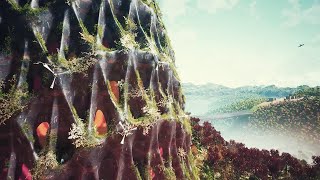
So Vanessa Keith just won an award at the Sundance Film Festival, so I'm really excited for her. And please reach out to me if you'd like to get, uh, connected to Vanessa, they're always looking for new partners to collaborate with, and it was really great to be part of that. So, uh, how many of you have heard of The Slow Factory? They are a movement about, uh, really, uh, fashion revolution, uh, about environmental activism within the footwear and apparel industry, and they've covered some really great, um, progress of how indigenous land victories have, and indigenous tribes have really made some progress in saving some parts of land and some of that grassroots organization. So I encourage you all to take a look at Slow Factory and some of their posts. They have great posts on Instagram, so I took a few screenshots here. So in a nutshell, we can learn from planet Earth. I truly believe that. I teach at Washington University as well as at MIT and some other universities for engineering classes. And one of the classes I teach is in biomimicry. And by using the principles of biomimicry and sustainability, I truly believe that designers will start to look at that once we all get onto the 3D digital product creation train. We'll start to dive deeper into how we can look at nature for sustainability and design. But these are the basic principles of biomimicry. Nature runs on sunlight. Nature runs only on the energy it needs. Nature fits form to function. Nature recycles everything. Nature rewards cooperation. Nature banks on diversity. Nature demands local expertise. Nature Curbs excesses from within, and nature taps into the power of limits. And nature provides 3.85 billion years of trial and error, research and development, rigorous quality control testing that resulted in— that results in a 99.9% failure rate. We have 30 million different species of organisms living on the Earth today. That are success stories, and many that we have as humans brought into extinction. But they have figured out— nature figures out materials, forms, processes, systems, and strategies needed to sustain themselves in conditions on Earth as it is today, the very same conditions in which we must sustain ourselves. So my hope for the future is that designers will also start to look at biomimicry as a design principle. So as we start to wrap this up, why is this so important for brands and why was I asked to speak here today? What is the why? The more goodness and opportunities that we create, the more we support authentic social impact, the more impact brands will have. The more likely we see collective action on virtual stages, such as virtual reality, augmented reality and mixed reality, the more tangible actions will shape and support brands and consumers. We have a lot of virtual spaces. There's a lot of buzzwords about the metaverse. I'm hoping that these technology platforms will just be another digital layer in our life where we can have community. Who are the people that can be part of this change? Consumers becoming creators, brands, nonprofits, education, healthcare, grassroots groups. And how can this happen? With a digital twin, with a smart city, by supporting Indigenous futurism, by really going back to the basics of nature, by sharing content via digital twins, by having diversity and inclusion in virtual spaces. By engaging in learning platforms, by participating in virtual giving, virtual volunteering, building community, and creating virtual platforms that have a true purpose, not only for monetary value. So imagine if we use nature as a model with form, process, and system. And imagine if we use nature as a mentor, combining technology. So launching soon, I will be launching Nature Verge— Nature Verse with Meta, which is a virtual reality platform where we will be taking digital twins of state parks, botanical gardens, different areas on planet Earth where you can turn back the dial and see what it looked like 100 years ago. Where you could turn it forward to see how climate change will affect a region. I'm a tree hugger, so whether it will be virtual tree hugging, it will be a learning platform with a panel of scientists, also with the fun and magic of virtual reality. One thing about VR is that the headsets are going to change where we have Apple Glass. It's the content that is going to be the most important. So this has been a project that I've been working on and thinking about for many years. I encourage you all to go get a headset. It's not— it's a little clunky, but the content is really what's fascinating right now. And these virtual platforms where you could view a smart city, where you could do a video game, where you could work out, are evolving so quickly. And tying it back to some conversations that I heard today about AI, I just know from myself with a team of designers and engineers that I'm leading, we are using AI for concepting already. And there's going to be some really great use cases in viewing virtual platforms beyond the metaverse, just on a web browser, in VR, mixed reality. So I encourage you all to reach out to me. I'm going to have a beta launch. If you'd like to be part of it, please email me. And I'd love to hear your thoughts. So, that's it for today. If there's any questions, let me know.
Okay. Yes.
So, yes. So, an example of virtual volunteering is right now there's certain brands like Hellmann's in the UK, food brand or supermarket where they have a, a, a consumer be part of a video game, but then with points they're donating money to certain causes. So it's not Bitcoin, but it's a way of having a virtual experience right now in VR, uh, and in gaming to basically donate money and support causes through a virtual experience.










