Digitizing LVMH and Preserving Its Timeless Legacy | LVMH | PI Apparel
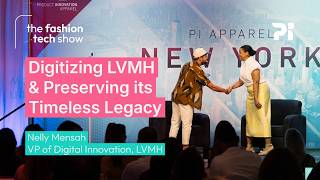
Nelly Mensah, Head of Innovation for LVMH, discusses how the luxury conglomerate balances heritage craftsmanship with digital transformation. LVMH built an internal 3D Factory to create digital twins for all its brands, uses AI to augment human creativity rather than replace it, and launched Aura, a private blockchain for product authentication and sustainability tracking.
Chapters
Which side do you want? Yes.
Hello.
All right, hello, hello, good morning.
Good morning, bright and early.
Yeah, you're looking lovely. I love this yellow dress, it's getting me feeling good about the summer.
It's summer vibes, right? You know, I feel called out about the badge thing. I usually just have it off because sometimes it just clashes with the outfit, so it's just in the purse.
I think it's— first of all, no shade on people that turn it around, everyone's busy, so that's fine, but I'm just giving my perspective on that. But also when you're on stage, I think that's the past, right? I mean, it's not great for photos and videos.
Yeah, exactly.
That's the reality. OK, let me pull up my— actually, before we start and I go into it, really, it's easy for me to kind of read off what I've read about you in a tailored bio. But why don't we start with introducing yourself, what you're all about in the context, and then Yeah. And what you're all about. Yeah.
So great to be here. My name is Nelly. I head up innovation for LVMH here in North America and globally. I oversee the topics of Web3 and metaverse, both words that we no longer use. But here we are. It's a completely made-up job and I love it. My background is actually in engineering and primarily industrial engineering and computer science, but with a bent on design thinking, human-computer interaction as it pertains to emerging technologies. So basically basically how do you take a technology that is completely new and make it valuable to a business and usable, helpful, frictionless to a client. And with emerging technologies, there's always a lot of kind of thinking and brainstorming and experimenting and figuring this out. And so my entire career has kind of has been built on that. I started in consulting with Deloitte Digital and then transitioned to Sephora, where I also headed up future innovation, looked after AR, VR, and AI in its first wave when personalization was recommendation engines were a big thing. And now at LVMH, I sit at the corporate level, which means I do 3 things. One is a lot of evangelism and educating all of our brands. We call them maisons and their execs about these technologies, what they can do and what they can't do, their level of maturity. I also spend a lot of time in the ecosystem, so at events like this, meeting technology partners, vendors, providers to understand what's possible, but also to educate them about what a luxury brand might need because oftentimes the needs are a little bit more specific and startups come up with a tech concept without really thinking about the roadmap or what features, you know, a fashion house or a spirits brand might need. And then the third is actually being very hands-on with projects. So it could be either advising Amazon on a particular project. For example, we worked very closely with Louis Vuitton on their Via Trunks NFT program, or it's actually building capabilities and features in-house at the corporate level in a kind of like a white label form and then allowing them risons to then take advantage of that.
You're a developer and a community organizer.
I aggressively send Stack Overflow links to developers. That's the extent.
Well, I mean, you've organized a community for developers. And I think that that's unique in the sense that you also kind of had a lot of hands-on experience with kind of tying these things together in your past. How do you bring that community sense into your role today?
Yeah, so what Pawan is referring to is I also ran a meetup when I was in the Bay Area for cryptocurrency developers. I knew very little about crypto at the time, and so the best way to learn is to jump right in. And so a friend of mine and I started this meetup that grew to 1,000 developers who came to talk about crypto. We started hacking together. That led me to basically organize a crypto conference that my co-founders and I ran for a couple of years. And then I was also a VR developer in undergrad. And so I kind of understand the intricacies of it without being hands-on. And so now at LVMH, actually a big part of The job is content and community because the best way that you can get brands to understand anything about a technology or what's possible or learn from each other is to bring them together in a really exciting and engaging event. So we actually organize a lot of events, conferences, happy hours, panels. And for our brands, they're scattered all over the world. And oftentimes, they don't actually have a way to talk to each other. So if any of you are at kind of like the corporate level of a multi-brand organization, very often, the brands are very siloed. One will experiment in one area. The other will experiment in another. But they don't have a way to come together and discuss what worked and what didn't and learn from each other. And so a big part of what the teams at LVMH at corporate do is organize these steering committees, these conferences. And so we actually had a great event last year all on the topic of 3D in partnership with Epic Games, which is a huge partner of ours. And it was just such a phenomenal event. We organized an expo similar to what you see outside. And all the brands were just blown away at the possibilities possibilities before them because they really saw it come to life in a way that was relevant specifically for luxury.
Y'all, she's a bit of a unicorn. I mean, this is insane. She's a VR developer, has background in brand technology, is a community organizer. It's— I mean, it's— I don't even know where they found you. But the topic today, it's From Heritage to Horizon: Digitizing LVMH and Preserving Its Timeless Legacy. That has to be such an intricate balance. Why don't we start with, you know, in your role currently, like, what is it that you look to accomplish?
So you're right, it's exact— there's a tension when it comes to innovation and luxury that our brands have been trying to balance for a really long time. At the very core of it, our maisons have always been innovators, but when it comes to product. So very often a maison becomes very famous because they started doing something differently. So Vuitton, for example, You know, innovated the trunk pattern, the very special lock that Vuitton trunks have. Veuve Clicquot, you know, the widow notoriously invented the riddling process for champagne. So this idea of doing something new in order to differentiate yourselves has been pretty core to the LVMH DNA. But when it comes to digital, that's where the tension comes in. Because when your heritage is built on tactile savoir-faire, heritage, craftsmanship, it's really challenging to translate that into the digital realm. And so that's And that's one of the things that we're trying to figure it out because it is inevitable that the next generation of clients are digitally native. We already know that. And very often, as much effort as we put into a beautiful boutique, the merchandising, the signature scent, training the client advisors, oftentimes the first time a young client will encounter a brand is online because they might not have a store. They're intimidated to go in. And so if their first encounter is online, How do you make sure that that same emotional experience that you get when you walk into a store is translated into the digital experience? And so that's why we termed kind of like the expression digital craftsmanship that we use quite a lot. One, it's really resonated with a lot of our execs and it helps kind of push our agenda, which is looking at how do your products look like online. So we're really investing in things like 3D, real-time 3D, and really kind of the level of detail that's possible. We're really looking into AI and GenAI around personalization and creativity. And then also when it comes to Web3, right? Like this idea that when you own a piece of luxury, that's part of your identity. And our identities are moving online as well. So we really are looking at Web3 as a way to extend our physical products into the digital space. So all of these technologies are helping us translate our brand DNA online and into digital, but in really meaningful ways that are not brand destructive.
When I first started going down the Web3 hole, what I thought was truly interesting about how retail specifically around fashion and beauty is positioned is that when Web2 and that influx social was really starting to shake things up, I mean, in '09, luxury was still hesitant, if you all remember, on e-com, right? We weren't even selling online.
Yeah.
And there was just so much investment that was made in those kind of the hard conversations internally had happened. And there was an environment around innovation or a culture of innovation that had developed over the last, let's call it, 10, 12 years. I actually think it's crazy to say that now 10, 12 years after that, we are uniquely positioned as an industry to take advantage of new digital in ways that other industries just, are going to have trouble catching up. When you— not talking about your role specifically or LVMH specifically, but are you finding across the board when you speak to your peers that you're coming into an environment in which the accelerant is there already or you are the accelerant?
Yeah, it's really interesting because I think to your point, when e-com first came around, a lot of brands were very hesitant. And then when social media came around, a lot of brands were hesitant as well. It actually parallels the journey from Web 1.0. I think e-com started a little, just a little bit earlier, or at least like having a landing page. Here's our stores, here's our opening times. Give us a call if you want to know anything more. And that was kind of like Web 1.0. Web 2.0, I think, was primarily social. And so brands were so worried about opening up the conversation in their comments or being able to turn around photos and posts really quickly in response to moments. And now And now we're already in this Web3 revolution, which does combine things like NFTs going into gaming and being on Roblox or co-creating your products with consumers. So all of that is very scary. And so on the one hand, I think a lot of execs in the fashion space know that they don't want to be left behind. And so sometimes there's an overcorrection and a lot of experimentation just for the sake of experimentation, kind of throwing things against the wall to see what sticks. And then when you end up not having a disciplined approach to it, then there's kind of a backlash. Well, that didn't work. We're never innovating again. But on the other hand, I think especially for luxury brands, older brands, there's this responsibility to be a curator of the brand. Like if the brand has been around for 500 years and you do something and all of a sudden brand value goes down, you don't want to be the person responsible for that. So this is why I think retailers that do really well are the ones who are very excited to try things to not get left behind the way it happened with e-commerce. But at the same time, They're doing it in a very disciplined, very intentional way with a very specific hypothesis of what they want to test, limited scope, and then scaling anything that works well.
Well, how are you doing that at LVMH? There's the group side, which is the individual brands or maisons, and then there's— sorry, there's the group side, which is LVMH, and then there's the individual brands or maisons. How does that all get— How does it end up with you?
So usually there is a couple of things. Either there is something that at the group level we see as imminent, and so we will kind of kick off the conversations around exploring it, or there is kind of scattered demand from different maisons and all of a sudden like, we actually think we need to scale it. So one example would be, let's say, 3D. We're starting to see a lot of brands really diving into 3D on e-commerce, whether it's for kind of like a 360 viewer, an interactive experience, or virtual try-on. And what we found was very often different brands would kind of have like one-off— maybe there'll be one product that they'll create a 3D digital twin for and not do it for anything else. Or we'll find that the e-commerce team and the marketing team are working with two different agencies Both agencies will create 3D models for them. Both agencies would retain the rights to the 3D models, so neither team can use it again for anything else. And so we were like, wait a minute, this is completely inefficient. The level of quality of the 3D isn't up to par anyway. And so I remember actually being at this conference exactly a year ago being like, oh my God, we're so behind on 3D. There were like just amazing companies sharing what they were doing. And so my teammate who's in the audience and I were like, okay, we need to do this, feverishly writing notes.
And now you have a 3D factory.
And now we have a 3D factory that we launched at the beginning of the year in Paris. That is an internal team of 3D experts who basically take on the job of overseeing the 3D production, having guidelines around the level of quality that's expected, the standard, you know, the lighting, the styling of different products and making the life of the brand so much easier because they don't have to deal with the vendors, with the contracts, with the constant review process. And then they get back this asset that is literally usable across the board, whether it's e-com, marketing, social media. And we're hiring. So if you know of any production managers for 3D, let me know after.
This is remarkable, y'all. Like a year ago, she's listening to someone and realizing how behind they are on 3D. A year later, you have a 3D in-house factory developing your own technology for it to be deployed. Like, can we just appreciate that, that from a program standpoint, shout out to Pi as well as you for taking that initiative. That is, that really is remarkable. What I would like to do is I think go into some kind of like tangible categories, how you feel about different broad strokes, and then go into maybe some specific initiatives that you found particular success in how you're measuring it. —across the portfolio. So you touched on it, but I'll go back into artificial intelligence for a bit. How are you most excited about leveraging it? And how are you leveraging it today versus tomorrow?
I mean, AI is absolutely everywhere. And so at LVMH, multiple teams are deeply engaged on the topic. The overall kind of philosophy— when GenAI kind of exploded, there was already a ton of work being done with kind of like your classic machine learning propensity model. So we had a team of— over 20 data scientists already working on the topic. But GenAI specifically touched on something very sensitive, which is this idea of, you know, AI versus creativity. And so the very first thing was for us to come out with kind of like a philosophy that it's always human at the center. Nothing will replace human creativity. And AI and GenAI is just there to enhance what we're doing, help us do it faster and cheaper. And that was kind of like the very first thing that the entire group came out with.
We've gone through this before with big data.
Yeah. Yeah, and so on that topic, we're seeing use cases across the board, but specifically with GenAI, what we tell people is it's not quite enterprise ready. So there's definitely huge benefits to individual productivity. Like I'm sure you guys all use ChatGPT, yes? Yes. Show of hands? Yes, please.
There we go. If you haven't, next year. If you haven't, please try it.
Raise your hand. So there's definitely individual productivity gains, but even with that, we're finding that we need to educate our employees and train them on how do you prompt, what are the best ways to get a good result out of it. By the way, we use a private protected instance of it, not the public one for obvious reasons. In terms of the rest of GenAI, it still needs one, a lot of tweaking because the output is still not perfect enough to be put in front of clients as is. At the same time, there are still concerns around IP protection, privacy, You know, copyright, kind of like, you know, what can you do with any kind of like AI output? So right now there is a lot of experimentation and a lot of it is kind of like internal facing until the technology is mature. But I think we're really excited about the possibilities of it.
Have you started to kind of going down SEO strategy as regards to Gen AI? And there's definitely discussions around that.
I do find that I think a lot of the big tech companies are also unsure about how it will turn out. And so we're obviously kind of working very closely with all all of our big tech partners and monitoring it and getting ready for that future. But I think it's kind of a little premature. I don't know if you guys have seen all the TikToks about putting glue on pizza because Google AI suggested that. So I think right now we're just kind of monitoring to see what will happen.
3D and augmented reality.
To me, that is the technology that is probably the most mature of all the ones that we're discussing when it comes to the innovation horizon. So I say like 3D and immersive, Gen AI, and then like full-on Web3. In terms of 3D, I mean, other industries have been doing this forever, right? Like interior design, architecture, automotive. And so retail is now catching up. And so for us, it's been proven by others. And now it's just a matter of kind of going through the digital transformation to truly have end-to-end 3D. I think that is kind of the beautiful end goal. But sometimes it's easier, again, kind of tactical advice, find the team, you know, that is most excited about it and then kind of like double down So in some companies, it might be your designers that are digitally native, young, familiar with CLO and Browzwear. So it's straightforward. But if your design team still prefers sketching with pencil, that's fine. Your e-com team might be really excited. And so then you just start with that team, build out the use case, show some KPIs, and then kind of work your way upstream.
What do you find? What are early indicators in terms of success metrics that you're really riding on in terms of 3D? So whether it's the product images and maybe some 3D environments online, Yeah. What have you been—
We look at it kind of like we divide it up into upstream, downstream. And so upstream, it's things like time to market, kind of reduction in the number of samples, environmental metrics and cost metrics. So it's around how you work. And then downstream, it is things like engagement rates on websites with 3D content, conversion rates, reduction on returns. We're tracking both of those.
Well, I guess that's an easy transition to blockchain because you're working with the Aura Consortium on a lot of those aforementioned tracking things, can we talk about blockchain a little bit and how it's being used today versus how you see it being used tomorrow?
Yeah, absolutely. So Aura blockchain, for those of you who don't know, is a consortium. So it's a consortium that was founded by LVMH and a few other luxury brands. And it's not just retail. So we have car manufacturers there. Steinway Pianos is a part of it. So anything that is kind of in kind of like the luxury space and the reason— and this was founded like years and years ago before the NFT boom. Because I think a lot of the brands realize that it does make sense to have things like authenticity data, raw materials tracking, provenance on the blockchain. But public blockchains were too open. So for example, let's say you have a limited edition product dropping. We might not want everyone to be able to see how many are available. And so this idea of a private blockchain was the perfect balance because it's still blockchain technology that is run by multiple independent party, so you still have that degree of trust, but at the same time it's private, so you get to decide what information is exposed to your client versus not. And so the use case that we're really excited about is digital product passports for a variety of reasons. One, in Europe there is a lot of regulation that is coming requiring digital product passports. Two, we're finding that, uh, the next gen of consumers really care about sustainability again and raw material sourcing and being able to verify kind of where the product's coming from. And 3, in regions, for example, in China where there is a lot of counterfeits, even if you kind of like buy online, there's some mistrust about where a product is coming from. And so being able to then verify that the product you have in hand is authentic has been huge for us. So Dior, LV, Loro Piana, Rimowa, Bulgari, Hublot already on board and have launched digital product passports and more to come.
Yeah, I mean, the LV jewelry passport is just a wild example of that, right? Tracing the stone from, from mine to finger. Exactly. Which is really tremendous. Going into, I guess, you know, man, time flies. So gaming, it's obvious where gaming is. You all have been a part of that. Spearheading the gaming side for a number of years, whether it's even product integration, celebrity endorsements, concerts, those sorts of things. Obviously, you mentioned Epic Games before. So there's obviously a very large interest in the space and growing that and attracting younger audiences because of it. Howard Schultz, of course, famously tagged like the third place being the coffee shop. But really, truly, the third place these days is the gaming environments and the 3D environments that young folks are engaging with. That's where they're socializing. That's where they're getting their information. That's where they're doing their purchasing. So we've all heard it before. Really tremendous work that you all are doing over there. I do want to spend the last few minutes just talking through kind of like what is your discovery? What is, you know, what are your kind of rhythms to keep abreast of, you know, all the trends? And really, of course, you work with a multitude of very, very intelligent people and agencies and things like that. But what do you do to really keep ahead? Like what are some resources that you're reading on a regular basis? Like what is your schedule?
Yeah, just being chronically online. TikTok, shockingly. Yeah, I love TikTok. I think once you've like refined your For You page, you're going to get some amazing content. A lot of conferences, absolutely. There is a few that, you know, my team and I will attend kind of across the board to see what's going on. LinkedIn has been doing a pretty good job, I think, also surfacing again depending on who you follow. I'm not on Twitter anymore. I used to be for, for a while. For Web3 quite a bit. Um, yeah, I honestly, that's mainly it. And then you kind of like poke your head into like different articles, different podcasts.
You don't want to enjoy the crypto, uh, the crypto Twitter. It's a fun one. It's a fun one. Um, are you participating? I mean, look, LV does the Innovation Awards. Yes. Um, tell me about that a little bit in terms of how you all are like, what's your involvement with that and how how you spearhead from an organizational standpoint this culture of innovation as we're going into another period of hyperdevelopment? Absolutely.
So LVMH is a co-founder of an event called VivaTech. If you're familiar, it's like the CES of Europe, but everyone's better dressed. It is a very fancy French tech conference.
Excuse me, I'm wearing New York's finest right now.
Yes, indeed. Also, by the way, part of LVMH. So this was completely unplanned, and I very much appreciate it. And so the idea behind VivaTech was to really kind of bring innovation to Europe. So Publicis and LVMH came together to create this event, happens in June every year. And a highlight of that event is the LVMH Innovation Award where a ton of startups from all over the world kind of submit themselves for consideration. There's different categories. So it could be sustainability, employee experience, omnichannel. This year, like immersive experiences, so kind of metaverse, Web3. And then we had data and AI. And so every year, Every year, thousands of startups apply. There's a selection committee. I am among them of experts both within LVMH and our close partners that end up voting. And then there is a huge ceremony on stage with Bernard Arnault, who's just such a huge celebrity there. When he's walking through the conference, there's a slew of bodyguards and paparazzi. I'm like, who is that? Is that Kim Kardashian? But no, it's Bernard Arnault walking through because he's so admired.
Yeah, I mean, for good reason. Yeah. And so— oh, well, no, I was going to— I want to rip through a few more things because now I just got like the full amp. But you have a certificate program, which I came across for the first time just in kind of this process of chatting with you leading up to it. But I thought that that is tremendously valuable, folks. If you haven't already, you could get a free account to LV. They have a whole online portal of education. They have a certificate program.
It's called Inside LVMH. It's free to access.
Yeah, which I think is a tremendous generation of value, but also pipeline and again, eyes and ears on what's happening in the industry.
Yeah, that's exactly right. So the structure of the program is twofold. There's a lot of free content, so 4 to 5 minute videos from experts from the different maisons on various topics. It could be craftsmanship, it could be innovation, and the videos are pretty short. And then there is actually a formal certificate program where you go through much longer form content about LVMH. It's primarily targeted towards young talent. And what I will say is I have gotten so many inbounds from students interested in working at LVMH, specifically in digital because of it. And I think for brands kind of publicly putting out there that this is something that your company values is really important if you want to have a pipeline of digitally native and savvy talent down the line.
And so what we're going to need to do now, Nelly, is because I wanted to really go into use cases, but we don't have 3 hours, which I think I could fill up with things like your Epic Games partnership, diving deeper into the passports. I'm assuming a lot of those are NFC triggered. Yes. Hublot's Timekeeper of the Metaverse. You have the Fenty Beauty and Skin Experience, which looked incredible. Sneaker Twins through Dior. Cafe Eleven with Hennessy, which is private community club. The NFT trunk sale, which was ridiculous. It sold out within like 30 seconds or whatever ridiculousness that was. Was. What else you got? I mean, it goes on. Oh, the Orient Express, you guys just announced, wait, a few days ago? Yeah. So you knew—
So Accor— Exactly. You had mentioned like this idea that a lot of things are moving online. But I think a big part of what our brands are trying to do is actually create IRL experiences where you actually slow down. And so you'll see a big push in hospitality in luxury. And so yes, LVMH Accor partnering on expanding the Orient Express trains. And the idea is to be on the train and to be present and to slow down. And our hotels and restaurants are all about the physical and tactile. So I don't think we're going to go in the Ready Player One world where everyone is VR. I think in-person communities, experiences are still alive and well. I think digital innovation is just there to enhance it, not to replace it. And we should probably be looking at all of our technologies as such.
Yeah, I think, look, the magic, just like we've experienced in a recent wave of innovation, is that the magic is when we stop stop talking about it in terms like Web3, um, and things are just happening in the background and they're enabling experiences that we wouldn't have had otherwise. Yeah, so Nelly, thank you so much. I'm gonna have to have you, um, would you agree to doing some sort of live, maybe like a, not a Twitter live I guess, but maybe IG or TikTok or something where we, we dive in a little bit deeper?
You see how he's putting me right on the spot on stage?
Well, because then I'm going to ask people that they should follow you to have your people contact my people.
All right, sounds good.
Follow, what's the best way to follow you and your your work?
Uh, probably LinkedIn, weirdly enough, Twitter. Uh, those are the two, yes.
And you're posting there regularly?
On LinkedIn, a lot more. Perfect.
Long form. Ladies and gentlemen, Nelly Mensah. Thank you so, so very much. That was awesome. French. Yes.










