Fashion Design Reborn through AI | HGVIS | PI Apparel
In this conference keynote, speakers Baris Kangel, Heechin Joo (Isola), and Yijin Zhu present a comprehensive view of how generative AI is reshaping fashion design and creative direction. They begin with personal backgrounds that ground their authority, then define AI’s role beyond image generation—positioning it as a collaborative tool that augments creativity, accelerates concept development, and frees designers from repetitive tasks. The talk walks through a practical workflow: prompt engineering in Midjourney, DALL·E, and Stable Diffusion; rapid iteration of concepts (e.g., a 6‑meter rabbit installation); selection and refinement; translation of 2D AI outputs into 3D garments using CLO 3D, Blender, and Unreal Engine; and finally deployment in AR/VR metaverse experiences. Real‑world case studies include the first AI‑generated Fashion Week on Discord, a Moncler Genius AI campaign, an AR runway in Milan, digital‑wearable avatars for the metaverse, and collaborations with luxury brands (Vogue, Hypebeast, Nike/Artifact). The speakers discuss broader industry trends such as digital twins, phygital collections, NFT‑linked physical items, and immersive brand experiences for Gen Z/Gen Alpha. They address common criticisms (AI as “evil” or a “copy‑machine”), argue that the threat lies in misuse rather than the technology, and emphasize the need for designers to master prompting. The future outlook predicts faster, more inclusive workflows, AI‑driven personalization, and a convergence of AI, AR/VR, and 3D tools that will keep human creative direction at the core while automating routine stages.
Chapters
For our final talk of the day, I introduce to you Baris Kangel and Heechin Joo, who are going to talk to us about the intersection of AI, creativity, and fashion, or fashion design reborn through AI. Thank you. Thank you. Hi, everybody. I'd like to go over a little bit about my background. I've been living in Asia. This part of the world like 22 years. I'm originally from Cyprus, it's a beautiful island, and I have a beautiful cat, Nana, that changed my life. So every speech, every keynote, I have my Nana and my country behind me. But yeah, here's the second home for me now, and 22 years in this part of the world has gained so much experiences. And we're going to change OK, so my partner on this speech.
Hello, everyone. I'm Yijin Zhu, Isola. I came from Shanghai, and we're based in Milano. We are doing digital fashion, bridging the digital and the physical world together. Here today, I'm very happy to talk along with Boris. Yeah. So we are doing to have AR and VR to bring more inverse immersive experience for the fashion industry.
So my focus in this session is to give my perspective on AI as a creative director. And I hope that I will help participants here to see effective ways of using AI and to understand the power of AI goes well beyond the pretty images. These are the contents that we're going to cover. We will be talking about AI in creative process. We will go into those discussions like, you know, is it really a tool or is it something that copy machine? Because we are going through now is from CG-generated computer-generated images. So now we're going to AI-generated images. And then a lot of things on social media happening and the news coming out, like, AI really evil or angel? That I will talk about this a little bit. And then I will talk about some case studies that recently done. Some of them I've been involved with the big brands. And then after that, I will talk about AI role in product design, AI fashion, AI photography, digital art, and then we will, we will speak about the future of AI. What is the benefits? And then we will also showcase AI work through AI-born work go into 3D Cloe program. And then we have two cases. One is for the digital world, is a digital wearable as avatar for metaverse. Another one is daily life wear, which is created by the AI. And then, uh, Isola will take over more in the talking about the her Milano showcase using AR in the fashion show in Milano. And then we will talk about a little bit about other case studies in the digital world and NFTs and something like that. All right, I hope it's gonna be interesting topic and not so boring. There will be so much visuals and videos that try to let people understand the quality and the speed of the AI that evolving and changing. You know, when I'm talking about AI, I say that like, you know, a couple of times in my interviews and articles that I write it as a creative director and how I feel about the AI. I asked this question, right? I mean, if AI can't help imagine anything new, why would a designer or creative person or artist see any point in using it? And my answer to that is because I think that it can help augment our creativity as there is a value in creating combination of known elements to form new ones. And this boundary of what we can imagine based on what we have experienced is the place that I've been exploring last 3, 4 months. So, and for me, my AI journey, it starts with a rabbit. It was Chinese New Year. I was in Shanghai. And then we were struggling with COVID but on and off. So we got a brief from the client. It's a retail brand. They wanted to create installations giant, like 6-meter rabbits and digital content and do the campaign. So I was working with the team, in-house team, with my designers, giving references and trying to describing, no, Chinese will not like it. You know, they want really little, some kind of rabbits. They want some, you know, like in the Disney. I say, no, no, no, no, no. This is what I want. And I want something interesting because every year, rabbit year, we have installations in China and all the rabbits looks like each other. So how are you going to create impact? OK, so they didn't listen to me. I start with Midjourney. I said, OK, I'm going to try Midjourney. And I try to generate some. Visuals, some conceptual works for the rabbit that client asking for. And we went to the client meeting. Actually, this rabbit is the, I think, work of hundreds of variation and trials and 60 different versions. I picked the one that I like it and what I wanted actually, what my designer wanted. I mean, I asked my designer to watch it, but I couldn't be happy. So I got what I want from Midjourney and I went to the client. We, we, we present everything that in-house and the one that with Midjourney, without telling client that how it's, it's been done. And client said, wow, this is unique. No eyes, big ears, giant. It's cute and not like anyone else did. And I look at my team. Now, you know, do something that anyone else did. Not just get some rabbits, you know, and then put it there. But unfortunately, but what happened to this rabbit? The sad story. She got COVID. Yeah, whole project is canceled because of COVID We were struggling in Shanghai very much. It's January, December before lifted the rules. And all the shopping malls and us again closing, again lockdowns. And the project is on hold. So we need to wait another year for this. So just give you a little bit example of how I see AI as a creative director and how I was like— One example from daily work, how it can help to do things in a faster way and at least understand me better than my designers. I'm going to talk about a little bit on AI creative process. And I always, when the people come to me, I am very active on LinkedIn. I do a lot of sharings. And of course, there was a heat times that all ArtStation— I use ArtStation as well. I have my works there as well. And a lot of people start the boycotting against the AI. I don't blame them because there's an insecurity of losing jobs, right? And but what I can tell, what I can see is that, you know, this AI is just a tool. It's like any other tool that you are using. Even you are using data as a tool for your businesses. It requires creativity to make use of it. So AI, I think, you know, my suggestion that the designers and creatives need to embrace AI. And they should not afraid of AI, but they should afraid of the people who really mastering the AI. So as a creative director, as a, you know, running by designers and agency. I see that I'm now working in my laptop with bunch of designers and copywriters. And then I can express also what I like to do, as was fashion design was something that in me, long time in my life. And I never have a chance to start because I'm too busy with my routine jobs. That what I've been doing, I've been doing experiential stuff, immersive stuff, retail stuff. I work with fashion brand, luxury brands. From Cartier to Furla to, you know, Aston Martin, Zara. We're creating in-store and pop-up stores, more experiential things we've been doing. And we are using AI also in the office to create all these things to at least give designers free from these repetitive tasks and AI making more efficient for them as well. And then these are just conceptual and then we work on the details and and then changing. So it helps a lot. And then also I like to say that a lot of people think AR is just like magic tool. It's not a magic tool. It's not a magic tool. I spent 18 hours in 3 months. I generated, I think, 34,000 images, roughly. 18 hours. Then, yeah, I am featured on Hypebeast magazine. My first AI works. I did interview. I said that, look, you know, in any creative industry, you can be very talented person. You can have very good skills. But if there is no input, constant input, there is no output. And then your input must be— I mean, you have to be curious. You have to be looking at different angles. When you're looking into sneaker design and shoe design, You not just go and look at what Balenciaga or, you know, Yoshi Yamamoto doing. Go and inspire from Zaha Hadid architecture. Go to look at the Tom Dixon, how she doing the furnitures. You know, it's all kind of things that AI giving you a lot of, you know, freedom and stretching my creative boundaries. And that's why you're coming up with interesting works, not like just, you know, the copy of something else. And it's all about input and output. And of course, trial, being persistent and keep practicing is important. But also you have creativity. You need creativity. You need taste. You need taste because in AI at the end, you are the one giving the creative direction. You are the one making the selections. If your taste is bad, your selection is best. You know, so what I like to tell— so I mean, the quality output is directly related to the quality of the input in our database. The more knowledge, the more and more information we have, we are able to come up with something more interesting. So we have to keep ourselves, feed ourselves how we are feeding the AI. And then, yeah, evil or angel. So there was a case that has come out on the social media. Pope wearing Moncler jacket, and then Trump is going to the— where? Police, right? Police for this kind of stuff. And there was again, like, big outrage. AI is bad. No, no, no, no, no. I mean, I think human is bad because human is bad. Human being doing social media posts, fake posters with PS, with other tools. So many years, for decades already, we are doing it. We're creating this. Now you are using AI to make a fake story. Then you're blaming AI as a fake, bad. You don't blame the person behind it. You don't blame person. You don't blame the Photoshop. So that feels unfair, right? And in a business perspective, I will talk about it. There are people out there, they want to use AI in any way they want. This are not control. My interest with AI, I see as a great collaborator having with me. And you really stretching my boundaries of imagination. We are inspiring each other. It's like partners. So as I said that I don't see as a threat, it's opportunity. Is a great collaborator. So I like to share case studies recently we did. So this case study, the first ever AI Fashion Week is done in the Discord community involving a couple of fashion brands and Vogue magazine. We asked to create fashion catwalk design with the same collection. We asked to create fashion photography with the same collection, because in AI, consistency is so difficult. I mean, it requires so much practice and try. But once you get there, it is easy. So 350 over submissions. Been made within a month. And recently, like 2021 April, AI Fashion Future, you know, all the works in USA, and really pushing boundaries and taking risks and creating something truly unique. It's AI Fashion Week. AI Fashion Week was providing opportunity emerging fashion, AI fashion artists, and also fashion artists. So the winners, 3 winners were picked by the companies. And their AI-created collections turn into real clothing that you can wear outside. So that's also in the Vogue magazine. And these are some images of each collection that people submit. I cannot put all of them. I put some of them. So there was different moods, different stories behind it. And then each image at least have another 20, 30 images. As requested by the organization. They want to be catwalk, they want to be street, but then you have to look consistent. And these are the one that I made it with the AI for this competition. I just wanted to make everything minimalist, less material use, sleek, and easy to produce. That was also in the brief. And you can see here the consistency, everything. In the catwalk. And then they ask us to also show similar, same collection in street photography. Street photography, there's no photographer, there's no studio, there's no model, and you are having all your campaign now visualizing it. And then they ask also, we need accessories. It's all done by eye. It's the same AI program. There are different AI programs that are good in different ways. So the earrings, rings, posts, and shoulder bags for that collection. And these are also shoes for that collection. It's all done by AI. So a case study, second one is a Moncler Genius AI campaign. It was 21st of February in London Fashion Week. I will show you some of the images that done by AI generative tools. And Moncler is using it.
Click one more. Click again.
Most of the projectors you see on the containers, all the visuals also there is done by AI artists. So the Moncler CEO reposted on his Instagram, and then Vogue also covered the project. So brands are embracing and bringing in AI into different parts, right? So here I will talk about a little bit my own experiences and works, which is I've been doing just 4 months with AI. I want to share some examples how can we help on product design, AI in fashion photography, digital arts, product design, as I said, conceptual works, and, you know, and fashion was always in me. I mean, I'm a creative director, but I never had a chance. But now I feel good. I'm getting a lot of attention. That post down there, let me see if it is Monarch Butterfly here. No. So Monarch Butterfly that you see there, right? 100,000 only, only this post, it's got views, thousands of likes. And then, you know, magazines started contacting me. Some of the brands started contacting me and like, you know, how you come up with all these things? And I told them, I'm not fashion designer, I'm doing my AI. They said, okay, maybe we may like to collaborate with you. So this started taking me more like then more than hobby. Now it's just as I am really enjoying what I'm doing and people appreciating. I think AI is the great tool, as I said, as a point of perspective as a creative director and artist. You know, as a human, we are Everything in our hands. You know, things doesn't work right by himself. I mean, you're using camera and you're taking photography and you don't call it like camera art. Now you're calling AR art. You don't call it like is an Illustrator art or PS art. So every time there's a change, there's a resistance, there is a questions. But this is the way we are going and AI gonna make a lot of things more efficient, more faster, and I think more creative. Because you are like just working like with your creative partners and designers. And that's the speed and efficiency is unbelievable. So next slide. These are some of the— if you are familiar with Midjourney, these are the Midjourney version 4, version 3 and version 4 works. Because I want to show you the difference that outcomes. So this was like a soccer boots kind of experiment. And then this is the version 3, previous version. It's kind of ninja boots inspired by more Yohji Yamamoto kind of things that I like to use elastic fabric on it. Then we got this one with version 4, version 5. So getting details, you're able to come up with something now. I am able to come up with something now unique, something like, you know, that can go all the details. I will run through with you a few of them. So there is no 3D, all these images, it was all created by AI and with a prompt base. Just prompting. And then this collection is something interesting for me. I was talking to a fashion designer. I was asking her to come up with a shoe for me that I wanted very minimalist, very clean, but also I wanted to inspire from dolphins. And I want like, you know, it's less detail as possible. We couldn't work out something. Then I went to Midjourney. And I created a series of versions of the same shoes. The Nike logo here, don't get me wrong, I put the Nike logo here because it was going— is visually appealing to make the picture more visually appealing rather than the empty. So I put in some kind of text there and logo. And then here I want to talk about fabric details with AI. How detailed can we go in the fabric details and printing? What kind of material? How you can, you know, implement this on different works? So here is the same material, but in a different way of application. Same patterns, more or less. This is more like those patterns that I just showed you before, right? So this is a— I wanted to create like a fashion collection for the studio photography without studio. With that model. Whether there is a story, there is a concept, um, a bit Chinese, Japanese blend, kind of glorious but also quite simple material. These are the versions that has been created. I want you to focus on the fabric only, how detailed you can go now. These can go up to 4K resolution. It just looks awesome. And then there is a question now, is it future of photography? No, it's not the future of photography. I don't believe that AI is going to change or replace any photography. Photography is going to be photography. But then, you know, when photography started, the painters were like, kind of unhappy about it, but what paint, whatever, help that impressionism born because of the photography started. So it's not gonna replace, but I think it's gonna be complementary. So imagine all these pictures, that product photography, you are a jewelry brand, or kind of like you are Tiffany, or you are someone, You need images that you want to use on your social media or you want to use on your catalog. So these are all possible with AI. And then this is an interesting story I like to show. Interesting story because I put these images was on my Instagram. And then one day I got an email. These images come to me with this logo, jewelry brand Diva from Istanbul, Turkey. They took my photos from Instagram and they put their logos and they sent to me. And they said, look, we love this, we put our logo. Thank you very much. And then, but look, 'Uh, we want to use it.' I say, 'Yes, you can use it.' 'And we want to pay it.' I say, 'That's great.' 'Or you can do a new collection for us.' I said, 'Wow, you guys are so honest. Thank you very much.' So then we start collaborating. Now they, they're jewelry brand and they love these images and they want to combine with their jewelry, uh, com— visual communication and social media communication on their websites and stuff like that. Yeah, this thing happen. Normally people take it and they don't tell you, and you don't know where is the image, right? And then here I will talk about consistency again on photographic images, surreal images. These girls, and one UK company approached me for this one. They saw on my Instagram. They are a perfume brand. Beauty, cosmetic brands. And they said, these are super cool, super creative, and it's unique. And we want to do something with you. So I'm happy to hear all these things. I mean, you see, I used to— I'm working, I have my daily life, I'm doing my agency work. Yes, we do maybe events, still sometimes get AI on the conceptual process. But you can see that where AI going. Where how the levels of imagination is exploring, inspiring me and inspiring us, inspiring user, and also AI inspiring from us and start knowing my style. I mean, this is unbelievable, right? And when you're working like, is that you are chatting with your creative partner in the office and discussing about the concept, or you are just like with your team members and discussing about and creating some of the things. And if it doesn't work in the office, I do it with Midjourney and I bring to the office and I brief them, brief them more clearly, not with the reference images from Pinterest. So then the client also understands more about the concept and your creativity when you are pitching the idea, right? So this video I will show with you because it's made by AI, everything made by AI, including the video. So where AI going now? Just imagine this social media video. We have sound.
Yes, click.
So this video created for other client, uh, they wanted to use, um, is a Middle Eastern client, is they want to bring this ancient Egyptian elements and stuff like that. So they, they reach me out again on LinkedIn, they see my works and whatever, and then AI is developing this. You are using different tools now, not just Midjourney. You have DALL-E, you have Stable Diffusion, able to now taking images into motion, into simple motion. And then it's coming next is the 3D. From AI-generated images, you're going into the 3D of your work. You're able to, at the moment, At the moment in true way, we are able to see, like let's say, the woman in front dress, back dress, side dress, all 360 way we can see in a 2D now. And then AI is going into the 3D. But at the moment, not going. So that's why we are working together to turn some of the clothes into using CLO 3D and similar works. So here, I like to show you this, my, one of my favorite work that I just came out with this work first. I wanted to create something that which is a bit science fiction, but also I wanted to touch a little bit with this photo to gender issues. You know, the backbone is a woman and gender equality and all these kind of things. I want to make it like, you know, it's something like a cover photography. And then I said, okay, let's apply this concept. Let's create like a capsule collection or let's see in different spaces how we can apply with just using AI. Consistency, improving same elements, look and feel great. Concept presentations is for pitches and ideas. So you have that element, you're taking similar elements, same clothing almost. You are going into presenting a fashion brand for the catwalk like that without 3D designers, without sketches, without this. Everything gets right. The brief is there, what being asked. So you're also doing installations with the same kind of structures you're bringing into different places. Okay, so here I will talk a little bit more. Here I will talk a little bit more about future of AI. It's very promising. I'm a bit scared. Because it's good, but I never see any technology, generative AI, at the moment developing so fast. So many players coming into market, so many apps, applications coming in the market, and they are keep improving. It's constantly improving. If you ask me, how is the 5-year from now on? Are we going to lose photography? Are we going to lose our designers? Everything taken by the AI? No, no, no, no, no, no. Everything taken by human and everything in the control of the human. As I said that we should not worry about AI, we should worry about the people who embrace, who put their heart and try to, you know, use as a tool to enhance their works and has these businesses. So we already got invitation from Huawei team. To give training, prompt training to them. And we've done a couple of with the overseas clients. So training them, training their design teams to achieve the things more easily. So what will going to happen is like more efficient workflow. So repetitive tasks is going to be freeing up the creative people, design team. They can focus on the big idea. So all the repetitive tasks, mood boards, all these kind of things, conceptual works. No need to go from sketching anymore. You can come up with just amazing AI visuals that present your concept to the client. Enhanced personalization, faster iterations, and of course, more inclusive, more inclusive creations will be in the future of AI I'm seeing now. And as I said that, I think by in one year, we will be really able to do a lot of things with the AI tools without using really the things that we used to use. They can be complement at the moment, but some of the AI tools going to be taking some of the part of our load in the office. So this is an example that recently with between ChatGPT and version 5, Version 5 of Midjourney. I give the prompt example here. This prompt and the image, you look how realistic. This is crazy, right? But you are giving all the input like Canon EOS SD Mark. If you don't have all this information, then you cannot do that, right? You cannot come up with this something. So as I said in the beginning, It's very important that you're here, that your database is well, well, how to say, well, very well, fully capable. And you know a lot of things. You should know a lot of things. You should, because you are giving inputs and all your inputs coming up from your head. Then this is empty. AI not can give you anything interesting or simple. You know, if you want to do something interesting, you have to look at the different places. So in every creative industry is like that. I mean, you can be a very skillful creative person or designer, but if you're constantly looking at the Pinterest, all your work is like they look like whole team looking like a Pinterest. They're all looking at Pinterest. No, go and look somewhere else. Go into the fashion show, go into the window display, walk on the street, look at the flowers. Inspiration from everywhere. So it's just creating this works, right? Your experiences, as I said in the beginning of the speech, all the things that we experience in life, in our database that helping us to lead the AI because we are giving AI creative direction. And it's not just the magic button. As I said, it takes some time, painful days, not at the moment for me because I'm doing 18 hours, 4 months already. But first 2 months was so much struggle. It's not easy that what I want when I get something that I'm satisfied. So this is the example.
Yeah. Here.
You may take it here.
Yeah. Yeah. OK. From the AI part, now we can see a video. It's more about AI-generated fashion video show. Let's see it. So what is happening for that video, it's the London College School. They did this totally fashion show in the AI-generated video. Now AI is not only can do the still picture like a fashion image, it can be a very nice model work show. And from here you can already see this rig, it is going to make with the motion capture and you are going to make this under 3D software and capture all the things and use the software to control it. It's called ControlNet and use all the things combining together to make all the things that is not happening in the real world. Now we can see this. This is the AI-generated.
Yeah. This is another example that this the left image that she asked me to create something like this because there was a metaverse conference in Milano. Um, our team is something that, you know, we are with your avatar, with some celebrity want to wear with her avatar, with kind of dress. So I generated the image on the left one is with AI, and she using Clo3D and other kind of Blender 3D software to turn into this. You can play that. You can let them see the difference.
Yeah. So in this video, we can see it. It is a metaverse wearable. So let's see the more details about it.
Okay, so yeah, and then here, uh, the collection that you've seen before, uh, she tried to wear a short time period that turned into the 3D garment, but it's not completed, they're still working process.
Yes, so here is the 3D garment. That we transform. So it's really easy to see that how AI is going to be first from generated picture, then to visually you can put into the Clo3D, even to produce it.
And you can come up with your conceptual, conceptual image that's work, eliminating a lot of things, you know, between between their starting point to the end visual. So you have a strong visual and then you don't need to go into sketching periods. You need some amendment, you need some changes, of course you're going in the sketching period, but then you're going directly into the 3D software and you work on the 3D software, all the details. So it's coming from AI to the reality now. And every pro, every industry now is getting very interconnected each other.
Yeah. And let's see our next project. The project is called—
Yes, Hustler. So it's from the Evolve that I'm part of it. This project is that we can play. So we did it with the AI first, visuals, then we use Unreal Engine and create whole CG 3D animation. So everything here in Oslo is a little more about high-end fashion, but fashion for the digital world, fashion for metaverse. So you can see the, like, you know, how AI and digital transformations and everything are coming together.
Yes, here is the work that we do. So you can scan the AR QR code.
Can you try to scan?
Yeah, you can try it. We made this with our team based in Milano. So we made this first in the 3D software, and we tried to run the database of how to see in augmented reality it is working, the AR runway show. So by using AI, we are transforming the digital garment into the real life, into the real show. We bring it into life. So also, now I want to talk about future. Future of the fashion is immersive. At fashion, we know the industry. It's really very— never miss a trend. During the pandemic, there are so many technology like augmented reality, virtual reality. They're raising. So it means the technology right now we have, it enable us to attract, to attract, have more interaction with the young generation. And brand are creating immersive experience to interact with their audience. And fashion is about experience. It's not only about you buying a garment. Like we see before the cases, the Moncler, they created virtual garment. The virtual reality show and the virtual flagship. And also with the fashion, they create dynamic. We have in real life identity, social identity on the social media. Also now we are entering a digital place. We have our digital identity and all the technology with AR and VR, it makes more immersive to enhance the experience. Now let's see how other luxury brands are navigating the immersive experience in the fashion world. So here I want to showcase the event that we are—
Recently.
Yeah, recently during the Metaverse Fashion Show. It's happening on March 31st in Milan Piazza di Duomo. Let's see the video. By the team of Overreactive, they bring the first AR fashion show, runway show in the world. And our company are very happy to showcasing the—
Showcase our work.
Yes. And also other luxury brands like Pinko, Balmain, Gucci, they are also interacting with this show. It means they are bringing their physical item into the digital world. And also with this experience, it allow audience all over the world to experience the fashion show clearly and more have the immersive experience. And here we see the video about Adidas. They just launched this new totally digital collection, new manual fashion show. [FOREIGN LANGUAGE] So this is the collection they launched in the digital platform. All the assets you can see is based on their virtual experience. And also I want to ask, what is digital transformation? Why is it so important to the brand? Digital transformation is no longer something new. It's going to revolutionize the traditional fashion industry. And by the digitalized 3D modeling, brand can also save time on making all the patterns, doing the on-time changing on the garment, then produce the prototype. And also, it brings the digital world— the physical item into the digital world. And here I want to show, it's the first digital garment. It was made in 2019 by the fabricant, At that time, there's no idea—
Metaverse.
Yeah, there's no metaverse. Also no idea of digital fashion. But this garment, it was sold for $9,500. It's amazing, right? So why it can be like this? Because the Gen Z and Gen Alpha, they are the young generation that growing up with the internet. They spend a lot of time talking with people, and they have virtual identities. Yes.
And they want to dress their virtual identities. They want to blend in virtual places with different look.
Yeah, that is very important. And also the global fashion brand from the Roblox, they already show that 17% of the young generation, they exchange their Roblox avatar every week. So digital also become very important part of the traditional fashion. So let's see. Here is the idea of the digital twin. As a lot of people have already know that, it's a replica of object that exist in the physical world. It can collect data and reflect from the simulation and make accurate prediction and save the time for making the different SKU and prototype. And also with digital twin, Brand can enter into the metaverse and have more interaction with the young generation and doing the customized things that provide a different experience to their audience. And here I want to talk about a new idea. It's called phygital. So we have already seen a lot of things about digital, about metaverse. So what is phygital? Phygital means physical plus digital. So this is a way that bridging digital and the physical world together. And in 2021, Dolce Gabbana, they launched the first luxury collection. It's called "Collezioni Gen Z." So in this collection, they have 9 digital assets. It was sold in $6 million. And 3 of them, as you can see from picture, the owner of the digital asset, they can unlock the physical item. It's a very good way for a in-real-life brand to engage in both part of the world together. Digital fashion now acts as an extension to the physical fashion. So here I want to talk about a very famous brand. It's called Nike and, and Artfact. How they do this? Because the idea between them is not like other traditional brands. They shifting the mindset of consumer to collector, and this watch has reached that Nike in 2022. Only in the digital fashion world, they sell $185 million for all the digital assets. Not like the traditional brand create and educated consumer, Artifact encourage their community to co-create with them and empower and adding value to each other. That is very important to a fashion brand to have more interact with their audience Here we can see these are the AR filter that Nike and Artfak, they launch in the Snapchat. With this, they have more interaction with young generation, and people are really interesting to share the content and make more people are bringing them into the community. And here we can see just now Nike did the, drop from the artifact, and the Air Force One made the collection collaboration with Takashi Murakami, and they are having the— here's the video of how—
Tokyo, yeah.
This is the collaboration section. And this is the avatar of the artifact. So they're using this to have more interact with young generation, and people who own the digital asset, the NFT, can unlock the physical item. That is very interesting to combine physical and digital element together.
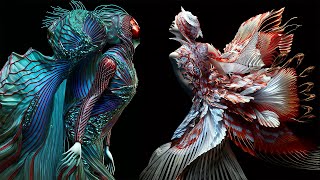
So here I will go back to a little bit. I want to share my experience because I'm excited because it will be the first time in the world AI, generative AI digital art is going— is already started running 6 cities of K11. Um, my concept, I know, is, is this is not about the fashion. But I'm just saying that the concept was about metamorphosis of Siamese, beautiful Siamese fighting fish, and humans are evolving into it, because the sea levels have risen. That was the story. And I created some of the striking images that got a lot of attention from all over the world. And now they are running, it's just a few of them here, they are running in K11s now in China cities and also Hong Kong K11s. So the future is high fashion now and AI and the 3D tools are offering really more than what you can see on the surface. They are complicated. They are getting better and better. So I just suggest, like, you know, take a moment, you know, go into it. Either you're a designer, you're creative, doesn't matter. Just, just try to interact with it. You won't believe what you can do.










