FASHION MADE: Footwear Materials, An Honest Conversation with Stuart Jenkins
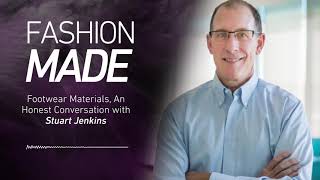
In this interview, host David talks with veteran footwear innovator Stuart Jenkins, who recounts his career highlights—from creating the first air‑cushioned running shoe, Energair, in the 1970s (rejected by 94 companies before Reebok licensed it) to championing the disruptive Hoka One One brand while at Deckers, where he secured the sole decisive vote to bring the “clown‑shoe” to market. Jenkins critiques the typical corporate innovation process, arguing that organizations empower everyone to say “no” but rarely give anyone the authority or reward to say “yes,” which stifles breakthrough ideas. He then introduces his current venture, Skypure, a low‑cost, fast‑turnaround midsole manufacturing system that can produce multi‑material, multi‑color midsoles for $5,000 in two weeks, with up to 85 % recycled or bio‑based content, dramatically reducing water use, energy, and waste compared with traditional foam molding. Jenkins discusses broader circularity challenges, such as grinding used shoes or flip‑flops into new midsoles, the high price and limited recyclability of TPU, and the shortcomings of current “bio‑foam” solutions that lose performance after ~150 miles. He proposes an X‑Prize‑style challenge for a midsole that retains 90 % cushioning after 1,000 miles and suggests embedding piezoelectric sensors to alert wearers when a shoe’s cushioning degrades. Throughout, he emphasizes persistence in the face of repeated rejection, the need for innovators to be comfortable operating as “islands” within risk‑averse companies, and the importance of practical, hands‑on experimentation over buzzword‑driven consulting.
Chapters
Hi, I'm here with Stuart Jenkins, owner of White Hat Innovation and footwear industry legend. Stuart, welcome to the show.
Thank you, it's good to be with you.
Yeah, excellent to have you on the show. Stuart, a little bit of background on you, former CEO of Shoes for Crews, before that former SVP of innovation and product development of Deckers Brands, created Energair, which was the first air-cushioned running shoe in 1976, famously stolen by another company as well. And I see here that 94 brands rejected that idea before Reebok licensed it in 1986.
[Speaker:GREG] Yes, I took Energair to 94 companies, that might say something about my ability to sell. Perhaps. But, uh, after a while I got used to rejection. It was like an 8th grade dance.
Well, it seems like good things come to those who wait, uh, because Reebok obviously had some success with that.
They sure did. And I do want to be clear, uh, Nike, uh, our approach there and Nike, Nike's approach there were completely different. We used atmospheric air. We didn't pump it up and put it in a bag. And so their approach was completely different. And obviously the way they marketed and sold and used that technology is to be commended. And Frank Rudy, the inventor of that, should be commended for his— he got rejected, I think, by 83 companies, I've been told, with Nike Air. Wow.
Well, it's not quite 94, is it? So I think you're winning on that one.
I was better. I was better than him.
You're better at getting rejected.
And he did make more money, I'm sure.
Um, so yeah, I mean, you've been in the footwear industry for, for a long time. Um, tell me, aside from that successful EnerJare project, what would you say has been your highlight of your career so far in terms of ideation and innovation?
Well, I think probably a highlight was when, as SVP of Innovation at Deckers, uh, I was introduced to Hoka after they had sold maybe a few hundred pair of shoes. And Johnny Halberstadt, the owner of the Boulder Running Company, had bought the first Hokas ever sold in the United States, and he called me up and said, "This is a great idea," but he thought a bigger company needed to get involved and support it. And I don't know if you remember how big those shoes were, but a lot of people called them clown shoes or whatever.
Yeah.
They were really dating condoms. I mean, if you wore them, you can never get rid of it. But I remind people that ugly in shoes is not like ugly in babies. You can change ugly in shoes. And the thing about Hoka was when you put them on, you just had a different experience. You know, as a runner, as an industry, we had spent 40 years talking about, you know, my cushioning is better than your cushioning. And in reality, you know, you could blindfold most people and put them in any brand of running shoes, and you really couldn't tell the difference between flubber and foam and air and gel and whatever. The experts couldn't tell the difference, really. And with Hoka, when you put that shoe on, it, it felt different, but it also looked different. So that when you thought on the shelf, yes, it may not have the best aesthetics, but you said, I'll bet that shoe does what it looks like it does. I'll bet it's soft and cushioned. And then when you picked it up and it was super light You know, it was just fabulous. But I remember well presenting that idea to the executives at Deckers. Keep in mind, all of those people in that room are successful, smart, intelligent footwear people. We had a little internal innovation session, and there were 28 people in that room, and Hoka got 2 votes to go forward. CEO, the only vote that counted, and mine. Everybody else said, you know, this was the height of the barefoot running movement. Uh, you know, Grandma Tilly was healed running barefoot, so everybody should run barefoot. You know, the caveman ran barefoot, so you should run. They never mentioned the caveman died when he was 30, maybe because he was running barefoot. But the point of that is that disruptions don't look like the past, and yet We always want to be safe and secure by mimicking the past, and therefore progress is generally incremental instead of taking leaps forward. And Hoka, by being off-trend, by being disruptive in look and price, you know, they're the— I believe they're the only running shoe brand that has grown from zero in revenue to $250 million in revenue in the last 40 years. And think of all the people that have tried, and I'm not talking about people who have had a barrel apparel brands and added on a shoe brand like Under Armour or whatnot.
Yeah, yeah, sure, sure. Yeah. I mean, they've gone literally zero to $250 million. It's an incredible story. And you're right, you know, it didn't look great. And I can kind of understand why 26 people in that room said, hmm, they weren't sure. But you're absolutely right. You got the one vote that counted. And that's so essential. In getting possible game-changing new products into market is having that faith and that absolute top-level trust in your idea.
Well, I also think that it sets up some guiding principles around innovation and innovation leadership that most people wish to ignore. One, You know, who in the hell in your company is empowered to say yes to an idea? Because in most companies, every single person from the janitor to the executive assistant is empowered to say no. And when you set up the process for accepting innovation where everybody can say no and no one is really empowered to say yes or held accountable for yes, And which is worse, all of those vice presidents who say no to great ideas all the time— Energizer 94 times, Nike Air 83 times, and the list goes on— the organization is never set up to hold them accountable for saying no to a great idea. They only get punished for saying yes to an idea that fails. And this is just backasswards. And at Deckers, our CEO, Ángel Martínez, at the time I thought had a brilliant strategy as he set me up as the leader of innovation. He said, look, no one in the organization has to accept the ideas you bring in. They don't have to say yes. They just can't stop you. And that is an unbelievable leveling tool when you're trying to push innovation. But most CEOs will not do that because they don't want to deal with the conflict that it might engender between their VPs. You wonder why we don't have innovation coming into corporations. It's because all of the tools are set up to block ideas, say no. Nothing is set up to encourage them to say yes, to reward yes. So it's, you know, people sit around and go, oh, why isn't it working? Well, it's obvious.
Very risk-averse, you know, no one wants to lose money even if it's in the pursuit of a great idea.
Thinking of it in that way is the problem, isn't it? Because the risk-averseness of it is what they're really risking is success when they try something new. What they are guaranteeing if they don't change or don't do something new is what they have. So by limiting new ideas and innovation and not setting up a process for accepting them or being rigorous in reviewing them, they are ingesting more risk than you can imagine. They are turning down great idea after great idea after great idea. Energiar, which is a little nothing idea, in essence, was rejected, as we said, by 94 companies. Within 2 years, as a division of Reebok, it was larger than 84 of the companies that rejected it. So what was the risky decision, saying yes or saying no?
Yeah, absolutely. So how do you overcome bureaucracy in this regard? Because surely that's one of the foremost things that is holding people back in making these good decisions?
I don't think you ever overcome bureaucracy. I think training as a marathon runner prepares you because you just keep going day after day after day and trying to build relationships. You can't take the rejections too personally. You know, if I could find the line between— the line of demarcation between stupid stubbornness and professional persistence, I would probably have a lot more money. And it's, you know, when you get rejected 94 times and succeed, you're a genius. When you get rejected 94 times and it never succeeds, you're an idiot. And you just have to have this sense of, you know, when to quit and when to keep going. And it's— you can't write about it in a book and you can't hand it to somebody. You've got to earn it through everyday practice. But innovation is, you know, I mean, I was innovating for 30 years before I ever knew that they called people like me innovators. I mean, it wasn't cool 30 years ago. And I think it's gotten to be such a buzzword that it sadly has been diluted and polluted because everybody wants to use the term, but they don't want to do the hard gritty work of actually trying new things, getting rejected, pushing the envelope, being the one vote out of 26. You know, the human species is a herd animal and they want to be liked and they want to be accepted in the group. They don't want to be the oddball. And to innovate, you have to be comfortable being on an island alone while your friends are partying at the next island over with all the cute girls.
Very well said. What innovations are you most excited about right now in footwear industry?
Well, uh, you know, I'm obviously most excited about my own innovation, and I think anybody that's an innovation consultant ought to have to practice. That just ought to be a part of it. I get a little tired of people that want to consult on innovations but never do it because it isn't a theoretical exercise. So I'm working on a, uh, you know, you say How does innovation happen? People talk about getting out of the box or whatever. I don't even know what the hell that means. To me, innovation happens because there's a problem to be solved or a pain point to be solved. You know, if you got a rock in your shoe, what the heck do you do? You don't form a committee on rocks. You don't ask somebody how you get a rock. You bend over and get the rock out of your shoe. And in the footwear industry, the rock in our shoe is the way we produce foam midsoles and insole. We've got uppers that are automated. We can knit uppers. We can do hot melt uppers. You can do them in any color, many fabrics, many patterns. You go to make foam, you essentially can get one material in one color in one hardness, unless you want to spend a lot more money, and you have to make that piece of foam in a dirty, filthy, carbon-intense process. So to make a set of molds for a midsole, you've got to go out and spend $50,000. You wait 8 weeks. So what is more antithetical to progress than that. And then once you've made that mold, you can put one material in it, in one hardness, in one color at a time. I mean, if we had these kinds of restrictions on uppers, the footwear industry would be in a riot. So I got tired of that and have been looking with various friends at how do you solve that problem. And we believe we have found a way to make midsoles using tooling that instead of costing $50,000 is $5,000. You can build it in 2 weeks. You can put in multiple materials, multiple colors, multiple hardnesses. It can have up to 85% sustainable content. That sustainable content can be both organic, like rice husks, sawdust, or recycled foam. And it's going to be in a faster, lighter process. And that, I think this is the most important work I've done because not only does it solve the design and performance limitations of midsoles, but it has the added benefit of being salubrious to the environment. I grew up on a cattle ranch in central Nebraska and we grew crops. And my dad, you know, old Depression-era rancher. And I remember in the late '70s, early '80s when environmental practice was being discussed on ranches and farms because of the runoff of fertilizer. And my dad kind of tugs on his Stetson. And when I asked him about environmental practice and environmentalists telling us how to ranch, he tugs on his hat and he says, you know, hell Stuart, I don't grow a goddamn thing in the ditch or the river. Why would I want to run my fertilizer down there? I want to keep it right on my field so I can grow crops. And then he just pauses and said, you know, good environmental practice is good business. And I think in this case, making midsoles out of foam that has a high degree of recycled content in a lower carbon footprint manufacturing environment is just better business. It's cheaper, it's faster, it has all these benefits. But the industry is locked into this old way. They want to spray mold release on products like they're They're watering Grandma's petunias, and then they have to scrape the mold release off with chemicals. Do you know that to make a foam midsole, we use almost 1 gallon of water per foam midsole because of the manufacturing process? We're heating tools up to 400 degrees and then pouring cold water on them to cool them. Now, how archaic is that? To make 12 billion midsoles for shoes, we're using 11 billion gallons of water. In our process, we have no wastewater, no heat, no mold release, so no steel. So I'm excited about that.
Yeah, I mean, that's game-changing. Um, how long have you guys had this in the pipeline for, and, um, how's it going?
Well, uh, the inventor of it has been working on this idea He and I did another startup called Skydex where we licensed the technology to Nike for tuned air and then have been selling it or it's being sold to the military for blast mitigation in Iraq and Afghanistan. And that inventor told me about this idea he had in about 2002 or 2003 and he's been actively working on it for 8 years. His name is Joe Skaja. He was actually the young product development guy at Nike who put together the Tailwind, the first air shoe at Nike. And, uh, he kept calling me and say, Stuart, we need to do it again. We need to do another startup like we did with Skydex. And, um, I kept saying, it's not ready, not ready. And I went over to China to see him a year ago and said, you know, I think it is ready. And So we've launched, uh, Skypure, our foam process. We're foam agnostic. We can put in PU, EVA, Styrofoam, neoprene, it doesn't matter. So, uh, I've been building a manufacturing plant for the last 6 months, and, uh, because I think the only way to sell this technology is to be able to produce it. I think my sense is that nobody will really believe it's possible unless we actually do it. We should have our manufacturing plant up in another 6 or 8 weeks. But you know, this, uh, you know, I could run right off the cliff or into a brick wall.
But you're, you're on your island and on your own, are you, at the moment? Back in your happy place?
Yeah. Well, yeah. You know, somebody said it's exciting. And I said, yeah. And so is hanging in the morning. But it will be interesting to see how the industry accepts it. I think that the industry, the footwear industry, I would encourage them to be more transparent. I mean, there's a lot of talk about biofoam, and great, you want biofoam, but the dirty little secret of biofoam is that once you get past 30% content, the foam performance goes to hell. 30% isn't exactly, you know, at least where I went to school, wasn't a very good grade. No matter how expensive that shoe is, its ability to cushion shock deteriorates to such a degree that it's essentially— its shock-absorbing ability is essentially worn out after somewhere between 150 and, if you've got Hoka, maybe 250 miles. That means that real runners are going through shoes at a rate of about every month and a half. I mean, I've been doing this for years. How do we know that our shoes are worn out? Oh, our knees hurt. Because nobody in the footwear industry will tell us when their magic foam, the greatest foam ever, the lightest foam ever, the best foam ever, the best cushioning ever, the best gel ever, the best air ever, wears out. But they all wear out after about 150, 200 miles. Now, That's nuts. The uppers don't wear out, the outsole doesn't wear out. So if we want to make a sustainable shoe, and you know what, let's do a challenge. I'll bet you I could make a midsole today that will have 90% of its cushioning properties in 1,000 miles. So let's put a prize out there and make it a nice prize, you know, sort of an X Prize. And now instead of making shoes that get thrown in the trash every 150 miles? Why don't we make one that lasts 1,000 miles? The technology is here, which leads me to the next innovation, saying, you know, you should practice what you preach. Okay, all of this discussion about wearables. So now we've got clothes and shoes that are telling us 3% more information than our watch tells us, and our watch tells us so much information we can't process it. You've got to go back to your computer to look at what your watch told about how you're running, and you ignore 90% of that. But now we're spending all this time and money as an industry having clothing that's going to tell us more than our watch tells us. But what's the one piece of information they won't tell us? When your shoes wear out. I mean, it's simple. Put a damn piezoelectric dot in your shoe and say, "Okay, when this cushion has gone from 100% which it was day 1, to 70% or 60% or whatever the biomechanists tell you is when the body can tell that the shock absorbing capacity has been reduced to the point where your knees hurt. Why don't we just tell us that? That is the one piece of information that every single runner and every single consumer needs to know for health. You know, what good is a heart rate monitor if your knees are so corrupted that you can't run or walk? What good is a heart rate monitor if your hips are shot? The reason your hips and knees get shot to some degree is because your cushioning fails. Who would think you could spend $150 on a pair of running shoes and that their ability to absorb shock is gone in 150 miles? That's the truth.
Yeah, you're absolutely right. So, so what do we need to get these guys to, to energize this, you know, to the— for them to do the right thing, which is basically to monetize them telling people when their shoes are going to wear out so they can come back to them and buy more shoes. That's surely got to be the idea.
Yeah. And you think of all of these companies spending— I get calls all the time about wearable this and wearable that. Oh, it's going to tell you how much you sweat. How much I sweat?
Who cares?
Yeah, for God's sake. I mean, you don't have to teach a dog to eat a steak, for Christ's sake.
Yeah, well, this thing— everyone just wants to sell more footwear at the end of the day. So if we can, maybe in a few years we're going to get to a system where the game changes a bit and people are going to repair more shoes or send more shoes back. Obviously Adidas have just released Future Loop, which is a mono-material shoe. But even that, well, yeah, let me hear your thoughts on that.
Well, no, look, I applaud Adidas for what they're doing. Um, with my technology, Skypure, I just threw a sheepskin boot in a grinder and it became 20% of my next midsole. So I can do that, but let's, let's also remember, look, there's no perfect answer and I applaud Adidas what they're doing. But TPU is about the most expensive material you can get. And I think it'll be quite a while before Walmart starts making shoes out of TPU.
Hmm.
Well, you know, maybe we need to find a loop solution for the masses. And Walmart sells more shoes than Adidas or anybody else. And you're not going to be making shoes for $30. To retail for $30 out of TPU.
Yeah.
Again, I think it's the right direction. One solution. We need more than one solution. You know, it's going to be a long time before we have cows that have TPU hide. It's going to be a long time before we have sheep with TPU sheepskin. And those materials are going to be used. So how can we take things like sheepskin boots and put them in a circular environment? Or flip-flops.
Yeah.
With Skype, we can do that today. We made a midsole out of 85% recycled or reground flip-flops. But even there, you start going out and you pick up trash, and we've got to have an honest conversation about We found these flip-flops and started grinding them up, and a couple of them are— had, which is unbelievable to me, PVC in them. People still make PVC, speaking of not exactly TPU. PVC is a banned material. It's got all kinds of bad properties. Is it better for the environment to grind up PVC and put it in a loop, or is it better to throw it away? Of course, it would be better not to make it at all, but You know, some of these footwear guys, they chase a fart through a bag of nails to save a penny. And if they can get away with using cheap materials, they will. They do.
Yeah, they do. And that's the point.
But more— but let's, you know, somebody put an X Prize out there of $100,000 or whatever for a midsole that will go 1,000 miles and not— and at a, you know, we got to put parameters on reasonable weight, You know, not too heavy, real wearable midsole that doesn't lose its cushioning. Because if you could produce, instead of 12 billion shoes a year, you could produce, you know, 4 billion, that's far more sustainable. Yeah, yeah. And by the way, I think you could do that with existing technology And, and would that midsole cost twice as much? No. Might it cost 50 cents or a dollar more? Yes.
Well, this is it. And you, you know, you talk about the, the cost differences between making an Adidas shoe and a Walmart shoe. Um, and yeah, Adidas are to be commended, but again, it's not looking at the whole story. You know, you mentioned the price of TPU, but it's also isn't it something like 90% has to be virgin TPU and only 10% of it can be recycled TPU? So actually then the maths further down the line doesn't quite work out, right?
I, again, but to their credit, they have started the conversation. Yeah, yeah. And I was, you know, the fact that I I have within the last month taken a complete sheepskin boot, thrown it in a grinder, hide, hair, and all rubber, and put it in a midsole to 20% content, which is 10% better than the 10% content Adidas is talking about in their Loop product. I can do that today, and it feels good. It's not hard. It feels soft. It's pliable. We've got to look beyond these mono solutions. Again, I'm not saying that Adidas should be doing what I'm doing. I'm just saying that there are other ways to deal with this problem that are currently available. Yeah. The companies that should be criticized are the ones that are using all these natural products and simply not trying to do anything other than just put a vice on the head of their suppliers and squeeze them down for more sustainable products. They're not investing in it, they're forcing their vendors to invest in it. They then don't want to pay the vendor anymore for investing in sustainability. And, you know, they want to put all the cost of new sustainability on vendors and reap all the harvest here on Wall Street, and it's a shame. I mean, if you're making flip-flops and sheepskin slippers or sheepskin boots or all leather product or even foam and canvas product and you haven't figured out a way to put that in a loop process, or you're not investing in putting in a process, uh, you're— you are— you are— it's, it's just shameful.
Do you think that, um, you're talking about grinding down shoes, do you think that it's, um, maybe a step too far sometimes? Because, you know, everyone's— I've got probably, you know, 20 pairs of shoes at home that I never wear. Is it efficient to grind all of those down, or is there actually an in-between where they can be sort of repurposed without that quite extensive grinding process?
I take all of my shoes that I don't wear, and I have too many, just ask my wife. One bay of my garage is full of shoes. But no, I think the first alternative for used shoes is homeless shelters, Goodwill, organizations like that. Repurposed is better than that. When I think about grinding up a shoe, I'm thinking of a flip-flop where the strap is pulled out, you find at the beach, one of them. Mm-hmm. And again, it's not the solution, it's one of many solutions that we could deploy. Yeah, but I think that— I believe, again, I can only tell you what I believe. I think this idea that you're going to build shoes that magically come apart in their various components is a lot farther down the road than taking a flip-flop or a sandal or a a lightweight running shoe and grinding the whole thing up and finding a purpose for it. I mean, but if you can find a way to disaggregate all of the interlaced ambiguities of footwear manufacturing and, you know, separate the TPU from the PU from the vinyl from the— okay, but, uh, I think that's a— it might be a better solution. I just think it's farther down the road, and I hope somebody's working on it. I would support their working on that.
Yeah.
But the notion that you either have to disassemble them and get them back into their component pieces, or that you have to make them out of one really expensive material, I think there's a— there We have proven there is an intermediate step.
Stuart, look, I wish you all the best. I'm excited to see when this factory comes online. I think you're absolutely right, once you start showing people how it's done, um, hopefully it'll be the start of, uh, some real, real good change. So, um, yeah, I personally wish you all the very best with that.
Well, thanks, and thanks for what you're doing on the podcast. I hope it causes people to think and invigorates them and, and maybe inspires them to to take more action.
Absolutely, absolutely. Well, Stuart, again, thanks for coming on the show. I really appreciate it.
Thank you very much, David. Everybody get up!










