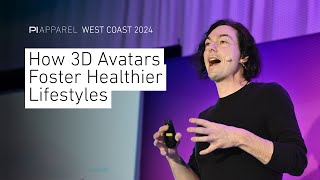
In this talk, Alex, a technologist and former celebrity portrait photographer, shares his journey from traditional photography to photogrammetry‑based 3D avatar creation through his company Blue Vishnu. He explains how highly accurate, millimeter‑precise avatars can serve as personal digital mirrors that make future‑self empathy tangible, thereby motivating healthier lifestyle choices. Alex recounts his own weight‑loss transformation, driven by tracking habits, weight, and periodic 3D scans that visually confirmed progress. He cites research from Stanford’s Virtual Human Interaction Lab and other studies showing that avatar appearance influences physical effort, financial decisions, confidence, and behavior. Commercial demos with fashion brands (Vogue, Zara, DressX) illustrate increased engagement when shoppers interact with their scanned avatars. Alex outlines a future vision where ground‑truth scans combine with wearable data and predictive algorithms to model future body states, while emphasizing user ownership of avatars. The Q&A clarifies product launch status, avatar ownership rights, and potential applications such as virtual fitting, dermatology, and other health‑related services.
Questions this video answers
We haven't launched a public‑facing product yet, but we have built the technology stack and 3D scanners.
We have ground‑truth scans and can use wearable data to run predictive algorithms that adjust the avatar. Additional scans are also possible, but the primary goal is behavioral influence.
Yes, users should own their avatars and likeness, as is standard in celebrity portraiture.
Once scanned, the avatar can be used for virtual fitting, dermatology, and other applications, providing endless possibilities.
Chapters
My name is Alex. I am a technologist and avatar enthusiast. My background, actually, I come from photography. So I have a career in celebrity portrait photography. And I always was very interested in working with talent, particularly the talent that I would meet. I would have only a short amount of time to gain a rapport and gain some trust with, so I was always very interested in the people that I was working with have so much invested in their image and what they look like and what they wear and how they are interpreted. And I have just a tiny bit of time to establish this rapport and bring that out of them. So it's always been a fascination of mine to do that and see how people express themselves through their image. So I had a good fortune of working with some really terrific talent. Over the years, my career had transitioned into going from taking one photograph with one camera to a process called photogrammetry, which is 3D scanning using hundreds of cameras. So it's a similar type of process, in the fact that we're creating images of people, but we're now scanning people in 3D. So I've had a lot of fun with this new technology of 3D scanning. We went to scan some people for the Vogue at the Met Gala a few years back, and we've done quite a bit with this technology. That's actually not what I want to talk to you guys about. I want to talk to you about something that I discovered while using this technology along the way, and how it has actually had a very profound transformation effect on myself and how I think it can actually be used to have a transformational effect on y'all. So the kind of work that we do— so I now have a company called Blue Vishnu, and our thesis is effectively to create avatars and use them to help better our lives, and I'll explain what I mean by that. But before we get into that, show of hands, who here in the past year has tried to lose weight or go on an exercise— or get into shape? In the past year, who's made an attempt? It's a good amount, about half the room. Congratulations. It's actually really tough. Those who've done it recently really know that getting into shape and doing these things, it's all a series of healthy choices and sacrifice, or put another way, delayed gratification behavior. Our thesis, one of our thesis is that positive lifestyle changes are really about being able to emphasize with your future self. And delayed gratification is most prominent here in the marshmallow test. Show of hands, who's seen the marshmallow test? Who knows what this is? Okay, this is fun to watch because it's really showing healthy choices is real sacrifice. So they took children, presented them with a marshmallow, and you had a choice. You could either eat the marshmallow now or delay the gratification and wait, and you get 2 marshmallows later. And you can really see some of these people struggling with this choice. This is a longitudinal study, and so they actually showed that the way people interacted actually was a bit of a predictor in other outcomes, in people's ability to delay gratification in the future. So it really all comes down to choice, and how do you make that choice? What are the things that will motivate you to make these choices? We all know what's good for us and what's bad for us, but— Making those choices sometimes really involves these life hacks and really challenging things. There's reason to believe that we'll have digital assistants that can help remind us and help guide us. But I actually believe that the best digital assistant or guide will be a version of you. It'll actually be you, or more to the point, something that looks exactly like you, an avatar of yourself that looks exactly like you and is accurate right down to the millimeter. And this is what I've dedicated my life's work to doing. So this company, we create 3D scans of people, and it's using a process, as I mentioned, called photogrammetry. And so when we're done, we've got a series of images, and when we're done, we get an avatar that is really accurate and looks exactly like you and can be very photorealistic. It can be accurate right down to the millimeter. And we can do fun things like rig and put a skeleton in it so that we can animate these avatars, like we did with my friend Jimmy here. So we can do a lot of really cool things with just a single scan. What I want to show you next is something that I actually discovered by accident a few years ago. Now, in the process of doing all this, I 3D scanned myself. I tasted my own cooking and got my avatar and discovered something that— well, you guys want to meet my avatar? Do you want to see him? Yes. OK. Woo! This is a scan I did several years ago. And when I met my avatar, I was pretty surprised. I was like, oh, wow, I didn't think I looked like that. I have this whole mental picture of what I looked like and who I was. And it was really not what I was. And I had this idea that— I think I'm healthy, like, I exercise at least 3 times a week, I eat really healthy, and the vision of this avatar really didn't reflect that. So it turns out that, you know, I see myself naked in the bathroom mirror, but there is a wall of delusion between you and the mirror apparently, 'cause I could never see that. So what I wound up doing is I wound up actually just looking at what my behaviors were. What was I actually doing? I was giving myself credit for, for being healthy and being this person that I really wanted to be. But when I actually wrote things down and tracked it, you know, this is what I thought I was. I was eating oatmeal every day, big healthy salads, salmon and greens. But when I was tracking, you know, I actually hadn't done yoga that last week, and really it had been a few weeks, years since I really did it consistently. I was eating all these healthy things, but also these healthy trash snacks, and like eating really late. So the reality was much more different than what I was able to fool myself into. So what I wound up doing is very simply just taking it very— taking it seriously and cutting out things that weren't serving me, and then just moving towards the behavior that I knew that I wanted to become. I also tracked my weight and tracked a few other parameters, and wound up in a period of about 5 weeks of just getting I started just cleaning up my act and doing what I said I was doing, losing over 20 pounds in about 5 weeks, which is not usual and common. I think I attribute a lot of that to maybe cutting out dairy, and that wasn't working for me. But I was able to track all of this. And then because I have this scanner, I wound up getting another 3D scan. So I was able to see the difference in the results going from A to be, and it was really motivating. It was really motivating to see how my behavior could actually change my body so dramatically. And so I had this idea, what if we could actually not just track the difference, but project into the future? What if you could say, like, this is how I'm living my life now. If I keep this behavior up, What am I going to be? What am I going to look like? Who is my future self in maybe, say, 3 months? And we ran a model for that. And this was a version of me if I kept up that activity and somehow was able to make abs. I still haven't gotten the abs, but I will say that I have since that time actually kept that weight off. And that's been— years. I think that first scan was done in late 2016 or something, and it's been years, and I've actually kept that same behavior pretty much up even through the pandemic. So what we want to do is basically offer this same technology and the same thing that I've found so useful for me to everybody else. This actually brings up a question: Is there evidence that supports this? Turns out there is a lot of evidence that supports that an avatar could have a massive effect on your life. And I think Jeremy Bailenson, who runs Stanford's VHIIL lab, the Virtual Human Interaction lab, has been studying this stuff for almost 2 decades now. And so there's a couple of studies that I'm just gonna run through very quickly that I think are very fascinating, but really prove the point that your avatar really has a big influence on you. So there's one study that had people playing, I think they had people playing a video game version of an avatar. This avatar was not themselves, but it was an avatar. And they found that those who were playing an avatar that was healthy and more fit over a person who was playing an avatar that was less fit, maybe overweight, they wound up physically exerting more effort and more— it was a game that had you be physical. So they wound up physically exerting more effort just because they were playing an avatar that was more physically fit. This study was across a wide range of people with different BMIs. There's another study that I think is pretty amazing, which is— which looked at a bunch of college-age students. I think there was 60 in this study, and they had them all interact with an avatar that looked like them. Half of them interacted with their avatar that looked exactly like them, and the other half interacted with an older version of themselves, so a 60-year-old version of themselves. It turns out those who had bonded with their older selves wound up putting twice as much into a retirement account as those who hadn't. So we're talking about really direct— a direct effect. You're empathizing with this version of yourself. This goes back to our original thesis that this delayed gratification behavior is so much more accessible and less abstract if you're able to empathize with your future self. Your avatar can change you, but you guys already know this. You know, in the fashion industry, if you're wearing clothes that make you feel good, that make you look good, you feel good. It's a phenomenon called the Prometheus effect. And it's also— this was also coined and first discovered by Jeremy Bailenson again, that avatars affect behaviors. There's a lot of studies that prove that if your avatar is taller, it boosts your confidence. You may act more friendly if your avatars are more attractive. There is a lot of studies that show that there is a huge influence in how your avatar looks and behaves, and that has a direct influence with you. My friends at DressX know this really well. They have a company that does virtual fashion. And so people buy virtual fashion for their avatars, and it really does have a huge impact. And how people feel about themselves when they're able to show themselves looking really incredible. We had the good fortune of working with Zara and Good American. And so we found this same thing firsthand. We set up our 3D scanner at a pop-up store that was a collaboration. And people came into the store, they tried on clothes, and they were able to see themselves. They would get scanned, and just in a few minutes, they were able to see themselves as avatars scanned in and presented on this giant screen and in social media. So we really got to see a firsthand effect of people just really enjoying seeing themselves as avatars and experiencing this. It actually had increased dwell time in the store by 50%. So there was a lot that was really positive out of that experience. Finally, this is the slide that I like ending on because it really emphasizes the point. This is not an avatar. It's a photograph of two— identical twin sisters, one of them who smoked most of her adult life and the other who hadn't. And you can see the effect on their photograph here. But can you imagine if you were able to see this version of yourself in the future, if you were actually able to see these results, if they had access to this, how much more how much more powerful that would have been in influencing their behavior. Again, my name is Alex. The— that's my whole talk. That's everything. That's all I got for you guys. But I'm going to open up to a couple of questions if you guys have any questions for me. Yes? Yes.
Is the customer an app or a system?
We haven't launched. So we haven't launched our public-facing product for people to come get 3D scanned. But we have built the technology stack and the 3D scanners.
And so say you get scanned. Yeah. And you lose weight. Do you get rescanned, or is there an algorithm algorithm in this application that's kind of modifying your avatar to reflect the inputs of your health choices?
Yeah. So the vision is you have your scans, so you have your ground truth. You have the ground truth of what you look like. And then you have other avenues, like Apple Watch and different things that measure you. So there are predictive algorithms that will actually take your body and change your shape based on your current behaviors. Getting additional scans so that you have more up-to-date scans are certainly available. But I think this is more of a behavioral influence play than anything else. If it's able to positively motivate you so that you enact the change that you want to, you become the person that you want to be, then I think we've done our job.
Do you own the avatar?
Do you own the avatar? Yeah. So I believe that people should own their own avatars, own their likeness. In my work in celebrity portraiture, everyone that I worked with always had the rights to their own likeness. So yes.
Well, I think that's cool because somebody could then take their avatar can come to an apparel company that's offering virtual fit, and we can use them to help them with their avatar find a good fit.
Absolutely. Absolutely. So once you're scanned in, once you actually have this avatar, then there's endless possibilities of virtual fit. There's dermatology applications. There's a lot of different applications once you have that. Thank you. Any other questions? Thank you guys so much for staying, and it was a pleasure speaking for you guys. I'll be around for a few minutes if you have any other questions you want to ask me. But yeah, thank you so much for having me.