How can we make strides away from greenwashing? | Queen of Raw, ECOfashion, Komar | PI Apparel
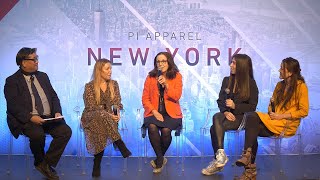
Four sustainability experts discuss moving fashion beyond greenwashing through transparent claims, third-party certifications, and technology like blockchain. Brands communicating waste-reduction stories see up to 15% bottom-line improvement and three-fold conversion gains. Real solutions include dead-stock reduction, on-demand production, and verifiable impact metrics built with MIT algorithms.
Chapters
Hi, my name is Yelena Mogilevsky, and I'm Vice President of Product Development and Production for Comar Brands. Might not know Comar Brands, but you would definitely know our brands. We do a lot of brands such as DKNY and Ellen Tracy. We do private label. We own factories. We manufacture overseas. And I'm happy to be here.
Hi, I'm Carolyn DeBare. I am a consultant in the footwear industry. I've been in shoes for about 35 years. I work with some startup brands and also most recently a few years ago, uh, co-founded a footwear brand that is manufactured locally in downtown Los Angeles.
Oh, wow.
So sustainability is at the core of that. And I, um, am an adjunct professor of footwear design at California College of the Arts in San Francisco. And I do work on intellectual property as a footwear expert for trademark, patent, and trade dress and trade secret litigation.
Hi everyone, my name is Stephanie Benedetto and I'm the queen of raw. I come from a family background of over 100 years in fashion and textiles in New York, so it's definitely in my blood. And I'm here to tackle the $288 billion a year of unused textiles that sit in warehouses collecting dust, right? Or get burned or sent to landfill. So we built supply chain software with an integrated marketplace So businesses small to large can buy and sell that dead stock, keep it out of landfill, turn what would be pollution into profit, and read the data to minimize it going forward. So we've already saved to date over 1 billion gallons of water. We're just getting started. I mention that because never doubt that the actions you take can't save you a lot of money while changing the world.
Hi everyone. Hi everyone. I'm Mary Kate Vaida. I'm the sales and marketing director at Eco Fashion Corp. And Eco Fashion Corp is a greenhouse brand as we like to call it. We have a couple in-house brands, including two for PVC, Sea to Style and Farm to Home. And I personally manage our B2B division, MetaWear, which is a turnkey sustainable supply chain manufacturing platform. And what we do is we help both brands, big and small, have a turnkey and simplified way to adopt sustainability. In addition to that, we have our own cotton farm project called Reset, which is Regenerate the Environment, Society, and Economy Through Textiles. Thank you. And with that, we put a priority on preferred fibers and materials to really help try to push the whole industry forward. Our founder is eco lifestyle pioneer Marcy Zaroff, who's really been a leading voice and authority in this space. So super excited to be here to chat with everyone.
Great. So we're going to start with our first topic, and we're going to start off with Stephanie. But, um, After Stephanie, if any of the other panelists want to chime in on this topic, feel free to do so. So how would you define meaningful sustainability, and against which and what types of metrics should the apparel industry be measuring itself to demonstrate it?
We're jumping right in. OK, so that S-word, sustainability, means a lot of things to a lot of people, of course. And at the end of the day, for us, it's about building solutions, technologies, business business models that make sense for people, for planet, but also for a business's profit. And those are kind of the metrics that I really wanted to focus on. When we first started talking to fashion brands and retailers years ago about opportunities to buy and sell deadstock, it was kind of seen as like a nice-to-have and not a have-to-have. And we'd end up talking to only the sustainability departments in brands and retailers who, don't get me wrong, they're your brand champions and incredibly important, but a lot of times they were a newly created position or they didn't have a budget and weren't fully integrated into the business. And, you know, fast forward to today, of course, I'm sure people see the latest McKinsey reports. This is a top 3 priority for every C-suite. And so when you're looking at the metrics that you were going to report on around these initiatives, it has to speak to people, planet, and profit. And you need in that room the CEOs setting the corporate agendas, the CMOs doing the storytelling, the CIOs and the COOs who manage the technology that this stuff touches, the CFOs for whom this is about their bottom and top line, and, you know, supply chain, of course, and procurement who touch this stuff every day. And so when we started measuring impact that we were having with our community, the first thing we did was look at profit. How much money are we saving and making? And we spent a lot of time building out an ROI calculator that's showing just by finding some of this deadstock and selling it, some of our Fortune 500 customers have saved up to 15% of their bottom line in just one year. And not only that, by talking about the good work they were doing, they saw 3 times the conversion rate in their online direct-to-consumer business, just by talking about it. And so I think those are the kind of metrics that this movement needs to lead with. But of course, that doesn't mean it doesn't also matter to people and planet why we do what we do. And so we also spent time this past year with MIT building out an algorithm. So in real time now, you can measure for every single product that has textiles in it, the amount of water, toxins, carbon emissions, and waste saved by the actions you take. And I think, you know, more like those kinds of metrics are going to be important, not just because CEOs are setting the agendas and asking for it, not just because ESG and the world is demanding it and the laws are changing, but also because your consumers are demanding it. So I do believe it's the future.
Anybody else?
Yeah, I definitely would mimic what Stephanie says. It's a holistic approach. It's not looking at one singular thing in supply chain. And I think what's exciting to see is, as you spoke to, it's no longer, you know, this department owning it. It's the whole team coming together to figure this out because now it really is all hands on deck. Following COVID, 2 out of 3 customers now want to really put more importance on climate change mitigation, and it's now up to the companies to really drive that.
Well, each brand, I think, defines it maybe differently for themselves, and not every brand is in the same place at the same time. So as part of footwear, there's the Footwear Distributors and Retailers of America that did a survey recently, and they said that 19— I think it's something like 19% of companies haven't done anything yet. 43% of companies have a plan, and this was of hundreds of footwear brands that were surveyed. So not everybody's going to be in the same place, and I think it's a matter of setting goals for yourself that are attainable so you don't always feel like you're failing, but also just taking it one step at a time because if not, it becomes too overwhelming and you won't be successful.
One of the things our industry partners are always talking about with respect to sustainability is sustainability is a target and moving towards that target. So echoing many of the things that you've been— the panelists have been saying. Why don't we move on to the second topic. Are the consequences of greenwashing sufficiently high to limit its practice?
Yeah, so I think just for anyone in the audience who doesn't know what greenwashing is, it's essentially keeping broad topics around your sustainability goals that can be oftentimes misleading for different companies. And I think as of today, it's not something that's too heavily regulated, which is the biggest issue, 'cause then the companies that are doing it right ultimately are the ones the ones that hurt the most. And where it becomes really important to shine light on the importance of really banishing greenwashing is having those impacts to back the claims that you're making and really starting to be able to say if you're gonna claim that something is quote unquote sustainable, how and why it's sustainable. And there's a lot of great organizations out there such as TE, who's really driving material health and material change, as well as Fashion Revolution, who has their own index to really help the customers start to learn what companies are taking strides to really propel their goals and do it in a way that's authentic. I think where authenticity really starts is understanding every single touchpoint of your supply chain. So that's where the transparency piece definitely comes into play. And ultimately, I think as this continues to keep momentum in our industry, the consumer is going to be the one that's demanding all of the impact that's really backing what it is you're saying. and that will then also empower them in terms of the purchasing decisions that they're making.
Great. Anybody else?
You know, the greenwashing word, I have a bit of a controversial opinion about it because of course I strongly believe you should never be lying intentionally, of course, or false and misleading statements. But there are a lot of awesome, powerful organizations out there doing incredible work or starting to do incredible work. But because of greenwashing and other issues, they're afraid to speak about it, right? And there are amazing commitments being made, "We're going to be 100% sustainable by 2025, 2030," which is awesome. I think it puts a stake in the ground as to where we are going and what people care about. But when you hear those kind of statements, you almost don't know where to go and what to do on day one. You're a bit paralyzed. And I do want to encourage brands and retailers, small to large out there, I mean, you do need to start somewhere, and there are places. Like your deadstock and waste, doing better with it, that can save and make you money while also starting to do good. And you are right, there are a lot of technologies out there that are very quick, easy, and cost-effective these days for you to start, even just at the beginning of your journey, measuring that stuff and having that blockchain record and proof to talk about it articulately in the public. So, you know, with everything going on, I hope people are encouraged, though. Keep sharing what you're doing. That is such an important part of both attracting consumers, but also for building for the future that we want. And we know the future supply chain is going to be one more that is on demand, more local, more digital, more sustainable, and we want you to be a part of it.
Totally. And just one more thing I'd like to add. I think another good security blanket for brands is looking to adopt third-party certifications because that's a huge piece of the puzzle and something that you can ensure, like organizations such as GOTS that look at not only all the way through to the finished product, but each singular identity on the way to ensure compliance. It then becomes your recognizable stamp of approval that you're doing it in the right way. But as Stephanie said, I feel like we need to shift the perspective from being one that's heavy or something that paralyzes you and instead be something that you see a lot of potential in and can get excited about.
Yeah, absolutely. And I— if I add, I think that a lot of companies, like you said, are starting to do things on a very small level and just not talking about them. For example, like, all of our hang tags right now are recyclable. We don't scream that to the public. We don't call that out anywhere. All of our warehouses have solar panels and LED lights, okay? That was some— a change that we made. We are moving towards sustainability, but yet not screaming it. And I think that we don't know how to communicate that to our customers. Having so many different brands, having so many different customers, so we're touching not only our own brands, we have D2C, we work with private label, we work with manufacturers, we work— so how do you tell that story and where is the right way to tell that story? Through our own brands or through our private label partners? So although sometimes companies and manufacturers are moving towards the right way and they're making changes and continually improving, they're not speaking about it the way they should be. And they're not out in the public telling everybody what they're doing.
We'll probably go to the next question. I mean, I have plenty to say, but—
Oh, OK. Well, the only thing I was going to say to reinforce some of these points is that I think there is something to be said about brand storytelling and integrating sustainability into the brand storytelling because there is— this danger or this perception of this danger within this era of cancel culture. Gen Z, whatnot, demanding sustainability and willing to call out brands. And if you're a smaller brand that doesn't have a crisis PR management company, you could be at a disadvantage. So I could definitely see why a lot of brands are kind of feeling a little sort of wary about about this whole greenwashing topic. And I think some of the things that can be done have to do with the brand and have to do with storytelling and things like that. So great, great responses here. OK, so next topic, how can we leverage technology to drive true sustainable impact for businesses while also providing a meaningful experience to end consumers?
Well, it's funny, as I've been— if my great-grandfather were alive today and I were explaining him what I'm doing with technology, right? I think we're selling technology to, in many ways, an industry that historically has still been doing things the old-school way, right? And with a lot of legacy systems. Totally understandable why that happens, but the unique opportunity we have with what we're going through today is that this is the opportunity to you start to digitally innovate. And I think for so long sustainability has been seen as really good for little eco-conscious collections, right, and pilot projects, but nobody believed, and it is such a myth, that this can't be done automated and at scale for the most powerful companies in the world. I mean, we do it with Fortune 500, and there's some amazing large organizations out there who have published their EP&Ls showing you, here's the blueprint for how we did it, and here's how much money we saved and made by doing it at scale. And, you know, how do they do that? Well, when we started building our platform, we focused first on a marketplace. We built a place where you can go sell your waste, make some money. But we did that intentionally because we wanted our customers to be able to make money and then take that money and put it back into doing good work in their supply chain. You can then adopt technology innovations. You can pay your workers more. You can use your more sustainable materials. And your CapEx expenditure doesn't go up. How nice is that, right? And so now that our marketplace has been growing globally, we have built out fully supply chain software, and we did that to help businesses automated and at scale, not only find all this waste and sell that waste, but read the data and intelligently minimize waste going forward. And that's the ultimate goal, right? I hope someday we write ourselves out of a marketplace business 'cause we've solved the world's waste problem. We got a while to get there, especially through the pandemic, but the opportunity is there. And, you know, within our software, that's where we leverage tools like blockchain and machine learning. But at the end of the day, my goal is, and if I'm doing my job as your technology partner, you don't have to worry about that, right? We take care of the technology and help you do your business, track those KPIs, and help everyone do better for people, planet, and profit. And then hopefully it's a win-win-win, and how do you say no to that? So that's where I think technology can really do wonders.
I think that technology is helping us save money in many, many ways, right, with less sampling and the ability to digitally fit products. All of these things that we can do digitally are amazing and saving money, but then when we save that money, where do we want to put it, I think is the big question, right? We can raise our profits, but we can also reinvest in something that would help educate our consumer or achieve our sustainability goals. So I think that what we save doing technology is really, where do we apply it after?
Yeah, I mean, technology in general has just changed the game. Specific to us, since we really help build supply chains on behalf of brands, now being able to track and trace the product and really highlight the work that you're doing from a sustainability lens, has shown all the way through to the customer transparency on a whole nother level. What we're adopting now, much like Stephanie is, is blockchain to be able to show all of the story, like we say, doing versus storytelling along the way, really helps engage with customers all the way up through a QR code on a hang tag so that you have that kind of visibility with your customer and can start to share those stories. Because we all know in terms of engaging with customers, it has to start with storytelling. And then, all of the yummy, juicy metrics on the back end needs to become just embedded into the models that we're working with. So I think in this digital age, we're now in a whole new day in terms of an industry, and it's really exciting to see all the touchpoints we're now being able to have access to all the way through the resale economy and really helping make sure that we're adopting circularity as part of this equation too.
And what's kind of cool about that, right, is in addition to your customers being able to scan that QR code and seeing at point of sale point of purchase, their impact. It isn't just about the story doing the storytelling. They can also see why something is ascribed to the value that it is. And with business models like ours and others that technology is opening up, it's helping you run more quickly and more efficiently, improving speed to market, but also helping you save costs, right? And then your consumers can actually get a like quality product at point of purchase that actually costs them the same or less while also being sustainable. And I think that's And that's where we can start to shift the narrative too, that sustainability has to cost you more money at point of purchase. It doesn't, and it's part of how we have to show the consumers.
I think I look at technology and sustainability a little bit from a different angle because, like you said, I think I look at it more from the 3D angle, and that's how it affects my world. And I continually am pushing my team. We have an amazing innovation center in Sri Lanka with a 3D— with 3D that, and I'm pushing my team to sample via 3D instead of actual samples. And then it becomes, you say to yourself, you have big box retailers pushing us for sustainability in fabrics, in hang tags, and yet the amount of samples that they demand, when you think about it, from color runs or when we're just presenting, they want to see before they even buy an entire line fully sampled, fully colored. When you talk about sustainability, how is that sustainable when we now have this incredible technology and we all have incredible imaginations? We know that we're experts in the business and we have this way of looking at product in a different way. It doesn't have to be tactile. You don't have to touch it when you could see it in this 3D with this movement. And now I'm seeing downstairs during this incredible event, the 4D, and you can actually have avatars that move. So sustainability to me in a way when big box, you know, we deal a lot with private label. And when I see what we are trying to do with 3D and sampling, and then I see what we are being asked for, what my design team, the sample requests that they're pushing through to my production team, to my factories, it It just doesn't go together. It's like they need to be— it's like the big box, or, you know, retailers need to be educated. On the one hand, you're screaming sustainability, and then what you're requesting from vendors, factories, and manufacturers is the opposite of sustainability. Because samples, they don't fit, they're not color right. Where do they end up, right? So they end up— they don't have an end life. They don't have an end use. So to me, I really see that as an area of really where we need to tackle and educate and educate and push and make it where we're not rushing. Right now I have a deadline of 5 weeks to get samples, okay, completely. They want 380 samples.
Why?
I just don't understand it. And to me, when I look at technology and sustainability, that is where I feel like we should be pushing the needle. Needle.
There is some cool tech coming out that you can feel the fabric through the phone. So it is coming, right?
No, it's, well, a matter of saying— I mean, haven't we all worked with people that say, I have to touch it, I have to see it, I have to feel it? I mean, a woman that I work with on shoes currently, it's the same thing. I can see it, and I can visualize it, but that might be because I've been in design and development for over 30 years. But she can't. She's been in buying and planning and inventory. And so for some, it's just not in their mindset yet to make that transition. And where we look at things, it has to be collaborative, and we don't want to leave others behind. There can be resentment that comes from that. So it's a matter of making a decision, I think, as a brand or as a company to do it together, to collaborate together, and really educate in a way that's kind to show people what the real benefits are so that it doesn't become a negative.
Wow. Yeah, I have plenty to say on this, but I'll just park one thing is that I think one of the fascinating things that we've encountered in higher ed and working with industry partners like, say, First Insight, who does predictive analytics with CRM, is sort of the integration of various technologies. And the students are really interested in combining 3D plus predictive analytics. And it's a really exciting time. And they just want to blast everything apart with respect to current business models when it comes to sustainability. They said, well, the current model is sort of broken, so let's rethink it. And I think that that's really exciting to see. So moving on to the next topic, what are some of the models and strategies to support the future supply chain, one that is more on-demand, digital, local, sustainable, and profitable?
Well, I've been looking into this concept of microfactories. I don't know if any of you saw when Keen had that mini factory that drove around the country and they could make a shoe in 8 minutes. And people could pick, you know, they were going to universities and you could pick your upper and your outsole and they would put it together and they'd make a shoe in 8 minutes. I wanna do that. So I've been looking into it with a simple product that we're making right now, and I think that when it comes to local manufacturing, the costs are really high because labor is the most expensive part of making a product and making a shoe in the United States. In the United States. So I think that we can look at minimizing the number of materials. I'm trying to make a shoe that has no glue right now, and we're doing it unlined. And so it's taking— I think it's deconstructing the product, looking at how you can make it in a way that is more simple. And I think globally, you know, you're sourcing from less vendors if you're doing that, right? So you're reducing your supply chain a little bit. You're getting a little bit more efficient. And you can continue step by step, I think, to do a lot of that. So I'm really into the micro factories, really into trying to use no glue in making footwear, reducing the materials. I think all of that will help profitability to some degree. And you just keep going and going and educating yourself, educating the consumers, and the rest will follow.
Thank you.
It's kind of cool to see too what's going on with design. I mean, we can go through all the incredible things that Nike and others have done to create really cutting-edge, hot drops, sold out in minutes, innovative shoes, to your point, and clothes, but with minimal waste and minimal toxins out of their own recycled materials, right, with that story to tell and at a good price. So, you know, to some extent, I think we need to think differently with design thinking, which obviously education is doing an incredible job doing, but we find ourselves spending a lot of time I spend a lot of time talking to design departments in big fashion houses, from fast fashion to luxury, about how to design with deadstock. And it's interesting 'cause they get challenged in the beginning. They're like, "But this is not how we normally do it. We put an order in and we need a sample and we prod—" Right? Like, they just don't know. But when I talk to them about the benefits, well, guess what? Here's X amount of yards of what you need, located Y, right where you need it, Z, at 80% off your wholesale price. And by the way, if you wanna cut a yard from it in sample, it's cut from the same lot your production run will come from, no discrepancy in color, quality, style, curation. I mean, talk about improving speed to market and price and opportunistic pricing and cost. And then they realize how much time and resources it actually saves. So I think that's where we start to shift a little bit of these business practices while still integrating it into existing practices. And it just opens up a huge amount of opportunity for design and business.
[Speaker] We're doing small runs at this local factory in LA, and they do have a sample area with kind of the waste or things people didn't want. And we can just walk over there, and because our runs are so small, producing locally in the US, I got the stuff for $1 a square foot, and it was available that day. So we could just use it. And same thing, there was a leather warehouse 3 miles away, went over there, got this amazing product that had been rejected, and same thing, had, you know, the Uber that I was taking to the factory, and 3 miles away delivered it to them the same day. It was amazing. Anybody else?
Yeah, all of it is so incredible, and I think lean manufacturing and on-demand really is going to continue to be on the rise, so personally with our business as well, it's something that we're looking at and seeing how for the bigger retailers, do you incorporate that and slowly start integrating it so that you can more adapt to what the consumers want when they want it? And as you were saying too, there doesn't have to be compromises along the way. And I think that's a huge message with sustainability in general is, yes, you can make sure that you hit your price targets, quality, design, comfort, fit, et cetera, and you can have all the rest of these things that we're speaking to. It's just thinking differently and adopting those new models. Excellent, excellent. Did you have—
Yeah, and I think, I think just the world we're in has been pushing designers towards designing more sustainability. I mean, just look what happened with Cannes. You know, we could just look at that. You know, with the Xinjiang area and the ban of Cannes from certain areas has really pushed people to BCI Cannes. So now I can tell you from my company perspective, all of our Cannes on is BCI now. Where 6 months ago that was completely not the case. So it's sort of, uh, we're not the designers pushing it, but what happened in the world pushed us to be more sustainable. So there's that aspect of it. And now our designers are seeing things from a different view. And now they're saying, well, maybe I should be choosing more sustainable fabrics. And now we're seeing, well, guess Guess what? We actually could afford the BCI where every single time we were like, "Oh no, no, don't go for the organic or the sustainable kind because we can't afford that." So my designers never even priced it or stayed away from it. All of a sudden they're forced to it, and guess what? We still got orders.
Mm-hmm. So the Sustainable Apparel Coalition did a study, and it says that 80% of sourcing and material and sustainable decisions are made in the design process. So it makes a lot of sense. Great.
All right, so next topic. What is our role in educating the consumer to better support a more sustainable operation internally?
Well, we've touched already, I think, a good amount on the storytelling and the unit economics that our consumers want and need. But what I think and what I'd really love I would love to push all of us here to do is more collaborations and partnerships that we're then communicating to our consumers. There's an interesting book called Transformative Markets by a man named Bob Lutke. And he went out at Georgetown and he analyzed all this publicly available information from 2018 to the present and looked at companies and people who are transforming markets. And he ranked them against a trust factor of how much consumers really trusted and believed them. And somehow, Ranked the highest above Amazon and above Google and above really powerful companies. And I asked him, I was like, how is this possible? And he said there were 3 reasons, and I mention this because I think this is valuable for any business that wants to transform a market. He said, one, you are always talking about collaborations and partnerships. You work with MIT, you work with SAP, and you're out there doing cool collaborations together. Two, he said that by doing that, we also are communicating really important met— metrics, and we stand behind those numbers. We talk about the water, the toxins, the carbon emissions, and the waste saved. And 3, he said that we also have a lot of fun in what we do. And funny enough, those were the factors that actually contributed to us ranking so high in trustworthiness. So as you think about your brand and your journey in sustainability, I'm excited when this becomes less about sustainability, more just about the way good business is done. But I mentioned that in storytelling and in sharing to your consumers, have fun and do some cool partnerships. There's a reason that ThreadUp and JCPenney and Macy's, right, did collaborations. There's a reason all of these cool companies going together and doing cool stuff, and don't be afraid to do it and talk about it.
So COVID has given us an amazing opportunity to go more direct to the consumer, so it gives brands a better opportunity to educate them as well and to not forget about that. So I think it's about keeping it short but sweet though. Don't inundate them with pages and pages of FAQs. You know, we're all moving too fast for that, right? Unfortunately and fortunately. But I think that if we educate, but educate in a way that is collaborative and helpful, it will be more meaningful. And storytelling is definitely, I think, one of the biggest ways to do that, it engages the consumer. It's just like you want to engage the people that work for your company and have them believe in your values and your ideals as a brand. That will be your happiest employee, but it will also, I think, be your happiest consumer.
So we talk about transparency a lot, and that's the big buzzword now, you know, risk management and transparency. And we talk about transparency a lot from from the vendor perspective, the factories. Are they being transparent with us? The suppliers, are they being transparent with us? But what about us? What about us as brands and companies who represent multiple brands? You know, when we talk about a lot of companies, and I kind of keep going back to that as a manufacturer, you know, we talk about brands and they have a brand that can tell a story. How do companies who deal with a lot of different different retail spaces or different customers tell their story. I think it's important that they be transparent with their customers, be it either the retailers or the direct-to-consumers. So a lot of times we're not telling the story. As everything that we're doing to be transparent, we're not actually being transparent with the consumers, yet we want the transparency from our suppliers. Supply chains. So I really just think it's taking that same transparency and flowing it through to the end consumer.
Well, they'll go with us, you know, kind of every step of the way, right? Our successes and our storytelling is about saying, to some degree, we're not perfect, we didn't start out perfect, and as we go along and we tell the story, bring them with us because they'll be happy for our victories along way.
For anyone based in New York or with a large presence in New York, you can check out circularnyc.org. That's an initiative we started with H&M, Unilever, Cisco, Goldman Sachs, and the Ellen MacArthur Foundation, and some other big companies, um, to change the laws in New York, make New York City circular in the coming years. But the goal is not just to slap businesses with millions of dollars in liability, it's to give us a community with platforms like ours that can actually help you solve those challenges and do better as a business and offset that coming legal liability. So the world is shifting. There are great groups and collaborations. This is just one example that you can be a part of today and start that partnership, that storytelling, and working towards that future.
You know, we talked about, or I know a question was, how do companies, how do we keep companies accountable? You know, and something that Joe said, you know, he was the speaker before this one, is that article of credit companies not giving credit if you are not meeting your sustainability plan. I think that's really interesting. You know, that's actually putting your money where your mouth is. That's saying, okay, here's our sustainability plan, and as long as you're moving forward towards it, well, then the credit stays. But what if you're not? I mean, I thought that was a really interesting concept. To make companies accountable.
And gamify it. Gamify it for the business, but gamify it for your consumers too. Let them track the impact they have and give them loyalty and credits and coupons for recycling, reusing, reselling their goods, right? And you can get a business economic advantage from doing it and get more consumer loyalty.
Well, this is a great segue because the next topic is how do we hold brands accountable for their product statements and defined terms terms such as sustainable, eco, green, recycled, organic to educate consumers?
Yeah, I definitely think this goes back to the metrics. That's definitely inherent to any of those claims. And last thing, just going back to the importance of community too, I think a great way to share this with consumers is to bring it back to what we've seen in food with the farm-to-table movement. Now we're really coming to age of the farm-to-fashion. 'Cause people forget your clothes don't grow in the department stores, and a lot of times they come from the same places your food does. So I personally, as a consumer, think that that's a very digestible way to really hone in on what the overall message here is and the interconnection of it all. I like that, farm to fashion.
I know. We should start a brand. Right? Right. Now, we had, I think, touched briefly on certifications, and there are groups like the Leather Working Group, which those of you in footwear might be familiar with, and they have like gold, silver, bronze certification. So I was looking for gold-certified tanneries, 'cause that's the only type of tannery that I wanna work for, but I can put in Brazil, Novo Hamburgo, and the gold-certified tanneries will come up. Or you can go to the Sustainable Apparel Coalition, you can look at the HIG index, asking for LCAs. There are so many opportunities to get the information that you want, hold people or brands or others accountable just through getting that information or certification.
Well, perfect segue to our last topic, which is what role can certification play in communicating sustainability, quality, and transparency?
Well, I guess I started on that already a little bit, just kind of jumped right in. I think that it's going to be more and more critical and that, again, you know, going back to the Forward Distributors and Retailers who did that survey, word is that 51% of consumers are asking for, maybe it's not a certification, but for information about what they're certified and how they're not greenwashing and what they're doing. And so I think it will become more and more critical, suggest. I think that you'd mentioned a couple of different places too that were doing certifications, and just ask the questions. If you don't ask the questions, you won't get the answers.
It's great too to see the people like the Amazons of the world with the Climate Pledge Friendly starting to help consumers identify how to look out for those labels, because I think that's kind of the disconnect that we've seen in the last couple years is people don't know what to look for when they're in store. So, I think having those marketplaces and really starting to educate the consumer is very important.
Yeah, the more we know. Definitely. Excellent.
Well, we are out of time, but why don't we give a hand to our excellent—
Thank you. —panelists. Thank you, everyone.










