How Digital Capabilities Helped PVH Overcome COVID | Tommy Hilfiger, PVH | PI Apparel
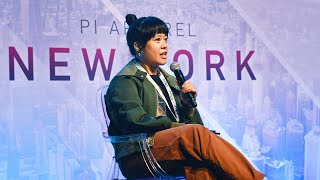
When COVID shut offices, Tommy Hilfiger and PVH used 3D technology they'd built before the pandemic to launch 3,500 products online and collaborate remotely. They'd already created a library of 1,000-plus materials and an auto-button generator. The teams expanded 3D into new categories like denim and outerwear, training designers fast and cutting physical samples entirely.
Chapters
Hello. Welcome to PI New York. It's been a while. It's been about 2 years.
Yeah, it's been 2 years.
Yeah.
How'd you have any trouble getting in today, Tracy?
Oh, you know, just an Uber ride that smells like an ashtray. It was great.
Back in New York.
Traffic is back. Good morning, everyone. Thank you so much for joining us. I'm Tracy Mancinito. I'm the director of digital product creation at Tommy Hilfiger.
And I'm Karen Martone. I'm a director of creative digital technologies at PVH.
So in our session today, we are going to speak about how the digital capabilities helped us overcome many of the obstacles that COVID presented to us. We're going to start with a brief video, the design evolution, a primer.
Some of you may recognize this video from the last Live PI. It was a lot longer than— The only sound was the squeaking of the markers. And when we were telling the story that time, we were really talking about how 3D and how technology has helped speed the process back from the old days when we hand-sketched. If you wanted to make a change, it was a big deal. You had to essentially start from scratch. And then Illustrator came along, and it was just so much faster to add in any colors or patterns. But we also had the ability to add in different ways to ideate without having to start from scratch and really expand. How we thought about color blocking and proportions. And now with 3D, we have that same ability. We have the ability to really change how we think about designing, how we look at our design, and create as many possible garments as we want.
Now, thank you, Karen. We're going to take you on our pandemic journey. We're going to start with never wasting a good crisis. Again, how our present digital capabilities allowed us to pivot and support our business, quickly accelerating its usage and adoption. Then we're going to go into the crisis team, how our teams became the crisis team and how we can lean on digital to help mitigate risk. And then living with our new normal. It's what we're all faced with today. How do we find opportunity and look beyond the crisis? Chapter 1, Never Waste a Good Crisis, Building on Our 3D Foundations.
So pre-pandemic, we were in a pretty good spot. We started our 3D journey many, many, many years ago, but we really took a deeper dive in 2016 and then dove in headfirst in 2017. And as part of that new journey was building out our core foundations and our library— Being a company with several brands and several brand priorities, we were given the opportunity to really scan and think about a lot of different types of materials as we built up that foundation. We had a material librarian, and we built up a library of about over 1,000 products. The same is true for our trims. Tracy was gonna— I gave her an image of our hundreds of buttons, but she thought it was an actual button card. And didn't include it.
You fooled me, Karen.
Because we had so many buttons for so many different brands, we actually even developed an auto button generator where all we needed to do is type in the size of the buttons, the number of holes, the size of the dome, and we can kick out a button like that. Working closely with our, our partners, our vendor partners, they even added the ability to change that diffuse channel directly in the tool. So if I wanted a zipper pull in 3 or 4 different colors, the designers can do that themselves. They don't need to come to our our team to build them out, these 3D assets. And that put us in a really good starting place for expanding 3D quickly.
I couldn't agree more. And now that we have these incredible digital materials in place, we started with our foundational core products that drive our business. This allowed us to build the trust in digital over time so that when the time was right, we hit the ground running. Your core product is the building block to your digital adoption and transformation. It's where it began for us.
And then March 13th happened in 2020, and our offices closed. And with the closing of our offices and everyone suddenly working at home, with supply chain shutting down, working overseas, we no longer have access to samples. Our process had to change. So with COVID we had to do new processes and new systems, and we were able to adapt to that as well. During COVID as well, when we're locked down, there was a need for new products. One of my favorite stories, we're in a meeting and the brand president's like, I want a gator on a hoodie. And in the meeting, we were able to pull up a hoodie that already existed from our fabulous— brought it, put— and right in the meeting in Webex, share my screen, sew on a gator. Is this kind of what you want? Fabulous. Tech team sends that off to a factory as an idea. They come back. And within a month and a half, we were selling. Gators, we had what was something like 50K unit sell-through.
You know, Karen, once we heard you did that, we at Tommy also jumped on the fashion PPE bandwagon and created a women's and men's version. And I'm proud to say that our women's made it to our top 10 for heavyweight knits for women's. And there you have it.
And if I planned ahead, I should have worn one today.
I know, me too.
So as part of that also in our change of processes, we also escalated our 3D fits. We didn't have fit models coming into the office anymore. We couldn't fit on them. Not everybody had— I call him my boyfriend, the avatar, the Alvinon form in their house. So how were we going to do fitting? We were able to quickly pivot and start working on digital fitting.
And at Tommy, over 65% of our current protos are digital protos. And you know what that means, Karen, right?
What does that mean, Tracy?
Savings. Savings on fit samples, savings on shipping, and also it's a more sustainable practice.
So it wasn't just a benefit during COVID that you could actually keep working.
No, and you get a more accurate sample and/or top-of-production sample on top of it all.
We'd also, with our new practices, need to upscale some of our designers who were not necessarily on the 3D bandwagon to start with. But we had our own in-house design training that we had in place, and we were able to quickly pivot that to an online platform as well, targeting specific case uses in that workflow that we could train and upskill all of our team members in.
I sat in on some of those sessions, Karen.
Save early, save often.
Now we're going to jump into selling virtually from the comforts of our home.
We were also in a great place pre-pandemic. We had started working with a digital merchandising tool, and because we had that in place, when the designers suddenly were working from home out of the blue, they didn't have their foam core boards, they didn't have little rooms they could set things up on. They were able to use our Visual on Merch tool to start working in that as well. So it became a collaborative design tool while they were at home. In addition to that, not only were our design offices closed, but so were the showrooms. How are we going to sell to all of our wholesalers when they can't come to the office to see the product? Quickly turned that into a digital selling tool. Lots of our retailers were closed. Our sales team and merch teams were chasing new retailers that were actually open. Can I get the polo in a racing red or a peacock blue? We were able to open up that block. Quickly color it within an hour, have a deck made, and they're showing it to a new retailer by the end of the day.
It's pretty exciting how far this tool has come for us and how we've been able to stretch its usage, right? It wasn't a design tool. Design started adopting it. It wasn't a production tool. Our production team started using it. Our sales team started using it. And then we're using it as a selling tool. And it's still being used today. E-commerce. I don't know if you remember, Karen, but our stores were shut.
Yeah.
Our photo studios were closed. We had a ton of product that we needed to get on Tommy.com, and we had no way of doing it. Or did we, Karen?
Well, we had only started dabbling in digital e-com selling. We were doing some A/B testing. We were taking our time, truly vetting it out. Could we use it as secondary images for collar details, cuff details, unique plackets? Could we do some, which version's selling better if we have it with a split yoke or a stretch yoke? And that was about as far as we had taken it. And mostly we focused in on our core products like woven shirts, some knit shirts, and maybe some swimwear. And that's about as far as we had taken it.
And then it grew.
Grew.
And then there was 3,500 SKUs on Tommy.com to date.
During the height of the pandemic, wasn't it almost all 3D too?
Yes, it was. My incredible team, with your support, has been able to unlock this for our business, not just for Tommy.com, but also for our wholesale partners such as Macy's.com, Kohl's, and Amazon.
When they saw what you were doing, they wanted in, right?
Not only are we benefiting the cost on samples needed for shooting, but also the cost associated with photography and post-production.
I'm really happy when pre-pandemic, one of the categories that wasn't going to work was the underwear. We didn't have soft avatars. We can't do underwear. We can't do underwear. We can't do underwear. But we had some really really great designers. We had Graham, we had Megan, who really saw the light, embraced it, and wanted to jump on it. And I would say they had pretty much finished their first season for market right before the pandemic. Well, then when the pandemic hit, we didn't do the current selling season, but we were able to take those blocks and those styles that they had worked on for that current season and retroactively fit it to that current selling season. And we were able to get them up on Amazon, Zappos, everywhere else. Then that designer, he is wonderful, Graham, he was able to reverse those. We took some of those Tommy blocks he had done, and through digging through tech packs, we started adjusting them, lengthening the gusset, making changes, and actually adapted them to Calvin product so that they were able to have a digital market. So back in that earlier screen you saw where we had the slides, that we were able to leverage existing products and existing materials to build out those styles quickly.
What about expanding categories? Expanding our capabilities and our opportunities. Karen, do you think you can make us a hat?
Oh gosh, I have been dying, dying, dying to do hats. Pre-pandemic, we had to focus on apparel first. We never had time for accessories. No one ever wanted to do it. And yes, we would love to do a hat for you, Tracy. Can we start with, like, 1 or 2?
Sure, that sounds good.
Or 3 or 4?
But we might need more.
Yeah? So now we have got bucket hats, visor hat, trucker hats. We are hats and men's, kids, women's. Do we even shoot hats anymore?
No, we don't.
And I challenge you if you can tell the difference.
She got me with the button, guys, so be careful. What about flip-flops?
Sure, boy, you wanna send me a flip-flop?
Send you a couple. Do you have room in your house?
Oh, I have a lot of room in my house, yeah. I live in Brooklyn, I don't have room for all these samples. So yeah, we can start with one flip-flop if you like it. We can give it to you any way you like it. You want flowers, you want gel, you want slides, we can give you flip-flops. And sparkles.
And sparkles. You can't forget the sparkles.
Can't forget the sparkles.
Now, what about sweaters, Karen? I feel like for a long time I've been hearing that sweaters is out of scope. It's a difficult product category to onboard.
We have been traditionally told we cannot do sweaters because sweaters are not using patterns. They don't use DXF files. They are out of scope. And that's true of not even 3D. Everyone thinks sweaters are unique and different than anything else we do in apparel. Well, my father has been going to Macy's for as long as I can remember and keeps buying his Argyle Christmas sweater. And it comes in red and gray and green and gray and big girls, girls and little Argyles and broken Argyles. But it's the same sweater. So we took a couple of our Heritage Core sweaters, the V-neck, the crew neck, a vest and a cardigan, and we took them apart. And it wasn't that hard. We ran them through our physics machine. We were expecting them to unravel. They did brilliantly. And we mocked them up and we went to town. We built the quarter zip. We expanded the knit categories. We worked with the design teams and we were working on aligning up how they can go from CADs, but they were still skeptical. And then we had a pandemic.
And now our sweaters business is no longer an out-of-scope category. And you recently trained our sweater designers.
Just had another training, yet another training just last week, and they were thrilled. What they did in class was just wonderful.
And the same thing applies here. We started with our core sweaters so that our designers can begin to ideate within the tool with their core business. What about socks? Aren't socks like small sweaters for your feet, Karen?
Okay, I never back down from a challenge, but this one I was like, "Oh, I don't know about socks." Come on, Karen, you could do it. Who is buying socks in a pandemic?
Everyone.
Apparently, they're selling. So as much as I pushed back, it's circular knitted, we can't do circular knitting, but Tracy's right, it's sweaters for your feet. So talking to our vendor, they gave us the first foot avatar, which was a little interesting to say the least. But we were able to take apart some socks, turn them into pieces, start doing the physics on them and scanning. And the next thing you know, we build out a men's avatar, a women's avatar, a kid's avatar, little infant avatars. We are sock happy. We can do socks all day long. And I think the designers enjoy doing the socks.
They do. And same thing here, building their block library for accessories and having them starting to ideate within their core product. One of the exciting things here too is that we started our vendor collaboration process with socks. We started requesting BMP files for graphs for socks so that we can more accurately depict stitches.
Yeah, we bring it into the CAD tool, boom, insta-stitch.
Now, outerwear is something that also everyone has been saying we can't do. There's no way we could do it. Too many pattern pieces, too many layers. There's lining. What about the fill? Well, we started out with a lightweight bomber jacket, and it was season appropriate at the time. And then as you can imagine, winter was coming. So we started getting requests for puffers, for fur, for full-length reversible puffer jackets. And now we're V-Ray rendering all of these assets for e-com. And then our merchant sales team started inquiring on key looks for go-to-market. Then our marketing team started inquiring about mannequin looks for VR experiences on Tommy.com. So we started creating these stylized looks that you would normally create in person or in our showrooms. Just clicking away here.
Oh, you over-clicked.
I know. Sorry, guys.
So the crises. So we are the crises team.
We are indeed.
But we've learned a lot in this last crisis. And I think if we can survive a pandemic, I think we can survive just about anything. You got a cargo ship stuck in a canal. No problems, that doesn't impact at all. And I'm actually kind of surprised we don't have the new Frogger game of like how to get your ship through a canal or, but then it gets stuck off of California. You got China turning off electricity. We don't, none of that phases us anymore, right?
Not when you have digital capabilities in place. We're going to round out our session with the new normal. Finding opportunity beyond the crisis, building on the momentum, and building on our success. We'd like to start off with a where we were slide.
Yeah.
And as you can see, as we mentioned time and time again, that we started with our core foundational product, and that really was the building block to help propel us forward into unlocking future categories.
And we thought we were hot. We were so far along. We thought we were cool.
And then fast forward to today. This is where we are today. And what's really interesting here is that you can see that there are still gaps and places where there are opportunities for us to further unlock.
That's why we're here today, hoping we can fill in some of those gaps. Some of those gaps and some of the progress we've made is with our underwear team. We keep getting told we need soft tissue. Would love to have somebody help us and come up with some soft tissue. But we've come a long way with foam, slides, different types of material. How can you best present these? Laydowns on forms, stretch. There's a lot of opportunity here, and we're only just starting to scratch the surface.
What about accessories?
Oh, you know I love my accessories. We'll be starting once again lessons learned from our apparel, starting with our core product, why we've got a Julia backpack you can get at Tommy.com, as well as wallets, gloves, scarves. We're just starting to scratch the surface on those.
And building on our enhanced and future capabilities, we can now do folded product as well as create animations of the adaptability of this product. As some of you may know, Tommy Hilfiger launched their adaptive line in 2017. And with simple animations of our 3D assets, we can show the adaptability of each garment from magnetic buttons to magnetic zippers and Velcro closures and entries. With the use of Adobe Substance, we now have the ability to create photoreal textures. Virtual photography is something that we're also looking forward to to using in the future, as well as stylized laydowns for our e-commerce. Well, we weren't allowed to show these next few slides and we apologize, but we hope that you can wait a few weeks when it launches for holiday. Really exciting marketing capabilities that we've unlocked at Tommy.com.
Yeah, we got edited.
So what we've learned is that we need to stretch the use of our 3D assets to increase our consumer engagement. Now that we've amassed all of these learnings, these capabilities, these foundations, what do we do with these assets now that we have them?
Do you wanna talk about this slide?
You got it, Karen.
You got it.
Let's just play the video.
Okay.
Thank you all.
And thank you. So I guess we have lots of time for Q&A.
Yes, we do.
Or for people to go get sandwiches or coffee. Yes.
Hi, uh, when you were talking about doing sweaters in 3D, I got the impression you're not using Shima Safety but maybe one of the other programs. Can you talk a little bit more about that?
Yeah, that is correct. Uh, we are at this time, we're not using Shima, we're using our current process we use for everything else. We essentially converted the sweater blocks just into a DXF that simulates the panel. We had done a lot of work previously with our CAD tools for not only our yarn dyes and our cut and sew knits, but for our sweaters as well. So we were able to take the DXFs as a panel, and with a combination of scan textures and our CAD tools, we actually aligned those panels directly within— we're using Kaleido and Pointe Carrée for that— so that we can do things like take the Fair Isle, which is what the designers have been designing in Coleto all along. And we just pop that right on top of the sweater graph. And now they can see exactly where that's going to lay on the tool. With the team the other day, we were doing things. We've made textures or seams or patterns out of, say, cable knits. So they can draw that as a line, move it around, and they get to see exactly where it fits in the tool on the garment. Okay. I don't know.
Okay. Hi, I think I reached out to you on LinkedIn about— you recently posted about NFTs. That's the space I work in. Is that on Tommy's roadmap? Is that something of interest to you guys? It's definitely of interest and it is on our roadmap. We are beginning explorations.
Hi. I have a question. I saw on the slide that denim was an opportunity. So I was just wondering if you can kind of expand on that a little bit more, like why it's a little more difficult than every other category. Do you want to take that one? Do you want me to take that? OK. Yeah, we see a lot of possibility with denim. Once again, we haven't had the opportunity to really start building up the denim library and the wash library to the point where we'd like it to be. We see the opportunity to start deciding where, and we used to have a spinning thing in our lab. If I'm gonna be doing whiskers and washes and sandings, can I place it right on that pattern and make that predictive possibility? But we just haven't had time to roll up our sleeves and do it the way I'd like to do it. Did that make sense? And I know there are some people here in the next two days who have really dived deep into denim. I'm hoping to touch base with them, see if we can work on some industry standards on how best to proceed. So could it be that because of its unique quality, not quality, but denim is very unique, some denim, it's hard to reproduce? Is that kind of why, or— Mostly it's around standardization of the library and creating those images that we'd want to use. Now with V-Ray, I'm really excited, like, if we are going to do any fabric and any splits and how that's going to render out. That gives us a lot of opportunity. All of the denims we've done so far have been a little bit labor intensive that I have to validate, is it worth the effort? Versus getting that sample. So we're trying to find that fine line of where's the breakpoint. And I believe the unlock is the libraries. Hello, Dariusz. Hi, Karen. Hey, question for you guys. How much heavy lifting did you guys do for raw materials versus leaning on your suppliers for raw materials and avatars? That is a great question, Dariusz. It was her idea. I just was communicating for her. So I can't see who's behind the beam, who she is. But we have over 1,000 fabric scans, and we have done those ourselves.
Yay!
Mostly because when we started doing it, there wasn't a lot of resources to do that. We are working with our vendors currently on what they can do when we vet it. But we are still looking at what that vetting process would look like. 'Cause once again, if I have a garment from vendor A and a garment from vendor B in the, long run, they sit next to each other, and we need to make sure that they're cohesive and that they look cohesive is the big— and they meet our standards.
Just got someone over here.
Good morning. Alexei from Unrama. What I was really excited to see was on the roadmap, the e-com and how you're really leveraging the assets directly with the consumers. Have you run any tests before, any A/B testing, or what are the results that you're seeing, especially from a conversion rate?
So we have run several A/B tests. And as you can imagine, it's a good problem to have. The product was selling out faster than we can actually get statistical data on it. So to us, we're seeing that as a good sign. But it is something that we still see an opportunity to continue to test. But we haven't seen any slowdown in sales, which has been fantastic for us. And we do have a disclaimer on our site that does say that these assets are 3D. There may be some slight— nuance or variance to the product. But so far, no slowdown.
Of course.
Thank you. I'm sorry. I just wanted to find out if you were still encountering resistance inside of PVH to 3D. Because if you think back to before the pandemic, there's often been a lot of friction, people having to do a new way of working. But COVID meant there was an opportunity for that to change. Are you now still encountering some resistance despite of people realizing digital can help them in their workflow? Do you want to take that one or do you want me to take that one?
You can start and I'll answer.
Yeah. We have seen a huge acceleration since the pandemic of people adopting it. Once again, just having the training, we have people, I want to learn, I want to learn, I want to learn. But we also have some people who may not be as receptive. And we've also had a lot of personnel change as well since we started this journey.
Yeah, and to Karen's point, I think what was helpful is while working remote, you lean on your digital tools, right? So you're leaning on Webex or Zoom. And I think understanding and seeing that reliance to digital kind of unlocked a lot of opportunity for people and they saw the real value in it. Of course.
That was a good question. Hi. I have a question. Or you can just shout out the question.
Yeah, you talked a lot about training and I wasn't sure who actually Who did you train? What groups or functions? And what did you expect them to do? So what were their roles in 3D?
Well, we've trained all of our tech designers as well as all of our designers. Pre-pandemic, we used to also train up a little bit with what we call a discovery for almost the management teams to train them to look at 3D so that you have to train the eye from a 2D to a 3D mindset. When you look at something in 2D, it's very flat. I like to use like High Point shoulder as an example. So you're used to seeing a flat sketch, your shoulder's a little higher. When you're looking at it in 3D, you now have perspective, but you're still looking at something in a 2D mind. So you have to train them to actually adapt the 2D to 3D in their eye. But since the pandemic happened, we haven't had to up-train because it is what it is. And I think that they've just, kind of gotten used to seeing the 3D more, but right down to like even a shadow, they're used to seeing a flat CAD, all the color is flat and it's consistent. Well, now you have highs and lows and that would confuse them also. Yeah.
And you?
Oh, and we also have to train up the RM team and how we receive materials, like little nuances like that. Hi. A question regarding your 3D assets. When you first started the pandemic, you said you started leaning heavily on 3D. So how did you guys handle that? Storage? Did you build something in-house or— Oh, we— right now, we are actively researching library options. I think that's the nice way to say that. Yes.
You mentioned moving to virtual fitting. Sorry. We work— we are a resource that does digital product creation as well as programmatic photography for e-commerce using 3D assets. And so we land up speaking to brands and retailers. And it's a cross-function between e-commerce teams and design and technical designers. But when we reach the technical designers, there's always friction around, they want to take the 3D assets and like lengthen the sleeve, change the armhole. We're not there as a resource to help them with that part. But considering like 3,500 SKUs on Tommy are virtually fitted, like how— I mean, is there a separate program? How can you use the 3D to actually be ready to send it out to the factory? You know, like how did you have friction initially with your tech team on that or?
They actually adopted 3D before design did.
They were ready to dive in. Sorry. They were actually one of our biggest champions. Yeah. That's a good problem to have. I think— the hurdle of possibly slowing down design within the pipeline? Could you hear me? No.
Oh.
I just wanted to know how you approached design because we seem to have hurdles convincing them that 3D will actually be a benefit instead of slowing down their process. And they're— in the extremely tight deadlines that they're already functioning in. So I was wondering what your approach was with that.
To be honest, it was education. It was creating a town hall or a space for them and educating them on the benefits of 3D and showing them a video similar to this of how it really can support and help their process. And again, starting with their foundational core products, it shouldn't be taking time away, but rather giving them time back. That's how we addressed it.
And we're both designers, so we speak their language. We understand. I attribute it to going back to that first video. It was the same thing when we suggested Illustrator. So when we started sketching in Illustrator, that was like a crazy thing. And then some designers wanted to hire their own Illustrator sketcher to help them. And now I can't even imagine anybody not using Illustrator or some sort of digital tool to ideate. So it's really showing them the benefits and letting that light bulb go off.
I think we have time for one more question if there's anyone left. If not—
Thank you.
Great. Thank you all.










