How Footwear Designers Must Evolve in the Digital Age | PI Apparel
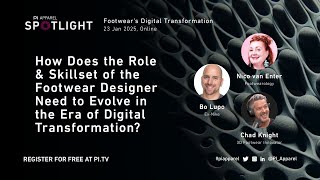
Footwear designers Nico, Beau, and Chad discuss how AI and 3D tools are transforming their work. Designers now direct AI-augmented systems rather than craft individual shoes. They must master 3D modeling, real-time rendering, and generative AI while grappling with job displacement and ethical questions.
Chapters
Hello everyone and welcome to today's Pye Apparel Spotlight on footwear's digital transformation. Uh, for those of you that don't know me, I'm Michael and I'm the Director of Content and Production here at Pye Apparel. Uh, usually very much behind the scenes putting the, uh, events and online events together. But today, um, I've had such a great time putting together this spotlight and the Stride event that we have coming up in March that I thought I'd try my hand at chairing. So, uh, thank you all for joining us today. As you no doubt already know, today's Spotlight is going to be made up of two panels. The first is going to explore how the roles and skill sets of footwear designers are evolving with digital technologies, and the second is how can we bring together craftsmanship and digital innovation to work together for the future of the industry. So I know you're all keen for us to get going with the panels, but just before that, a couple of announcements that I wanted to make. Should you have any questions that you'd like to ask during the spotlight, you should be able to see a chat box on the right-hand side of your screen. Please feel free to put any questions in there and we will endeavor to answer as many of them as we can, um, either throughout the panel or at the end of each panel. Um, you also can connect with the speakers via the Swapcard platform that you are on. So, uh, please feel free to reach out to them there. You can chat to them after the, uh, panel takes place through our platform, or of course, reach out to them on LinkedIn and chat with them there instead. Um, I mentioned this a moment ago, but for those of you that don't know, coming up in March, the 11th and 12th of March, we will have Stride, which is our first ever footwear-specific event that will be taking place in Portland over in the US. And I believe I'm right in saying that for the next week there is an early bird rate that is still running. So if any of you are able to come over to Portland this coming March, we would love to see you there. And please grab your ticket in the next week to make use of that special discount. Um, I did just want to mention, you may have seen that we have lost a couple of of panelists. We were meant to have Sophia Bilali and Chris McGrath join us, but due to personal reasons, unfortunately, both have had to bow out, but they do apologize. And rest assured, we're still in good hands with the remaining panels that we've got set up. So I believe that is everything. So without further ado, I would love to get going with the first panel on how does the role and skill set of the footwear designer need to evolve in the era of digital transformation. So joining us today are Nico, Beau, and Chad. So if you guys want to take just a minute each to intro yourselves and tell everyone a bit about who you are and your connection to the industry, that would be great. So Nico, why don't we start with you?
Sure. My name's Nico. I am the founder of Footorology. This is an international footwear innovation platform. I think many of you who are probably attending will know me and will know also the courses that we give because I'm coming at this subject today essentially from two angles. We, on the one hand, develop, indeed, digital transformation workflows together with software and other tech suppliers. And we also teach digital transformation to footwear professionals. So that's how I'm going to be looking at and contributing to the subject today.
Thanks, Nico. Great to have you here. Beau, would you like to go next?
Absolutely. Thanks, Michael. And also thanks for having me be part of the panel. This is really exciting for me. I spent the last 28 years or so up until about 6 months ago at Nike. My first half of the career was as a footwear designer and design director where I participated and helped lead digital transformation efforts from the design side, which was really quite interesting, especially dating back as long as I had been at Nike even back then. So it's been quite a long journey. But after that, I had the opportunity to lead several 3D design teams, both on the apparel and the footwear side, contributing to the advancements of digital creation efforts and helping to build technology capabilities that were aligned with Nike's strategic product creation goals. So again, long journey. I've been in it headfirst ever since. Super exciting topic.
Thank you, Beau. And Chad?
Yeah, thanks, Michael. I am Chad. I am a hands-on expert that has started in skateboarding. I was a professional skateboarder for a long time. Learned the value of trial and error, discovered 3D, and kind of chewed my way through it and learned everything I could. And am now trying to find a way to face that and turn that back and help 3D experts who are trying to navigate the system.
Amazing. Thank you very, very much. And I do want to add that all 3 of these amazing panelists are going to be joining the event in Stride too. So, uh, lovely, and cannot wait to see you there in person. So let's get going with the actual themes itself. We've got a lot to get, to get through. Uh, Nico, I wanted to start with you. So how do you see, uh, digital transformation is changing the role of footwear designers, um, including everything from just creating individual shoes all the way through to the design, uh, systems that they're using?
Yeah, I think actually there's going to be a really big, uh, shift, uh, at this moment. Also within Footrology, we are preparing a completely new program to teach people how to design because I think we're going to need a very different type of designer also in the future. First of all, what we see is indeed that things get much more automated than before, which is not necessarily a bad thing. I think when I look also at people that come into my courses, I just even this past week had a lot of good conversations with designers who are in my courses who are like, I'm so frustrated. I feel that my only job is to kind of tweak existing styles into something slightly different, but not really new. And when we look at that type of thing, of course, now we have another contender coming, for instance, like AI, that could also do that. So what will we see in the future? I see very much that we are shifting from designing individual shoes. Of course, in the past decades, the whole focus of design was, okay, you are visualizing, that's your main task. And then in the case of footwear, it's you visualizing the shoe. And now we see that we might very well have big data systems that are going to take a lot of the data, whether this is your e-commerce data, your sales data, things from online. We see online forecasting agencies coming up that have AI-based systems. And it could pretty well be that those systems could do that tweaking of shoes very much themselves. However, if we are all only going to do that, then where's the innovation? So what I see is that designers will be used actually much more for their creativity. That might not even have to be them drawing a shoe. That could be them giving more of a creative direction input, them thinking about what goes into that system. What data are we using? How are we using that? We see it now even when we create designs, for instance, in AI. We do a lot of AI training where indeed the AI can easily and probably faster and better than you can visualize a shoe, but it's also asking you Are you asking the AI for a style, an atmosphere, a thought? What are you asking the AI for? And that's where we see the biggest gap because this again is a whole new way of thinking for designers. What am I creating?
Why?
What is the purpose? What am I doing this for? What am I trying to achieve? Those are essential questions for design and it should always be essential questions. But now this is— and I really love that— that's going to be the main focus, I think, of design. Develop vision, understand where you want to go, And it might open up also the industry to many different creatives. So it might not just have to be actual shoe designers. All of the different creative inputs that could go into an automated design system could be completely different, could be more graphic design, animation, music, poetry, anything. We will see merges between the designers that do the shoes and the people that do the marketing where this is now usually two separate types of creativity. So I do see a lot of big shifts there. And that also relates, and I'm sure we will talk about that also in the rest of the panel, to the more technical side where we also see a lot of automation in terms of the generative design systems, procedural design systems like Grasshopper, Houdini, things that have been programmed, for instance, to provide customization that we now want to have in footwear. So I see a lot of interesting shifts there, but in generally going from, I am a designer, I design one individual shoe and this is my thing, to going to a big collaborative system where there's many different roles.
Amazing, thank you. Beau, Chad, do you want to jump in there and add? Why don't we start with you, Chad?
Yeah, I would second everything that she said. There is a fundamental change happening, and it is something that I've sensed for the last 5 years, not to make me sound special or anything, but it's something that's in the zeitgeist is what I'm pointing out. And it's something that I believe Nico's very in tune with, and that it is artificial intelligence is being introduced to our systems. As a collaborator. And what we've built up until now are foundations. And this is another layer of that foundation. So when we talk about things like digital transformation, these are layers of enablers. And I think that that is what's been very hard to see. And I think what people are starting to identify, and that there, there is some kind of logic behind this, and we can figure out how to optimize it and extract what elements of it add value to the system so that we can focus on creativity and the idea and our perspective and sharing that with the world.
Thank you. Beau?
Yeah, I mean, I'll just kind of reinforce what Chad and Nico just said in terms of, like, just think about historically in the role of designer. And how in today's world, the way technology and design overlaps is undeniable and inescapable. As a designer, maybe even 10 years ago in footwear especially, you can opt out of using any advanced technologies or tools, maybe if you didn't feel like it or didn't want to or didn't feel like it benefited your process. But the way things are evolving today and extremely rapidly advancing ecosystem, it's something that you have to opt in on, I believe. And so like Nika was saying, beyond just the individual shoe, thinking about systems and ecosystems and pipelines and how all the technology may fit together to maybe enhance your workflow or or bring you to a place where you can work better, faster, smarter, leveraging the automations and AI that we see being realized today. And the advancement, again, of the technology is quite striking. And you see more and more companies investing more and more in these spaces. So I just think as it relates to the role, like, you know, it's just going to be something that is part of your repertoire. Technology as well as design.
Amazing. Thank you. So really, in summary, it's coming whether you like it or not, but embrace it because there's a lot of opportunity and energy around it too. If used in the right way, you can refocus your, your time on the more creative stuff that we all know designers love. Um, so I think it is an exciting time for sure. And we touched upon this a little bit, but now going into kind of like specific tools and tech, uh, Beau will start start with you. What would you say are the specific tools that every footwear designer needs to be learning today to stay ahead and to stay relevant, I guess?
What a great question. I feel like it's a gotcha question. So what specific tools? I don't know if— I'll be leaning on my panel to help me with this one for sure, but I think there's a lot wrapped up into that question. It's— the answer is, I think, kind of complex. I have to— you have to step back a little bit from the individual tools, I believe, and just look at technology in general. And again, how it's overlapping with design. And also consider your current environment. Are you working on a team that's already leveraging certain tools or technologies? Is there already a pipeline or ecosystem in place? What's the goal? Are you 3D printing at the end? Are you looking for visualization? Is it a combination of all those things? Are you creating data that's supposed to feed a knit machine? So obviously that'll impact what maybe tools you decide to focus on. But I will tell you this, it's better to just start somewhere and don't sit on the sidelines. And so I look at, you know, there's a bunch of different ways to break out the technology and the tools. I think the 3 big ones, ones that we'll probably talk a lot about, obviously the 3D design and modeling tools, I personally, as a designer, would bias towards things that enhance my speed and iteration abilities and automation capabilities. Not everybody is going to jump right into computational design for sure, but if you can master a 3D modeling program, whether that's a NURBS-based or mesh-based program, it might depend on personal preference. But there are several tools in there that are obviously great for that. So you have that space. And then beyond that, you want to think about maybe rendering and visualization. So in my personal experience, I know there's a— because a lot of the traditional 3D tools are very heavily based in CAD and your connection with engineering, there was definitely a day when there was a push to have designers engage in 3D so that you can feed maybe your files to an engineer, which is great. I think there's a lot of value in that. But there's also a tremendous amount of value in just producing a visualization of your concept because that communication and the accuracy of that communication goes a long way. So when you talk about visualization of your 3D designs, that becomes really important, I think, especially for footwear because of the materials and how big of a role materials play in your designs. Obviously, they can make or break your designs, and especially considering The way design trends are going today where things are super simple, you can have an upper that's just one piece and it's all engineered knit. And so being able to represent that accurately and in a way that helps sell your idea is going to be really important. And beyond just a, maybe a static image, real-time representations of your design so you can quickly get feedback, quickly iterate, and quickly move through different design options is obviously going to be really important too. So those two big buckets and then Probably, I don't want to say the biggest, but definitely on the rise and very quickly, like Nico and Chad mentioned, AI and its influence on design. That's a whole topic we'll get into. But it's, again, it used to be a fun hobby and it was interesting and yeah, maybe someday. But again, with the advancements in the tools today, you could see how designers are actively working on incorporating AI into their design process and into their workflow in ways that are super, I think, beneficial to design and the process itself in iteration and just conceptualization, generating inspiration and things of that nature. And that'll only continue to evolve and integrate into your process further downstream and even into manufacturing. So again, to maybe reiterate, you got the 3D design and modeling tools, you got visualization tools and real-time applications there. And then AI is, I guess, the 3 big technologies technology buckets. There's specific tools within there that we could spend a whole day on diving deep, but that's how I kind of look at it today.
Thank you. Nico, is there anything you'd like to add to that?
No, I think it's— I agree to a degree, basically, with what he says, because we get, of course, a lot of the people that now are asking, am I— Nico, should I still learn the full 3D? Should I jump into Rhino? Or indeed, is this something that's going to pass me by because will be 3D AI. And I think the answer is a little bit in, in the middle. Maybe we can look for inspiration there to, for instance, the animation industry where this is going way faster, where yes, you still need to learn 3D, but a lot of the work that you might do might be fine-tuning and adjusting a 3D model that could be generated either by another application that you don't do or by another party, where of course also in our industry is very normal that 3Ds are made in Asia in the factory, which would also be logical. So that you want to be able to do 3D, but maybe to tweak certain things. I do think there an exception will be the 3D printing industry that I am in a lot. There we already have a workflow that we teach ourselves that is going— that's without any modeling, that goes straight from 2D AI, 3D AI. We just subtract to last and print. And we're still a little bit limited in how the 3D AI comes out. But okay, this is also— the application that we use has been around for 6 months. So, you know, these things go fast. But I do think that more deep understanding of computational design will happen in the procedural side. So that if we want to do all these things, you have to be able to do things parametrically. So we want to be able to have, I don't know, custom-to-size. We get a lot of people now, especially since Tellerfeldt has launched with Nike. I think everybody and their mom is calling us We want to start printing shoes and we're going to do it custom to size because I have a foot scanning app and blah blah blah. Of course, yes. In order to do that, you need a whole system that is parametric, that will take all kinds of preferences into account. We need more knowledge of biomechanics, which I think would also be a great thing for designers to connect to the digital side. Same with manufacturing. Can we connect manufacturing knowledge and the digital training? So those are also things that I still think are important because that's still the gap also that we have. Of course, AI can generate any type of shape. It doesn't have any consideration necessarily for either fit or manufacturing capability. So those are still things that I think are going to be really important combined with the digital knowledge.
Thank you very much, Chad. There was a lot said there. Do you have anything to add?
Yeah, I think I love it. I am so excited to have these conversations because for a long time I've been struggling to identify what was weird with what we've been trying to solve for. And digital, when we bucket it all as digital, it is the enablers. Those are the codes that enable the experiences that then the, those with the idea can use those tools to communicate their idea. And we've been stuck for a very long time in building those tools, and the users of the tools who want to leverage them as advanced means of extracting and communicating their ideas— we've been waiting for these tools to be built for us to leverage. So, um, I think that we're— we have to start learning. Anytime, um, something foreign and uncomfortable comes around and other people are good at it, it's uncomfortable. And but it's about learning. It's constant learning. That is the only way to stay ahead of things. And it's about humility and curiosity. And I think you have to fundamentally understand just what these tools are You can work in a virtual environment as a crafts— craftsperson, or you can work in a virtual environment or a digital environment building systems and inventing new tools and techniques. And it's an expansive space. The fact that we've labeled it 3D is what has been problematic as well. I feel like the whole industry is going to collapse and realize that ideas are in 3D, actually 4D, actually 5D, because we live in a physical world. And we need to find ways to best get those out in order to share our contribution with somebody else. And that's the product that we create. And retail is essentially outfitting life, and that's why it's been so complicated for us.
I will also say, I know especially on the footwear side, there are a lot of tools that offer free demos that people can use. So for anyone that is on here at the moment and hasn't yet dived into the world of 3D 3D modeling and, and, and AI. I'm sure you have, but if you've not, there's, um, there's a lot of ways that you can already start to try and play around with them for free, uh, so you can kind of get a grasp on how, how they work and how they would impact your day, day-to-day. So I strongly recommend you do a bit of, uh, a research and look into that. Um, right, we've spoken about AI. Of course AI was going to come up, uh, in, uh, today's, uh, spot— spotlight. Um, There are actually two questions that I'm going to ask about AI, but first I want to talk about how is it changing footwear design as we know it today in terms of creativity, workflow, but also what are the ethical considerations behind that as well. There's a lot of fear with AI, but there's also a lot of opportunity as well. So, um, uh, Beau, I'll start, start with you. Uh, the good and the bad of AI and how it is changing design today.
Yeah, well, I think how it relates to today is there's some tools available to designers. You can go on and use them and you can master them to what extent you can within your existing process. A lot of them are very good at the upfront part of the process, which you're just creating inspiration or ideation, because it'll generate as many opportunity or any, as many results as you want it to, related to kind of what you feed into it in a very visual way. So the visual AI tools, I think, is the easiest entry point for designers today in helping them with their current process. There's more advanced applications of AI within, like, again, like Nico was mentioning, in generating 3D, and we're going from an image to a pattern to a 3D, and things like that that are still a little bit experimental. But I have seen a lot of really great use cases where designers have implemented the more visual actual application of AI into their workflow in the very beginning parts of their process where they're looking to break out of their own kind of mental constraints. We used to call it the shape of fear in design where designers get caught in a rut and they keep drawing the same shapes over and over again. I think AI is one of those tools that helps you break out of your kind of your own mental box, if you will, and just generating generating images and ideas based off of what you feed it. So, so that's a really great use case for how AI can help with design today. And then, ethically speaking, you know, I would never assume that what AI would produce for me as a designer would be something that I could just run with, like, oh, let's go make this. I got it clean out of AI. It's an image of a shoe. Let's go make it. It looks looks great. I wouldn't, I would never approach AI in that way. I would never maybe even assume that it could actually nail a design in its complete 100% resolution as well, like in terms of like providing everything you'd want to provide as a full, fully designed product. So as a designer, you're just, I would assume you're just using it again as a point of inspiration, as a means to generate ideas, that you would use as a basis for your own work and not replace your work. That's both from an ethical standpoint, in my opinion, and just as a designer, like, it just doesn't sound like you're really doing your job then if you're having basically a machine give you the answer, if that's the case. So that's how I look at it today in today's world. But again, it's moving fast.
Yeah. Anika, would you like to add to that?
Yeah, yeah, yeah, because that's where there's a tricky point where I see things differently, where I don't agree. And that actually has not so much to do with the AI. That has to do with what design has become in the past decades for most people. So of course, when we're looking at a company like Nike, that could be different. But I'm, for instance, from the Netherlands, where we have a gazillion companies that are doing private label. You know, designs. And that's of course still a big majority in the industry that is not necessarily making, uh, high-level brands that have a high, uh, you know, percentage of authenticity, etc., etc. So when I'm looking at things like, um, tweaking existing shoes— so companies that, for instance, that have a lot of carryover products that they have every season, companies that are indeed saying, okay, we want to see what's in the market and tweak on that. That's actually where AI is already very far. And that's also actually now, which is a little bit sometimes my concern, those companies also, when I am asked to teach AI, that's also what many people want. Can you, which of the applications can keep my shoe design the same and just give me some new color and material renditions? And yes, for sure, there's a bunch of applications that can do that. But let's also be honest, for those applications, we also honestly don't need a designer. So you might be the one curating what the AI comes up with. And eventually, as the AI learns, people who are on that end of the spectrum, I do think, will be— not everyone, but there will be people out of a job because of this. I do think we can be honest there. Where now it says it's only collaborating, it's only a tool. It really depends on what type of design you do and where you are in the process and what your task is. I can imagine people who are colorists, for instance. I can think that an AI can actually be quicker there than a human can. Not always also bad news since we have in our— in the area of the world where most of us live that are in this meeting, we have also shrinking labor populations. So that might not always be bad. But I do think that that is a that is a change. One bigger concern that I have, but it is the same with any technology, when a new technology comes to the market, the first thing that we do is try to squeeze it into the workflow that we have now. So, for instance, I get a lot to deal with people who are like, so am I making an Illustrator CAD first and doing that into an AI, or do I do an AI and then have the AI make my Illustrator? Where my question would be, And I'm going to use Illustrator for— because if I could have a better system that uses that 3D visualization and could still connect it straight to a bill of materials, which is for sure what eventually happened, we don't need the CAD. I remember me teaching years ago for a— I was a consultant for a big sports brand and there were like 30 new 3D visualizers hired that had just come out of university for gaming design because they wanted to do more 3D visualization. These people could not visualize from CAD drawings, from Illustrator, because it's about as 2D as you could get. They're like, could you not just give me the actual shoe, tape over it, draw me some lines, give me some swatches, and I'll, I'll make it as you wish? So, uh, I think what is more interesting, um, we are doing that a lot internally, is to start looking at, okay, what could AI add to the system that we cannot? What— how could it do things that we never do. And, and for me, that's also why I'm hoping to discuss that more with people at Stride, is indeed using different data. A lot of times now, I think that the design process is very subjective, which is not always good. It's the people bring in their own background but might be producing for people on the other side of the world that have a different preference, different things. I'd love to see more data being put into the system and really think about how could that really change our system and what are things that we as a designer, human designer, can contribute that we otherwise cannot. I mean, AI iterates from existing things because that's how it's trained. As soon as you want to do things— we are actually doing some experimentation internally right now with that— as soon as you want to create things that don't exist, it doesn't understand that. So, things that don't exist, that actual innovation. This is often actually very conceptual type of creativity. This is also where I see a lot of opportunities for creatives to be really creative again and let the boring stuff, indeed, which is all the tweaking, be done by the AI. So that's what I hope will happen.
Thank you.
Just keeping an eye on the time, Chad, I'm going to skip to the next one, but it is you that I want to pick on first. So we're not going to skip you, don't worry. How can, how can we instill a lifelong learning mindset so that we actually focus on the big picture, the workflow, rather than just, oh God, here's a new tool, here's a new tech, what the hell do I do with this? Because things change so fast. We need to change the way that we approach these things. It's so much more than just a tool that we are looking at. We obviously, with every new tool that comes out, the industry is trying to fundamentally transform the way that it works. How do we instill that lifelong learning mindset and curiosity?
Thank you for the question. That is a great question. And I think that what we're all scratching at here and kind of we've been feeling is that there's a different way of doing things moving forward, right? And Nico touched on data, but it's about where do the ideas come from? And how much value do they contribute back to the, the community that you're creating those, those contributions for. So when it comes to a lifetime of learning, I think it's about understanding where as humans— and this again, it gets very abstract and it gets very complicated and challenging. And this stuff isn't easy. We really have to look at the interaction of points within our process and what they mean and what the role is and how it's communicated. And right now in the system, we have a lot of communicators in the roles of functions. And it's, it's getting confusing because they don't have the knowledge that's required to execute the tasks of that phase. And I think that if we have a pure intent to create something that is of value and to contribute back to the system, our system, our ecosystem, our community, call it what you will. If that is our fuel to contribute, then we will constantly learn and find new ways to do that better. And we will leverage the technology that's emerging to help us shape those ideas that we've established through our experiences and our knowledge and our understanding of how things operate and be able to understand again the needs of our, our community through culture. And that's why all of these things are so important. You can't just read data, you have to have context for it, and you have to be able to interpret it based on your knowledge and turn that into something that's a contribution to society. And I think that that is essentially defining creativity and figuring out how we work with technology. To maximize our contributions. And that is how we keep it, um, kind of void of corruption as well. And I think that that's a lot of it, is when, when resources get hoarded in certain areas, they don't go to the, the, the, the parts that need to execute and be able to deliver those ideas. And I think that that's where there's a really big restructuring coming And when it comes to like the next internet, that's it. It's how do we adopt and use 3D tools and technologies and all these things. And if you're waiting for technology to solve that, you have an empty enabler level to put it on and it's not going to work and you're not going to have people who understand how to use it either. So that's why knowledge is absolutely critical. Technology can help us, but we have to understand what it does to utilize it.
Thank you. And Nico, I'd love to jump to you because I know you do a lot of work educating brands, but also students too. You know, you've been doing this for a long time. So do you want to add to this?
Yeah, actually, I mean, I was almost, when Jed said that, I was like, mic drop, amen. So what he said, because that was No, but as we are talking about that subject, of course, unfortunately, because that's indeed a lot of things that I notice on my side teaching. So we teach new workflows, so we enable people to create their own printed shoe line or work with knitting. How can we do things locally? And the good thing there is that this technology also makes it possible for people that have that mentality that Chad is describing to enter this field, because let's be honest, not all companies would talk about it like that. They're not necessarily— when we have a shareholder meeting, they're not talking about the community, they're talking about profit. So it's, uh, but you have of course many, many, many, uh, great entrepreneurs that before were not able so much to start creating because they themselves are a little bit more visionaries than they are actual designers. So they were always like, oh, I cannot draw. I see that a lot also in courses, which I always love when I start teaching a course at a company, especially if it's at their offices, then originally they're like, oh, our designers need to do that course. But then management is watching. And then managers, as they realize that for many AI applications, you do not need to draw, they're like, would you mind if I try? I was like, sure. And a lot of people, of course, also in management have fantastic vision. They're like, oh, I feel we need to do this. But they are normally not able to visualize that because that's not what they normally do. And it will bring very different conversations to the table. And I think that's interesting. That's also for some designers a bit like, because suddenly you have different people in the team. It could go either way. You could have more commercial people indeed who say, I simply want to make a copy of that shoe. And then you do that quickly. But you also have the other side where people are like, finally, I'm able to visualize first and then also actually make the things that I think we should do that could indeed contribute to that community. And it's also lowering the threshold. a lot. So we see that we get completely different people into courses that from either side, could either be from large company, could be from a startup, that are extremely creative but not necessarily in the traditional way of drawing shoes. So I think, and I think that's only even more exciting.
Amazing. And yeah, I want to also say, even I can use AI, um, AI for these things. So if I can, you all can that are here today during the spot spotlight, believe you me. Uh, Beau, I'm going to put you a little bit on the spot now, but how much of this kind of long-term learning and curiosity do you think starts at school? You know, like, when, when these— when students are going to college, my understanding is, especially in this field, the way that they are taught is still very old. It's like based on how we've been doing things for a long, long time. Um, I do know some schools, especially on the apparel side, that are doing amazing work in, uh, instilling digital product creation into how they, how they teach. But the reality is there's also no incentive for them to do it, so they're kind of doing it off of their own backs and blood, sweat, and tears. So I guess based on your own experience too, what could we be doing differently from the education side at the college level to start to instill this?
Well, to be honest with you, it's been a while since I've engaged in any, um, any of the design schools to really understand where they're at in their curriculum, but I have a sense just looking at some of the work coming out from students, and they are dabbling, I would say, in some of this. I might look for a complete revolution on how designers are trained in their education process in regards to a lot of the stuff we just talked about. It's funny, like, I was just thinking to myself before we started the conversation that when I— way back when I was in in college, I was doubling down on 3D. There was a lab where we were learning Alias Designer, and I was like, this is the future. This has got to be the thing that's going to give me an advantage in the workforce. And I got hired into Nike, and there was no 3D anything at the time. And so I do believe now industry has far outpaced where they are with the educational system. And I think there's a real need to really rethink. Like, I don't know if they're still teaching industrial designers how to make physical models by hand like I was taught, but I kind of think that's a little bit of a waste in their time. Like, whether you're going to 3D print something or create something in 3D or use AI or whatever that is, like, I would be doubling down on these technologies as it relates to design in school. I just don't know if they're really there yet.
Yeah, thank you very much, guys. So, Chad, I'm going to jump—
oh, sorry, Anika, did you want to Yeah, just a real quick thing that they're just very short, that indeed what I think these colleges need is that— and that's still what I miss— so they started out from very conceptual, conceptual design, then they started adding some of the digital skills. But what we really need is that indeed vision, overview, understanding of manufacturing and materials, because we are materializing stuff, and to connect all of those things. And that's where I really see the lack. The 3D is great to learn, they should, but it's a It's a tool, not a goal as such. So it's a tool. And if you don't know where that fits and how to think about how to use it, how can we indeed think of the bigger picture, what we want to create? I see a lot of times people that have been educated to visualize a problem rather than solve it, where it's kind of like, oh, this, my collection is about blah. And then you're like, great. What you've actually done now uses way more water and way more resources, way more anything. So I really like that, that vision and connection. And also the program that we are developing now, this is going to be at the core of it and the rest is all tools to realize that.
I love that because I think obviously sustainability is huge, especially in this industry as well. And I think you're right, it's very easy for someone who works in a particular team or silo across that value chain to be able to disassociate themselves from the actual end impact. And I think having that overall vision of what's going on not only helps you as a company, as an individual, but from a sustainability standpoint as well, I think it's very, very important. Um, Chad, I'll jump to you. Um, what could footwear designers be learning from other industries in terms of tech advancement and overcoming also challenges to adoption, which is big? As we all know.
I think that is an awesome question, and I think that a lot of the answers lie in cross-industry knowledge and exploration. And for, so for this question, I'm going to answer it like the footwear designer is their own business. The footwear designer has identified an opportunity, right? And, and, and they need to solve that. And they have a set of tools to solve their problem. Right now, what we have are the tools that have been labeled specifically for that task and that, that role based on branding by software companies, right? So in visualization, it had the need to visualize things for entertainment purposes, so they made polygons. Manufacturing had to engineer things that were perfectly smooth, so they ended up invented NURBS. Medical, they invented voxel technology to be able to simulate how the body interacts. And these are all different solutions that solve a problem working in 3D, and it's a virtual environment. These are just different ways that shapes are manifested that we can interact with. And again, when you go back to like where we're at now, all of our— everything's labeled digital and that's just code. The experiences and the interactions and how we use those, that next layer is being captured into that. So I think that we need to look across industry to help us develop a perspective on what all of this is. And I think that that's literally what I've been doing for the last 5 years is looking across industry at 3D and trying to understand what all of this is and fold it into or break it all down and then uncollapse it back into a framework that's logical, that can be leveraged by all of us experts in university to be able to say, like, this is what 3D is, this is what the techniques are and the tools and how they work together to create systems. And right now it's impossible to learn because right now there is no source of truth. And our words are all being used differently too across industries, even within industries, even, um, within expertise within visualization. You'll hear different terminology within the 3D realm than in engineering or, um, things like that. So all of our solutions right now to solve problems are mislabeled and scattered throughout a bunch of different industries. So that's why I think looking across industry is critical. But I think that those things are being brought together right now, and they won't stay separate. I think that we're just in a very clunky time as we've, as we've introduced these capabilities, um, to humans through, through our computer collaborators. Like, these systems have built from tools to systems, and there's— it's logic, there's logical progression there. It just hasn't been captured yet for a way for people to see it, to understand, to be able to then leverage it. And you have to understand something to leverage it as a solution. And I think that that is our, that is our crux right now, is, is words.
Thank you. Beau, anything you'd like to add?
Um, I was just kind of, I was chuckling to myself a little bit because what Chad just said, um, we, we've talked about, um, for some time. It's all— and he's right, he's absolutely right. I'll add one other thing, maybe a little bit different perspective. I had the opportunity to participate in some cross-industry kind of collaborative work sessions with these topics, and you would find that everyone's pretty much trying to solve the same problems, and you'd also find that in some industries and some companies, they were doing a better job of moving moving forward, they're like coming up with solutions. You're like, yeah, that makes sense. Why aren't we doing that? And a lot of the times the answer was because the leadership, either of those in those industries or those companies, were in line with the people who were trying to solve these problems. And so whether it was a case of investment or even just getting the right people involved to kind of get the work done, they were able to actually move the needle much further, much faster based off of that. So, if we were learning anything from these sessions, it wasn't necessarily like, well, how are they putting their pipeline together? It's like, how are they getting support from leadership to move this stuff forward? And I think that was just an important lesson.
Amazing. I'm conscious of the time, so I'm going to— we only have 3 minutes left because obviously we have the other panel too. So, I wanted to end with this, and it was something that the panel and I were speaking about just before we came live. Moving forward, moving forward and with the continuous kind of growth of AI, how important is 3D modeling still? You know, is it dead as we know it? Is it going to adapt? Or, you know, is it still going to stay as relevant as it is now moving ahead? And Nico, I'll start with you.
Yeah, it's going to adapt and it's going to get easier. That's definitely where there are certain things that you now do in manual modeling. I mean, it almost kind of became a self-fulfilling prophecy that some of the 3D is so difficult to learn, you know, steep learning curve, etc., etc. But that also pushed a lot of people away from, from doing that. So it's definitely still going to be relevant. Like I said, it might be more that you tweak a base design that has been made. I think it's going to be made a lot easier to do without having to build everything from scratch.
Amazing. Chad, do you want to add to that?
Yeah, I think that we just need context-based tools. And I think that, look at Unreal Engine, you can build a character creator in 2 seconds as long as you've had someone who understands that technology build that system for you. And there's no reason we couldn't have that for products. We just need to build it.
Thank you. And Beau, we'll end with you. End strong.
Just quickly, I would just add that We're obviously in a period where we're being able to leverage AI in ways we never thought possible, and even to create 3D, I think we're probably much further along in some areas than others. But I would say understanding 3D and the tools and technology is also important as a designer as we make that transition, because in order to influence those AI tools, you kind of need a little, at least the understanding of how 3D works and the different aspects of it.
So.
Thank you. And thank you to the crowd too. I know some of the questions questions were sent in. I'm sorry we didn't get around to them. I felt like we did touch upon a lot of them anyway in the answers that the panelists gave, so I forged on ahead. But I wanted to say, Nico, Chad, and Beau, thank you so much for your time today. Can't wait to see you in 6 weeks at Stride. And I want to remind the audience again that you can still connect with these speakers via the Swapcard portal once the panel is over, or I'm sure feel free to reach out to them on LinkedIn as well. I'm sure they'd love to hear from you. So thank you guys so, so much and enjoy the rest of your day.
Thanks a lot, Michael.
Thank you.
Thanks.
Thanks for having us. Thanks. Bye, everybody.










