How the Classroom Affects Change in the Industry | Arizona State University | PI Apparel
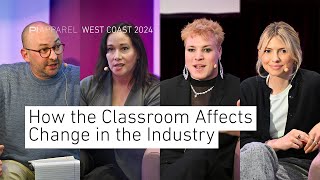
ASU's fashion program overhauled its curriculum after 2020, adding digital design tools like 3D fitting and PLM software that the industry had suddenly rushed to adopt. Students now learn cross-functional collaboration and data-driven decisions. Companies using these methods saw 50% faster time-to-market and 20% lower manufacturing costs.
Chapters
Wonderful. Hi, everybody. Welcome to Future Forward: How the Classroom Affects Change in the Industry. My name is Alex Snyder. I'm a clinical assistant professor that specializes in digital pattern making, 3D prototyping, and technical design with ASU FIDM. And that's been my specialty for over 2 decades in the industry as well. Just kind of giving you a high level of where we're at and how we're setting up this conversation between our students, our faculty, how we're looking at change. Um, we launched the program, um, at ASU, the fashion program, in 2017 in Tempe, Arizona. Um, in 2021, we built a beautiful brand new state-of-the-art, um, school, uh, and building that showcases high-level technology for our students. Um, it is absolutely stunning in the downtown of Phoenix. Um, we in 2023 integrated with the legacy school FITM. And so now our program is known as ASU FIDM, and we're just continuing to grow from there. We're really excited about some of the new things that we're doing. In fall, we're launching our technical design-specific track. Later next year, we'll be launching our product development-specific track. And we both will have in-person and online modalities because just students today are all learning so differently, that not only accommodating the working student, but people who might be more comfortable behind the screen. I know we don't want to, but let's go back to 2020. But kind of the catalyst to this discussion was that in 2020, we saw a lot of acceleration to e-commerce. And in that, we saw integration of digital technology, both from day-to-day operations, but also in decision-making. And what we realized that it wasn't always a smooth transition. And I worked with a lot of companies pre, during, and post the pandemic. And I think during 2020, 2020, there was such a race to getting digitalized that cross-functional teams weren't always having the conversations needed, because there really isn't a single source solution. And we're taking those learnings as we're building out our programs in this. How do we enable our students to not only know one product or one software, but allow them to understand their capacities in their future roles, and be able to talk to cross-functional teams, whether that's merchandisers, buyers, planners, and know the different softwares interact, but they're all there for the common goal. In turn, a lot of this, a lot of the material that we saw with digital integration, that there was an acceleration of time to market that increased by 50%. So we saw huge growth in ideation or chase items, materials like that, with the proper integration of tools and proper integration of tools through cross-functional teams that accelerated that time. With better analytics for online shopping and all of the drives when you leave something in your cart, for instance, and you get an email like, hey, you forgot this in your cart. Do you want to revisit it? Stores, online stores, started to see an 8% increase in full-price sell-through. And in turn, a 20% decrease in manufacturing cost. Because what was happening? Well, we all kind of learned that fitting and working with our vendors could be done remotely. We innovated around that. And in turn, McKenzie and companies share that investors are likely to favor companies investing in technology that will promote agility and environmental or social responsibility. One thing that I thought was interesting, again, we're just setting the stage for this conversation, was that 65% of students, and this is as a whole, this isn't just in fashion, but technology is a landscape that is all-encompassing and not just specific to our our industry, but 65% of students who entered school in 2019 will eventually work a role that doesn't exist. And I think that that is quite powerful when you look at it not just as a faculty member, but maybe as a leader in your company. What roles are going to develop? I mean, when I started as a technical designer, there was no such thing as a 3D technical designer. And lo and behold, here we are. So— Where is the intersection between the classroom and the boardroom or the company? I think that that as ASU FidM has continued to grow, the industry leaders that we're so proud of having as faculty members like Nicole, who will get some questions about this. What we've done is we've looked at technology and technological integration, not just the outcome, but the community and the culture that surrounds the overall idea of getting a product from ideation to that market, and how do we communicate it with the future students that we have sitting here? And in doing that, as we've consulted, the successes that we've seen was not thoroughly retraining the entire company for one particular software, but bringing on brand new students that understood these softwares, and in doing so, they were not only able to provide the knowledge that they've learned from school, but in turn they would train that team that they were hired on to integrate that sort of technology that they were looking to bring on. The interesting thing with younger students is that they already have an understanding of digital integration into their life. A lot of students are learning how to manage their day-to-days already with something digital. I I'm very analog. Everything that I do is incredibly analog. But these, all the notes, are done in some form of computerized system. So they're already integrating that. So when you think of PLM, this is very natural for them. They're also eager to learn. Once they're getting out in the industry, they're really excited about not only showcasing the knowledge that they've got and the experience that they got from the classroom, They want to bring that to an actual job. And with the right leadership, it's a great way to promote successes both in the team and in product excellence as it goes to market. So now that we kind of did that, I would like to introduce the panel that we have here for the discussion. I've got discussions, and then I would love to open it up to more community discussions. We've got Nicole Craig, and she's one of our amazing esteemed faculty members. She's spent— a lot of time in the merchandising field in the industry, and her track that she works and teaches within is our merchandising department. And then we have Keegan Vance. He was— he is currently an amazing student of ours. He will be graduating next spring and spending the fall learning in Italy this year. And then Jesse McKenzie, my TA for the last 2 years and very devastated that she graduated, but she actually graduated with a job in the industry and has been able to find that connectivity between what she learned in the classroom and the accelerated forward thinking that we've brought to the classroom and, and how that's affected in her jobs. So are we ready? Yes. Okay, so what I'd like to know, Jesse, is, um, having now entered the industry, how do you see the correlation between what you've done in school and your current position and job?
Yeah, going into my position, I found that it was really easy to compute the language that they use with what I had been studying. So I caught on to that fairly quickly. Also, what I studied is digital fits, and seeing real-life fits is very easy to get a hold of. Also, working within their tech packs and our tech packs, it's all very transferable. And so it's really easy to get a hold of.
Well, and you brought up digital technology. So Jesse specialized a lot in, on technical design. And I think that one of the things, if there are faculty in here looking at bringing in digital integrations, one of the things that we broke down were things like grade and fitting on size sets. What are some of the learnings that you took from that, that might have not been in your conventional physical education?
Yeah, so, um, during my studies we worked on Alvinon forms, and at my new position we're also on Alvinon forms, so it's very easy to go from our grading chart that we studied to their new body chart.
And with the grading, when you started to look at it on various different sizes, that was that something like an aha moment for you in the terms of like forward thinking?
Yeah, definitely. It's been really interesting to understand how the body grows and how that goes into different sizes.
Wonderful. So Keegan, as you are marching toward graduation, how has the forward-thinking approach in our classroom, specifically with technology, affected your career choice and/or your future goals?
Yeah, I mean, for me specifically, going into, you know, fashion as a degree, I wasn't aware of the different realms and levels of fashion that it had inside of the industry. You know, whether that be technical design, fashion design, or pattern making, or printmaking. There's so many different aspects of the industry that I wasn't aware of, and with the forethinking of bringing in technology, and it has opened my eyes to, you know, what else there is and your possibilities possibilities that I wasn't even aware that I had and talents that I had to integrate from flat pattern making to digital pattern making and making that connection with technology. So I think it's been really, it's greatly impacted my, you know, my schooling as it's opened my eyes to a whole lot of new things and it's opened me up to a bunch of new courses and classes that I wasn't aware of before that I'm now taking and really enjoying. And then also, it's, it's been great to, you know, see what else my future can hold.
Yeah, and I think you brought up an interesting thing because I think, again, for a lot of educators that might be in here that do flat patterning, because I've taught that before, but we spent like 6 weeks doing the basic bodice dress Where technology and the way that we are reshaping the way that education looks at, we were accomplished with that within 2 modules. And then by the end of 15 weeks, we saw about 50 patterns. Yeah. And we fit them digitally. So it's not just the approach of digitally designing. They're learning how to fit also multiple different product categories, woven, knits, bottoms, tops, tailored wear.
Exactly. So going along with that too, we also, we use Optitex in our program, and with that we also are able to, you know, render out our products that we built. So seeing and testing that fit on, like Jesse was saying, we use our Alvinon models, so we get to put those directly into our Optitex system and use the patterns that we make to be able to test fit directly onto our models and our mannequins, and also be able to render those products out and see, you know, the different types of fabrics that we're able to use, which has been, you know, very eye-opening to us as well, and seeing the different career paths that can be opened up too.
So, and that leads into Nicole being on the business end. What have you seen with technology as technology starts to expand? In the day-to-day business, and you've seen that from the business realm. How have you been able to take those learnings back into the classroom and showcase to students, here's what we're using, you need to learn this?
So I think it's such an interesting question, and there's so many different answers that you can go there with. You know, when I look at the data that you were showing earlier, was it 60, 65% of graduating students who entered in 2019 are, those jobs are not going to exist that they came in for. And I think that it's accelerated, but that's kind of always been true. And so we always, as educators, have to have technology in the classroom. We have to be talking about what the newest, most innovative things are. Because to the other point that you made, any of you who work in businesses know that no business can thrive with only, you know, with the older generations, the experienced generations, of which I would count myself in. There's a lot of, wealth and knowledge that comes with that, and it's vital to any organization. But no organization can thrive if it's just experience or it's just new and innovation. That's why we see very often some of the startup companies where everyone's got a lot of ideas, but they don't have the experience. The best businesses are building experience with bringing in new students that have the innovation and the technology. Our job as educators is to make sure that our students come out with understanding all of that technology. And it can be from a million ways. It can be understanding how data is driving sales. When you look at the landscape of retail now versus 10 years ago, the big buzzword is supply chain. How do we use supply chain most efficiently, effectively, sustainably? And a lot of that is by utilizing that data and using these programs so that you have speed to market with not mass-producing a lot of stuff that's going to go into landfill. And that's our responsibility as educators to make sure that our students are leaving knowing how to access that data, understanding how they can bring something to the table when they come in in jobs. And then they can actually— I love having youth that comes in and knows how to use new stuff, and they can teach me, and they can teach all the people that I work with, and that's how we grow.
And again, I think in the learnings that we've taken from where the industry has been to what happened in 2020 to the future of it, there's no single source solution. And those conversations, as you start to build storytelling within an educational environment, it is how the business track is re— reacting to the design track, to the PD track, the TD track, and setting those up with the softwares that actually work specifically. With that, with the little bit, I think, time that we've got, right? How much time do we have left? You can have a couple more minutes. Perfect. So I'd love to open it up if anybody here has questions or thoughts, giving everybody the opportunity.
I have a question.
Yeah.
How do you keep up with new technology?
Like, how do you know?
So we are very fortunate at ASU FIDM that everything's at our disposal. There's constant meetings of one of the exhibitors outside, 3D—
Style3D.
Style3D. We just had a meeting with them. So we're always looking at what those options are. And we're very fortunate. Fortunate that it's, it's available to us. I don't know that everybody has that, but we're very fortunate.
Well, and I think also one great thing is finding the right people to lead charge in bringing those opportunities into a school or into a setting. And cross-functionally, whenever we meet with people, it's not just me on the TD side, it's also Nicole on the business. We bring everybody in So we're looking at it more holistically in our approach and the connectivity between all of our classes.
The other thing that I would like to add, and it's one of the things actually I really like about ASU FEDM, a lot of the classes have crossover in the degree. So when you're in a class, it's not just all design students, or some of them are, but many of the classes, there are students on the business track working with the fashion studies track, working with the design track. And so you get that cross-function and you get that collaboration, and so they get a really good understanding of what their partners on the other side is, because that's what this business is. It's, you have to be able to understand what each team is doing, and you have to be able to work collaboratively.
Yeah, and from a student perspective, especially too, like Nicole was just saying, we get that a lot of connection-wise with the cross-training and everything. Because, you know, like I said, we, we go in thinking one thing, thinking we want to be, oh, I'm gonna be the next best fashion designer there is. And then we go into school realizing, oh, that's, you know, not my path. I'm actually a technical designer. I am a, you know, digital pattern maker. This is where I'm supposed to be. This is what I'm supposed to do. But with going in that and taking those courses, you're able to meet all these different people from different backgrounds and build those connections early on in your career so you have that in your back pocket for later on.
Can I saw?
Yeah. Do you have people from different industries come in and do guest lectures or projects with the classes? And do you go on field trips to visit, you know, different brands or whatever it might be? You know, how is What is your interaction during actual academia with what's happening?
Yeah, I think it's a really— that's a really great question because we do try to approach our education as immersively as possible, especially now two campuses and making sure that the student learning outcomes are always going to be the same. We've got— we do partner with a lot of localized designers. We bring in a lot of guest speakers. Lecturers. Our director and steward of this amazing program, Danita, teaches a series of lectures from industry professionals that come in from business or fashion journalism to heads of design or accessory designs at large companies. So we're trying to enrich and educate and try to showcase that the industry is not as linear as Gotta be a designer. There's so much other fun things. Wish I was a colorist.
If I can add a couple other things, definitely having the LA campus and the Arizona campus has been extremely helpful. And we do integrate, obviously, in Los Angeles, we have a ton of companies and guest speakers available to us. Our campus is walking distance to all of the markets and the California Center. And so we definitely utilize that. We do field trips, we have guest speakers that are coming in, but we also integrate, you know, we're involved in the Fashion Scholarship Foundation, we're involved in NRF, and so we're really putting our students, you know, having mentors in the industry, you know, traveling to places like New York City for the Fashion Scholarship Foundation where we had 4 finalists, like 4 finalists. So we have a lot of that integration within the industry. And especially most of the faculty come from the industry. And so obviously, you better believe we call up all of our friends and make sure that we're getting field trips, opportunities, all of that stuff. And in terms of integrating between the two campuses, we also, we did a weekend, like a fabulous weekend that the Arizona students took a bus and actually got to do all these amazing things. They went to like Mood Fabric, which they'd only, probably half of them had only seen on TV before. And got to go to showrooms and work with these amazing people. And we're actually having now some switches in between that students on the LA campus can go work, can go do a semester eventually in Arizona because there's, as Alexander was saying, the technology that we have at the Fusion on First building is amazing and we want them to be able to take advantage of that. And then we have, in the fall, we have a group of students coming from Arizona to do a semester in LA.
And I think to that point, to kind of bring it back to the larger discussion that we were having in how the classroom can affect the industry change, I mean, I got into education because what was being taught to me was the same that was being taught 10, 15 years later. We're not updating, we're not changing. And I wanted to go in and shake things up and— The faculty that we've got have done that. And as we're starting to see our student go out with these connections that we're all bringing— every faculty member has them— in the way that we're looking at it, and everybody's— every campus is capable of doing it. It's just different thinking and teaching our student to be powerful and confident in the changes that can be done. And a lot of them are going out into the industry and having those conversations with their leaders, and their leaders are giving them the opportunity to explore that and take ownership of it and utilize it in a bigger way. Do you see a trend moving away from seasonal line plans and collections to an open-to-buy model, given the length of product development from concept to in-store, 18 to 24 months in the current system? I mean, we don't buy clothes because of weather changes.
Right.
Do you want to take—
It's right now, honestly, every company works differently. And I am a big believer in that every company needs to figure out what works for them. A lot of companies are trying to shorten up their lead times, shorten up the supply chain, looking into are there places that we can move production closer, and all of that sort of stuff. But really, every company works a little bit differently. So that's actually jumping off of something that you had said. In the classroom, sometimes those textbooks are— it's outdated already by the time that we're teaching it. And so I know for myself, and I'm probably all the faculty, we do a lot of making sure that our students are reading the Apparel News, all of the different articles that are coming out, and we're really abreast of the latest things. And one of the things I always tell my students is, this is how it is today. It's not going to be this way tomorrow, and it's not going to be this way the year after that. And so the best tools that they can have when they graduate is to learn how to adapt. But I don't think there's— like, I can't answer your question with one distinct answer, because every company works differently. And our job is to make sure that we have students that are adaptable and can work in any environment.
But to that point, just to further it a little bit more, a company that wants to go to market with shorter product lifespans or basically a quick access from ideation to the retail market goes back to the way that the classroom is operating and showing how our students, both in more of design, more in technical design, can cross-collaborate to bring a product to life much quicker and understand when to hand the baton to the next person. And that's kind of where that change in the education and not making it as linear, but making it much more expansive, can help future companies as they're starting to charge to that.
And to also do this, the lack of season and just having more deliveries. I come from a background where I worked in fast fashion, I worked for Forever 21. We were seasonless. I delivered every single week. And I think that a lot of companies started to move towards that. And I actually see companies stepping back from that and saying, we actually don't need to deliver every week. Can we have more specific drops that maybe it's every month, maybe it's every 6 weeks? Can we have more key items that are going to live for longer and then flow in? So I think there's no one— yeah, the typical seasons are done, but I don't think we've landed on what it's supposed to look like.
So with the last couple minutes that we have left, I just got the warning. Anybody here that might be, I forgot to bring this up, a FIDM alum or anybody, we would love to have a conversation. We're reigniting and revamping the FIDM alumni network. We just want to let everybody know that. Is there any last things that you guys would like to say before we adjourn.
I'm just very grateful I got to be able to study technical design and 3D pattern making because it opened the doors of the fashion industry to so many different opportunities. So I'm glad I got that education.
It's great.
Yeah, and I think going off that as well, ASU FIDM is— I've been so lucky, you know, just to attend there with all of the different faculty members and their backgrounds, and how they're bringing in everybody for us to be able to make those other connections and integrate from classroom to industry directly. I think it's, it gives me a lot of hope and a lot of excitement for my future, still being on my discovery and my journey in the industry.
So, wonderful.
I have nothing else, I think I've said enough, but I will say this: if any of you in the industry or in the LA area and and you're ever looking for interns, please let me know because I always have a ton of them. Or if you're available for a field trip, I would love to bring some really amazing students like these to see you.
Yeah. Thank you all so much for your time. Look forward to more conversations today.
Yes.










