Immersive Virtual Reality 3D Experiences for Sustainable Conservation | Natureverse | PI Apparel
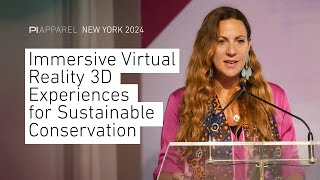
Natureverse uses VR and AR to teach conservation through immersive experiences like exploring the Grand Prismatic Spring and Brazilian rainforests. The platform guides users through an airship journey with AI characters, showing forests across time. It partners with national parks and indigenous communities to create authentic environmental education for brands, schools, and consumers.
Chapters
We are entering the age of re-enchantment, and one of the reasons why I decided to build this startup along with an exceptional team was to really utilize virtual reality, augmented reality, and immersive experiences as a storytelling tool to talk about what's happening in our world today, about endangered forests, protecting indigenous communities, and really talking about the role that brands, retail, and environmental organizations can really utilize this technology. As experiential demand grows among consumers, multisensory design will be the norm in the future. Think of National Geographic in 3D or as a hologram 10 to 15 years from now. The goal of a VR, AR, and mixed reality platform is really to give you that sense that you are immersed in that experience. So when we were thinking about Natureverse, we were thinking about a way to bring that experience to users as if they were in that forest, and to understand the importance of 1,000-year-old trees that are cut down for packaging and apparel. When I take on a new project, and one of the genesis, the reasons of building Natureverse was to really have these 5 pillars of purpose-driven technology values. Thinking about what a tech platform would be for the impact to humanity, building community, sustainability, developing corporate citizenship, and also having diversity and inclusion for indigenous communities. Nature provides everything, and looking at nature as a model, thought 3.85 billion years of trial and error, really understanding the biodiversity and the different species on Earth and how important it is to look at nature as a model rather than just a resource for us to take from. Deforestation in the tropics, especially in Brazil, is increasing. Many people don't realize that there is so much logging happening in these remote forests and in the rainforests. And one of the, the goals of Natureverse is to highlight ways to help to bring awareness, not to create gloom and doom, but really to show what's what's happening in those areas that are so remote that you can't even get to them. This is increasingly happening more, where we don't see the effects of logging and what's happening in these forests. So for our first project, which I'm gonna show a short video of, we went on a 4 to 5 hour trek to get actual film footage and drone footage of areas that were logged for the use of cutting down those trees for packaging and certain materials for apparel. [FOREIGN LANGUAGE] So imagine if we saw nature as a model and looked at nature as form, process, and a system, and appreciated the biodiversity of those areas. And then thinking about kicking off projects with this UN sustainability goals in mind and how important that is, and understanding that these predictions have long existed with such great thinkers as Steve Jobs, and understanding Understanding that there is going to be an intersection of technology and biology as we move forward into the future. But why is this important? To build a foundation to do good on our planet without scaring consumers about what's really happening, to inspire them, to inspire creators, consumers, brands, nonprofits, educational communities, and grassroots groups and environmental organizations by really engaging them in community sharing in a gamified experience and also building that community together. There are thousands of apps right now on the Meta Quest Store that are about gaming or training baseball, but there's really not that much right now about environmental education. One of my favorite icons is Buckminster Fuller, and he believes that a designer is more than just a designer, but an evolutionary strategist. And when thinking about these areas and how we can interact with them, rather than just taking the resources out of these areas, we can look at them and build products around these beautiful places on planet Earth. One of the ideas I thought about when creating Nature Verse was looking at the history of travelogues. I'm sure you all remember National Geographic. I love seeing all those magazines on my grandma and grandpa's living room shelves. And the history of travelogues really started, you know, with radio travelogues on ABC, NBC in the 1950s. I encourage you to check out some of those videos on YouTube. And then of course, blogs, the internet. But digital storytelling in the future is going to consist of VR, AR, and immersive experiences, especially as the hardware gets better and better. If you have a chance to demo the Apple Vision Pro, I highly suggest you try it out because it is an exceptional experience. You basically can use, move objects and, frames and pictures with your eye movements with these new headsets that are coming out. I also do believe that technology can facilitate human thriving and inspiring us to do better by actually creating empathy by being in these environments. Grace Dillon termed the coin— coined the term indigenous futurism. And Indigenous communities have lived off the land for centuries. And one of the use cases for Natureverse is to help us storytell how they live off the land, how they have plant medicine, and how they're preserving these areas, but also simulating what's happening to some of these endangered rainforests, especially down in Brazil, and how there is flooding, and with the logging, A lot of villages and communities are being destroyed. NatureVerse takes you to botanical gardens, national parks, endangered forests, indigenous communities, as well as arboretums and even Central Park. Our goal is really to create a scientific educational platform that teaches consumers about biodiversity right in your backyard. Our vision is to create an experience that bridges the natural world to a digital experience in a gamified way. We bridge brands with nature education, places that you normally wouldn't think of. And many brands do an excellent job right now educating consumers about their sustainability goals with apparel and footwear, but what about the national park that's right near their headquarters. There is a huge opportunity to have community engagement with a digital community. AI guides, gamification is one of the pillars of Natureverse. And you'll see in the 3 videos that I'm going to show you that our trademark is an airship that takes you to an endangered area, and then you can float down to it in a bubble in VR. It's pretty cool. I wish I could give you all a headset right now to test it, but we don't have that capability. Capability at this moment. But we've really worked hard to create an experience that you can experience in VR, but also in store with 3D polarized glasses as well for live installations. So these are just some snapshots of some concepts that we've done for some clients, where you can experience it at a flagship store or at a museum. This is the Grand Prismatic in Yellowstone National Park, which is one of our first demos. Gamification is a real component of NatureVerse. The average gamer spends about 40 hours a week using video games. So why not utilize that for learning about nature, but making it fun and not boring like a documentary, especially for the upcoming generations? We really like to make sure that at retail there will be an exciting experience, so these AI guides can be interactive as well. This is Bernie the gnome. In our experience that we created for an environmental organization, we had Chims the bear, which you will see in a few minutes. And then having really strong partnerships with national parks and environmental organizations is really the backbone of NatureVR. Which is important for us to help support these organizations that normally are seen as complainers or gloom and doom, but we can make it a fun, exciting experience as well. This is just an example of the first-time user experience, and one of the key elements of Natureverse is a time machine, which you can see an area, what it looked like 50 years ago, 100 years into the future, and we do that using LiDAR scans and data. You can see what Yellowstone National Park looked like 100 years ago in VR, which normally you wouldn't be able to see unless you did a lot of research from a lot of different places. So these are just some before and after pictures. And this is our current time machine for our current client for Vancouver Island. We did a simulation to show the ancient old-growth forest there. The key advantages are being able to get to these places immediately in VR, AR, or via a web experience, and really highlighting something that can be seen in 2 or 3 minutes without taking too much of the consumer's time. The user journey, like I said, starts with an airship. There's always a bubble. You land in the forest, and then another key trademark of of our experiences, the mother tree. The mother tree is a term in environmental education, and we always like to highlight one tree that really speaks to the whole forest. And with that, I'm going to show 3 videos, and, uh, enjoy. And this is the actual experience. It's a video of the VR experience, so it's about 5 to 7 minutes long. So sit back and enjoy.
Hey, yeah, over here. No need to be surprised. It's not often you get to talk to a bear, right? I'm going to show you around this amazing forest. You can call me Chims. It's one of my many names. Ready for an adventure? Welcome. We are walking on Indigenous lands. More than 30 Indigenous nations have stewarded forests in this region for millennia, and they continue to do so today. Let us promise to proceed with care and respect for this place. You are standing in a coastal temperate rainforest where the trees, the soil, and the neighboring sea are all interconnected. Look around. This is one of the rarest types of forest on our planet. This forest has never been industrially logged. Call it an old growth or a primary forest, Forest. Some of the trees here stand over 70 meters tall and are hundreds of years old. Look up. See the light breaking through the canopy and how it reaches trees and plants of different heights and sizes? See the different leaves and needles? This is the diversity that nature offers when left untouched by industrial activity. Look around at the kaleidoscope of life. Each species, from the smallest fungi to the towering cedars, plays a role in this complex ecosystem. This diversity is not just a marvel to behold, it's the backbone of the forest's health and resilience. I need to show you something. This used to be a thriving ecosystem with trees that were around when Isaac Newton discovered gravity. Everything this forest once was has been lost. It's hard to grasp what has been taken. Every year, billions of trees, many from forests just like this one, are logged. And many of us don't realize how much is ending up in things like boxes for your lipstick or cereal, or for fabrics like viscose. Ancient ecosystems turned into things that humans often throw out in an instant. I could tell you about the carbon released into our atmosphere, the stress that habitat destruction places on species, and the impossibility of recreating what once was. But look around. What you see speaks for itself. Take a moment. Then follow me back into the forest when you're ready. Has anyone ever told you that trees grow back? They do, but the forest that was there before does not. Look around. Can you feel what is different? Once there was rich biodiversity. Now, while it may look green, what is here is a biological desert. Look up. Where are the giants? Where is the light? Do you hear anything? Gone are the birds and the bugs and the animal sounds. Look down. Do you remember the forest floor in the first ecosystem we visited? This understory is different. How much life do you think it can hold? What will grow here will never be the same as the forest that was here before. The trees here are all the same age and similar species. Take a minute to feel the difference. This feels so much better. Do you feel the difference? See the difference? Hear the difference? We're back in an old-growth primary forest. It's amazing what nature can do when it's left undisturbed. I'm going to take you to a very special place. Scientist and Canopy board member Suzanne Simard calls it a mother tree. This is a mother tree. Don't look confused. This tree speaks to the other trees in this forest through an amazing network that's been developing for hundreds of years. This mother tree has watched over these woods for centuries, some for over 1,000 years. These pillars of life are not just witnesses to history, they are the backbone of the forest's connectivity and resilience. I hope you understand that forests are way more than a bunch of trees. I'd like to introduce you to a rather extraordinary device— a time machine. This isn't your ordinary time machine. It won't whisk you away to the past, but it will offer you a glimpse of two futures, both 30 years from now, on the very ground we now stand. In the first future, business continues as usual. This is what this forest and the forests around the world might look like if things continue as they are. But another future is possible. Turn the dial and find out how.
So there's a lot more, but I don't think we have time. And next time I'd like to get you all on the headset so you can see it in VR. But there is just one more demo of Yellowstone National Park. It's only 1 minute, and then we're gonna wrap it up.
Welcome to Natureverse, where technology and nature unite for a transformative experience. Immerse yourself in digital twins of Earth's wonders, unlocking scientific and biodiversity treasures. Begin your adventure aboard our Natureverse airship. Choose your iGuide, your companion on this educational journey. With your Natureverse Globe Watch, explore locations in the past and future. Discover the history of Yellowstone, Earth's first national park. Witness the vibrant Grand Prismatic Spring, a marvel of colors and science. Learn about microbial mats, and their impact on medicine and space research. See how debris has affected the ecosystem and take action with our Natureverse drone. Help clean up the Grand Prismatic and you'll receive exclusive collector's items. Use your Natureverse Globe Watch to explore the effects of climate change. Thank you for joining Natureverse Expeditions. Explore, learn, and make a difference. Join us in preserving Earth's beauty and natural wonders. NatureVerse, where education meets sustainability.
So the future is endless. There's lots of locations on planet Earth where we can go to really tell the stories of the land. This is our advisory board. Dace Campbell has worked extensively in VR and AR and at Autodesk. I founded this company about a year and a half ago, and Igor is our creative director. He did a lot of CGI work for Star Wars, Lord of the Rings, and most recently the MGM Sphere, the Rings of Time installation in Vegas. And with that, may the force be with you, and thank you for your time. Thank you very much.










