Innovation at Gucci - Micaela le Divelec Lemmi
Micaela le Divelec Lemmi explains how Gucci defines innovation through heritage and responsibility, not new technology. The brand keeps all manufacturing in Italy despite higher costs, maintains a three-pillar CSR framework with 2,000+ annual supplier audits, and has cut CO₂ emissions by 25 percent. Gucci treats responsibility as long-term competitive advantage, not a cost.
Chapters
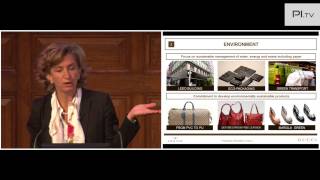
Good morning, everyone. It's a real pleasure to be here today. I would like to start this presentation, which will be a little bit different compared to the others that you will enjoy today, because I will speak about innovation, but in a completely different way compared to the one that you are used to, to hear. So I would like to start with a brief introduction about the brand for which I'm working, which is Gucci. I believe this is a quite well-known brand, but there are some aspects of this brand and the strategy of the brand which maybe are not clear at 100% to everybody. So when you hear the name of Gucci, the first thing that is coming to your mind is about a brand which is an iconic fashion leader. What does these words stand for is that Gucci is a fashion leader. So you know that since years. And we are talking now about a brand which has more than 90 years of history. Gucci has always been one of the leaders in managing the runway and in being the brand of the jet set. If you think back to the year '60, where most of you were probably kids at that time, Gucci has always been recognized as the brand of the celebrities and of the people, the most well-known people in the world. What we added to this concept of fashion leader is the concept of iconic, because this is one of the brands which has most of the icons, and so the signs which can be recognized in the world. I leave your thinking to the bamboo, to the, the WG, to the, the horse bit. So there are many symbols which allow this brand to be recognizable. These symbols are representing a strength for the brand, but on the other side, a great challenge, because it's also a brand which can be easily counterfeited or copied. Having said that, we are still talking in the middle of the year 2000 about a brand which still is one of the hotspot brands on the runway. On top of that, it's a brand of the confident sensuality. Why confident sensuality? Because we can recognize that this brand is inspiring the sense of sensuality on the people wearing the, the products and wearing the ready-to-wear of the brand. And on top of that, the fact of using this brand is giving power and confidence to the the people wearing the brand. But there is another important dimension which has been reinforced in the past, during the recent past, so in the past few years, and of which you have to think of. Please, I would like to show you a quick video in order to give you the sense of what this brand stands for. [FOREIGN LANGUAGE] So the additional value that I would like to talk about is the made in Italy and the craftsmanship. I think that there are no additional words that I can spend because this video is quite self-explanatory. This is our supply chain. So in that respect, I would like to stress the fact that in which respect Gucci is innovative. It's innovative in respect to the coverage of some of the key values, of the core values, that a brand of 90 years old need to preserve. And these values are the artisanal craftsmanship and ability of our artisan, and the fact that starting few years ago, when most of the brands were delocalizing their production, we decided to invest in our supply chain, to reinforce the supply chain, and to keep the entire supply chain in Italy. In a responsible manner. So strengthening some of the competencies that we are running the risk of losing because most of the artisans that are in the video and some of the one that are involved in our supply chain are getting older and so close to retirement. And we need to preserve these competencies, trying to create an atmosphere and an environment which is also improving and attracting the new generation to some of the key artisanal job which used to be part of the Italian artisanality in the past and that we need absolutely to preserve in consideration of the future of the company from one side and the future of this sector on the other side. So in that respect, what we mean with Made in Italy and craftsmanship and all the thinking through the preservation of this value has driven the brand to take into consideration a responsible and sustainable approach to the supply chain, to the environment, and to think to the medium-long term more than to the pure short-term. As you can see in these pictures, these are some of the pictures coming from our archive, which means are dated back to the year '40s, and some of them has been taken quite recently in our production facility in Florence. So just in order to show you that the way of building up the bags and the shoes are exactly the same that used to be more than 60 years ago. So how to get there? We need, in order to be able to preserve and to reinforce this value, to strengthen this responsible and sustainable approach. And this is the reason why there is an additional value which has came to the hotspot of the strategy of the brand, which is the socially responsible approach. Approach. So we need and we want to be a responsible brand, which is an innovative way of managing a fashion brand in the sense that this concept and this value has become something which is completely embedded within the strategy of the brand. Why a luxury brand like Gucci and like some of the other competitors' brand needs to take seriously these this concept and to move forward in this direction. So first and foremost, this is a matter of risk management and cost control because we know that some of the raw materials are becoming scarce, and so we need to preserve the sourcing of some of the raw materials. There is a reputational risk, and you can easily think to some of the competitors' brand which has suffered in the past about reputational risk because of some not let's say, fully ethical approach in the management of the company. There is as well a matter of price volatility and managing the volatility of prices and managing a sustainable pricing in the future. There is a matter, as mentioned, of talent war, and so the fact of preserving some of the key competencies. And there is a matter which is key for us and key for most of the luxury brands to preserve the know-how of the industry. On the other side, we know that there are short-term financial opportunity because we are not an NGO, and so we need to take into consideration, and I personally coming from finance, so I have a financial background, which means that we have to take into consideration also the expectation of the shareholder and of the different stakeholders of the company. So in that respect, we believe that This kind of approach can generate in some respect additional sales, catching some customers who can be interested in this kind of approach and who maybe could have not joined the brand. This strategy is, is also enhancing the brand value, and more and more we see that there are investors and analysts sensitive to these kind of topics and able to, to define a value added coming from this kind of approach. This is representing as well a competitive advantage, is helping to meet the customer request and expectation, and is representing an innovative opportunity for a brand like Gucci, which is a quite old brand having more than 90 years. So the mix of all these aspects is generating an approach, which is an approach that we, we love to call a responsible approach, but which can also be defined as a sustainable approach because it is an approach which looks for the medium-long term. And we need to take care of that in each and any respect within the management of the company trying to balance between the short-term business opportunity and financial benefit, but looking more— which is the way in which we are able to build up an additional value for investors and for stakeholders— we need to look for the long term. And looking for the long term, it means that maybe we can renounce in the short term to some additional margin, like for instance the moment that we decided to keep the entire production in Italy when most of the competitors were delocalizing, this has had an impact on our profit and loss. This is a fact because keeping the production in Italy, it means additional cost, it means that we need to do things upon a certain level of bureaucracy, which we all know that the Italian government is a master in doing. And so, In managing this kind of lever as a priority for the company, we had to renounce to something. But the reason why we decided to do so is because we believe that this will give strength to the brand in the medium-long term and will enable us to have a platform which will be always available and sustainable in order to sustain and finance the future growth of the company. In order to do so, I would say that it's quite easy to tell the history about the responsibility and the sustainability at Gucci today. It has not been easy at all to manage and to get there from inside the company, a company that, as most of the fashion leaders, has a culture which is far away from the sustainability. So in order to do so, we needed to start in an innovative way, trying to capture first and foremost the commitment from the top management, because we believe that this is key in order to drive and to embed this kind of value and aspect within the strategy of the company. So we define what's the mission of the sustainable approach and the sustainable strategy had to be for Gucci. Starting from that, we defined where and how the values should have been and could have been defined and declinated. And then coming from the definition of the strategy and the definition of the key pillars, we define how we could have introduced and embed within our strategy in the, in practical terms. So within the daily activities of the operations, this concept of having a sustainable approach. So it's quite evident that in the current days, most of the brands are talking about sustainability, and there are more and more conferences talking about this topic. In most of the cases, I can say you by experience that we are hearing very interesting projects but just projects. What's the difference at Gucci is the fact that we defined a complete CSR strategy, and starting from there, we declinated the project. So it has been an approach which has been managed in the other way around. We can say that if we have to look at the clear path of development of a CSR strategy, there are different level of implementation which some of the fashion brands can recognize itself. There is an informal status when there are occasional activities and occasional projects. There is a current status, which is the one once the ethical code, the social responsibility, the philanthropic approach, and the certification in terms of respect of the ethical code are achieved. Then there is the further evolution, which is represented by a systematic approach, which means start to monitor the, the environmental impacts, start to take into consideration and to deal with stakeholder engagement, and to think about new welfare initiatives. Where Gucci stands is in the innovative status, which means that we are currently looking for innovative and competitive solution at 360 degrees of the organization in order to be able to define and deploy the strategy in the best possible way in each and any angle of the organization. And in order to do so, we created also a logo, a logo which is, of course, is taking care and is taking advantage of some of the icons of the brand, so the famous interlocking G And why we use the interlocking G? Because we believe that the CSR strategy is strictly locked and interconnected with all the other aspects of the brand. We needed to have a bit of a green because it's easier to transfer the message using the green. And then we use the word responsibility. Responsibility because all the strategy started from the supply chain and from a responsible and sustainable approach of the supply chain. What we, we like to say is the fact that, as you know, 95% of the production of Gucci is externalized, so we are using third-party suppliers. What we love to say is that we have externalized the production, but we didn't externalize the responsibility. Which means that we feel responsible for the third-party suppliers in each and any respect. So we need to take care of them and to sustain them. In order to be able to deploy the strategy, we have created a specific department within the organization which is called CSR and Sustainable Department, with the head represented by a leader in the sector who's a lady coming from Buro Veritas, which is one of the main consulting firms with significant experience in the field of the sustainable approach to the supply chain. What about the strategy? So the strategy is defined through 3 key pillars. The first one is people. So we pay attention to people And when I'm saying people, I'm talking about in all the people through which the company is getting in contact. The second pillar is the environment. So we take care about the environment and we define a specific roadmap of projects that we need to develop in order to reduce the impact of the supply chain and of the production on the environment. And the third one is culture, which means from cinema to restoration of key art pieces in the world, and so take care of some of the key competencies and of the values which we run the risk of losing. People. So about people, as said, there are many angles through which we take care about people. We have been, as Gucci, the first fashion company in the luxury industry to get the SA8000 certification. So I don't know if you know what it stands for. It's a matter about a certification that the working environment of our company and of the supply chain is upon an international standard which is recognized. And we have got the certification SA8000 in the first place at the Gucci production facility in Florence, and in 2007, we got an enlarged certification of the entire supply chain, which means that we need to audit our suppliers and to be sure that they are applying in a responsible way all the key principle of the international standard. We got as well the RJC certification on the jewelry business, which means again that, that the approach used in the production and distribution of jewelry is sustainable and is taking care about people. We have been engaged with the campaign through the Clean Clothes Campaign of the Killer Jeans, and we have been one of the first brands to sign the commitment in order to change some of the practice in the production of these these typical ready-to-wear product. But on top of taking care of our internal stakeholder, we, we have a key focus as well on the external stakeholder. And in particular, we are taking care about children. And in that respect, we signed an agreement with UNICEF, which is now dated 9 years ago. And we created last year a movement which is called Time for Change, that the The English people maybe can know because we hosted a concert last year on June 1st at the Twickenham Stadium in order to support in particular and to reinforce the dignity of female, so girl and women in general. So about UNICEF, this has been— we will host next year the 10th year anniversary What has been raised for the time being and donated from the company to UNICEF, we are talking about $18 million in the past 9 years towards children programs, in particular in order to build up schools in the sub-Saharan area and in Asia. Why children? Because we— Gucci in particular cares about children and about women. And so we need to concentrate our effort in order to be sure that these efforts are giving a result. I just mentioned the certification of the supply chain as well as the full compliance with labor, health, safety, and freedom of association. Just in order to give you a few numbers, Gucci is currently employing 10,000 employees around the world. But if we look at the supply chain, so the third-party suppliers working for the company, we are talking about in Italy 45,000 people. So, and out of the 45,000, there are 7,000 people working in Florence and fully devoted to work on the leather goods production. So all these are people that we need to take care, which means that they have to work upon a certain standards in order to be part of the Gucci supply chain. But on the other side, we try to give to them some, let's say, advantages of working for Gucci. And so last year, for instance, we were able to finalize a deal with an Italian bank in order to give access to the suppliers, the first and the second level of suppliers, to some special condition in order to, to got access to credit, just giving transparency to the bank in respect of our internal vendor rating. So we credited some of the suppliers just for the fact that the quality of the products that they were supplying, the timing of the supplier, and the financial situation was good, which is something that we monitor for ourselves. And so just giving access to the bank to these data, they were able to get a credit facility with a significant reduction in the interest rate. We are talking about 3, 4 points of interest rate of spread, which has been benefited for them. This is a kind of approach that we think that if we want to keep the supply chain growing, And if we want to reinforce the fact that there are competencies in the country that we need to preserve, and these are competencies that are historical of the area of Florence. So, you know that most of the competitors are coming to Florence and around Florence in order to produce their leather goods because there are key competencies that you can find only there. If we exclude the Chinese worker not regular and not upon the law working close thereby, But in principle, this is something that is dating back to a few centuries ago, where— when this area has become a key area of development of the competence of production of leather and of development of specific artisanal attitude and abilities. And Time for Change. This is a movement, as said, sponsored by Gucci, which is currently involving more or less 200 projects in around 7 countries, and which is concentrated on 3 key aspects: the support of the female in respect to health, to education, and to justice. So I would like to show again you a quick video in order to show you and to let you understand what this movement stands for and what has been the event which has been managed last year. Please. Hi, my name is Frida Giannini and I chime for education. Hi, I'm Beyoncé Knowles-Carter and I chime for health. Hi, my name is Salma Hayek-Pinault and I chime for justice. We're all here because we want change. What happens when we educate girls? We empower them. This is not a fringe issue. This is an issue that is basic to absolutely every issue on Earth. Tonight we're focusing on 3 powerful agents for change: education, health, and justice. None of us can move forward if half of us are held back. Who would have thought that a tiny device like this could be a weapon? The click of a button, we can be connected around the world. You can spread messages that lead to revolutions. The most powerful tool a woman can have is her own education. Justice. 3 things to change the world. My name is Katy Perry, and I chime for justice. Justice. My name is Ben Affleck, and I chime for health. Education. Education. I chime for my daughter. I chime for Malala. I chime for my mother. My grandmother. My mom. Alfarita Marley. My name is Julia Roberts, and I chime for every woman. Let's listen very closely. Listen closely to the voices that have never been heard before. So this is something that it has been managed in an innovative way, also in respect to the technological approach. Approach because it has been really a viral movement. So I encourage, if you want, there is an application that you can download on iPad and iPhone, and I encourage each one of you, if you want to make a donation, because I believe that each one has a mother, a sister, a daughter, and so this is something that's really worth to pay attention. Environment. As far as the approach to the environment, we are taking care of the environment and we are dealing with, within our strategy, on how to reduce the CO2 impact in the process, in the production process of our company. And so we committed for a reduction of 25% of CO2 impact in the coming 3 to 5 years. We already launched many projects in that respect, from the certification lead of the building and of the new stores that we are, we are currently opening. We launched a completely eco-friendly packaging which is managed through FSC paper and recycled material. We are running the transportation, we call it the last mile, which means that from the hub of the, the key city, we manage the transportation to the stores using green, green vehicles. And on top of that, in terms of development of new products and innovative products, as well as In terms of innovation applied to the materials, we committed to fully eliminate and discharge the PVC by 2016. We run a project together with Livia Firth on leather coming from Amazon in a zone Free of deforestation, which has been a real success. And these bags are coming with a passport. So in the passport, you have all the information about the traceability of the materials. And we develop specific plastic materials, which has been the key for developing some of our products, like the Marola Green shoe, as well as we develop a bio liquid material our sunglasses. On top of that, we last year, we announced the, um, that first in the industry, we launched a complete metal-free leather, which means that we came out with a new, in an innovative process for, uh, the, the leather, the tanning of the leather, which is discharging completely all the metal materials. Which means that in terms of consumption of water, we reduce this consumption by 30%, and we are reducing the energy through the process by 20%. And we are currently involved in a process, in a project of sustainable cashmere, which means to regenerate some of cashmere fibers originated from cashmere fabric in order to have, as well as on the leather goods, a full traceability of the materials from where they're coming until the completion of the product. And in order to manage in a responsible way the approach to the environment, we decided to develop, and we have been pilot within our group, Kering, in a tool of reporting of the environmental impact of our production process. What does it mean? It means that we will be able in the end to come out with a value which is the cost to the environment of our production process and what we should have to invest in order to recreate the environment in the condition precedent to the production process of Gucci. It's quite innovative in terms of way of reporting and of tracing the impact on the supply chain, but we believe that if we want to apply our strategy in a responsible way, we need to do it monitoring what are the results of the project that we launch. As far as culture is concerned, we have agreement with the Martin Scorsese Film Foundation for the restoration of some of the key movies of the past, in particular Italian movies, but as well as some of the key movies of the year '60. We have an agreement with the Tribeca Film Foundation and Tribeca Institute, as well as we sponsor the Gucci Awards in Venice for the world of cinema. On top of that, we just announced a few weeks ago the restoration of some tapestries of the year '60s in Florence, which has been part of the archive of of the house of the Palazzo Vecchio in Florence, and which has been restituted to his previous location of the Year of the Renaissance. As you may know, we opened a Gucci Museum in Piazza della Signoria in Florence, where I invite all of you coming to Florence to visit us, which is a quite nice location also to spend half an hour and to take a coffee. Because of his position, but on top of that, this has been in the year of the Renaissance the house of the arts in Florence. So we call it Palazzo della Mercanzia, and it has been the place where the responsible of the different arts used to meet themselves and to exchange on their cultural, the different cultural aspects of their organization. And then we have also in the different parts of the world agreement with and fundraising initiatives like the one that will take place next week in Japan with the support of Hidetoshi Nakata, who is currently very much involved in the sponsorship of innovative application of art using different kind of materials, and he is using this kind of initiative in order to sponsor the craftsmanship of the Japanese artisans on one side, and to sponsor and raise funds in order to partner with, you know, very important and key initiatives at worldwide level. So, back to the first question, why responsibility? So I believe that I explained to you more or less what are the main reasons why Gucci decided to move in this direction. I would like just to add one word, which is the main reason why we think that it makes sense to act in this way, As you may know, our main shareholder, Mr. Pinault, anytime that he has the possibility, he says that responsible business is a smart business. And I do believe that this is really true, because this is a way in which we think that a brand can stand up from the crowd and can show that there are values that maybe can be a little bit, let's say, forgotten, that we need to revamp a little bit. Because of all the innovation that we are involved with, sometimes we lose a little bit the fil rouge of what are the key values that we need, by the way, to bring to the attention and to take to take at a significant level in, in the different organization. So we act in a responsible way because we believe that this is a serious commitment. This is the first and key driver of our strategy. We decided to integrate these within the brand strategy, so each and any angle also also of the innovation and research and development of the material involving our designers is now looked from this perspective. Is an innovative and proactive approach, and we believe that in defining our strategy, we are really embracing sustainability at 360 degrees. So the main reason why we are doing so is because we believe that this is the right thing to do. I'm really proud of this, and if you have any question, I will be happy to answer any question. Thank you. No questions? Um, what is the most effective way that you think you engage with your customers? Is it through using celebrities? Sorry? What's the most effective way that you think you engage your customers? In that respect, yeah. Is it through using celebrities? For the time being, to be really honest, we believe that we didn't manage enough to engage our customers in that perspective. So what I'm saying in the last slide is that we are managing this kind of strategy because we believe that this is correct. It's been a little bit too on this angle, which means that we think that the main reason why the customers are coming in the Gucci store is not about the responsibility. They are coming because there is an engagement with the brand, because there is an appeal of the design of the collection. And so the iconic fashion leader aspect is the one driving the buying attitude from the customers. So if we have to make 100, the reason why customers are buying buy from Gucci, I can say with a reasonable support on that, that 80% is because of the collection, of the success of the brand, and the appealing of the brand. Of the remaining 20%, I must say that maybe 10% is coming from the craftsmanship, the artisanality, and what's behind in terms of quality. And the remaining 10% can be an additional value added by the the social responsible approach. This is something that we need now to exploit, and this is something on which we are currently involved in terms of future plan of development and of communication in the store. We believe that the key driver of the communication will be the store and has to be the store. And why not, we would like to be helped by technology in that respect. —aspect. What is the total percentage of manufacturing is in Italy? You're saying you're trying to retain Italy as your manufacturing base. Presently, what is the percentage of your manufacturing in Italy versus the rest of the world? So if we exclude watches, which are produced in Switzerland, and the licensed products, which are eyewear Eyewear, which by the way are produced in Italy because our partner is an Italian partner, is Safilo, and fragrances which are produced around the world. I would say all the rest is 100% made in Italy, which means that of course in terms of sourcing of the leather materials and the raw materials, we are buying also from outside because some of the materials cannot come from Italy. But in terms of production, which means From the cutting to the full assembling and the finishing is 100% made in Italy. I know that this is something that is still not believed, but this is true, and I can assure you. [FOREIGN LANGUAGE] [Speaker] Is there another question back here? Yeah? Are there any software solutions that you use to help you with the reporting of your CSR program progress? Sorry? Do you work with any software— Keep the micro a little bit— Okay, now it's fine. Are there any software solutions that you use to keep track of the progress of your CSR program? On this program, we have many software. In terms of IT, we are not a fully integrated company as some of our competitors. We have some software helping us to take care of this. In particular, we have software taking care of the control over the supply chain, of the vendor rating, which is the basis for us in order to evaluate the suppliers, and which has been the tool who gave us the opportunity to get this agreement with banks. And this is helping us also in order to monitor the audits that we perform on the supply chain. Just to bear in mind that on average we perform more than 2,000 audits a year. So which means that if we finally realize that one supplier is not compliant, we give them a window in order to address the topic and to adjust. It. If this is not happening, we clean and we close the relationship with the supplier. So this is in order to say that we are of support to the supply chain, but what we ask to them is a lot in terms of quality and standards that they need in order to work with us. There's one more in the front. Yeah, and then Then we'll have to move on. We're going to have to hold the questions for now, though, just because our next session is about to start. OK. OK. Sorry. I'm sorry to interrupt the session. Sorry. No, that's OK. That's OK. Thank you. Thank very much. Thank you so much.










