Intelligent Textile for Fashion, Interiors and Rehabilitation | AiDLab | PI Apparel
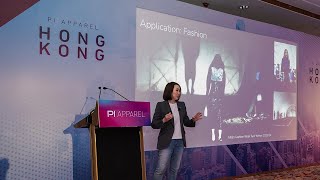
Jeannie from AID Lab developed a smart textile that recognizes hand gestures and glows in response, using knitted photonic fiber instead of bulky electronics. The fabric works offline, survives 20 machine washes, and has been used in fashion collaborations, interactive home panels, and rehabilitation centers for dementia patients.
Chapters
Good afternoon. Thank you so much for coming to attend this talk. Hi, I am Jeannie. I am from AID Lab, and today I would like to talk to you about my research on intelligent textiles. Before I go into how craft and technology forms the fabric of my work, I would like to talk to you a little bit about— AID Lab. Now, AID Lab, I work at AID Lab. I actually wear two hats. I actually am academic staff at the Hong Kong Polytechnic University, just right next door to this area at Tsim Tong, okay. And then I also hold a position at AID Lab. I've been seconded there. AID Lab is a very interesting research lab. You know, at a university there are many different research labs, but our lab is actually situated at the Hong Kong Science Park. The main difference The difference between our lab and the ones at the university is that at our labs, we are expected to commercialize our inventions and to make sure that it comes out from the research labs and has direct applications in real-world context. So our lab is actually established between the Hong Kong Polytechnic University and the Royal College of Art in the UK. Under this lab, we actually have over 20 projects. So my project that I'm presenting to you today is just one of the many projects that we have over there. This is actually funded by the InnoHK Research Clusters of the Hong Kong government. Now, I'd like to start talking about my research work. Now, over the past few months, we have been hearing so much talk about ChatGPT, and especially within the context of being an academic at the university, people are saying that, "Oh, are you getting all these essays that are being submitted by students that has been written by ChatGPT?" Nowadays, are we trying to point out original work by the spelling mistakes that they have, right? But I must assure you that I do not think that AI is here to take over the work of the designers. In fact, I come from a fashion and a textiles background. I think that AI to me is a medium, just like the way that I will use a yarn, a bead, a sequin. AI is a medium for me. So I also think that AI is a great tool for transformation. You will see later on as I show you the applications of my materials how I can use AI to transform a conventionally passive material into an active platform. And it is also something for collaboration. As we know, with technology-integrated wearables and materials, often we have to adapt according to the needs of the market, according to the needs of the users. With materials, it is important that it is useful. At the end of the day, we are all users. We want things that are easy to use and more intuitive. So, this is always a great chance. Whenever we have craft design, it is great for us to use AI as a form for collaboration. And most importantly, I think AI can be used for good. Now, a little bit of a background about smart textiles. I think many of us have seen smart textiles. We have seen it in books. We have seen it in research journals. Many of them are often integrated with sensors and reliant on proximity or touch for it to have a reaction. Now, this is some of my old work. So, these are the existing research. Right now. But do you notice that we have been talking about smart wearables for years, okay? But there is very slow adoption, especially when it concerns the textiles. Some of the 4 main reasons why it has been so slow for adoption. Number 1, do you want to read a manual before you use a textile? I think for many of us, we just kind of like, hey, I just want to grab and go and use it. I just want to engage with it immediately. So right now, many things are still difficult to use? And when you touch it, does it feel like fabric? Does it actually feel more like plastic? Or does, does it feel crunchy because it has got so many components hidden right behind it, right? So that's number 2. And number 3, cumbersome components. What's the point of having a fabric and like a giant computer connected right behind it? It's just that I have used Photoshop to kind of Photoshop it away. So we know that Photoshop does not exist in real life, so how are our users going to be able to put on these garments without so many cumbersome components. And the most important one, how are you going to clean it? You know, what's the aftercare? For many of the products that we show, and especially at the university, we make a lot of proof of concepts. We will make a very nice prototype, demonstrate that it works, but people tend not to wash it and they tend not to clean it afterwards. But this does not apply in real life context, right? So for our team, we have come up with a new invention. It is an intelligent textile system that changes color according to hand and body gestures. Now this is actually based on computer vision. The reason why we have used hand gestures and body gestures, the real reason is because we wanted to do something that is very inclusive. We want people of all ages, ages, backgrounds, and abilities to be able to interact with our materials. The main features of our work is that you can see that it is very intuitive to use. It is contactless. In fact, it is the first contactless mid-air gesture recognition textile that illuminates. Now, for the research that we have seen, existing research, they are still dependent on physical contact. Even though they are called gesture recognition, you still have to hold the material, you have to flick the material, or you have to swipe the material, but ours is completely mid-air gesture recognition. And we have immediate feedback because we have an offline system, and this we actually developed over a series of different tests. As you would understand, I'm not sure whether you have gone into spaces where they are supposed to have Wi-Fi, but the connection might be a bit week. We noticed that when we were doing our initial tests and prototyping at the university— surprise, surprise— even at the university there will be places that you can't get Wi-Fi, and we realized that, hey, it doesn't work. We can't have an online system because if we want to have a portable product, there will be people who go into places where there's no Wi-Fi. So we made it into an offline system. Our materials can be customized in terms of the gestures that we design and also the fabric materials. We can knit it into any designs, textures, and weights. And later on, I'll talk more about patented knit structure. And of course, as I mentioned, it works anywhere. So the textile system is actually based on computer vision, deep learning, and illuminating photonic textiles. Now photonic textiles are not new, but our knitted photonic textiles is 100% new. It is a new patented structure. The reason why we have gone into knit is because we believe that with the casualisation of society where people are now wearing more relaxed clothing, that you will find more comfort. You know, if you're going to be having wearable technology, comfort will be one very important concern. So we think that by going into a knit structure, it will be more applicable for many of our fashion products. Now, how is it intelligent? Our textiles is integrated with a camera, okay, and it is processed by the images that we get from the camera. It is processed by a mini computer with AI algorithms and it gives feedback by changing colors of the textiles. Now, as we are a research platform, we constantly work with our collaborators. Some of our collaborators prefer to have the integrated camera whenever they have it in, let's say, an interior context. For our fashion applications, we will have collaborators coming to us with different kinds of requests. Now, Just to specify how it is intelligent, for example, we will have different hand gestures. For example, we can program it to have very simple 1, 2, 3 gestures. So our system will be intelligent enough to recognize, let's say, 3. If I were to give it 3 sticks, okay, if I were to give it 3 chopsticks, it will be able to recognize that, hey, that's not a hand and I'm not going to recognize it. And many people will ask me, "Hey, Jeanie, is there any privacy issues with this?" You know, because people feel a bit sensitive like, "Oh, maybe they'll be collecting data about my surroundings, etc." or remember the different gestures that I've made. Actually, we have designed the system in such a way that it is forgetful. So after doing the first gesture, by the second gesture, it would have forgotten the first gesture. So again, this This is about how we have designed the system according to your needs. Now our system comprises of two main patents, and sometimes people come to us to say that, "Hey, I only want one part, I do not want the second part," etc. So we can always accommodate, and we can always come up with new technologies by working with our stakeholders. So the number one patent that we have is the contactless gesture recognition system, and the second one is the knitted POF textile. Now, what are POFs? What are photonic fibers? Now, photonic fibers are basically, if you think about the logic like a drinking straw, where light actually travels from one end to the other. Now, without treatment, a photonic fiber will only emit light at the very tips, but we are able to give it a special treatment so that light will actually emit from the lateral side. Now, if you were to look at the existing woven photonic textiles, there are many woven textiles that illuminates on the market, and there are some major brands recently in the past few months may have launched ski jacket with Illuminating Textiles, you might see that existing textiles right now have a lot of spots, and it looks as if it's an intentional design detail because it looks like a galaxy of stars. Yes, it is really beautiful, but actually the little spots are often fiber damage because if you think about it, light travels through the core of the fiber. Whenever you have breakage, there will be a spot of light. But for us at the university, we do a special treatment so that we have a very even light emission throughout. Okay, so when you touch our textiles, it's cool to the touch and it does not carry any electricity. So we have three distinct applications. As you know, fabric is omnipresent in everyday life. Anything that's made out out of fabric, we could basically use the intelligent textile system. So mainly in fashion, interiors, and rehabilitation. Now this is a quick video of our installation for interiors, and I would like to remind you that for each of our installation, we like to program it with different things because my researchers love to play with our technology. So— This is a demonstration. You can see that I have programmed it with two modes. This is a playful mode. You can use your hand gestures to chase the light across the room. And in the second mode, you can use your hand gestures to change the color illumination so that you can change the ambiance of the room. So for this, I think for interiors, it's got a lot of applications, especially within the context of Hong Kong. You know, in Hong Kong, we live in such small compact spaces and we share the space with many, many different people. So by having that space, we being able to quickly customise an area, we will actually create a better sense of well-being. Well-being. So interiors, this is one of our presentations for the interiors. And for the second application that we have, I'm very, very honoured to have been invited by Antiprima, an Italian luxury brand, to collaborate with them. They have used our materials as part of their Milan Fashion Week presentation, and this just happened in February, and we were the initial looks for them. So we presented Look 00 and Look 0 at Milan Fashion Week, and this is a short clip of our journey to Milan. And as you can see from that garment, um, I would like to invite all of you, if there is a chance, to come and feel my textiles. They feel like any other knitwear textiles. And one of the key innovations about the knit structure that I have made is that now I can actually knit shaped pieces. So you can see in my knitwear, it's all fully linked. Then with our collaborators, of course, they were saying that, hey, for, for our fashion, we don't think that it is viable to have an integrated camera. Can you think of some other technology, something that's easier for us to control? So we actually integrated it with a phone app so that they can easily adapt the fashion according to their needs. So if you were to open up my knitwear and look inside, the linking and the finishing is just like any designer knitwear. So this is one of the breakthroughs, because previously when I was working on woven textiles, one of the problems that I had was the finishing of the items, because they were just so difficult to cut and sew and throw away the materials and remove the excess. So the knitwear is actually solving a lot of the problems for me. And for the last application, it is for multisensory rehabilitation. This is for our well-being applications. As I mentioned, one of the key strengths of being at AID Lab is that we pride ourselves in collaborating with stakeholders. We often co-design. So for this project, we actually worked with the different therapists at the Hong Kong Shen Kung Hui Welfare Council and the end users. They have actually licensed this from us and installed it at their Wong Tai Sin Healthcare Centre. And this, these panels are actually meant for people with dementia and learning challenges because they benefit from multi-sensory stimulation. For many people with these concerns, you find that they have very suppressed sensory stimulation. So they actually, by having a lot of light, sound engagement, it actually enhances their well-being. So this is a video of our work. The issue of having a textile within this kind of context is that, you know how textiles is omnipresent in everyday life, so people are not going to be resistant to the material or the technology. They are more likely to be able to engage with it. And the other great thing about this panel is that we can also customize the gestures. They can have immediate feedback. They can give them a gesture and then it will actually change colors. We can actually co-design our intelligent textiles with our users because the belief of our team is for our designs, our products to accommodate accommodate the needs of the users instead of the other way around. So for example, if you look at the panels that we have installed here at the healthcare centre, you'll see that the surface patterns are actually based on the important landmarks of this neighbourhood, and this is actually based in Wong Tai Sin. We share the common vision of, uh, want to create products, new products that will actually help our users. So the team would include their management staff, their healthcare providers, and also the users. So we all were able to sit down together and look at the materials that they like, the colors that they would like to use, the functions that they would like to incorporate so that they can actually encourage the users to engage with with multi-sensory stimulation.
Throughout the rehabilitation process, because for the trend, we adopt different technology and also intelligence to enhance the effectiveness, efficiencies, and also make the rehabilitation process more fun. AI seems very high-tech, but here, everybody coming here, every member tourists can enjoy it and also find the fun in the AI textile. So thank you very much.
Now here comes the crucial question. This one is the one that people usually ask: can it be washed? Yes, my fabrics can be washed. It can be washed in the washing machine under gentle wash, cool water. We have done tests. After 20 washes, we find that there is no effect on the illumination. So, but I need to emphasize the components cannot be washed. So we have designed it in such a way that the components can be disassembled and reassembled very easily after cleaning. So we understand that materials are there to be used, they are not there to be seen as an exhibit piece. So that's why washing was very important for us. Now, for our system, there are actually existing gesture recognition systems. In fact, there are some very well-developed ones that you can buy from Amazon, et cetera. Very nice systems, works very well. But our team actually have to design our own system. Why? Because it is specific to fabrics. Now, with fabrics, we need things that are lighter, easier to integrate things that are not too obvious. The ones that are on the market might have a very big bulky stick on it. So in order for us to make sure that our system accommodates to the needs of the textiles industry, we actually design our own system. And it is also more affordable, it is more portable. So if we want to make small portable objects, we can also make them. And also And so the third one, as I mentioned, it is an offline system so that it works anywhere and everywhere. Now for our textile structures, we are not limited by the surface design. We can design with anything. As you saw from my example from the rehabilitation panels, we actually design all the different graphics on it. They wanted us to include the landmarks of their neighborhood. So I can have different graphics, I can have different textures, I can have different weights. We have been knitting with wool, we have been knitting with cotton, upcycled yarns, etc. So if you have a particular handle that you would prefer, you want it in a different weight, or you have a garment that you want to integrate with, we will be able able to help you develop swatches. So this took me 2 years to get onto the machine, 2 years to be able to come up with the know-how and the technical skills in order for me to be able to produce this on the flatbed machine. Now by having it produced on a flatbed machine, it means that my textiles are scalable now. I can actually have it for mass adoption, customization, and production. Now, this is the end of my presentation. Uh, if you have any questions, please feel free to ask me. And if, uh, you have further questions, uh, away from this conference, uh, please, uh, don't hesitate to contact me on my email. Thank you. [FOREIGN LANGUAGE] Okay. So if you have any questions, feel free to use the QR code. Right. Actually, for the POF textile, it is like a transmitter of light, so it actually carries light from one end to the other, so it actually does not reflect light. If you think about it really like a straw, the light just comes out. Do you— can you advise the weight of the fabric? Now, because we can knit in a wide variety of structures, so it really depends on the design and the yarn that we have used, the textile-based yarns. Now, because we wanted to illuminate and we also wanted to have a really good handle, so we usually have to strike a very nice balance between the textile-based yarns and and the photonic yarns. How is the stretchability of the fabric? The stretchability of the fabric is just like any knit that you have, like any designer knit. It is very, very stretchy, can be very stretchy. If you are interested in our textiles, I would like to welcome you to our lab at the Hong Kong Science Park. This is, we have a small installation installation that's going to come up in our office as we speak. We are installing it right now. And we have a lot of fabric samples that we can share with you. Like I mentioned, touching is believing. After you touch it, I think it'll be easier to understand the capabilities of the materials. Ah, the patents are secured in China for the patents. So these are the questions that we have. And also, if you haven't had the chance to come to our Hong Kong Science Park office, we are going to have a large-scale exhibition at the Hong Kong Science Park in late June to July where you'll see a lot of the different projects represented by AID Lab. I'm very, very fortunate for my POFs. We actually purchase it, but for the textile-based yarns, I'm proudly sponsored by Woolmark. So many of my work, you'll see that I've been working with very nice wool, and people from Cotton Ink has also reached out to me. So I'm happy to try any textile-based yarn. So if you would would like to recommend any yarns for me to try with, please come and let me know. Ah, the price of the fabric. Now this is difficult to say because I'm R&D price and not manufacturing price. So usually the way that we are going to commercialize this is that we will transfer the knowledge to the collaborator, right? So they'll license it and then we'll transfer all the information. Now currently my textiles are made by the tiny hands of my research assistants. Everything's made in Hong Kong. Everything, a lot of work is done, in fact, just at Hong Hom. So all made in Hong Kong right now. Yes, you do need power for it to be active. I'm not sure whether you have been buying toys recently. When you go to Toys 'R' Us, when you buy a toy, the batteries do not come included with the toy. So just like that, our garments do not come with the battery, but we have recommendations for the battery. For example, for my big installations, they are very easy to install. You just plug it in and it works fine. It doesn't need a lot of power. For example, for our wearables, we have a lot of different batteries that we will recommend. They are very small, they are very portable. It really depends on the applications. Some people have been applying for accessories, They will have different needs. Garments will also have different needs. Yes. And but the batteries that we recommend are usually things that you can buy on the market, but you may not be aware of them. Ah, the solar power, that is fantastic. Thank you so much for this question. I know that this is something that I really need to go and do further investigations in for it to be more sustainable. This is an area that we plan when we receive more funding to go ahead, to go and look into. So this is definitely something that we want to look at. Yes. Yeah, so these are the questions. So thank you so much for all your questions. Thank you.










