Is AI a Threat or Tool for Fashion? | PI Apparel
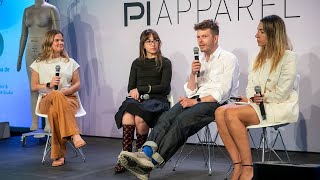
Mariana Solano, Dominik Slaeter, and Karina Ochoa discuss how fashion brands can use AI without replacing designers. They cover copyright risks, the need to document human versus AI work, and treating AI as a copilot for faster design iteration and cost estimation.
Chapters
Let's kick off. And please help me in welcoming on stage Aaron, the founder and design director of Reborn Designs, Mariana Solano, AI and IP attorney, Harvard Business School Online, Dominic— I'm going to owe you the name so you can teach me— co-founder of Enhance That. And Karina Ochoa, creative director and consultant of Infinito Estudio.
Thank you.
Perfect. Well, the Spanish I can nail.
Good morning, everybody.
Thank you all for joining today. I'm really honored to be here speaking at the PI Apparel event. My name is Erin Bornstein. I am founder and design director of Reborn Designs. We specialize in the design process of footwear from strategy to design to development to go to market, allowing you to not just create a product but really experience the whole product journey. Joining me today on the panel today are Mariana, Dominic, and Karina. We're really excited to discuss— thank you— AI-driven fashion innovation or industry disruption. Artificial intelligence is transforming fashion at an unprecedented pace, reshaping design, production, and consumer engagement. But is AI an innovation that enhances creativity and efficiency, or is it a disruptive force that threatens traditional craftsmanship and industry jobs? This panel brings together AI pioneers, fashion technologists, and brand leaders to explore how AI is revolutionary— revolutionizing trend forecasting, product development, and supply chains. Today we'll debate the ethical, creative, and business implications of AI in fashion and discover how brands can harness its power while staying true to their brand identity. So I wanted to open it up and just let everybody on the panel introduce themselves and give a little bit of a summary of who they are and who they represent.
Hi everyone. My name is Karina. I am a creative and consultant. I I love to use all technologies, really. I wouldn't say at this moment that I specialize in any. My goal is to use technology to either do pre-production, post-production, and I help brands in this regard, either is, you know, creating libraries of blogs or creating music videos.
Excellent. Thank you.
My name is Dominik Slaeter. I work for a company called Enhance That. We literally enhance people's way of working, how to use 3D, how to use AI in their workflow with any of the amazing tools that you saw downstairs. My background is in product development design, and I've been leading and implementing 3D for the last 20 years, and also coming to this conference to share and ideas.
Excellent, thank you.
Hi, my name is Mariana Solano and I am an IP and tech attorney. And we know that AI is a fairly new area of law that's developing very fast. I am specialized on consulting startups specifically on their compliance with fast-paced moving new legislation in AI and tech protection as well as in privacy.
Okay, excellent. Thank you and welcome. I'm gonna open it up today by directing some questions to our panel, opening up the conversation about AI. And please feel free to use Slido to join us in the conversation and ask some questions that we can answer at the very end. So this first question is for Dominick. What lessons from the past digital transformations, like with the rollout of 3D product creation, should companies apply now to ensure AI adoption doesn't stall due to skepticism or poor change management?
Yes, thank you. It's a very long question and I think it holds multiple things in there, right? I think first of all, realizing that AI, like the fact that we can create amazing images, doesn't mean necessarily that everybody's going to know how to use it and is going to enjoy using it and then it can scale across the company, right? There's a couple of things that we learned over these last 15, 20 years in the implementation and the using of 3D and other technologies is that you really need to understand what problem are you trying to solve. Are you want to make the creative process, the, the concepting faster, easier? Then, then that's what you need to focus on. Do you want to create images that can go into e-com? That's a completely different use case. It's a completely different process. And so it also requires a different strategy. So knowing what the problem is that you're going to solve is one, and creating that framework on, on what you want to achieve. What does the— what does success look like? And it's a bit cliché, but I think it's still relevant. And then thirdly, also realize that AI might spit out amazing images. The whole implementation of it it's not magic, right? It's still more than half of it really relies on like, how are you going to speak to people? How are you going to introduce it? What is your process? It's human effort. It's, it's not magic.
Absolutely. I agree. I think a lot of us can relate to the fact that, you know, AI is powerful in a lot of capacities, but, you know, it still can't wear your garment or your shoe. It can't tell if it's comfortable. It can't tell you if it will buy something from you. So there are a lot of other pieces that need to be considered as well. The next question is for Karina. AI in fashion is moving fast, but what are the real barriers to implementation for brands and creatives?
I think this ties up a little bit what Dominick was saying. I feel like when we start to implement tools in companies and they're accepted by the directors, they're like, oh, wonderful. Yes, let's do it. This is going to solve so many problems sometimes. The issue is that maybe they don't understand how we make these products, right? And so they are expecting the AI or these tools to just come and solve all the issues and then to everyone to know how to use them very quickly. But I think we all have to understand and communicate 100% better and understand what the other teams are doing, right? What is the end goal and what is your problem? Can I make it faster with this technology and can I solve the issue that you're having at hand? Once you identify that and you learn how to communicate, you know, from a creative brain to a more maybe logical or numbers brain and start this communication. You can be like, OK, we as a design team, we want to implement AI. But we're going to use it for concept development. Or we're going to use it to do iterations of our designs and see what performs better with the data we're getting. So when do we want to use it? How are we going to implement it? And how we're going to make sure that Higher-ups say, sign on it and say, let's implement it. And the design team or the technical team, production team, sales teams are happy to implement these tools and are actually being helpful to them.
Very good. Thank you. Mariana, this next question is for you. As AI begins to influence everything from fashion design to marketing, how should US brands protect their creative output when copyright law doesn't yet recognize AI-generated works?
Yes.
So I come from the compliance perspective where I would say that every process in the creative— every step of the process in the creative process has to be run by your legal team. And I'm not coming here from the point of stifling innovation, but from the point of protecting yourself and protecting your process in the future. Currently, there is no AI protection, no copyright protection for your AI-generated images and designs. However, if you protect yourselves from the trademark perspective using your logos, from the trade dress perspective, you're able to, together with your legal team and your compliance team, streamline a process that's going to project your product at the end using AI. So use AI as a helper, don't use it as an employee who's gonna do all the work.
I, I often say that AI is a great copilot, but it's never the pilot. And I think that rings true for a lot of people. Dominic, this next question is for you. AI on its own won't innovate, people will. Based on your experience, What strategies should leaders adopt to integrate AI in a way that actually drives innovation, not just automation?
Yeah, and I think I already mentioned some of it. I think I gave it away in the first answer, but it's keeping closely in mind, like, what are you trying to solve? And maybe one thing to add there, lead with empathy, right? I think you spoke about the people change management, one of the things that I've learned when working with 3D and implementing and getting people on board is by doing it yourself. Like everything you ask others to do, no matter what role you have, if you're the CEO, CFO, try it yourself first. It has a massive impact. And what we used to do as well at the brands where I led DPC, make those technologies that you introduce not only available for designers, developers, but make them available for like a week or a walk-in for everyone, whether you work in finance, HR, everybody in the company should feel the same emotion of change that you go through as the role that you're trying to change. Change is much more than giving someone a training. Change is about having the company knowing that you go through a big change and feeling that support.
Absolutely. I think knowing why the change is being implemented is key. And I agree wholeheartedly that having that experience and walking through it can really make a big impact on the appreciation for the change taking place. Great one. Mariana, another one here for you. The FTC has started policing AI-related marketing. What should fashion brands be aware of now? And how is enforcement already shaping how we talk about AI and product development and branding?
A very good question. Federal Trade Commission, which is the federal agency for protecting consumers and ensuring the fair business practices, despite the fact that there's no federal AI regulation, is policing the businesses, and especially businesses of fashion where products are not correctly marketed. So if you are marketing something that has been created by using AI, you're publishing it on the social media or on your website, it has to have the stamp that is created with AI. Also, if FTC comes with an investigation, you have to have your processes streamlined and documented, that is documented each step of what step was the human, human-created, which step was created using AI, and how it altogether, what percentage has been used with AI and what percentage has been done with a human. And if it's completely done then by AI, it has to state AI-generated. So labeling correctly the products that you are marketing is very important to avoid being fined and being heftily fined in an environment that is not regulated. So as we know, it's all based by principle. Same happened with the privacy laws. Big companies got big fines. There is still not federal legislation for that in the US. However, the practices are being set by the industry, And by the fines that have been already— by the precedents, by the fines that have been put by the FTC already.
That's great to know. Thank you. Karina, next question is for you. Is AI more of a tool for innovation, or are we headed towards a place where it disrupts roles before we're ready?
I used to think— I mean, and I've been called a button clicker before. I try everything. And even if I don't know a software, I just want to see what it does. And with AI, it was the same. And then as a person And it took a long time to become a designer, a fashion designer, and then to learn all these 3D softwares. I'm like, is it really just going to throw away everything I did? Right? What about all this time I spent trying to render something beautiful with animation? And I understood. I mean, I always have to— technology is not going away. It's going to keep changing. It's going to keep improving. And how do we use it as a tool? And you were mentioning this earlier too. What is the end goal? Right? What do I want to do? And how do I go about it? And I think it is wonderful if the whole company understand that, you know, it's a tool, how we're going to use it. And I actually learned this from Stitch because I met you guys in 2019 when you told me you had like basically schools within the companies and everyone could come for training. And I feel like once you're able to try these new technologies, you can design on your own. How is it going to help you? So it is scary, 100%. Every day there is so many changes. But how can we adapt to the changes? And also, do not throw away your knowledge, right? Now instead of doing something that is fully AI, can I integrate my 3D and use AI for making beautiful renders? But I have control over the motion. I have better control over the textures. The tools can connect if we kind of investigate how to make them work for us.
Yeah, I also feel like relating to that story that oftentimes people have their own workflows and maybe some of their skill sets are different than other people's skill sets. One designer might be good at rendering, one designer might be good at sketching, and so they may use AI in a whole different, for a whole different purpose than the other person. So streamlining is very hard. From my experience. Do you agree?
I can say one thing in here. I feel like I have had the opportunity to work with the advertisement industry and the video game industry. They have an artist for different tasks. In the fashion industry, for some reason, they expect to find one designer that can use CLO and do everything else. Or this designer can do Substance and ZBrush. And why not Houdini? Because Houdini is so easy to learn. So this is not how it works. When I work in these industries, they have 30+ artists working in one project that might be 1 minute long, tops, or 30 seconds. And it takes time as well. And it's OK if it takes time because it's beautiful. And it's also well paid. And so why don't we learn from the fashion industry? Because we're arriving a little bit late to these implementations of these workflows that other industries are already using and work so well.
Yeah.
Great, great, great story there. We have a couple questions submitted on Slido. Feel free to encourage anybody else to submit their questions as well. We'll take the first one here. It's from an anonymous user. What are the biggest legal roadblocks that come with AI? I'm wondering if Mariana, you want to answer that one.
I believe that's for me.
Yeah.
I would say that in the United States, the biggest legal roadblock is the lack of regulation. We have— California has a Privacy Act. New York has an Employment Data and Biometrics Act. But there is no comprehensive bill that regulates the AI use in the United States. So companies are left with wondering. And it's a wait-and-see approach or a legal risk that they have to take to innovate, but risking the fact that in a year or so when new legal precedents are going to come up or new regulations, they will have to redo, redefine all their processes and all their creative processes. And they would have to go back in time to make it compliant with the new regulations. So the previous administration came up with an— executive order that was repealed by the current administration, but the previous AI executive order was very comprehensive and it was built very much on the EU AI Act, but it definitely contained very specific for the US environments provisions. So now we don't have that anymore because the current administration wants to put forth the fast development of AI and to be one of the first AI countries in the world, which is not bad, but at the same time, I believe that for small businesses that wait and wonder is not the best approach. So my recommendation would be to look at the EU AI Act because Most of the businesses are doing business in Europe too and internationally. So yes, get inspired.
Thank you. Very informative. We have another anonymous question here. What are the best tech use cases that bring the best of AI and 3D tech together? Anyone have a point of view on that?
Yeah, absolutely. I mean, the best is a little hard to define. But if I think about this, right, and I've been thinking about it a lot, so I'm a little bit prepared. I think with the abilities of AI today, right? 3D has been really good on being very accurate, and you can really control and construct a garment. As a product developer, that's my core thing, right? I want to be able to really engineer the garment. What we've always been— and I really believe that that can change the process and then on how we make clothing, how we make product. What it's always been lacking a bit is the ease and the speed of creating high-quality visuals that could be commercially interesting. We tried super hard, right, to make 3D look so good that you could sell from it. It just was not too good, and if it was really good, it was too expensive to create, not really scalable. With AI though, right, you get the best of both worlds. It's the combination of a technical garment that can be produced and something that you can sell because you apply AI. And that sounds almost like that's already out there and it can be done immediately. I don't think that's the case. We're currently, as EnhanceDad, also setting up workshops with brands, manufacturers, but also tech companies to figure out what are the pieces that are missing in order to do that. And I'll give you one, is that we need to be able to cost a product based on 3D in a very accurate and a very fast way in order to sell. But imagine when you can do that, right? You can start selling before you make. And that is the biggest creative unlock, I think, today. That means that you can design anything. Well, not anything. It needs to be manufacturable. That's your check. But that's the opportunity, I think. And zooming out to what we said in the beginning, right? Think about what problem you are solving. I think that's the, for me, the thing to solve.
Yeah, I think that's really exciting. And if that software ever comes out, please let me know. I want it.
But I don't think it's software. It's a way of working. It's a way of thinking. It's a way of connecting your technology that you are— that is out here already with the right people. And we cannot do that on our own and that cannot do that. But we can work with manufacturers, brands, and technology to achieve that, to create that way of working.
Yeah, I think that's really exciting. And to tag on other use cases that I've seen myself have really leveraged AI technologies such as Viscom, Newark, or Kria, where they can rapidly iterate against the same design with microchanges and lightning speed. So that iteration process gets cut down to nearly nothing and you can just make faster decisions right there on the spot where that image or that visual of the realistic product now can either resonate or not and be compelling or not on the spot. So I think there's a lot of value to that. And some of those are the best uses cases that I've personally seen so far. We've had another question. I think we have time for one more here. Another anonymous user says, for copywriting print design with AI enhancements, can the human-generated portions still be protected by copyright law? I think Mariana, this is another one for you.
Yes. So that's a very interesting question. You would want your end product to be protected by the copyright law because that's what going into the public domain, this is what you're advertising, and this is what you're monetizing, pretty much, your design. The copyright protects the final product. So as long as there is human work on that design, as long as the human has did the finishing touches of that design, and it's documented, it's protected by the copyright law. Use purely the machine-imputed prompt, create a pink dress, a summer pink dress for cocktails, and you get an output from the machine and then you put it in production, that's not going to be copyright protected. Like, that's not going to be copyrighted.
Excellent. Thank you. Maybe we have time for time for one more here. Um, Karina, I have one more question for you here. How can we stay creative and human-centered when using AI tools to generate content?
I think it's important, and I think you have also emphasized a lot in this, stop thinking about technology because we kill words like metaverse and NFT already, right? So stop thinking that it's about the technology and Everyone is going to try to sell you something, especially if everyone already jumped in the cool wagon and whatnot. We are in the business of fashion. What do we want to create? And wouldn't you rather spare more time being creative and making what you love or filling out the PLM system or templates on Excel or whatever is the way you used to create? That's what the tools are there for. Moodboarding as well, concept development. It's a tool to just make it faster, to visualize it better, to make it more beautiful. I think 3D rendering, AI can be also an aesthetic. So think about what you want to make. What is the product you're selling? Who are you selling it? And then this has been always our business. The tools have just changed a little and improved and now are enhanced. So let's enhance our workflow.
Absolutely. And they're constantly changing, so just got to be on your toes. Thank you all for attending the session today. I hope you found this content valuable. Please feel free to come up and find us afterwards. We'd love to connect and talk to you all. Thank you.
Thank you.










