Making Your Brand a Retailer With Craig Crawford | Fashion Made Podcast
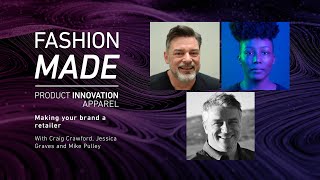
Craig Crawford, Jessica Graves, and Mike Pulley discuss how brands shift from wholesale to direct retail, facing three core problems: no direct customer data, gaps between designers and technologists, and too many AI tools that don't replace human judgment. Real examples like Pets at Home's app and data-driven cuts to Hushpuppies and Stan Smith show how data shrinks inventory and informs sustainable decisions.
Chapters
Hello and welcome to a new year of Fashion Made. It's, uh, quite incredible that we're already 3 weeks into this 2021, although it might feel a little bit longer than that for some given everything that's taken place. Look, firstly, I hope you and yours are keeping well, you're keeping safe. That's most important right now. At PyroPower, we've got loads of new projects coming up. Firstly, a new training series that we've launched, the first one of which is delivered by Christian L. Harris, and it's How to Win in 3D and Rock Your Implementation. Really, really important sort of first steps into that digital transformation journey, which I think is really relevant for a lot of people in the industry right now. We've also got loads of new Spotlight events coming up. These were really game-changing for the PyroPower community last year. And so we're going to have lots of them coming up over the year, one every few weeks. These are deep dives into specific topics. So, you know, it could be 3D, it could be merchandise planning, it could be anything. So go and have a look on the website and see which of those events are most applicable to you. And lastly, we've got a new podcast coming out every single week, so I hope you'll keep listening. The first one of 2021 is a great conversation I had with Craig Crawford, Jessica Graves, and Mike Pulley, which is kind of a part 2 from an event that we did last year. So here's that conversation, and I hope you enjoy. Hi guys, and it's an absolute pleasure to be joined by Mike Pulley, Craig Crawford, Jessica Graves, uh, once again. Hi guys, how are you doing?
Great, fantastic.
Good stuff, good stuff. Well, welcome back to the podcast, Craig. And, uh, Jessica and Michael, this is your first experience of Fashion Made, so a first, welcome to you.
Thank you.
Look, we're gonna be covering some of the stuff that we talked about at the Pye at Barrel Europe event in October, which you guys held a great session called Making Your Brand a Retailer, and some of the nuance, going into some of the nuance around then. And we had so many questions afterwards that we didn't have time to answer that we thought we'd put this all together and have a quick podcast about it. So for those that weren't there at the event, let's maybe cover some of the areas briefly around making a brand a retailer. Craig, can I start with you? What are we really talking about here when we're talking about making a brand a retailer?
Well, I think a lot of brands are still in a percentage split between wholesale and retail. A lot of brand— being direct retailers, I mean. A lot of brands still don't understand a lot of information around their customers. And we are used to working as brands the way we have for the past 100 years, with perhaps the mix of e-commerce being thrown in about 25 years ago. And so if our classic model has been create product based on trend information and then take that product to market, to wholesalers and to our own buyers, and to a small way sort of market that direct to consumer, All that shifted in a very short period of time, right, with all of this digital interaction that we now have with brands. Consumers expect, as we all know, brands to be engaged with us. And for some brands that have been around for hundreds of years, that's very hard to shift focus. And so I think that's really what we were talking about when the three of us did the broadcast through PIEU was, you know, there's just new behaviors and new expectations, and we have lots of information to sift through, but to allow us to engage with consumers in the way they expect, but also to give them what they want. And I think that's one of the biggest challenges with all the way we've been set up for 100 or so years, right, with the calendar being dependent on raw material lead times, for a start, right? So we're undergoing a seismic shift. We really are. We really are. And so we only scratched the surface on that, didn't we, when we had our chance to speak back in early by default.
Mike, Jessica, do you want to come in on sort of what are the nuances around this change that's taking place?
I think one of the biggest things that I've seen throughout my career is brands starting to understand that they need to access data. But once they have this realization, they don't always know what to do once they have it. And, you know, for a long time, people have depended on wholesalers and retailers and almost have no ownership of their customer relationship after sometimes decades, or a very, very small percentage of their sales is coming direct. So they just, they have no relationship with their customer whatsoever. And so I see a lot of brands where, you know, for the first time they're thinking about like, what is all, what is the data that's available? They're not even sure what to ask for. Then they finally get it and they're still not sure what they're supposed to be doing to improve the customer experience. And especially with you know, all the events of the past year, you can't necessarily depend on anyone else to get your product out to your customer. And if your retailers are not operating in certain countries or certain regions, or they're not using the right shipping partners or whatever else the challenge is, it's— you need to have that direct relationship with the customer to get them the product. So I think that's one of the things I've seen over and over. It's just being willing to take full ownership and really understand what are you going to do when you actually have all that data and how is that actually going to impact the customer and what are all those other parts that we don't think that hard about when such a small percentage of business comes from direct for heritage brands.
To add to that, to what Jessica said, I actually started out my career in not retail, but rather telecommunications backend systems. These were large transactional systems that really pumped a lot and a lot of data. It was customer information, where they were calling, eventually how much data they were using, were they roaming. These are massive, massive systems because you can imagine call detail records from— and customer care records from Vodafone that has 125 million customers, and then you look at all the other carriers, right? I think I did that for almost 10 years and then I got into retail and Apple and so forth. But, what I have seen over and over, and it hits on Jeff's point particularly well, the business domain knowledge and the data model knowledge oftentimes do not come together. We can have the advent of AI and so forth, some very clever algorithms, but it's— The real challenge, and I think it's very, very prevalent in retail, is can we capture the intuitive knowledge of a domain expert and translate that into a mathematical and data-gathering formula that makes relevance and context, and it takes data and turns it into information, right? That's actually usable, and we can execute and improve it in the business model. Everybody says this, but 22 years doing this, and I think that's the most difficult part, is that you have to have your domain expert and your technologist really walking hand in hand the whole way through, uh, and the refinement of the model and the use of the data, uh, constantly being updated by that business knowledge of what you're actually trying to achieve. Too often we collect huge stores of data and they sit there, and they're not— either they're not manageable or they're not used to the extent that they could be. Getting closer to that, from an Apple perspective, you know, all retailers will get kind of 3 things: how do you increase football, how do you increase basket size, and more often now, how do you create a brand advocate that speaks highly of the brand so that you can widen your audience? At Apple, both the use of data/information and the manual interactions with the customers, whether it was in the store or online, was really about that third point, which is creating the brand advocate, so that there is a clear perception of value in terms of the interaction with the brand. So I think going forward, how does a brand become a retailer is really understanding those brand advocates, whether they're direct customers, whether they're influencers, and understand that feed that comes through and helps them make a business decision. I'm sorry, that was kind of a long answer. That's my thoughts on that.
And Craig, I mean, for a lot of business owners, you know, making, turning brands into retailers, they might be scared by some of the language that Mike used, you know, around sort of technology and and data transfer and things like this, contextualizing data, these are quite maybe ambiguous for people that aren't experienced in this area. So how can they get more familiar with these practices?
I think Mike really— his first point really, really, really is crucial. And Jessica, chime in here as well, please, because like you— like me, you and I have spent time growing up in this, in this industry. And, and the first point that Mike made, which is making sure that there is a true collaborative partnership between the people who need to look at and understand this information and the people who have the capabilities to evaluate it. So in other words, marketing and IT, or merchandising and IT, but it's not broad brushstroke across they need to be partners. Mike referred to, you know, subject matter experts, the domain expert, the person who understands in marketing that particular suite of digital channels or those traditional marketing channels and what the brand represents and is trying to communicate. How do we then look at who's receiving that? How do we then look at who's cascading that information out? Yes, we want it to convert to sales, but if we spend too much time worrying about direct correlation. I mean, I'll give you an example. Bringing someone into a department store with a clienteling app by giving that salesperson, the domain expert, the knowledge of that particular customer, Mrs. Smith is looking for a pair of red shoes, and red shoes come in, and the sales associate has the opportunity to send an email or have a video call or a text message to say, "Those red shoes are in." And Mrs. Smith comes in and decides she wants black ones, and she buys them. Now, the people who are analyzing the data say, "Oh, but you told her to come in for red and she didn't buy red. She bought black. So that sale is not attributed to your engagement with her. I'm sorry. That technology is not serving us well." That is the wrong way to look at that. That salesperson made a sale because of that outreach, understanding that consumer, having that relationship. And using that technology got that consumer to come in and buy something. And that, by the way, she could have bought those black shoes online standing in the store, and then you're two layers removed from we asked her to come in for red, she bought black, and she bought black online. So when we start to interpret the behaviors, you need that domain expert, the retail person, not the financial person looking across it. They can work together, of course, but it's that partnership that we need to have between that store person and the data that they've sent out and the information that's come back. Mike said it very well, but he said it in more technical terms. Who are your experts in these areas, and how are you partnering them with someone in the technology area to understand one another? Because— and Jessica picked this up— the data scientists can help see new patterns and new behaviors when they understand and partner well with what the business wants and what the business objectives are.
Yeah, absolutely. I think for specifically the challenge, there's a lot of layers of challenges here. One is what you said, even between IT and merchandising, it's like there's also those same separations between IT and the data scientists. They're not always considered part of the IT team in the first place. And so there are just so many different cultures and nuances of understanding between different groups within an organization. And especially if you're a large brand or heritage brand, you know, hundreds of years old, 50 years old plus, you have lots and lots of employees, you're going to have lots of different cultures around the value of data, the value of intuition, the value of gut feeling, the priority to create versus to do what seems to have been done already. And so there's that issue, but then on top of that, it's interesting because we use words like algorithms and we kind of just generically mean anything that is an algorithm and we don't really specify, or we'll say things like AI or AI applications. And if you're thinking about the fashion world, it's kind of like saying, it's like saying fabric. It's like saying, Well, that's made of fabric, so it does XYZ. Or this is made of fabric, so that's why, you know, we don't use fabric here. You know what I mean? It's so generic. And it's actually like, well, you know, Instagram's not made of one algorithm. It's made of many algorithms. And if you use the exact same set of those for a different outcome, you would have a completely different product. The same way, if you have the exact same piece of fabric and you make it you know, let's just say Marc Jacobs versus Chanel, it has different value for no other reason than the product that you created, the experience you created, the brand around it. So I think it's just so important for, especially when we talk about technical topics, there is no reason for us to believe at the moment that data is pulling out cause and effect well because that's not the type of research we've been prioritizing as far as Can you look at data and say this caused that? We basically are just kind of this year starting to see some of the more advanced retailers who are tech-first bringing causality people to do this kind of analysis. Like, we have not had the tools for that in, in data for a very long time. So there is a healthy way to be skeptical about, you know, just because the data says this, you shouldn't do it. Um, but on the other side of that There are so many myriad of tools you can create from the same set of, let's say, algorithms, models, data that the idea that the entire field is right or wrong for a certain business, it just doesn't make sense. It's also a kind of product development process.
These are really good points. I want to build on something Jessica said about the fabric idea. I really love that, the way you said that. In my experience, the biggest problem that you have with the so-called partnering between these domain experts or different people in the business that have a legacy and technology people. I've seen this in various industries. The projects often fail because of different language and different perspective within the business. You may be using the same word, like Fabric or something else, but the meaning to that person saying it is different than the interpretation. Interpretation. Probably one of the most valuable players in any team that is trying to attempt to do some sort of digital transformation is what I would call a translator that can really go and stand between the technologists and understand enough of what they are saying and, more importantly, what the capability is within the systems that they're managing or building and what the business is trying to achieve. It sounds really easy, but it really isn't. It's the hardest thing to do because you're having to— sort of understand how to translate Spanish into Mandarin or whatever the situation is. And it is true, what is the contextual relevance? That's the hardest thing to achieve. And then, you know, you put the other dimension on it. What are we trying to do, turning ourselves into a direct-to-consumer retailer? You know, that's a shift. Now, we had this project with a retailer called Pets at Home in the UK, and it was an app that we developed with IBM when I was at Apple, and it was used by the sales associates to greet the customers and then help them with their query. And one of the things that in the design process, we always insisted that we had people from the store that we took to Cupertino actually, along with the designers, And what we learned in the first day was instead of capturing the customer data as the unique identifier, it was the pet name. When, when Mrs. Smith would come into the store, the first thing they said, "How's Fluffy?" It's like, and they knew what Fluffy ate, they knew what treats Fluffy liked, they knew the whole order history. And People knew that's the way that pet owners responded well to a customer engagement in the store, on the floor, right? You not necessarily would understand that if you're working in the technology department, but they came out in the design session. What they did was combine that ability with the ability to do ordering within the store if something was out of stock. So if somebody was looking for something on the shelf, they'd come up, They'd say it, they'd identify the pet name, and then they'd say, "Oh, your dog likes whatever brand of dog food. We have 4 sizes available. There's only one on the shelf, but I can have that 50-kilo bag delivered to your house by tomorrow. Bing, press here," right? And it was a very simple app, but it really achieved context and relevance. And sales went up significantly. If you look at Pets at Home right now, I mean, they're doing quite well. And it's because they have the real knowledge of what the customer is interested in. And perhaps it's a little bit easier because it's with pets and people express their emotions when you're talking to them about pets. And if you can capture any of that data, then it really does become relevant quite quickly.
But, Mike, to add to what you've just said around that, though, that is a complex layer of understanding who the end consumer is, in this case, the pet. And who is the provider, which could be an entire family, right? You know, and I'm not a data scientist here. I mean, I'm that guy that falls between technology and the business and explains it, and I'm giggling when you say how hard it is because I have a great beard to prove it, right? But the reality is you've just described something that the purchaser is going to be excited about because they feel as though there is someone at that store who understands the relationship they already have with their pet. And I think Jessica, these are the kinds of things you're talking about, isn't it? It's understanding what these parameters are, and then understanding the limitations or the advances. Because Jessica, you said earlier, we're just starting to get tools that are allowing us to do things that are terribly complex, such as true causality. So, you know, one-to-many, many-to-one, I mean, all of these things way back when I started my career, you know, we had to have dropdown menus and everything had to be exactly spelled the same. If they didn't, the data wouldn't line up, and then it was someone else's job to start looking at data that was misaligned and decide what boxes or categories of columns it actually went into. So I don't know, Jessica, in just Mike's example, you want to carry that a little bit further about how tools today make that even easier, but they're not simplified. This is not push a button.
No, I think it's really interesting because there are so many more things to choose from in terms of, if you can think about it, there's probably a startup doing it in Silicon Valley right now. Well, I guess they might be remote and distributed now, but still. So when I started going to conferences, you know, probably, I don't know, at least 5 years ago now, in the more focused on machine learning instead of focused on the fashion industry, what they would talk about that was emerging research would typically start to become productized within 2, 3 years from very, very early adopters in tech. And so suddenly you have all these options of very complex models, algorithms, and capabilities that— first of all, there's no other fashion people at the conferences. I've seen a handful here and there. I could probably count on one hand the major brands you could recognize who are going to these conferences. So the time lag, let's say, for the most cutting-edge research might be 2 years before it's in some kind of form where you could play with it. And the rest of the fashion industry is probably not going to find out about it for another 3+ years from there. And so you have a lot of options, but they're not necessarily translating it into what does this mean for fashion retail e-commerce. Like, that's not, that's not the agenda of a researcher. And at the same time, at the same time, you could, if you knew, you could access a lot of these teams really early. You could get them building things really custom for you. Uh, they're much easier to work with, uh, than really, really large brands, although they don't have the scale quite yet. Um, they have some of the smartest people on earth motivated to work for them, and there's just so many benefits, I think, to collaborating and working with, uh, early-stage technology startups who are starting to productize some kind of data software. Um, but at the same time, it just makes the ecosystem much more complex, and suddenly this app doesn't talk to that one. And so instead of getting tied up in outdated software, let's say, that's like one giant system in your company, you have like, you know, 50 different apps who all kind of do one little piece of the puzzle and don't really communicate with each other very well. And it gets really complicated to understand how do you manage that kind of ecosystem of capabilities. Because like you said, like both of you said, it's, it's all about defining the capability that you want to achieve with the, with data science. And so I think it gets really complicated for retailers who are not even, you know, they're not deep in the weeds on the research. So how are they even knowing what to ask for from the market even though it is technically available to them?
Yeah, and add to that the acceleration of the year of the pandemic, right, where the data we as retailers have traditionally looked at, a spend analysis, right? We don't have a year of decent data. A spend analysis stopped working for us, I would argue, 2 years ago, but many of us in retail didn't know how to get ourselves out of that behavior. And, by the way, it's part of the decision-making. It doesn't go away. You don't discard it, do you? But, if we base what we're going to make on the success, right, of what we've done in the past based on buying and returning predominantly across whatever the channels are that we offer our product, then that— those numbers are just bonkers now because people couldn't come into store and people may have gone online but may have, you know, didn't buy category. I mean, and so we're seeing, you know, a massive shift in how people are actually looking at apparel and what do they need and questioning that. And unless you're somehow listening to that conversation and participating in that conversation, well, you know, coming from a purely creative design-led brand, you're wanting to excite the consumer about what your vision is for new, not, hey, what do you think you're gonna need, right? Some retailers are doing that. Do want to know, hey, what do you think you're going to need? And we'll make that for you as cheap as we can and as fast as we can. And that's been a business model that serves some companies very well. But those that are out there in the creative forefront, you know, are like, oh my goodness, can't look at what, you know, what 2020 meant, because it meant a lot of bad things and didn't give anybody the historic data they were used to being somewhat comfortable analyzing, even if we've seen the numbers not being as exciting as we want them to be. So, you know, I, I'm sure you both agree with me, but from, from my perspective, let's stop admiring the problem. Let's stop looking at how bad the previous year was and what are we going to do about it. Let's start partnering with and getting out there as, as retailers and as brands and, and, and pioneering and driving, because Every piece of technology that gets released, at the end of the day, every piece of technology that gets released, the user makes it their own, right? And, and technology then follows what people want it to do. And it's our duty, I think, as retailers and brands to get out there and, and make our cause heard and say what we're confused by and start partnering with some of these researchers, but also partnering with some of these, uh, small startups and really looking across this opportunity, this broad-brushed opportunity that we have, um, or else we're going to be, you know, we're going to find ourselves with even more casualties in 2021 than we had in 2020. And we had a lot. I mean, my goodness, 3 dozen probably by the time the numbers were, were all tallied up. Um, that's a lot. That's a lot of people to lose because of consistent behavior that served us well for 100 years. But it isn't now. So I go back to that word I used, which I know is cliché, that seismic shift. But you know, there is an earthquake going on in retail, and the only way to get ourselves through this is to start thinking about working differently. And I think that's what we were originally communicating in our first talk, wasn't it? It's about you can't just think anymore as a brand. You have to think as, I'm a retailer now, and how do I do that? And data and information are critical to that.
100%.
And I think that's why it was such a popular session as well. And I actually want to bring it back to it because, you know, part of the reason we were doing this was to answer some of the questions we never got around to. So should we get around to them now?
Yeah.
Yeah, that'd be great.
All right, cool. So the first one was a question for everyone. Jessica, I'm going to start with you first. Do you think that we'll not need designers and trend forecasters in the future if AI is going to be better at it?
Yeah, you know, I think it's interesting because it's such a— it's, it's really an example that gets into, you know, really translates well because we're starting to see, you know, research coming out of Amazon, Stitch Fix, and other companies where they're able to use algorithms called GANs, generative adversarial networks, to synthesize proposals for new garments to produce. And so you're at the point where, again, there's you know, artificial intelligence, non-intelligent. It's not any type of conscious being of any sort. So I just want to lay that down immediately. But you can run, you know, data through certain models and have that model, say, output images of what garments based on the data may sell well in the future. So it's, it's obviously pretty complicated to put together. Um, I think maybe, I think it's both overestimated and underestimated how complicated it is, keeping in mind that, you know, if Amazon's doing something like this, you could do this on almost all the infrastructure they offer you for— to the public under Amazon Web Services. So I think there's just a difference in what we mean by forecast here, because some forecasting is based on can we make a decent estimate of what's going to happen in the future based on the data we have about the past, And then there's the forecasting where it's like, let's see what's happening that maybe cannot be captured by data right now and make our best educated guess about whether this will pick up or about whether this will be a created kind of trend, whether we think influencers are going to pick this up, whether we think celebrities are going to push this forward. So there's— we're kind of talking about two different types of forecasting, uh, some that's very traditionally about cool hunting and some that's very much more about, can you get as accurate as possible about seasonal patterns based on a history of data? So in some sense, we're always going to have— I think people will always be interested in what people want and what people believe is interesting for them, what's relevant, storytelling. So at the moment, we don't really have any type of AI system that is doing that. It's not a person, it's not your friend, like it's not creating culture from scratch. But at the same time, it gets— we do start to see a little bit of place where it can come in and do what— if your role is literally just to crunch data, look at the past, and summarize that data about the future, then yes, that is something that can be done pretty straightforward by an algorithm. And so, again, I think it's about building those systems that both have— do the best work they can do with algorithms, data, models, support some kind of decision, human decision process, and at the same time understand that there's some, there's other types of things that you're going to do that have nothing to do with reading a giant dataset, but have more to do with cool hunting and trend creation and kind of choosing and picking what you think is going to be relevant.
So I guess in relation to the question then, there's always going to be a manual element, a human element to these areas.
I agree with that. I, I do not think, uh, AI or so-called AI is going to replace human judgment. Uh, Jessica said educated guess, and I think that actually nails it on the head. We can use computation— I'm going to use computation rather than AI— to make things faster in terms of processing data and more accurate than a human being. That's clear. And we get better at it every year. We can even do a little interpretation of that data if we have a good data scientist create a model. But ultimately, in my mind anyways, it does not replace human judgment at all. It is the human decision-making ultimately. So what, what does that mean? That means designers get tools that allow them to exercise their judgment more precisely, faster, has impacts on things like inventory and production decisions. But I don't think it's going to be this simulation of what people want in the end. Fashion trends change people's behavior, change things that they're interested in. One day they lose interest in, the next day. I mentioned brand advocates previously. I think that's really, really important to keep in touch with where they're going. And a lot of that, you're not going to be able to capture all of it. Sometimes it's, you know, a human watching another human, whether that's online, whether that's in person, and saying, I think there's a trend of this. I'm not 100% sure but I'm going to use an educated guess, and then I combine that with what I get out of the system to make a judgment.
Yeah, I think just to add on to that, just a tiny, just for a quick one, I think for sure, and let's call AI can generate output that looks like design output, but that does not make AI a designer. I just want to make that extremely clear. I think that's what a lot of people think of when they hear that. They're like, oh, and AI is going to take by job, and it's like, there is nothing taking anything. It's, it's, it's a computational system and it can generate outputs that look a lot like what we call design outputs before. How you define design would definitely change how you answer that question. If design is just doing the same thing over and over again, or if you're, let's say you make, manufacture black leggings and you just want to know how many to produce. Yeah. If a designer was doing that before, then yes, an AI can definitely do that now. Like that's not, That's not going to be safe. But as far as, yeah, it's just, it's not an entity coming to take your job. It's really just computing faster and a little bit more accurate. And those outputs are just starting to look a lot like what we recognize as images and images of products.
Yeah, and I couldn't agree more with you, Jessica. You know, I go back to when I started my career doing textile designs using computer-aided design technology. When we had to understand Unix operating systems and the computers were half the size of our desks in order to just literally weave or knit or create graphics, right? So I started teaching at Parsons Night School when they set up their digital computing lab, and most of my students were textile designers who were afraid that computers were going to take their jobs. The computer did not take the aesthetic. The computer— We often started in class with painting, and we started with hand-done things that we would scan and then do colorways and manipulate more easily into overall repeats. So we use them as tools, and I taught them that they were another set of tools. I would say, you paint— you don't paint with one set of paints, you have different types of paint, whether it's oil, whether it's watercolor. This is just another box of paint, another tool to get your job done. You're not going to start just generating things in a computer. You're not going to push a button. And when I worked at Gap, I had a lot of people that I, you know, I literally had to say, it's not push a button. That said, when they understood how the system could visualize more, um, more combinations than they could write down or think of at the moment, they became quite frankly abusive towards, well, wheel all colors, excuse me. And I would say You don't want red and green, that's Christmas. You don't want black and orange, that's Halloween. You don't want yellow and black, that looks like a wasp. I mean, put some thought around it. And as we are in today with more visualization tools than ever, um, I worry that we're going to find, um, our design and merchandising communities wanting to see every possible combination, um, and then, and then not having the manufacturing data behind those combinations. And event— again, we create another patchwork of the quilt of stuff we use where it's not really communicating. So, A, in answer, David, to your question, from my perspective, absolutely not. There's an interest that this will change, that this will eliminate designers. It won't. It will become another set of tools they may choose to use. And if history repeats itself, we might find designers abusing that tool because they want to see everything. Look, remember, we buy based on an emotional reaction to something. Systems do not generate emotion.
That sounds very Apple-like, Craig.
But it's true. I don't know how many of you saw it. I'm sorry we don't have a visual to show you, but please, if you've got time, people who are listening to this, go have a look. Search for the Adobe Cornell Project, where they took a picture and I believe in this instance it was on the river in Amsterdam. And then they allowed, they taught machine learning, they taught the computer to learn Picasso's Blue Period, or one painting, I think it was a Cubist period. Kandinsky, one painting. A number of artists, The Scream, right? So they went through a number of teaching the system to learn that. And then they fed the original photograph through and said, give me this photograph in the style of Munch's The Scream, or give me in the style of Kandinsky, or give me in the style of Picasso. And the output's incredible because the system learned— it's not filters, it's not creating an Instagram filter here, it's learning the style of that one painting by that one artist. Now take that picture and apply that painting, that artist's style to that Starry, Starry Night, right? So when you see it at the end, it's that picture interpreted in that style. Wow, that's incredible. But that's not creating the Starry Night, and that's not creating the photograph. That's combining two things and showing me what an outcome can be. That's a designer tool to me. That's not replacing a designer, right? And, and Mike, I think you said it, you don't know what other people are looking at it and what's registering in their heads. Oh, her jeans are much shorter and they're wider. Oh, I like that look. Oh, but it's not all the way gaucho the way it was in 1970. It's slightly different. Oh, I like that. I might try that. I might try that. So that's, that's how these things take off, right? Um, now when everyone's taking pictures of themselves, to Jessica's point, and in those exact same jeans, then we can say, hey guys, there's a groundswell here, we might want to pay attention to that. But then, excuse me, then it is up to the brand to decide how to interpret that trend that's appropriate for that brand. And it, you know, we're nowhere near feeding our brand aesthetic, decades and hundreds of years worth, into a machine learning program to say, "Okay, now interpret every trend for me and tell me what my brand might like to do." And that would still give you so much choice. You still got to figure out what's commercially viable. You still got to figure out what's going to create the emotional reaction. No, these things are not here to take our jobs. These things are here to give us more information, and we already have too much, but more information that we can then harness in ways we want to drive our own commercial brand. Because at the end of the day, we are commercial. But if we're too commercial, then we're boring, right? We're giving people what's already out there. And that tends to be, in my opinion, why we are stuck with all this inventory that we have, because we've been so busy worrying about making sure we can catch— capture the trends. And we know how many customers we have, and we overestimate, and we buy all this stuff, and then there it sits.
What's interesting about what you said too, so it's interesting because we are, we're starting to get to a place where if you do have that brand history, you can feed in all of your brand's image history of like every garment you've ever produced and feed in a target garment and say, okay, reinterpret this in our style. We're actually, we're super close to that. It's not necessarily that it's going to be perfect output, but Yeah, that, that system has been, um, that has— that, that system works at the moment. And so we're seeing a little bit— I mean, we've seen— I mean, Acne experimented a little bit with it at Paris Fashion Week in 2020. Um, we've seen that more on apparel side. Like I said, Amazon, Stitch Fix have been playing with that a little bit. But, you know, we started seeing this at conferences probably a couple years ago where you feed in every type of— I think the first time I saw it was a bunch of Comme des Garçons kind of looking garments and could generate lots and lots of new ones. And the same, you could feed in all of Nike's shoes and get out images of things that just look like product images of shoes that had never been produced before, had never been designed by anything but that machine learning system. So it's interesting because brands who do have heritage have an advantage because they're— they could actually create better AI that does this. Than someone who's emerging. And so we're at the point now where if you wanted to build that yourself, let's say you're a totally independent designer and you wanted to like automate yourself, you would need at least 500 to 1,000 pretty sharp images of what your aesthetic is. So to your point, you still need something. Like you need to go, you need something to go off of, right? You still need your own taste. And, you know, we're getting to that level where you can do it with 500 to 1,000 images is already much better than what we've seen before. Um, but yeah, for the part— independent, even independent artists who are experimenting with this, like, you need to have already produced hundreds to thousands of works for it to kind of pick up on your style and be able to transfer that over.
Well, you know, I'm starting to see why we didn't get through all the questions, um, during the time. And next in part 500 of "Asians, what should we do with these people?" All right, let's go through one more, guys, because I think it's a really good question, and I'd like to hear all of your thoughts on it. So please, could you explain more about how the data can help reduce product portfolio? And Mike, I'm going to start with you, if that's right.
Start with the crabby old man that doesn't believe AI is going to take over the world. Although, hopefully, I'll be dead when it does. Yeah, yeah. I hate to refer back to this, but when Steve Jobs came back to Apple in 1996, Apple was a mess. Everybody knows the story. It was almost bankrupt. But one of the big problems that we had was that we had too much in the product portfolio. And the first thing he did, as well as cutting a few people, was he hacked down the product portfolio by his intuition down to 3 things. Was there data there? Yes, you could look at historical sales, you could look at costs and manufacturing input and inventory and so forth. But he did that and I think I talked about when we had the webinar, I talked about First Insight a bit. And that's one of many tools that you can use to take the human input in a quiz survey gamification type of a fashion to gain the reaction of what people will respond to. But it's human input. And you can use incentives to draw that out, or maybe it follows a post-purchase decision, and you gather more information. But that data then starts to— if you're using it right and statistically large enough, then you can start to guess a bit more accurately on what type of inventory should I be holding? And then you get a better picture. And I mentioned in the webinar, the case— there was two instances. One was Hushpuppies, where they had quite a big product portfolio, which they were able to reduce down using this tool to about 60%. I think there was a 38% reduction. And then, of course, their inventory and what they held got the benefit of that, because they weren't tying up all the capital in the space. The second one was, it was a particular shoe they were putting out that they had for years. I'm trying to think what it was, a tennis player, what the hell's his name? Anyways, the point was they tested the response on would you buy this shoe more if it was made of all sustainable product input? And they found that yes, there was a significant interest level increase. And then the second question was, would you pay more for it? Because, and because the demographic that it appealed to, which was a younger profile, maybe came from a slightly lower income, they weren't. So what that did was create an effective decision-making parameter for being able to say, yes, we should order more of this, but we shouldn't price it higher.
Very interesting point. I think Stan Smith, perhaps?
Stan Smith, that was it. But I'll return to that first point. Jobs came in and did it with very little information. So I will hammer that point on. It still takes human judgment. You can collect better data. You can make it more accurate. You can You can do it faster, which is great, and it affects the whole supply chain and what you're putting forth in front of people. But you still need a human there to take a punt on what the best decision is, at least in my opinion.
Yeah. I think—
Go on, Jessica.
Yeah, I was going to say there's definitely ways. I mean, it's great to hear about that at Apple scale, and there's ways you can do that at small scale. There's ways you can do it at large scale. It's more about what your decision processes are. And I think so one way data can reduce the product portfolio is if you think about what of my products are considered core is a really big question and it can be a really complicated question. But one way you can look at your products is say, how many products do I need to sell before I'm hitting 80% of revenue. And I guarantee you, you don't need 80% of your products to hit 80% of your revenue. So that can be one way you filter down and look at, okay, like, really, like, if you have— think of every product you have, if we're just assuming a single brand, you know, which, which can go, like, rank order them by revenue, by quantity sold, and just say, okay, like, how far down do we have to go this list of products before we're at, like, we're already at 80% of revenue, Those are probably some of the heavy hitters, especially if they're hitting that in both revenue and quantity sold. And then the other side of that, you can look at your customers. So Net-a-Porter saw that 2% of customers generated 40% of revenue. So just like, I think for a lot of people, especially if they're not super in the weeds of data science, that's a really shocking understanding. You basically, if they cut 98% of their customers, they would still have 40% of, except, except that special 2%, they would still have 40% of their revenues. Like that, that should be really mind-opening and expanding. So just like you can have products where, you know, you don't need, it's not that every single product contributes equally to the bottom line. Um, and there's just some way you can reduce it just looking at revenue. You can also get your customers the same way and say, well, Who are these special customers and what are they doing? I think with Net-a-Porter, it's luxury, so it's a little bit, you know, it's a little bit higher end. You tend to see that there's a very, very single-digit percentage of customers making up double-digit percentage of revenue. But for different types of brands, even for more apparel, less luxury, you see very similar trends. Very, very small amounts of customers are producing most of the sales. And so, I think it's super important to understand when you're trying to make these decisions based on data, you could do this at any scale. I think, you know, Samuel Ross was talking about this during, you know, how he adapted to the pandemic at a Coldwall. And, you know, it's not a huge team and it's not, you know, a billion-dollar brand. So, you can do this at any scale, but you will start— if you look for those patterns, you will start to see them where you could reduce quite a bit on both your product and and try to understand better which of these customers are really actually engaged with you in the first place.
That's right. Jessica's absolutely right. And I'm just going to throw into the mix, I guess, the emotional part of it as well. Every brand that I've worked for in my career at some point has over-skewed, over— the assortment has exploded, right? And it tends to happen because people are chasing money. They think they're chasing a trend. They see something's doing well, you have to go back to what your brand is about. You have to go back, back to what Jessica said, replenishment. I call it replenishment, but core product, replenishment product. What are those basic items that you were known for? And by the way, those are the things that you do invest in because you have done the numbers and you do understand that your, the customers that are loyal to you come to you for those go-to items and you will get new loyal customers to come to you for those particular items. And you have to keep them fresh, you have to keep them new. So, you know, they become— bestsellers become replenishment. Those of you who are listening who are in this business know exactly what I'm talking about. Your, your newer items that become good sellers or bestsellers roll into replenishment. Things in replenishment people are tired of, or your core that people are tired of, you stop making or you cut back. So you constantly evolve that. It's not dramatic, it's, it's reviewed season by season, but it's not a dramatic change. Um, and we, and we we tend to overdevelop, a) because we want to make sure we're covering off for everybody. And, and the fir— one of the biggest brands that I worked for, I remember when I went into the flagship store, there were 16 choices of a chartreuse shell in satin for a woman to buy. First of all, there are about 3 ethnic skin tones that can wear chartreuse. Most of them were not in this brand's demographic. And secondly, A lot of women don't like to show their upper arm. And thirdly, those that fit that, I might buy this, you're giving her a choice of 16? Are you kidding me? But it was because the brand had grown so much to be an all, all comprehensive lifestyle brand for, you know, whether it was career, whether that, whether it was golf, whether it was dressing up for special events or dressing down for the weekend. And so we just need to offer that woman everything. No, she doesn't want everything and she doesn't want to be confused by choice. So I recently talked to a brand that shall remain nameless but super successful over the course of last year. Right place, right time, right brand values resonated, the product resonated, and they sold out quite frequently when they launched new collections. And one of their executives said to me, his biggest challenge is holding the reins, pulling them back, No, we're not going to run into 15 different new categories just because we're doing well.
Craig, I would make a parallel there to the way we design IT systems. We want to try to do too much and it takes too long. It— they don't get used because it's too confusing, there's too much data, and it's not streamlined enough. One of the things about the Apple design process that we always did was very different when we designed software was strip out, not make things pretty, make them simple as hell, right? And that includes the data that the end user needs to access. So many times I saw apps develop that were pulling information out of inventory or SAP or a production environment, and it was like they just vomited data onto a screen and the human interaction was so poor, but it did so much and they took 18 months to build it. And they extracted all this wonderful stuff. It's getting that simplicity, you know, whether that's in the physical realm or whether it's in the data realm. I think that has to parallel.
Yes, yes. And then you also have to remember that this is fashion and there will be pieces that are showcased that draw people to the brand that aren't bestsellers, but they are the reason why people come in the door or go on to the site or want to learn more, right? So it's the balance between that. It's not pure science and it's not pure emotion. It's a bit of both. And I think as brands, we struggle with that because when we see something successful, we want to repeat it, or if we see other people copying us, how do we capture that back? And it's not that single track. And so I think, yeah, I think everything that we've talked about here just says to the audience, this is hard. You know, we do this because we love it. And as brands and retailers, we love this. It's in our blood and we'll never leave. But it's hard work. It's fun work, but it's hard work. And we can't ignore what technology is doing, but we also, we can't expect it to do everything. And we can't be worried it's going to consume everything. We drive this, don't we? I mean, between, quite frankly, David, between the 3 people on this call, we all have an ownership to some stream of this, and as does our client, our customer, our brand, right, and our consumer. And we all join together and collaborate to drive this in a way that fixes our industry. And I think that's what we're all super optimistic about. And we can see the vision on how this can change. And I think between the three of us, it's— and platforms like PI, it's our opportunity to remind everybody everything just keeps evolving and we just need to harness this evolution and be part of it.
Craig, did you catch yourself saying super super excited and then change for my benefit to super optimistic.
I did. I put that in for you because I'm humble.
Thank God.
Thank you.
And I can do it with a French accent if you'd like to.
Super optimiste.
Well, Craig, really kind words, and I completely agree. You know, and we need people like yourselves to help people make sense of the new technologies that are evolving, you know, continuously evolving. And I think Jessica made a good point about collaboration at the beginning of the piece as well. I've certainly seen that incredibly collaborative industry, and long may it continue.
Yes.
Well, look, I just want to thank all of you, Craig, Michael, Jessica. It's been really, really good to get together again. And look, I wish you all a very, very successful 2021. Let's hope it's a little bit better than last year and we can all, uh, yeah, get things back on track. Once again, thank you very much.
Fantastic. Good fun. Let's do it again soon.
Yes, thank you all.
Well, yeah, thank you to Craig, Mike, and Jessica again. Yeah, really, really great session, and I hope you'll come and join us next week, um, where we will have Jenny Seed on the, on the podcast. So tune in then. Until then, all the best.
Bye-bye.










