Navigating AI: Solutions and Case Studies | Barry McGeough | PI Apparel
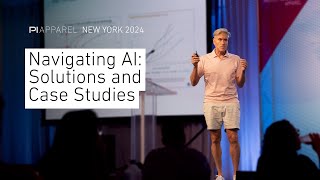
In this presentation, Barry McGough, a corporate innovation leader, offers a sweeping overview of the current AI landscape, emphasizing its rapid evolution, ubiquity, and the shift from hype to operationalization. He illustrates the explosion of generative AI through demos of synthetic avatars, text‑to‑video, voice cloning, and deepfakes, arguing that low cost and ease of use will drive mass adoption. McGough contextualizes AI as an "ingredient" rather than a standalone product, linking it to a broader tech super‑cycle comparable to electricity or railroads. He cites industry forecasts (McKinsey, MIT Tech Review, World Economic Forum) that predict trillions of dollars in economic impact and highlights killer use cases across coding, healthcare, supply‑chain, material science, and creator economies. The talk then pivots to hardware trends—exascale and quantum computing, the end of Moore’s Law, and emerging ambient, screenless, and wearable devices—that will fuel data generation and processing. McGough warns of ethical and societal risks: deepfakes, hallucinations, bias, and erosion of trust, illustrating real‑world failures. He outlines the accelerating regulatory response, from the EU AI Act to U.S. federal and state initiatives, emphasizing risk‑based compliance. Concluding with a quote from E.O. Wilson, he frames the era as one of "Paleolithic emotions, medieval institutions, and god‑like technology," urging innovators to stay informed, ethically grounded, and engaged with the AI conversation.
Chapters
Hi, everybody. Thanks. I'll be talking to you guys for the next few minutes about the contextualization of AI, what's happening. It's what everybody is— it's what everyone's talking about, right? But we're going to chit-chat about how AI is evolving, how it's maturing, some of the solution sets that we're seeing out there, and some challenges that are going to be facing us as business people and as a society. I'll introduce myself real quick. I'm Barry McGough. I run corporate innovation. I'm an applied innovation leader, looking at innovations that really affect the core business. I think I— there's a few things that I really make sure to focus on when I'm building innovation into an enterprise. But the one thing that I really want to focus on is that when it comes to technology, I am not a tech specialist. I'm a tech generalist. So I'm not a coder, I'm not doing regressive analysis, I don't know Python. And so a lot of things, I think it's really important that people would say, well, why are you on stage if you don't know what you're talking about? But in the innovation space, we have to contextualize. We have to let people know what matters and what doesn't matter, what you should pay attention to and what you shouldn't pay attention to. And as we know, nothing isn't digital now. So I have a picture up here as my ID. That's actually not me. But there's some context to this picture. This is actually taken on my phone through an app called Glam AI. Glam AI costs $6.99 a month. $6.99 a month. And they work with Midjourney. And they push images through. And they give you stuff like this. This is salient for what we're going to talk about today. Okay, I'm going to play a couple videos for you. I hope the video's up, uh, the, the volume's up. I'm going to play a couple videos for you just to, just to get this thing started. My name is Adrian. Well, not Adrian Adrian, but TikTok's latest Symphony digital avatar. I am a custom avatar born from TikTok's latest generative AI technology. What I love about my job here at TikTok is that we're building for the future of creativity and marketing. And today, I'm thrilled to unveil our new Symphony digital avatars right here and now. We believe this technology has the potential to fuel the creator economy and offer new avenues for creators and marketers to scale their content globally. In fact, I— So you get that, right? So that was just launched last week. That's not a real person. That's totally synthetic. And that's kind of believable. OK, I'm going to play one more for you. This is a company called Silicon Intelligence. [SPEAKING CHINESE] Should hear that, Nat. So that's a guy talking to his mom who already passed away. They are selling digital avatars of people after they die, and they're selling them for $1,400. And pretty soon they're going to have an app, and you'll be able to talk to the person that passed away, your loved one, for $140. So it's a little Black Mirror, but I would ask you guys, would you do either of these? So I'm going to postulate that you would and you will. Because this conversation is really around ubiquity. This is around the fact that this is coming so quickly and where AI is going and why it is as big as they say it is. Because there is a drive to make sure that all this is ubiquitous. And so I do believe that when a thing is too easy to use and too cheap to use that everyone will use it, that everyone can use it, everyone will use it. So this is the now, okay? This is a great quote from Sam Altman. He said, "I think we're going to drive the cost of intelligence down to so close to zero that there will be a before and after as a transformation to society." That's how big people are talking about. So if you guys remember this quote from 2006, I had to look it up. It's a guy called Clive Humby, and he said, Data is the new oil. I said, what does that mean exactly? And what he said was, data is the new oil, but like oil, it's valuable, but you have to refine it. So we were still trying to figure out things like data lakes. Okay, we don't have to figure that out anymore. We do a little bit, but now we're figuring out how to monetize data and huge multinational conglomerates and the future of finance and technology and society is being driven on data. Data. So it's never more true than now. So I start my process as an innovation professional at South by Southwest. I actually started in the beginning of the year. I call it the predictive quarter. But South by Southwest is something I really feel really strongly about. I call it Davos for the rest of us. And it's where the conjunction of art, media, science, politics, policy, it all comes together. Two years ago, not last year, not 2023 or 2022. They started talking about technologies that are going to be really interesting to us. And they said there's going to be this thing called GPT-3. I had to look it up on my phone. What is that, right? They said you're going to have this thing where you can text to image generate. So I tried it. I got on some Russian bot and said hurricane or a flood in San Francisco. This is the picture I got. They're starting to talk generative adversarial networks. So this one's really interesting. This is still up. This is— this person does not exist. Every time you refresh your browser, you get a person that didn't exist. Okay, this is a couple of years ago. And they said all this stuff is going to come next year. And we said, you're crazy. And it did. All this stuff came in one year last year in 2022. We got Midjourney, we got Stability, we got DALL-E, we got GPT-3, and we got Whisper. It all came at us all at once. Like this huge flood, and we just basically had a holy crap moment from technology, right? The adoption curve was amazing, right? So if you look at the chart on the left, it took Netflix 10 years to get to 100 million users. It took ChatGPT a couple of days, okay? And the adoption curve for to use this technology was super interesting, on the coder side. This is from GitHub. GitHub is a repository for code, and what you can see here is that line on the left is immediate. Where it took years for people to use different technologies for coding, they got it right away. And the killer use case, as of September last year, for AI is actually coding, because when you can have coding go faster, then all you have to do is you just audit the code. That means faster apps, fast, faster web, faster everything. So we thought it was going to be really, really disruptive on things like law or media, and it is, but right now still the killer use case is code. This year at South by Southwest, it was really around the operationalization of AI, and it was really about AI in everything, because AI is not a thing, it's an ingredient. At South by, they talked about it— this being similar to the Cambrian explosion, where life exploded on Earth all at once. And I've heard many people talk about how AI is a Cambrian explosion. That sounds really hyperbolic, right? But the other thing that people are talking about is this really a tech supercycle. Tech supercycles only come around very infrequently. And people are starting to compare AI to the introduction of electricity, the introduction of the railroad, and now the introduction of AI. It is definitely foundational to everything that we do. And again, all that sounds so hypey and hyperbolic. But we can start to look at how it's being started to use now, because this is the time where AI is operationalizing. So McKinsey is referring to this as accelerated intelligence, right? They're talking about it not being just automation, but acceleration. And in our industry, they're talking about adding $275 billion to the apparel sector in the next couple of years. At Davos this year, they talked about, uh, AI adding $20 trillion to the global GDP by the end of the decade and save 300 billion work hours a year. So this is huge. So it's going to be basically affecting every aspect of society. They did a poll at Davos and they pulled out some stuff, right? They said nearly half of consumers said they would place their faith in AI for big life decisions. 30% say that they would prefer AI over humans. 14% of consumers said they would prefer interacting with AI. And 55% of employees are already using GenAI once a week at work. This is just a couple of weeks ago. This McKinsey grab came out. 72% of businesses now say that they're using AI in their business, at least one function. And the use of GenAI in the workplace has doubled from 33% to 65% in just this year alone. There's a futurist at South by, her name's Amy Webb, and she has this really great chart. It's Future of Today Institute. I really would recommend you guys looking up Amy. And she does this great chart, a bit of an eye chart, but what it is is everything that's happening in AI right now in every industry you can imagine. Okay. And basically what's really from, from AI all the way out to quantum, right? What's interesting about this chart is there isn't any space in any industry that doesn't have a color in it. That means it's coming at you in the next 5 years. Everything here. And you can see our industry, it's already being affected by every technology that we can imagine. So the question that people are asking, what are the killer use cases? So they're— in the MIT Tech Review this year, they talked about the top 20 technologies. And they listed out— and this is very, very helpful, so I want to share it with you guys. They listed out where they thought the killer use cases are for AI. Health care, the speed of drug recovery, coding and development, which we talked about before, supply chain optimization, science, all kinds of science, applied science, industrial facilities, automation, digital twinning on the supply chain. Material development will be a really, really big winner here with AI, and all— and everything we're talking about, which is the creator community. So it's pretty specific. You could say this is everything, but this is very, very specific on, on where we're going to start to see see AI functionalize. And GenAI will not be a differentiator for long. This is a guy from Snowflake. He said there's a massive rush, rush for the— a lot of incumbents are embracing, uh, for smooth, frictionless, fluid functionality. And it's going to be table stakes, and it will be table stakes for us. So how fast is AI moving? This is Tim Urban. I really love him. He illustrates really complicated ideas with stick figures, so it makes sense to me. Um, so We had a view that AI would get to sort of Einstein-level intelligence by 2045. This was generally accepted a few years ago, and that by sort of now we might be at the level of dumb human. But actually, this is what happened. It's happening really fast. And this is how product— the idea of technology is exponential. It feeds upon itself and it gets faster and faster and faster as it gains momentum. So when we look at this idea around things like artificial general intelligence, it's now being predicted by— this is Che Chang, and he was again, he spoke at South by Southwest. He said publicly that artificial general intelligence that would understand and apply knowledge in the same way that human beings were will be here within 5 years. 3 to 5. So very, very much in our lifetime. This is Ray Kurzweil. He wrote this. He was part of Singularity— he invented Singularity and Singularity University. Talking to Nick Thompson, and he believes that by 2045 that we will merge with AI and we will have a singularity. And he actually said publicly, "If you can hang out for the next 5 years, you'll live for another 100." He's fully, fully convinced. So again, this is huge hyperbole. These are really, really big ideas. Who can back this up? Well, what AI does is basically it learns. Everything that AI is is language, right? So text, speech, words, music, talking, everything is language. So it's absorbing language at a huge clip. If you're following what Whisper is doing, Whisper is another OpenAI product where it's actually taking things that are audible and turning it into words that large language models can learn off of. Because they are audible words they need to put in to be written words so they can be accessed. That's making the database that, that these large language models can learn off of bigger. But pretty soon we're going to think about everything as language— molecular structure, network traffic, DNA, brain scans. It will all be language. And that's going to feed into these large language models and multimodal models. That have different media inputs to get smarter and smarter and smarter. And there's a big talk right now, actually, in terms of accessibility around small language models that are cheaper and easier to use, that, that use the same idea of studying a corpus and referencing it and learning from it continually. So as we move from large language models, we're already starting to see the commercialization of large action models. So you're not just saying, go find me one thing. You're saying, go find me one task. Go find me one group of things. So here's 3 products that are out there right now. If you've seen the Humane Pin, it doesn't have a screen. It shoots a screen onto your hand. It has a camera. It looks around. And it ascertains your environment and feeds back to you. You can talk to it. You can query it, right? Eyeo Drive, I don't know if you've heard of this. It's all in your ears. It's completely audible. It's screenless connection to AI, just like the Rabbit R1 device, which I just got a couple of days ago, so I haven't loaded it up yet, where it's push-to-talk. You talk to the world of AI, and it brings you back multiple answers. It'll read the room. It has a camera. So we're looking at an idea where ambient computing, screenless computing, and audio computing is being driven by large action models. That's based on— that's the access to data. But pretty soon, there's not going to be enough data left. So AI right now is actually in the process of eating the internet. It's eating every piece of data it can to learn as fast as it can to get as smart and correct as it can, to be as accurate as possible. So we're starting to see that what's being predicted is we're going to start to see a proliferation of wearable devices. Why? Because that will create more data. Sensors on plants, robotics that can learn what's happening in a room, what's happening in a family, what's happening in society. So we're going to see a lot more devices, but the— The endgame for the device manufacturers is actually data. And that's what's fueling the drive for NVIDIA being a trillion-dollar company, because that data has to be processed on these GPUs. And so this is— so you're starting to see this huge monolithic acceleration of where finance is going because it's about where the data is going. Remember, I said data is the new oil. So now you're starting to see why, because people are drinking very, very deeply from it. So we have all this data. Now we have to process it. So there are some big experiments right now on exascale computing. This one's going to go live. It's around the Chicago area where it's basically processing more than an exaflop of data. So I'm not a— I'm not a physicist. I'm not a scientist. But 1 in 18 zeros is a lot. So we need to be able to push this information through to get the answers that we're looking for. Quantum is something that we will start to see the realization of quantum, not on laptops because it's totally different, because quantum— and again, I'm not a physicist, but understanding quantum, you understand that when in our current computing process, it's all binary, it's ones and zeros. If I say this, then I get that. It's either a yes or no. But in quantum computing, it doesn't give you one answer, it gives you every answer ever, all at once, all at the same time. And then the process— the problem with quantum is you have to disentangle that data and figure out what's useful and what's garbage. But imagine if you ask a question and you get every answer ever, then you can perform calculations that would take billions of years for an exascale computer to run, and they can do it very, very quickly. So quantum is coming. Again, that's why you see this, this sort of what they're calling the Magnificent Seven. And NVIDIA is one of the most wealthy companies in the world now because of, because of what's happening with data. We're also going to start to see the breakdown of Moore's Law, where things— where chip capacity doubles every 2 years and halves in cost. We can't get there fast enough because we can't get the chips smaller and smaller and smaller. We can't get smaller and pack all that information on there. So where's all this compute power going to live? What are we going to do with it? So we are looking at places where we take this data and we take the questions that we want to ask. How do we make this go even faster than what can happen on a silicon wafer? That's what's going to happen with generative biology. Generative bio— this is actually brain cells that they put in a lab and they taught it how to play Pong. This was 2 years ago. So what we're looking at is this idea of developing large science models. So remember, we went from large learning models to large action models, and now we're at live science models where we're solving for generative biology. We have all— we're aiming all this compute to solve physics, to solve for computational biology. We have huge potential what we're going to be able to do. In science, virology, every aspect of, of human society. And if we're going to get that compute, then we're going to have to have things like brain computing. Now, this just received military funding where they're using brain cells and mixing them with circuitry to improve the processing speed beyond what you saw from that NVIDIA GPU. This is actually real. This is actually happening right now. So we are— when we talk about how fast AI is moving and its effect on our society and whether it's a supercycle or not, it's not a joke. It's absolutely transformational. This is something fun. OpenAI is working with Amazon to make a robot. It's called Figure One. So we're starting to already move into areas where we can look at real functional robotics in our society. Amazon itself, their warehouse has 500— has half a million robots in their warehouses. But we're in our world, getting like a little bit closer to home, we can start to see that we can start to use what's happening with AI and with all the technology, with the 3D technology to run stuff like this. A new day, the birth of an era. This is 100% AI-generated. There's no humans here. It's about power. It's about strength. About the audacity to define who you are. Crafted for those who rise with the sun, who dare to break boundaries. Sexy isn't a look, it's an attitude. Power isn't a gift, it's a choice. Make your choice. So that's in our space now. AI, ChatGPT, Midjourney, it's all in the pantheon that we can use now. This is also something that's really interesting. This generates AI voices indistinguishable from humans for chat purposes. Okay, sure. To activate your subscription, you'll have to click on the link in the email. You should have received an email from us when you made the purchase. Just click on it and you'll be good to go. Not a person. A person doesn't exist, right? So we're moving really far. The Sora, I showed Sora at the top of the presentation with those cute puppies and stuff. This was Sora a year ago, and Will Smith put himself up there and said, I want to see what it looks like with me eating pasta. Disgusting. Super scary. This is Sora one year later. One year later. That's how fast this is moving. There's a startup called Pika. They just received $55 million in funding. So this is video on command. This is text-to-video. So text-to-video generation, as you guys know, it's going to be a very, very real thing for us. All different styles, completely believable. Spatial computing, obviously. Sophia can tell us a lot about that for sure. But this, the fact that this is coming into the forefront now as being an operating system and not just a gimmick or a device will be absolutely transformational in every single way. Because when we start to think about this, so this is Morgan Freeman. As we start to think about text to text, synthetic humans, the TikTok video that I showed you earlier on Symphony, being able to create your grandma, right? Then this was 2 years ago. This is Morgan Freeman. I am not Morgan Freeman. What you see is not real. Well, at least in contemporary terms, it is not. What if I were to tell you that I am not even a human being? Would you believe me? What is your perception of reality? Is it the ability to capture, process, and make sense of the information our senses receive? Yeah. So you can see that this is getting to a very interesting place. But if you think about also our consumers and people in society, we're also really, really worried about this. So in this recent poll, that on the Capgemini poll, they were talking about the fear of impersonation of invisibles using generative AI to provide false and misleading testimonial reviews. In our industry. So consumers are aware that this is coming and they're actually worried about being lied to or being tricked. As a society, Americans, we're 50% more anxious about AI than we were just 2 years ago. Right? So we're less excited. We were excited about it and we're increasingly more concerned about AI. Because AI is constantly and consistently wrong. As we know, it does hallucinate because currently it only reflects back what it sees out there and does its best version of giving us an answer. It's a dog chasing a bone and coming back and saying, did I get the right bone? No, it was a stick. Okay, now go get a bone next time, right? And what we have to really, really be careful about AI If you remember this from last year, this is a lawyer who cited half a dozen court decisions and they were all wrong, and he almost got disbarred because he believed that ChatGPT was giving him right court references. So it's not— it's— we're not at the singularity yet. It's not all-knowing, and it has to be audited on a regular basis. So we have to introduce reinforced human learning factors, Rolfing, to make sure that we can teach the models what to do and what not to do. Good dog, bad dog, right? But sometimes we also overcorrect. So this was taken off. This is, this is Google Gemini when they tried to make sure that there was not racial bias. And someone said, give me images of the American founding fathers. And this is what they came up with. So it's not historically correct. So we're in a really, really tricky place ethically because we have to understand where it's gonna steer us correctly and where it's gonna steer us wrong. These are 3 interesting examples of how things went wrong last year. This is President Suharto endorsing his son-in-law for the election in February. He died 22 years ago. People think this really affected the election. The next one is Taylor Swift trying to sell Le Creuset. That's not Taylor Swift, and she did not try to sell Le Creuset. And people who bought the Le Creuset got scammed. And this is a guy from a finance officer in Hong Kong who transferred $25 million after someone deepfaked an entire video conference, like a whole bunch of people in a room. And they said, we need $25 million to fund this investment in London. He said, Send. So we're looking at some really, really interesting times. And one of the things I always ask people is, when we're talking about this assault on truth, how is it going to affect us politically? Do we think that 2020 was the last human election? These are two images that are already out, things that already happened. One, this came out last year. It was a deepfake of Trump being arrested. This didn't happen, but people thought that it did. And this was actually something where someone slowed down Nancy Pelosi's speech and then ran it back as fake news that she had had a stroke. She didn't have a stroke. But that created a news cycle that could change politics. So tonight's the debate, guys, right? A lot's going to happen between now and then. So we have to ask ourselves a lot of ethical questions. So when we think about this, we think about this idea of ethical AI. Are we at a point where we're God in the machine, or are we body versus the machine? Right now we're more body versus the machine. And so these are big watchouts for us. The World Economic Forum identified in Davos in February that the main risks of AI to humanity were oversight and accountability, transparency and interpretability, data privacy, bias and fairness, cybersecurity. So a couple— over a year ago, the White House Office of Technology and Science, Arati Prabhakar, actually started an AI Bill of Rights that actually has been published, but there's not an enforcement mechanism. However, there's a ton of legislation coming down the pike now. So we have the Bipartisan Committee on AI, the White House Executive Order on Safe AI, the California Executive Order. NIST has put out something on AI safety, and most importantly, the European— the EU Artificial Intelligence Act, which actually just passed about 6 weeks ago. But, but But just to give you an example of how much we're paying attention to this, last year there were 60 pieces of legislation. Today there are over 400. And most of them are happening at the state level. So this is a quick map. You can look where you live. You can start to see where AI is being legislated or where it will soon be legislated. But it's coming down the pike now where we're trying to get our hands around this. Even though most people think the genie's been out, is already out of the bottle. Okay. What is important for us to understand in this room is that the EU AI Act actually did go into legislation. It will be enforced at the top of the year. And they put things into risk levels. Unacceptable risk, children, finance, your surveillance, right? High risk, limited risk, and minimal risk. And if you don't comply and you're a major business, it could result in a €35 million fine or 7% of the company's turnover. So they're gonna actually try to put some teeth into AI legislation. We can expect that they will start to see that here as well. So I'm gonna end here. E.O. Wilson, the famous American biologist, he said famously, and I love this quote, "We live in a time where we have Paleolithic emotions, medieval institutions, and godlike technology." It's never been, never been more true. So, as I told you before, I really believe in South by Southwest. I try to pull out a bunch of insights. This year I did something really interesting. I told Safiya about it at dinner last night. I got together a group of innovation professionals, and we did an exercise called Red Thread, where we did all these tracks, saw thousands of panels, 300,000 people went, and we have a PDF. It's doing no good on my hard drive, so I would invite you to take a picture of this QR code. These are all the things that we saw, at South by Southwest year. Two years ago, it was about crypto and the metaverse. Last year, South by Southwest was around AI and psychedelic drugs for PTSD. This year, it's about the functionalization of AI, the crisis of loneliness, handheld devices and phones as weapons of mass distraction. And space. So I hope you like this. Please share it, share it out, share it with your friends, and join us next year because we're probably going to do it again. Just connect me on LinkedIn. I'll be— I would invite all of you guys to join us at South by Southwest and do this and kind of get some of the things that we get out of it. And then if you have any questions, I think we're out of time, so thanks.










