On-Demand at Scale With Kurt Cavano | Fashion Made Podcast
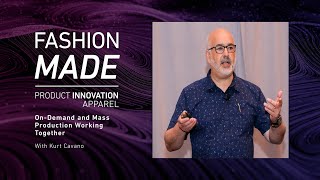
Kurt Cavano, CEO of Nimbly, explains how on-demand manufacturing is reshaping apparel production. His platform connects underutilized knitting machines globally to let brands produce small batches locally, cut waste, and hit full sell-through. The pandemic exposed fragile supply chains, and DTC brands are already leading the shift away from bulk production toward sustainable, higher-margin models.
Chapters
Hello and welcome to another episode of Fashion Made. On this week's show, we're going to be speaking to Kurt Cavanaugh, talking about on-demand manufacturing, sort of who are the big players in this space, who's going to win out ultimately, are there any losers, and what the nuances are, you know, like the different time and costs and and, um, materials that might be used in an on-demand manufacturing world. So yeah, here's a conversation I had with Kurt the other day.
Enjoy. Kurt, thanks for coming on the show today. It's good to speak to you.
Well, I'm happy to be here. Looking forward to it.
Yeah. Well, you know, we were talking about on-demand manufacturing here today, something that's been a buzz around the industry for a few years now, but do you feel like it's getting a bigger head of steam?
I think we're, really at the beginning of a new renaissance for on-demand manufacturing. I think this is the time that people are really waking up to the fact that we can't keep doing it the same way that we've done it in the past. And the pandemic is actually exacerbating that, where people realize that, you know, now they have all this extra inventory, even more than they had before. So how do they think differently about their business? And so I think this is actually going to be a new beginning beginning for on-demand and other kinds of circular economy technologies to improve the supply chain.
Yeah, yeah, I mean, what do you think of some of the other opportunities here?
Well, I think there's gonna be some things that are going to come out of this really strong and some things that are going to be a challenge. So for example, the whole rental model for clothing, I think, is going to be challenged for a while because certainly while the pandemic is going on, people are going to be questioning Do I really want to rent clothing, or do I want to own clothing? And I had thought up until the pandemic that that was a really great model, and it was really changing the way that people thought about luxury clothes, for example. But I think in— after the pandemic, that might be challenged. But I think that the inventory challenge that everybody has right now is really a wake-up call, and people need to say, how do I do this differently? And the old model of I design 8 pieces of clothing, I pick 2 that I think are going to sell, I send it to the other on the other side of the planet to have it manufactured. I wait 10, 12, 16 weeks, whatever it is, for 2 containers to show up with all the clothes, and I put 'em on the racks and hope it's gonna sell. And I sell half of it, and I discount half of what's left, and I throw away or burn or sell off to a, you know, whatever, what's remaining. And that model is just broken, and it's gotta change. So I think there's gonna be some really interesting new ways to think about clothing, and all manufacturing for that matter.
100%. I mean, this whole system, if you sort of came up with a, you know, fashion industry as a new industry today, you certainly wouldn't make it that way.
No, absolutely not. It's just people would say, what, how, why are you wasting so much? I mean, it's not done that way any other industry. And so it's just crazy.
Yeah, yeah. So I mean, bringing it back to on-demand, you know, what needs to happen to make on-demand the standard?
Well, I think that the biggest challenge to on-demand, ironically, is actually the merchandisers within the organizations, within the different retail organizations, and then the incentive structures. So if you think about most companies' way they incent their people in the whole sourcing end of apparel, it's about how do you get the lowest cost? How do you beat up your vendors to get the lowest cost and then source it there, which means you're going to the furthest part of the planet to source it. You're buying it really cheap, which means you're going to have really big lead times. So that means if you really want to change this model, you have to change the incentive plans of all these people to not be, let's base it on the lowest cost, but let's base it on the highest sell-through or the highest margin that we can get on this. And that, that's not definitely not based on cost. It's based on what percentage sells through and how much of it at full price. And so if you ask somebody to do the simple math, would you rather buy 10 things at $2 and and sell half of them for $5 and a quarter of them for $2 and throw the rest of them away? Or would you rather buy 10 things for $10 and sell all of them for $30? And that's the difference of the on-demand model. And you know, we see it, the company that I'm working with at Nimbly, that our customers are paying a lot more for manufacturing in some cases, not all cases, but in some cases. And they just buy it one at a time or two at a time, and as it sells through, selling through at a higher price, and so the margins are so much better. But that only works if the incentives of the executives within the organization are aligned with that model. The technology is there, the possibilities are there already, it's really around changing behaviors.
Absolutely, it's quite a tough one though, isn't it?
Yeah, it's a tough one, you know, getting people to change the way they think about things is hard, but I think What's going to drive this is the fact that the DTC, the direct-to-consumer brands, are being so successful at doing this kind of a model where they're not sourcing hundreds of things but sourcing a few, or actually even making them right on demand, right as they get the orders. And they're doing it locally, you know, US for US, UK for UK. Those kinds of companies, they're paying more, for their goods, but they're selling all of them. And I think that is a really interesting, different way of thinking about things.
Yeah, for sure, for sure. I wrote down just as you were talking about that, who loses out in this system? Because there must be some losers with an on-demand model.
Ironically, the discounters will lose out if there isn't a lot of stuff left over for them to sell. And, you know, the other person that needs to be retrained in this is the consumer. And I think that is also happening at the same time. And what do I mean by that is, you know, we've been used to, as consumers, getting a lot of really cheap clothing and going to really cheap sources for that. And then the on-demand model, it's not necessarily going to be a lot of cheap clothing. And it's going to be, you buy fewer, but you buy better, and you get exactly what you want. You have more customization, more one-on-one around marketing. And so the consumer has to change their behavior, because if, you know, you can go to Primark and get a piece of clothing for $8, it's not going to last very long, but it might be really cute, and you could wear it half a dozen times. But that model, do we really— is that the model we really want? Is that the sustainable model that we really want? And so the consumers are going to have to change, and the consumer that only wants to buy really cheap stuff is going to lose out in this model. Although, I can't imagine a world where there aren't going to be a few discount places available that, you know, for people that really want to buy that stuff are going to be able to do.
Yeah, I mean, I can't imagine a world where that isn't a thing either, do you know what I mean? Like Primark, you know, even H&M, these stores are going to exist because the demand will be there. I don't see that demand dropping off the face of the planet anyway.
Well, yeah, I think what we're gonna see is as sustainability becomes more and more important— and you have to remember that the other, the other thing that's underlying all this is the global warming problem that we're all dealing with— and the kids that are coming up now, this is right in their face. They're looking at this and they're thinking, boy, I got it, we— things have got to change. And part of all that is this giant push to sustainability, and I think that's going to push a a lot of consumers away from that kind of disposable fashion model into more of a sensible model that includes, you know, better clothing, fewer of them, but better clothing. And so, I don't think those discounters are going to go totally away, but I do think that the consumer is going to keep moving towards a more sustainable model, because, you know, maybe not my generation, but certainly the generation of my children, They're really worried about global warming. They're really worried about sustainability. And that has a big effect on that kind of consumption. So I think that that's going to be a big push that goes along with the changes that came out of the pandemic and other changes.
Interesting. I don't think they'll do it on their own, though. They'll need a big marketing story to follow, and multiple sort of brands who are really pushing the fact that they do on-demand manufacturing. I mean, from my perspective, that's kind of what it needs to really move into the next echelon of sort of popularity within the consumer base?
Yeah, I think you're right, that it is going to take pushing, but the pushing ironically I think is not going to come from the biggest of all the companies. I think it's going to come from all the direct-to-consumer companies, and all these niche brands that are out there right now that are actually producing on demand or producing in smaller batches. And this generation that's coming up is so digitally savvy, there's, you know, they're digital natives, digitally natives. They're growing up in this world where this is all they know. Unlike us, or unlike me, who's a digital immigrant, if you will, who had to learn it as I got older. And so, these digitally native, I call them kids, but these digitally native consumers are really looking to these online brands. And if they're going to go online, you know, you got Amazon, but then you have this whole slew of small niche brands, the, you know, the Allbirds of the world that are producing shoes differently and thinking about it. And there's all these other companies that are coming up like this, and they're pushing this model. They're going direct to the consumer with a more focused approach, a more direct approach, you know, almost thinking of things as a market of one. And I think as more and more of these digital brands take away market share from the bigger brands, then they'll be— the bigger The bigger brands will be forced into starting to think about it differently. I think that's the process that's gonna happen, and you'll start to slowly see the bigger brands start to convert over. And some of the savvy big brands, like the Nikes of the world, are already very, very good at reaching out to their consumer and helping to market to them in a way that feels very personalized. But it's gonna be a while for everybody to catch on. But as it does, I think it's gonna keep accelerating. As we go through this, and I think it'll get faster and faster.
Yeah. How can brands and designers, I think most importantly, use sort of on-demand within the business?
Well, what's really interesting about on-demand is, unlike the old model where you couldn't manufacture all your ideas, you had to kind of make a bunch of ideas and pick the one that you think is going to sell and manufacture that. With on-demand, what's really great about it is if I've got 8 ideas for a shirt, I can make 1 or 2 of each in on-demand model, put them on the web, see what sells, and then focus on the ones that are selling the best. And that's a different way of doing testing. Instead of just, you know, they get them, instead of the way it works now where everybody gets in a room and they put the boards up with all the stuff and everybody says yay, nay, yay, nay to the, what are the ones we're gonna do? This is, let's put them out there and let's look at, What does the consumer tell us? And you can either do that in a general way with the consumer, or you can have a set of consumers that are your special people that you early release things to so that they can see it and they can tell you what's going on. And that— just that change alone, one, it gives you more personalization with your consumers, but two, you have— even if you then went from there to more of a mass manufacturing, which I think makes sense in a lot of cases, at least now you've tested it in an on-demand way, you know what the consumers are liking, you know which ones they're gonna sell, and you have a much more intellectual or actual understanding of what's gonna sell, not just some intuitive thing, "Well, I think this is the right one that's gonna sell." And I think that's a huge change for the designers because it gives them a way to test the way that they do their designs and see what's working You can test colors, you can test sizes, you can test fabrics, whatever it is. You can test all those in an on-demand model. And you can't do that when you gotta make a container load over in Bangladesh and bring it over and see if it sells. That's a very, very different thing. And I think that's a really big thing. And the other thing that's interesting about on-demand is if you think about the curve of sizes, where you have extra, extra, extra small on one end and the triple X large on the other end. And we typically serve the people that are in the small, medium, large, and extra large really well. But the people that are at the end of the curves are not served very well. In an on-demand model, you can make your larges and your extra larges and mediums in a more bulk way in a cheaper location. And you can make the other pieces of the curve, the extra extra smalls and the triple extra larges, in an on-demand way. And then that way, all of the consumers, no matter what their size is, gets access to the clothing. And in that way, you're not only selling more, but you're being much more responsive to everybody that's in the, in the curve of sizes. And I think that that's one of the biggest challenges we have. You know, people that are either very large sizes or very small sizes have a very small selection of clothing they could buy. Imagine a world where we, we do make for the mediums and larges and extra larges, but the other people can do it and it's on demand. And then the stores or the brands are not stuck with, you know, the size 13s, you know, they got— they can do those on demand. And I think that also is a big change and it makes manufacturing a lot more inclusive than it is right now.
Hmm, yeah, that's very interesting. So would you advocate for a model where people use on-demand in that way, that sort of almost like an ideation, early-stage product development process, and sort of use on-demand for that, and then use sort of mass manufacturing beyond that.
Yes, and if you think about that curve, the bell curve that I'm making with my hand that you obviously can't see, you know, is in the middle of the bell curve you have the kind of manufacturing that can be done in a more bulk way. But at the edges of the bell curve, you want to do that definitely on demand. So you start with using the on demand to do, as you called it, ideation, which I love that way of thinking about it. So let's test out a bunch of things. Let's see what works. The stuff that sells really great, well, we can ship that off to a further away location, and we can bring that in as we, as we need it during the season. But the stuff that are at the edges, either the styles or the colors or the sizes, We do that in a more on-demand way. And I can see, for a big, for a large brand where you're doing some stuff hyper-locally, and that's the very extremes of sizes and extremes of colors, like the chartreuse, there's gonna be somebody that wants one of those. You do those locally, hyper-locally, and then sort of far away, like for the US, for example, in Central America, as you go up the curve, you'll do some stuff a little bit further away. Central America. And then for the center of the curve, you could do that really far away in Sri Lanka or in Bangladesh or India or China, although everybody's trying to move away from China these days, which is a whole other story. But, um, let's not get into that. Yeah, no, no, that's a— that's another big discussion we don't need to go into. But, but the whole idea of having this kind of portfolio of locations that you're manufacturing and putting that together That, from my perspective, that's the whole focus of what we're doing at Nimbly, is building a platform that says, look, what's— if you use data science and you say, where's the best place to manufacture this given the curve of demand we see, you can actually say, I want to have some hyperlocal, some medium far away, and some even further away. And then when you put the prices together, you paid more on average for the goods, but you sold so much more of it, you have so fewer markdowns. And that's, that's a different It's a totally different way of thinking of it.
Yeah. What about the limitations, you know, in scalability? Are there any?
Well, yeah, there's definitely limitations in scalability if you only think hyperlocal, if you only think that you're going to do everything on demand locally. But when you mix together your kind of hyperlocal small factories to medium far away, sort of, you know, within the next— within 1,000 miles kind of a thing, and then the really far away. When you think about the model that way, you have infinite scalability in different locations because you're combining them together. Excuse me. It's when you only think about it in one way, which is I'm going to make all this very locally in a small factory, that's not scalable. That's That's very good for a small direct-to-consumer brand, and it works really well. But as soon as you get to the bigger brands, you need to mix together the different locations to create a, to create a set of factories that are going to actually fulfill the demand. The other thing to think about with that is when you have a set of factories that are working together on the same product that are doing it at different costs in different locations, you also can insulate yourself against problems like this pandemic. Because you now have different places where you can manufacture, and it's not, you know, China was shut down for a while long before anything else was, and then other places were shut down. So by mixing it together, you actually have the ability to deal with other kinds of geopolitical, medical kinds of problems as well. Now I'm hoping very shortly we're not going to be dealing with this pandemic anymore, and we won't see another one for a while, but I think you can still think about how that portfolio approach to manufacturing and a more data science-driven approach to it, you know, that isn't just about the lowest price, can really be a differentiator for a company.
Sure, for sure. The one thing that springs to mind though, if you do have all these different factories in different places trying to make the same product, is the time to consumer, let alone, you know, as you mentioned, the costs per product, which might vary having that kind of model and potentially the materials as well, but I'm not so sure about that. But yeah, the time to consumer, surely that would vary if you sort of have some sizes here and some sizes being made there.
Well, you're— if you're talking about the size problem of manufacturing in different factories, that's a problem we have to figure out how to deal with anyways because Nobody seems to get size right, but I think if you're talking, if you're talking about being able to make things consistently, I think that a couple things. One is I think we have better technology now that we can use to, to really focus on getting the exact same thing from different factories. And if you really think about it, if it's a little bit different from one factory to another, The consumer doesn't really care about that. If you think about it, they're only buying one, right? They're buying one, and if it's a little bit different made in one factory and there's a slight difference made in another factory, they don't care about it. The only person that cares about that is the inspectors that are saying, oh, these are a little bit different than those. You know, it's, it's as long as their changes aren't material, then they're not going to be things that you can't sell online. For example, that this one's white and this one's black and you're telling everybody they're all black. If there's small variations I don't think the consumer really cares about that, and I think we're focusing on the wrong problem when we focus on those kinds of things. And that's, you know, when we talk about on-demand with big brands, there's always this kind of, "Well, you can't do this, you can't do that, you can't do this." And there are things you can't do, you know, you can't manufacture it all really cheap. But focusing on what you can't do rather than focusing on what you can do, you know, if you focus on what you can do, then you'll understand why those direct-to-consumer brands are eating your lunch. They're, you know, they're focusing on what they can do and how they can think about it differently and how they can manufacture things differently. And that's, you know, that's just a change in the way you think about solving the problem.
Yeah, yeah. The same thought process will go into people that say, well, you can't sell online, you know, 20 years ago because people won't buy off of a digital image. Well, they will and they do.
Exactly. You know, I've been in the business a long time, and if I've heard it once, I've heard it a million times. Oh, people will never buy clothes online, they want to touch it. Well, no, that's not true. That's— they'll buy it online. Maybe there are a certain set of consumers that are buying a $500 cashmere sweater that they want to go— they do want to touch it. But we also have other programs we can or other ways of solving this, which is I buy it, and if I touch it and I don't like it, I send it back, which is a challenge, I understand. But the whole idea that, "Oh, people aren't going to buy clothes online," I heard it so much, and then that just changed. And I think as we go through this change we're going through right now to a more kind of modern supply chain and a more sustainable, circular supply chain, All of those things that people say, "Oh, you can't do it, you can't do it," are all going to get knocked down, and we're going to just go through that and knock them down one at a time, and we'll get to a place where, you know, most everything will be able to be delivered online, and most everything will be able to deliver in a circular way. You know, the other opportunity here, I won't call it a challenge, is that technology is really enabling a lot of this, and if you think, I think the perfect metaphor for people to think about is automation. Automobile manufacturing. You know, back in the day, they were made in Detroit, and on the assembly line were hundreds of people that were making these cars in Detroit. Hugely intensive labor operation to build those cars. Well, people said, let's push that offshore. It went offshore to Asia, to Mexico, and into lower labor countries. But then something miraculous happened. That manufacturing came back to the US, and it came back in places like Tennessee and Georgia Georgia, and there's, you know, all around the country there's now these new car factories. But the car factories that came back were totally different than the car factories that left. The car factories that came back were, you know, a lot of robots and a few people. And the technology of robotics advanced to the point where we can now make the car mostly with a robot and a few people. And when that happens, when that technology enabled takes place, you then reduce the labor content that are in each one of these items, in this case a car. So it doesn't matter whether you're paying the autoworkers $3 an hour, you know, in Mexico, or $30 an hour in Georgia, because there aren't that many of them. It's mostly the robots. And that same process is taking place in all the industries, and they're not coming back onshore because somebody's told us you have to bring everything back. They're coming back onshore because the whole idea of getting local, getting close to your customers, driving it, but technology is enabling it. And whether it's the robotics in cars or other technologies in other industries that are happening. I look at the space that we're focused on, which is on-demand knitting. The products that we make are made on a computerized knitting machine, and they have very little content from a human. I take right now, we're producing masks. Of course, you know, everybody is in this pandemic, and the mask takes 7 minutes to knit on an automatic knitting machine, and when it's done, it has about 30 seconds of human input to put the elastic in it and put it in a bag, or maybe a minute, and boom. And so the labor content is not the important part of it. The machine and the programming that went in to program the machine to produce that, that's what's actually working. And I think we're going to see that in apparel in a big way as more and more technologies apply to this problem. It's going to be— allow it to come back into higher-cost places, which then enables this whole idea of on-demand manufacturing in an even bigger way. And I think that's a huge change that we're going to see.
Brilliant. Kurt, finally, tell me a little bit about Nimbly and your new product. You're CEO there, right?
Yeah, I am. Interesting story. It was a couple of guys and they had a couple of knitting machines and they were doing on-demand knitting for some of the direct-to-consumer brands. And it's great. One of their customers is Ministry of Supply, the The order would come out of the back of their system into Nimbly. 24 hours later, they would knit the goods, wash it, and send it direct to the consumer. Ministry of Supply has no inventory. They have no markdowns, none of that. And Nimbly went through an incubator in New York called XRC, which is part of Parsons School of Design. And I'm a coach there. That's one of the things I do. And I met the guys. I said, wow, this is a really interesting model. Well, their business started to pick up, and then the big brands came, and they said, hey, how Can we play in this too? A couple of forward-looking brands said, "We'd like to experiment with this." And so Nimbly had to make a choice. Do we buy a bunch of machines and start a microfactory to deal with this, or do we think differently? And what they realized is that there's thousands of these machines around the world, and they're, excuse me, all underutilized. And so what we decided, and at that point I decided, this is a really interesting problem, so I'm gonna join Nimbly, and they were looking for a CEO, I joined Nibbly as the CEO, and I said, "Wow, how can we solve this differently?" Well, by looking and finding all these machines around the world, we said, "Well, why don't we build a platform that connects these all together, and we use these machines that are not being utilized in an on-demand way, and kind of Uberize the whole knitting process, if you will?" The same way that, you know, Uber is using cars that are underutilized, these knitting machines are all over the world. And then you put a layer of data science on top of it, and all of a sudden now you can say, hey, how do I optimize this given the capacity— the demand for the goods against the capacity that's available in different locations? Where's the optimal place to produce this? And that's what we're focused on. We're in early days right now, but we're running at a million miles an hour. Actually, the pandemic has been kind of an amazing thing for us because we started producing masks, and before you knew it, we had orders for hundreds of thousands of masks, and we activated some knitting machines in Sri Lanka. Now we're, we're using the model to build personal protective equipment, which is really cool if you think about it. And it allowed us to scale from making one-offs to making hundreds of thousands. And if things keep going like this, we'll probably make a million masks. And in a lot using technology, and I think it's a really interesting example that for the, for the brands where you can go from a unit of one "Hyperlocal in Los Angeles," to, "Okay, we want to do hundreds of thousands." We just sent the computer program to Sri Lanka, and boom, they're up and running producing the masks. And that's how technology is changing things. And so we're really excited about it. I think there's a lot of companies that are, that are coming up in the space that are doing it. There's a company on the East Coast called Zealware that's doing— has a microfactory in in upstate New York, and they're doing the same thing for cut and sew. And I think as this technology rolls out and as people really get their head around on-demand, there's gonna be a lot of companies that are gonna come and say, hey, let's change the way this is done. And I think it's a really exciting time for apparel. I think it's, and for industry in general, and I think a lot of jobs are gonna come back. They won't be necessarily all low-labor jobs, but they'll be, you know, knowledge workers running the machines and doing that. And I think it's, it's an exciting time. So I'm having a good time. And hopefully we can change the world a little bit with what we're doing.
100%. 100%. It sounds fascinating. And I just want to say thank you for coming on the show. It's been really, really interesting.
Well, thank you. I really, I really enjoyed it. And hopefully from my home office setup, the sound's okay, and it'll come across okay. So take care and stay safe.
Yeah. Thanks for joining us on the show, Kurt. Um, that's Kurt Cavanaugh from Nimbly, um, CEO over there. Um, so yeah, check them out. They're doing some really, really good stuff around on-demand manufacturing at the moment. Um, so that's all we've got time for this week. On next week's show, we've got Melissa Martin, who works for Unify, the sustainable manufacturer, and we're going to be zeroing in on the circular economy. Um, what are the opportunities and whether the, the current crisis is going to provide a bit of a catalyst for more companies to move to a more circular business model in their apparel manufacturing. So yep, tune in next week and join us then. Until then, have a good time.
Bye-bye.










