Product Value Scores for Smarter Planning & Segmentation | First Insight | PI Apparel
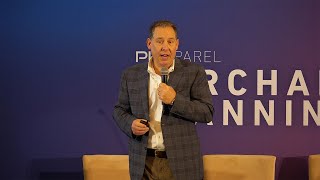
First Insight uses AI and early consumer feedback to score new products 1-10 before they hit shelves, helping retailers avoid costly mistakes. The company redesigned a kitten heel that saved $10 million in markdowns and predicted Kate Middleton's dress trend. Their system operates across 180 countries and serves 25% of the global market.
Chapters
I'll lament the fact that I was a retailer. I'm a reformed retailer. Years ago, I was a merchant, and then I went to work for the first supply chain technology company. Those who left me to go work and listen to Baudry— Baudry and I have known each other for 30 years, so great guy. And then I went into creating a company called First Insight. How many of you have heard of the company First Insight? Any of you? Yeah, quite a few hands. All right, good. Appreciate that. I'll tell you a little bit about what we do, but I'm going to be more interesting in answering what about me you may not know, and then hopefully helping you change your life for a little bit better. First thing, if you have your smartphone on you, I will tell you if it's on you even turned upside down, your IQ points are 15 points lower than if it's 4 feet away from you. Number 1. Number 2, 86% higher retention rate if you write something down on a sheet of paper. Okay. Average IQ scores have dropped since 1970. Why am I telling you this when I'm talking about predictive models and AI and all that good stuff. I wrote a book, it's called The Tyranny of Now. I was just telling Jason about it. It's actually an Amazon top pick, a bestseller called The Tyranny of Now. Feel free to grab the book. It will hopefully help you increase your performance both at work and at home. Something you should know too, 97% of people, it's the first thing you touch in the morning, last thing you touch at night. And here's the really bad part. 67% of all humans would rather experience physical pain than not have their phone available to them for 1 hour. Now, if that doesn't get your attention, here's what will. In 2007, when I started this company, smartphones didn't exist. Actually, the iPhone 3 was the first phone, if you remember it, came out in June 2007. When I created this company after working for the first supply chain tech company that did all the planning systems that many of you have, I said, hey, you know what will happen? I was here in New York. Women are going to use this new iPhone. They're going to play engagements and give their data feedback and we're going to use AI models. We didn't call them AI because no one really understood AI, but it's been around. And we're going to help you make better decisions. And when they stopped laughing in that conference room and said that I was crazy, right? Because middle-aged women didn't play on phones, but actually they do now, right? With games. That was the highest adopted group, by the way. Information is now being taught at FIT. I was just talking earlier to over 500 students about our technology and trying to help transform the world by doing something that I didn't have when I was a merchant, which is giving me data when I had no history. So that's the problem you need to think about in retail. Right now you have a lot of data around information related to products with historical data points. Justin and I were talking about this at Amazon and I said, I don't really want to sell you, I want your data. I want Amazon data. There's lots of data in the world, but there's not a lot of information that you can glean that's different out of it. You can mash it up in different ways. So here's one unique data stream I'm going to talk about today is how do you take it for items with— you have no history on them. You're going to make big bets, informational decision points around your company when you have no historical data streams and you're going to have a series of merchant and executive decisions, you and the planning side, are going to have to figure out how much to buy. And retail is really simple. More of the good, less of the bad, right? It's just really, really hard. And then what happens if you raise the price or lower the price? So you can have a great product, but then not set the price right, and then you don't sell it. So what I'm here today to talk to you about is a different way of doing business. The company that we formulated, First Insight, 17 years old, it's in 180 countries right now. 67 language currency combinations, and 25% of the global market uses us. My most favorite article ever written about us is called the Black Ops of Retail. We sit behind the scenes. We plug into planning systems now, forecasting systems, revenue optimization solutions, and most executives use us to figure out what consumers want, while they're in the design phase in every product category from couture, fashion apparel, all the way through light bulbs. And how does it work? So we've created something called a proprietary metric called a value score. Two weeks ago, I was in five countries in Europe. Some of the largest retailers in the world use us. And they all know the term value score. And we created this term with the idea that it ranges between 1 and 10. And if you were in the product design phase, 6 months prior to market, 12 months prior to market, 18 months prior to market, and I told you an item was going to sell extremely well by giving you a value score of 7 through 10, what would you do? What would you do? It'd be pretty simple. You'd buy more or make more of it, right? And then what if I told you a product was a 1 through 3 or a 1 through 4, a lower value score? You'd make less of it or buy less of it. You might still need it in your pyramid of what you're designing in your product set, but you're not going to make as much because it's really simple. The reason that you're making the investments that you are today is because you don't know how the items are going to perform. So what would you do? Competitive advantage is anticipatory, not reactionary. When I started in this business in 1985, it was all about understanding how the business was doing, meaning quite simply, Give me sales data that I can rely on so I can understand and then react to it and tell them what they need next. Where we are, flash forward nearly 40 years later, you're in an area of the business where it is about anticipating. You have a— we'll talk about this in just a minute. You have a very dynamic marketplace and your competitive advantage is anticipatory, not reactionary. If you're responding to business, you're already behind. That's just the fact. So let's take a look about how it works. And remember, 1 out of 4 retailers and brands in the world are already doing this in some way, shape, or form with us. Okay. So what is AI VOC? The first thing you need to understand is the data streams you already have available to you are historically based sales data, a forecasting based upon history. You have some sort of model related to that. Remember, I worked for the first planning company, so we did forecasting models, 36 algorithms, 2 years of history, models after that, best systems patterning after something. And what VOC data is, collection of data from direct consumers, you show them the products in advance, And then there's AI models that actually have to figure out whether or not they're valid, those inputs are valid, and then it forecasts how the item's going to perform. We'll talk about that a little bit further. It creates for us a proprietary value score, but it also creates the only elasticity curve without history. So go to Gartner or Forrester's reports and you can read about us. Giving elasticity curves without historical data points. So this is a feed into your planning system, one of the feeds into the planning system. But before we get there, the last— the next thing I want to talk about is what you're facing and why it's going to be so challenging. I've written for Forbes for 9 years on the investment side. You can read my column. There's a number of pieces that are covered. But the reality of the situation is You have an environment where it's so rapidly changing on the consumer side, and it's because of the advent of the mobile device, the smart device. Remember the professor, I forget his name, John, I think his name is John. Yeah, I'm pretty sure. He basically talked about that people used to go to market. The actual transparency of information is so visible today, that piece of the equation doesn't exist anymore. You have no trends. So the consumer is actually segmenting themselves. Dressing, the concept of dressing head to toe, very challenging. Maybe it resonates with certain brands, but across an industry, it doesn't work anymore. So you have a very fragmented market that's hyper-fragmented, that keeps fragmenting and grows by social groups, which you can't control. That's the number 1 challenge. Who's your customer and what are they doing? Second challenge that you have is you have disruptions. We all went through COVID. But the reality is right now tariffs, I just wrote about it. How about another one? Container costs are up. Here's what you do. Do you know that socioeconomically income levels under $100,000, have complete inelasticity to any price increase. That means that if you raise the prices and try to pass those container costs on to consumers, you're not going to sell it. What would you do? What would you do if you knew that was happening? It's going to be a business impact to your business. You've got to plan for that. You have an increased competition. You have competition in ways you haven't even thought about. Amazon is your competitor. Who, by the way, has your data. Just something to think about. And do you have the same weapons they have? So when I think about being a retailer in this environment today, super challenging, like beyond where I was in the 1990s even. Then you have the whole thing about economic uncertainty. So 2 years ago, I said there wasn't going to be I'm not a, you know, a prognosticator. Don't take me that way. But we looked at a lot of data and said there wasn't going to be a recession. There wasn't one. Now everyone's saying there's not going to be a recession, and all of our data shows that there's going to be one, and it doesn't matter who wins in office. So we have a lot of companies right now that are leveraging our platform to figure out economic models of depending upon who gets into office, what policies are going to be effective 'cause tariffs are gonna take place even though they both agree, but it may be different. If you haven't figured out what that cost model looks like, that's something you need to think about in your conversations. The last piece is technological advancements. That was absolutely spot on earlier today when they talked about the fact very simply, you can't keep up. So here's the facts. I think I forget the— I forget the person's name who said that, but you're not going to be able to keep up. That's just a fact. The reality though is you have to take a stake in the ground and you've got to figure out how you take a move forward with data related to what you should be doing today. Here's what we do. Just to give you an insight into it. We think of our systems no longer as systems of record, We think of systems that we're creating in technology as the next generation of system of intelligence. I don't know if that's the right term, if we're coining a term and we're thinking about it, but I want you to think about that. All your data sits in systems of record. They're out there, like Excel, whatever your planning system is. Then there's these systems that sit out there that can collect data and make those systems of record more intelligent, inform them in different ways. Our system of intelligence really captures information direct to consumer. So, I love it that J— Justin talked about the fact that Amazon's customer-centric. My question to people in 2007 was, when was the last time you asked a customer what they wanted? Before you made it. Here's what I used to hear: they don't know. The answer is you're wrong. Emphatically, spot on the line. Why? They can't create products. But what are— what we have demonstrated over millions of data points is they can choose just before the trend hits. Just before the products are designed. They can pick. And in fact, when you start to aggregate up groups of people in the right way, you get a very clear signal about the products that you're designing at different stages in the design process. Let me give you a few examples. These are well documented. You could go to our website and find case studies. But I won't bore you with that. I'm going to make one that's really interesting. I found interesting. Kate Middleton, remember she got married to Prince— what's his name? William. William, right. A while ago. They have kids now. If you go back in the archives of Women's Wear Daily, we actually predicted the dress she would pick off of 11 designs, sketches from designers that were submitted. And it was based upon a group of consumers determining that. Prediction models have been around and are very accurate for long periods of time. The challenge that we've had is not scaling them. And if you, if you listen to Justin earlier on, that also has been part of what AI is capable of doing. And there's all kinds of technologies, not to bore you around that kind of fun stuff, but the essence is it works swimmingly and it plugs into all of the existing systems without disrupting it. And it can do things like give you personalized messaging. You saw that, but we've been doing it for a while. Optimized product assortments, enhancements around customer loyalty and retention. One of our customers picked, launched, and had great success with their Super Bowl ad on different versions of the Super Bowl ad just this past year. So how does a value score work, right? It's a 1 to 10 numerical system. It ranks products. It ranks service offerings. It basically is a ranking system that puts a value quotient on a product where it exists at a moment in time based upon consumers looking at it. I'll give you a very unique example. A bottle of water to me right now is not that interesting or valuable. But if you moved me to the Sahara Desert and gave it to me, asked me how much I would spend for it 2 days from now, it would be a lot more valuable. So how products are valued changes very dramatically. We basically put it into 3 buckets: high, medium, and low. And now I'm going to tell you how hard the retail problem is. Just so you know, when you go back to work, you can tell whomever you report to, because we all do. I even tell our board this every time I meet with them. Let me make the problem really simple and we can guess. Anybody who hits the number, I don't know, I'll give you a Moleskine pad with our name on it. Okay. All right. You ready? 3 buckets. High, good performing item. Medium, average. Low bucket. 3 buckets are sitting here. I have 50 products. Only 50 products. Only 50 products. And I got to get them in the right bucket. This one's going to do well. This one's not going to do well. This one's going to do okay. You tell me. Anybody want to guess? What the odds of getting all 50 right one time? One in— anybody want to hazard? Come on. If I made it interesting, I'd give money away, like thousands of dollars. But come on, a little participation from the group. Anybody want to guess? All right, I won't embarrass anybody. 1 in 3.8 billion. 3.8 billion. That means you're sitting in your chair and you got struck by lightning. Oh, wait a minute. 3 seconds later you got struck by lightning again. That is the odds of that happening. So you tell me there's a person in the world who can get that right. And by the way, average company I'm talking to, or enterprise companies, have tens of thousands of products they launch a year. I was just at a company not long ago, billion-dollar company, 11,000 products. What do you think the odds of getting them all right? Zero. Statistically improbable. So what does this do? All it does is take away risk. It manages risk. The question I would ask you is, you're going to be wrong. How wrong are you going to be? Why wouldn't you take data from consumers ask them what they want, and then give them what they want based upon the information and input, especially if it works. So the input is basically, as we talk about here, it can be done in segments. Here's the other interesting thing that can be done that you don't have anywhere: your products, your competitors' products, and what consumers think about both of them while they're in the design phase. Okay, now you're talking about competitive advantages. Next, trends. Consumers don't know what trends are coming. That's true. It's a very famous study that was done on the iPhone. They would have never known that they wanted an iPhone. You would have known it. I wouldn't have known it. No one would have expected I need this blank screen with all these things on it. But yet you're, one would argue, completely addicted to it at this point. Because 2 out of 3 of you will experience pain as preference to leaving your phone somewhere. Not my study, it's in the book. I researched it, 2.5 years of research. Read the book. You would experience pain as opposed to leaving your phone. Yet you don't think that a consumer group Most— when we surveyed most merchants, they don't believe that consumers understand trends. And you're right, they don't understand trends to the degree that you do. But what they can do is rank them. And what we found statistically is they can tell you that the rank choice of order of trends of products don't change over a period of time, but they actually increase as it gets closer to the trend analysis. That green color that you're going to launch actually increases in value score as you get closer to the trend hitting the market because you begin to see everything that's going on in the market that they don't have visibility to. But they can also tell you yellow will never be good. In that case, just came back from one of those scenarios. So you've got to understand how data can be leveraged but you can't initially want to dismiss it. Okay. All right. Last is about segmentation. We talked about the hyper-segmentation. I want you to think about 1985 when I started and the adage that was at May Company, which was one of the larger department stores in the country, said, "Stack it high and watch it fly." We basically take orders. We tell the customer what they want. The inverse of this model is actually where we are today. It is a hyper-segmented market. You need to figure out if you even have a business model going forward every quarter. You need to test with a segment, multiple segments of consumers, aggregate it up, and let them build the assortment for you, as opposed to the top-down assortment planning that we're doing today. And it is completely possible. It basically feeds your system with information about what segments of products— because they're designing and creating and curating for themselves differently than they did in the past. And I can tell you this is absolutely true for toilet paper packaging as much as it is for denim labels, as much as it is for fashion items. This is a very interesting one. Our data is being used to cut the tails off of assortments right now. I just came back from the West Coast last— today's— I don't know what day today is, Wednesday? I think it was last week. It could have been earlier this week, but it's all about cutting off the tail. What part of the assortment can we leverage operating expenses? Remember I mentioned to you, I wrote about it. There is going to be, and it appears to be according to all the data, an economic downturn. If that's actually happening, most CEOs I'm having a conversation with right now want to free up working capital. It's the number one conversation taking place today. I only meet about 100 a year, about 2 a week. And the conversations are all about working capital at this stage. How can I free up working capital, cut expenses? Where do I need to slash expenses? This can tell you penetration and reach. And that's what data, I think, is designed to do from a system of intelligence perspective. It's nimble. It's not structured the same way because your problem's going to evolve, not just this quarter, probably even within the quarter. And then there's a whole lot that can be done on the planning and insight piece. If you're interested in doing that, just think about placing a value score on a product at the stage that you're in, in the design process or decision-making process. That's conceptually where it is going to be able to be useful. This is a use case. We have a couple of them, quite a— actually 300 of them documented on our website. So you can go into that and look at them. Found this one interesting. I didn't know what a kitten boot was or heel. If any of you know what a kitten heel is, I have no idea what exactly is. So don't forgive me if I'm, but basically this company was going to launch a kitten heel and then tested it, basically found the heel height wasn't right and other attributes around the product weren't correct. So they changed the design, relaunched the product, retested it, relaunched it, and saved them $10 million in markdown on their estimate on one boot alone. So, you know, we also do this with wholesalers selling into retailers because retailers, myself merchant, notoriously bad at picking products sometimes, right? So I love the product, but my consumer didn't like it as much. So That's okay, I was wrong on that item, but generally my assortment landed. Well, what if you could be perfect more often than not? That's all we're doing is trying to improve that piece of the equation. Last couple of pieces, demand strategy. These are metrics that we move. If you go downstairs, upstairs, sorry, Marks Spencer has a documented video case study 1,200 basis points in full-price unit sales that they publicly stated. Just one example. Um, all right, so with that, I don't know if we have any time at all. We don't, but I'm happy to answer any questions if you do. I will be upstairs, uh, near our booth area. I know we have to go to lunch. I hope you enjoyed the presentation, maybe gave you a new new ideas and thoughts. Don't forget, look for the book Tyranny of Now on Amazon. It is on Amazon. And thank you so much.










