Rethinking the Workforce in the Age of AI | unspun | PI Apparel
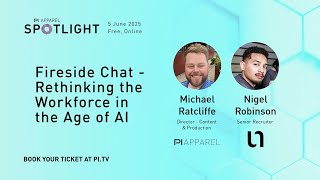
Nigel Robinson, senior recruiter at Unspun, argues AI's real value is speed, freeing recruiters to focus on human connection. He uses Notion AI, Claude, and custom tools to run his one-person talent function, and recommends HR teams start with small experiments rather than system overhauls. The goal: make AI a thought partner, not just a task automator.
Chapters
Hello everyone, and we're back for our second chat of the day, a fireside chat with Nigel Robinson from Unspun. I'm particularly excited for this one. I worked in recruitment myself for a little while, but way before AI was as big as it is now. So I'm really interested to dive into how we can start to use AI more in recruitment. So Nigel, thank you very, very much for joining us today. Let's start by you giving us just a little bit of background as to who you are and how you relate to this topic.
Yeah, so I've been working in tech almost 10 years now. Started in venture capital at a16z doing college recruiting, spent a year at Google, spent a year at Ouster, a digital LiDAR robotics company, did some executive search stuff during the pandemic. And yeah, now more recently, senior recruiter at Unspun. Have been deep in AI ever since the GPT moment. I've pretty much played played with all of the mediums, all of the tools. And so Unspun has been my first opportunity at like taking a real at-bat at what an AI-native talent department might look like. And so, you know, I want to say that I'm not an expert. I don't think anyone is an expert today as fast as these tools are moving, but certainly a practitioner and hopefully can offer something to folks who, you know, are using it or may not have used it.
So, absolutely. And thank you again for joining us. When I was speaking to people putting this spotlight together, there was a lot of interest in this as a theme, but a lot of people were saying that they're not quite yet ready to share what they are doing or their own personal philosophies on it. So really, really great to chat to you about this today. And talking of personal philosophies, um, when we had our prep call, you did say, um, uh, you did talk a little bit about your own personal philosophy as it relates to how AI fits into a human talent-driven process. Can you share a little bit more about, about that and elaborate on it?
Yeah, I think that generally what AI has to offer for any department, any workflow, is this idea of speed. Like, the velocity of any process when it comes to automation is going to increase exponentially. And what I think this speed offers to talent is an opportunity to be slow strategically. Like, you can slow things down in the talent process. And that's really the human parts, like all of the mechanistic, back-of-the-house administrative type of things. Those are going to be much faster and allow you to focus more on the human parts, being with your hiring managers, being with the teams that you're supporting, being more present with the candidates themselves. And so that's kind of my philosophy, is that it'll enhance and amplify the human element of recruiting. While all of the mechanistic parts kind of fall away to the AI automation, obviously with guidance, you don't take your hand fully off the wheel. But yeah, that's kind of philosophically what I am excited about is this strategic slowness when it comes to the people connection.
I love that. And it's something that I'd never really thought about before because, you know, to your point, we all think of AI and we think about how can we speed things up, but to your point, it's about kind of using it to reprioritize how you approach it and make it a much more personal and people-centric process. Unspun is arguably one of the best when it comes to fusing fashion world with technology world, putting two and two together. What specific AI or automation tools are you currently exploring to support your team when it comes to hiring and/or talent development?
Yeah, the, the company is, we're very heavy Notion users and, uh, somewhat coincidentally Notion has released a ton of AI stuff and because the company has done so well at making Notion, like every team uses it for really robust documentation, which makes our Notion AI like particularly useful, um, for spinning things up. So we use a lot of Notion. We use TeamTailor for our ATS. I think a lot of ATS systems are developing AI tooling now, and pretty much all of them are using some version of Copilot. So we use that as well. I think probably the biggest differentiators for us is, you know, I came in as the first and only recruiter. And so like I was the talent system, talent department. And one of the first things I did was create a cloud project to basically use as like a thought partner and as like a synthesizer translator. Like, to be more specific, like when I first came in, uh, the ATS data was really scattered. It wasn't TeamTailor, it was another ATS and all the data was really scattered. I ported all that data into Claude and basically used it as a business intelligence tool and had it tell us, tell me like the story. Of our recruiting numbers to date as I was doing this audit. And I would meet with all of the hiring managers and I would take notes about the conversation, what's working, what's not working, where is it hurt. And I would upload all of that into Claude and synthesize that into like, all right, what is a shared recruiting narrative? How can I best support these different hiring managers now given all of this context? Um, and I just consistently update this Claude project, obviously without you know, any proprietary information in there, but it's been really helpful. I use it to create the brand voice. I basically use fodder assets created by our brand team to create like a recruitment brand voice that informs all of our recruiting messaging. I think probably the other big difference is you know, when you're a startup, you don't just have budget for all of the tooling. And so AI also gives you an opportunity to develop your own tooling. We have an ATS system, but that doesn't help us with headcount planning. So I used, uh, Replit to create a headcount planner tool that now the, the company uses for, for planning. And you can make it as specific as you want, where every role is tied to company goals. And, you know, you can make it so it generates a 30, 60, 90-day plan, uh, based off of off of what you input. And so there's a ton of more tools coming online. We don't, we don't chase all of them. It's really like finding the workflows that work for you. And pretty much all of the existing recruiting tools are, are implementing some form of AI. But, um, off the top of my head, I want to say that those are probably the main ones that we're using. But it's, you know, it's resume screening, it's, uh, transcription for candidate notes, freeing up both, you know, recruiters and our interviewers to be more present and engaged in conversations with candidates where they're not just like frantically trying to make sure that they're catching everything the candidate is saying. Yeah, I think all of these things have been super helpful for us for sure, especially as a one-person talent department for a while.
Yeah, I bet. I bet. Thank you for going into that in such deep detail too. That's really helpful. I wanted to ask you, you know, again, during our prep call, you'd mentioned that, of course, you've been involved in other chats around AI and been to other AI events. And I remember you saying that you felt like a lot of the conversations that took place are quite surface level. I guess I'd love to understand what elements of AI do you think are the most overlooked or misunderstood when, as it relates to talent management and the hiring process?
Yeah, I think, I mean, to be fair to these people, it's usually like company panels where like they have something to sell, right? So they're plugging the, the tool or the, the usage of the tool that they're trying to sell. But what I think really gets misunderstood, uh, and or overlooked is people look at AI as like some task automation service or a task manager when I think it's much more powerful as a thought partner, as a collaborator, as like an additional teammate with way more context for things, you know, outside the company context. Like what I bring is like human context, Unspun-specific context. But the AI has so much information and it is great at synthesizing things. It's great at walking through idea mazes. And so there is a ton of times where I'm just talking to it, thinking through something of how we can be doing something better. Yeah, and I just think that people are not really engaging with it in a way that carries that level of depth. It's really like, hey, can I get this task done faster? Not, can I think about this differently?
Thank you for that. I also should have said it at the beginning of this fireside chat, reminding everyone who is logged in today, please feel free to share quick questions or comments in the chat box, and we'll make sure that we make time for that today as well. Nigel, I also wanted to, of course, talk to you about the AI fear. I feel like, you know, you can't talk about AI nowadays without someone bringing up the fear side of it, and understandably so. I think when it comes to recruitment, a lot of people are worried that AI will replace entry-level roles, especially those kind of more on the creative or operational side of things. What is your take on that, and how do you see AI kind of more coexist existing with early career talent?
Yeah, that's a great question. I mean, the dust is yet to settle, right? I do think that instinctively talent teams, founders, companies are trying to do more with less. I think that if I was— I came in through the normal kind of recruiting pathway. I started at coordinator, went to sourcer, went to recruiter. If I was a coordinator today in the age of AI, my learning would probably be even more accelerated. Generally, I think if people are only thinking about recruiting as operational, as like a mechanistic funnel process, like, yes, you technically could get the job done, but I think you really miss out on this people element that I emphasized earlier. It's like people don't join companies to like be a part of automated processes. They'd be there— they're there to work with people. Um, and so I think yes and no, basically. Like, there's going to be philosophical differences in how people look at recruiting, and the instinct to do more with less probably will impact early career folks. On the flip side, like, early career folks are going to be able to accelerate their learning way faster. Like, You know, as on the sourcing side, I was using AI to, uh, do deep research on all of the companies that sell, uh, weaving technology. You know, I don't even know how I would have gotten that. Like, that, that took 10 minutes, what would have taken me probably like days to assemble that kind of level of data. And so, um, yeah, short answer is like, yeah, probably it will affect early career people, but I also think that early career people as like in this era of portfolio careers where it's not just like one place forever, you can really expand your footprint to be a kind of professional that hasn't existed before. You know, when you have all of this AI augmentation, you don't necessarily have to think in terms of these like siloed roles and departments the way that we see them today. So, you know, I think, yeah, it'll be the good with the bad as usual.
I think many HR teams are hesitant to implement AI, even though they're curious about, about it. From a very practical standpoint, what's your advice on how someone in an HR or talent management role, how should they actually begin with this and not feel for— sorry, fail for the hype or feel overwhelmed in the process?
Yeah, I think like you can experiment without necessarily switching your own systems, like in the way that I talk about as a Thought Partner. Or anybody can do that today. Anybody can start a conversation and provide the context that can make a meaningful dialogue happen. I think if you're looking at actually augmenting your processes or your, yeah, your systems and your workflows, just start with something bite-sized. You know, you don't have to do this full system overhaul. Take stock of what you do every day, and there's probably something you do every day that could be augmented. And improved with AI. I think like usually there's someone on the team who is more comfortable and like giving them some running room to explore and then bring things back to the team. I think like you could even do these like almost hackathon-style work sessions where people— where you turn it into a form of play and just let people run and come up with ideas and I think like the tough part honestly is when you're a larger company, it's tougher to build consensus. It takes more time. It takes more like just hours from people. It can be really expensive to upend and switch processes. But I think if you start with something bite-sized, if you actually kind of, you know, you kind of treat it like a product management thing versus it being like a I don't know, some like cog difference that you make to the process, just in the, in the sense of like actually talking to hiring managers, talking to the rest of the company, like what are the things that could make our process better? And I think when you have that, that consensus upfront, it makes it easier to guide the exploration. But I would say, yeah, start bite-sized, start with just like question asking versus like task assigning. And usually you can find your way to someplace meaningful to start that is actually like an exciting task to take on, an exciting project to take on.
Yeah, thank you for that. And a quick question came in on email too. I think they were basically, I think what they were saying is that a lot of the use of AI at the moment is going into kind of like the product creation side of the pipeline. How would you recommend people go about trying to get their leadership excited about using AI from a workforce development or talent standpoint?
Yeah, that's a great question.
You guys, it sounds like you're kind of given the rein to play, play with it, which is amazing. But I imagine in a lot of companies that might not be the case.
Yeah, I had the advantage of being like a one-person talent department, so they kind of couldn't, couldn't stop me in some sense, you know, like, but yeah, I think it's the same with what I was saying, even for your own workflow, like take stock of like, what does an everyday interaction look like for your leadership? Like, When leadership looks to recruiting, goes to recruiting, when they're focused on it, like what are the things that they have to contend with? And just start with where you can make their life easier. What I, what I think is really missing from the landscape and something that is missing from not just AI conversations and talent, but like talent departments, everything is so efficiency metrics, data, time to hire. There's a narrative component. There's a story that candidates are telling themselves about their career and about your company. And everybody that works at the company is telling themselves a story about why they're there and what the company is doing. And I think this narrative element is like really where, where the people piece and the people connection lives and your leadership are telling themselves a story about their business and about talent. And I think data as a storytelling device is the way that leadership tends to interact with it. Like data on its own, you know, numbers don't lie, but they can be misleading. Like if you can tell a story to your candidates, if you can tell a story about your pipeline to your hiring managers, like these story elements, I think is where there's no, like, uh, all this to say, there's no like narrative-driven AI systems. Like everything is more task automation or like business intelligence. And I think, you know, Today that lands on talent professionals to like synthesize these stories, harmonize these stories, and tell compelling stories to hiring managers, to leadership, to candidates. And so AI is like a partner in that and make— and using that to convince leadership or to like compel leadership to, to kind of follow a certain story. That is kind of how I think about it. That's what I've tried to do.
Yeah, thank you for that. I want to talk to you about bias too. It was something that we were going to speak about, but we've also got a quick question from it too. So obviously AI can allow you to be quicker and more meaningful when you hire, if used responsibly, but bias is of course a big concern. What is your stance on ensuring that you remain fair and accountable when using automation to hire?
Yeah, I think that oftentimes bias is like said as a dirty word, but like there is no process without bias. There's no person without bias. To me, it's like being really thoughtful and intentional about the bias, making sure that the bias isn't blind or arbitrary. And you can kind of set, you know, every company sets a bias, right? They have like company values, for instance, that bias the way they, they view kind of people's working styles, or they have technical biases, or, uh, you know, these types of things. And you can actually build that into your process, not just from a workflow standpoint, but into the AI, um, that you're working with. And generally, I think that teams thrive from, uh, what I call like inclusive bias. Like you want the holistic bias to yield a certain conviction about a candidate. And so if anything, the AI can be used to emphasize and guardrail fairness and accountability while kind of propping up the biases that any particular company or process finds useful or meaningful. And so, yeah, that's kind of how I think about it. You're not going to get rid of bias. And if you think you have an objective bias, that's kind of a trap. On its own.
Yeah, good answer. Um, we've got another, uh, question that's come in too. How is HR tackling the pressure that employees have to deliver a lot in a very short amount of time by using AI tools?
Hmm, that's really interesting because nobody's really— there's no like standard speed now, right? It's like the speed, the speed limit is all over the place. This goes a little bit back to the instinct of, uh, expecting more from less. I think like a lot of what I can feel, right? Like I'm only at Unspun, I'm only one person, but what I feel is that people are still kind of like hush hush about where they're using AI and not using AI. And like, you know, sunshine is the, is the best, uh, disinfectant type of thing. Like I think, you know, when there's much more clarity around what's being used and how it's being used, you can start to, you know, track how fast the differentiator is. And I think, yeah, basically you have to start with open conversation where it's being used and then you can get a true feel of the capabilities and what speed really looks like. And, and again, like some speed is not the end-all be-all. You can go really fast into a wall. You can go really fast off a cliff. Like it's, it's in the steering, it's not in the speed. And so like being really thoughtful around where you choose to be fast And being really thoughtful around where you choose to be slow. I think these are the conversations that should be happening with HR that, you know, and that should be managed up also. Like, you know, if HR managers or talent managers versus, you know, sourcers, coordinators, recruiters, that has to be managed up on what the real speed is and where effectiveness, you know, breaks down. Like, yeah, I think that you can, you can also end up just being like very generic and sloppy moving really fast.
So absolutely. Out of interest, have you started seeing more candidates applying with what is obviously an AI-generated CV and cover letter? Yeah.
Yes, absolutely. I'm glad you actually brought this up because it's a part of our process now when we're developing application questions, when we're— any, any interview that happens remotely, We, it's part of like literally part of our prompt language of making sure questions are difficult to answer using language models. Because yeah, it's constant and I actually don't knock it. I think like, you know, not everybody's blessed with great communication skills and they might be the right person for the job, you know, if they could express their experience and their interest with more clarity. So you do see it a ton. Like, I don't know that really. Yeah, I would say probably the majority of applications are using AI somewhere in the COVID letter, in the, in the resume. And like, really, I think it's the beginning of kind of an AI-enabled SEO world of resumes to AI resume screening. Where, you know, the things that are going to float to the resumes are going to get floated to the top. The profiles are just going to be because they keyworded their way into the AI system, which again, that kind of speed might be beneficial. The kind of self-sorting that happens between companies and candidates might be beneficial. But, but yeah, it is happening. It is happening.
Whilst that isn't great, I would prefer that as someone who's worked in recruitment before than what you also see, which is where they just use the exact same CV and cover for every single role that they apply for, and you can immediately tell, well, they haven't even put any thought into where they're applying to, what the role is, or anything like that. You know, you still have to put in a prompt at the end of the day, so at least they've kind of given that some thought, I guess.
Uh, and you'll see the attention to detail. Some people leave like the prompt response in where it's like what GPT said, and then, then you can tell like, okay, for sure, no attention to detail, this person.
Oh God. Obviously, as, as this industry becomes more digitally native, what skills or mindsets have you started to look for when you hire? Are we at risk of over-indexing on the more tech skills and underestimating on human qualities?
Yeah, 1000%. 1000%. Like I said, I think most skills will be commoditized. Most hard skills can be learned. Soft skills. Taste, energy, you know, a way of understanding people, a style of communication. These are all of the X factors. These are all of the things that are like, can't be quantified. It's the ineffable that makes any place worth being, I think, you know, people, it's rarely what you're doing. It's who you're doing it with that can make or break an experience. And so I think this emphasis on, you know, the perspectives that people lend, the energy they come in with, The creativity, the collaboration skills, all of those become way more powerful in this world where the hard skills, the quantification elements are going to fall away to automation. And, you know, I think I'm really proud of the teams that we've built at Unspun to that end. Like, we emphasize collaboration and communication across every role. That is like, that's a nonstarter. If we can't trust your collaboration ability or your ability to like, you know, speak different languages, if you can't translate technical to non-technical and vice versa, that's going to be tough for us. And so yes, I do think that people are going to have to start, like the nature of interviewing, like what is it that's important to know about a candidate? I think should probably start switching more to these soft skill things. You know, how do you learn? How do you stay up to date? You know, what is, what is like the insatiable curiosity piece that you have? Because AI is just gonna accelerate that learning. And so if you find somebody who is already like, can't stop thinking about this thing that, that you need them to work on, AI is only gonna push them further along that path. And so yeah, I think that people definitely are, are still a little slow on, on that piece. Like I said, all of, all of the people, all of these industries are people industries first and foremost. They're not, they're not industries of tools exactly. And so. Yeah, that's my take.
Yeah, no, it's great. I actually read a book not very long ago that was all about how since the Industrial Revolution, they've obviously tried to standardize the human being, how we learn, how we go into industry, and that now, because tools and tech can do so many of those skills, it really, you know, there is a shift on trying to now prioritize the emotional skill set instead, because there's a lot of value and strength in that. But I think there's a lot of unlearning that needs to go go on in that, in that space. Um, we've had another question come in. So a moment ago you mentioned, um, you know, trying to use quick questions that are hard to be answered with an AI. Uh, this person said, could you give us an example of such a quick question?
Yeah, so usually this is like an application question. I always feel like there's some app, there's some question that would give you really high signal on, on somebody that you wouldn't learn on a resume and, um, that would give you, uh, more conviction on like whether this is worth a screen. And it usually comes down to a certain level of detail and a, and a certain specific example from their actual experience because LLMs are great at, at creating like very generic responses to like, do you know about this topic or something? But if you have to tell me about a thing that you worked on, the trade-offs that you made, what the results were, what, what the original problem was, LLMs aren't gonna be able to be that specific for you. It's fine if you actually have this experience and you use an LLM to like, you know, create the structure and like round it out. But ultimately you have to have had that experience yourself. And so That's kind of how we've been doing it. And you do see splits of people who are very obviously using an LLM to do it, and it sounds as generic as you might expect, and that's a signal. Uh, but you also get to— it becomes really revealing of people's thought processes, and especially when they're considering like trade-offs and what did you learn and what would you do differently. All of that goes back to what we were talking about of like the soft skills, like how do they process information, how do they reflect on their experiences, Those are things that are pretty high signal outside of like, what is your knowledge base? So yeah, hopefully that helps without giving a specific question exactly.
Great, thank you. Another quick question as well. Do you use any tools to check if applications that are coming in are using AI?
No, I don't. Like I said, it doesn't, it doesn't bother me. It doesn't bother me. I expect, and it will very quickly be an expectation that everybody will be using AI somewhere. The same way that every tech company is a, is a, every company is a tech company. Everyone's using software technology somewhere. That's, I think, how AI is gonna be both in professional and personal lives. And so I, I'm not spending any time trying to be like an AI detective on candidates. I think it's fine as long as it has the thoughtfulness that we're after. You know, there's basically a generic and kind of like, I'm gonna spray and pray the industry with my resume and, and application. And you can kind of tell when that comes across and then there's people who are just using it to polish up a little bit and be a little more clear in what they want and why they care about what you're doing. And so, yeah.
Thank you. We've got another quick question too, and then I've also got one more to go through as well. So again, for the audience that are joining us live, now is the time to put any additional quick questions in as we're almost at time. So Nigel, this person has asked, how do you personally stay informed or upskilled in this rapidly changing world of AI within the talent landscape? Are there any tools or resources that you'd recommend?
Oh, that's good. There's, you know, it's been over all these years of being in tech that my LinkedIn feed and my X feed are just curated to feed me new tools and relevant information here. I would say, yeah, like find some good AI newsletters, find some good AI-focused VCs. You could probably throw a rock and hit one these days. Like everybody's into it. But VCs always have an incentive to promote their companies. And anytime they invest, you're going to see like what the new tool is. And They also, there's like really, uh, valuable like, uh, info sheets. Um, this is not the word I'm looking for, but basically like there's these guides where it'll show like all of the sections of AI and here's all the tools that exist. And you, you literally just go out there and you can actually use AI to scout AI for you. I've, I've also used Deep Research to be like, give me a list of tools that are doing this. Give me the, the differences, you know. So I actually use Deep Research myself as a way of doing research on AI tooling. And then after that, you know, I'm, I'm big on play. Just find ways to play with it, find interesting ways to stitch these things together. I think that a lot of these tools are actually not that valuable in silo in that a lot of the unlock comes in stitching them together and like there's a ton of opportunity to have your own bespoke process for that. Yeah, I just play around in my free time, honestly. Like, I think in tech world, it's— maybe this is different in the fashion world, I don't know. But tech is, for a long time, not really been a 9-to-5 thing. Like, the more invested you are in upskilling and staying on the mark, those are typically the people that end up in the more interesting scenarios. And so Yeah, personally, I'm just every day my feeds are curating the info for me and then I just make time to play and I even do demos. I'm completely shameless about like hitting up founders and companies for demos and just talking through like what's on their product roadmap. Why did they do this and not that? And yeah, just, just trying to, you know, stay engaged.
Yeah, love that. Thank you very much. Okay, well, we've got one more quick question to end us off with. In an ideal scenario, paint us a picture. What would a truly AI-augmented HR function look like, perhaps in the next 3 to 5 years? Which I know is difficult to think about. We don't know where AI is going to be in 3 to 5 years. But in your dream scenario.
Yeah, in my dream scenario, I think talent departments become more focused as like meaning makers. It's like a magnet of talent where you're trying to find the most aligned people, and AI helps with that alignment. Because I think, I mean, especially for, for places like Unspun, it's tough if you're like selling ads or something for a business. But I think what the workforce, what this generation of workforce is, especially post-COVID, people want to work on things that are meaningful. They want to work on things that feel valuable for the life that they're living and those around them. And I think that the self-sorting automations of allowing people to find opportunities easier, allowing companies to find relevant talent easier, hopefully pushes things into a place where people are just focused on the impact they want to make. And the recruiting is almost like in the background and it's just people meeting people and this evolution of like talent communities versus this very transactional, you know, yeah, I don't know. I think like the dystopian version is maybe just like super optimized funnels that are just, I don't know that to me again, the people piece is, is, is what I care about is what I feel like really makes the difference. But yeah, so To be more specific, I think the resume screening piece could be really just like completely fall away where the only— it's only the most relevant people that land in your inbox. I think that the narrative-based data analytics probably is much stronger, both as like narrative adjustments for hiring managers, for recruiters, Like even if the transcripts could like tell you about your pitch or if there was like sentiment analysis for how the conversation went, I already know sales teams are using something like this. I don't, I'm sure that it'll make its way to recruiting as well. I think probably there's something about like onboarding that is, that's left to be done of like being really specific, but yeah, hyper-personalized processes is probably what it can offer as well. But yeah, I mean, it, it is tough. These tools have already changed so much just since GPT came out. Like it's been less than like, what is it? It's been like 3 years or something like that. 2 years. It's insane. So yeah, I don't know. Again, I don't, I don't claim to be, to be an expert in this, but I do what I, I guess ultimately what I hope is that AI will allow us to think about recruiting differently, that there will be like a paradigm shift, not just a process shift. And hopefully that paradigm is much more human. That's my hope.
Thank you very much. Well, we're at time. That was really, really great. Thank you for sharing all of that. It's been great for you to join us today. As I mentioned, for anyone in the audience, you can reach out to Nigel via the platform that you're currently on, or you can go to LinkedIn, of course, and send him a LinkedIn invite. I'm sure he'd be thrilled to speak.
Yeah, feel free to reach out, y'all. I think this is a conversation we all should be having. I'm happy to explore and help out. However I can.
Thank you. Well, on that note, that is the end of our spotlight today. Thank you for everyone, our speakers and attendees, for joining. As I said, the sessions will be made available on demand very, very soon. We'll be sharing them on the Py Apparel YouTube channel as well as via our seamless platform as well. Just one final note is that we have our Py Apparel New York event coming up in June, in a couple of weeks. So if you are interested in the themes of that event, go to apparel.pi.tv, have a look, and hope to see you there. But otherwise, thank you very, very much and enjoy the rest of your day.
Thanks, Mike. Appreciate you.










