Reviving a Forgotten Luxury Watch Brand | Fashion Made S4E11
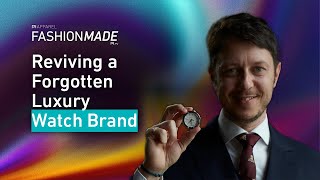
Daniele Campagnano revived Trématic, a dormant Swiss watch brand from the 1950s-60s, and now sells limited runs of 300-500 pieces at $800-$1,000. He credits his grandfather's watchmaking legacy, keeps production Swiss-made, and targets Gen Z through Instagram and influencer reviews rather than smart features.
Chapters
Today, it is true that Instagram is so fast in the purchase process, but not in this price positioning and in this product. Because when you have, once again, a watch around €1,000, $1,000, the consumer wants to know everything.
Welcome, Daniele Campagnano.
Perfect.
Yes. Thank you for coming. Nice to see you here today. Hi, everyone. Uh, so Daniel, you're the CEO of Traumatic, um, which is a— which I'm now wearing, which I hope you will let me keep. Um, so, um, so thank you for coming. So this event is a product development event, and, um, we've been doing it for 12 years. And one of the areas that we've never really, uh, engaged in a, in a, in a meaningful way is the luxury space. And I think we have lots of enterprise brands here, and I think that there's a, there's an expectation that the narrative that they need to commit to is very different to luxury. And that's why I thought it would be very interesting to talk to you. But so I'd love to find out more about Tramatic, um, how you got into it, how you took on, you, you took on the brand. Um, so it'd be great for everybody to understand a bit more about your journey, um, if you're happy to share that.
Sure.
So I'm into, let's say, watch business thanks to my grandfather. Because my parents used to work all day long. So when I was a kid, together with my brother, we was grown up by my grandfather, and he was a small collector at that time. Of course, many of the people in Italy, but also in other countries, used to have their small desks where they were repairing with their tools their own watches. It was not an expensive collection, it was a normal, simple collection. But let's say that he transferred his passion of wristwatches to myself and to my brother. I had my path, of course, with studies, and I started working actually in an entrepreneurial association here in Italy. So a different path. But at a certain point I decided that, okay, if I have to do something 8 hours per day, I need to do it with something that is moving something in me. Because of course it was not— it was not easy to do something that it was not involving my passion. So I started to search for jobs in the watchmaking, and I find a company in Bologna here in Italy that was actually doing a project in the field, and I've developed this project for them for 5 years. Then at a certain point, at 35 years, I looked in the mirror and said, "Okay, probably it's time to comprehend if it's the moment to do an own path." Together with a couple of friends already working in the watchmaking business, we had started to understand if it was the point to start a brand from scratch, But it was a moment that the watchmaking business, the market was so high. It was 4 or 5 years that the market was growing, and this brought to the birth of, I don't know, several companies from scratch, always doing new projects. So it was not hard to enter this market this way. So we thought, why don't we revive a brand that is not active anymore? I have to say one thing, that in the '50s and '60s in Switzerland, there was thousands of mechanical houses producing watches. And then when the quartz movements came around, it started a crisis for the mechanical ones, and a lot of them closed. Only the biggest ones survived, like Longines, Rolex, the one that we know. But actually, there were thousands that had to close for this reason, and Trimatic was one of those. Actually, it's called Trimatic in French. Yeah, and so when we started to understand what brand to revive from the past, I have opened, let's say, the wardrobe with a collection of my grandfather that, of course, passed to me after he passed, and And I remember that he was talking to me about this brand in particular because he found it so well-built, well-constructed, high-quality watches at affordable prices. And also they were producing complications that at that time was not easy to do. We understand that Trématic was actually doing moon phases and complete calendars when probably 30 maisons were able to do that in the '50s and '60s. So it was worth to bring it back. We started to understand how to do it. We involved the authorities in Switzerland. Lawyer associates to understand. And then we had the green light to register the brand. And now we are registered in 40 countries around the world. And we brought that— brought back the brand from 50 years of sleep, let's say. Yeah, it was not easy, actually. I have to say that we have done mistakes both in process, both in production, in communications. And then step by step, we have This was happening in 2022, so it's 3 years now, and we had to correct some things to understand how to communicate them. We needed to find the quality in the product, and I'm happy to say that with the last collection, we have reached the point compared to the price that we ask, very, very high, and the market is actually meeting this, is understanding what we're doing. In fact, the project is growing really well, I'm happy to say, but it's just the beginning. So we need to continue to respect what was the past of the brand and to produce watches and timepieces that might once again reflect what the brand was doing in the past, which is not easy.
No, of course. I mean, they're beautiful watches. Thank you for explaining, like, the, the genesis of it. So I have a question which is not probably not very interesting to anyone else, but what, why is it that, like, what's so special about Switzerland? But why, why do I care that it's made in Switzerland and not Paraguay or Ireland?
Well, you're making a question that is around the watchmaking industry since, I believe, decades now. Uh, you know, Switzerland is is like other places. Of course there's tradition, but there's Switzerland and Switzerland, okay? Like every other country, the point is not really, once again, the country, but the quality that you want to put in your watch, okay? And the assembly— there's a lot of things in the process that it can change also in Switzerland. So you can find cheap assembly, cheap, affordable— sorry, not cheap, affordable components, finishings, but you can find also very high quality. The difference is that in, in Switzerland there is a, there is a companies and suppliers that are able to deliver very top quality compared to the, to the price. Not only there, because I have to say that in, in the current market, uh, there are other countries and areas that are actually delivering very high quality. And I don't want to exclude, for example, China, because in some, some, some wrong talkings it might be addressed like a country that do cheap things. Not at all. They have very high quality in some components. I would say Japan. Japan is rising so much in the industry. It's already very established, but also in micro independent brands, which is where we, we are, we are, we're set. They're doing really well and they're growing. But also the United States. There are a lot of areas where in this price positioning, which is ours, so around $800 to $1,000, there are a lot of districts working really well. Switzerland is important for tradition. We wanted to produce Swiss-made watches also because the brand was from Geneva in the origin. So it was important that our production was still in place and it is. And Basically, it's not a matter of countries, a matter of quality.
Yeah, yeah. I guess it was a bit of a kind of— it was a question that was going nowhere just because I'm interested generally in why we attach a value to Switzerland. And so, and that's probably a segue into value, right? So why do I value a Panerai or a automatic or a Rolex? And what's the story behind them? And I think that most people, most young men who buy Rolexes or, you know, who— or young women who buy Rolexes, I'm not sure that they understand the product journey. And when you and I first spoke, we were talking about how do you access a Gen Z, uh, buyer, right? How do you, how do you explain your narrative as a brand, um, when the reality is most people are buying on Instagram? They don't care if it's Tommy Hilfiger or like the association that perhaps existed with my generation doesn't exist now. And so I'd be interested to understand your experience of luxury because you sit on the cusp of, of— it's a, it's a luxury brand. This is not a— I suppose it's not like a $60,000, it's not a Patek Philippe, but it's still a luxury expense. And so what's your, what's your strategy to engage, um, a young audience with this watch?
Well, thanks for the question. It's actually interesting because this is an environment where it's so much important. So, um, people, the enthusiasts, uh, they're very passionate about everything. They just don't buy the only the product, they want to know everything And sometimes you have to know that in some meetings, some trade shows, they're also giving me information about the brand. They're so informed also of the past because they have also them, their grandfather's watch from the '50s. So in the watchmaking, it's very important storytelling and what, where do you want to go and especially where do you come from. And I believe that today it is true that Instagram is so fast in the purchase process, but not in this price positioning and in this product. Because when you have, once again, a watch around €1,000, $1,000, the consumer wants to know everything. The construction process, where do you source, if you can, of course, disclose, why did you choose this specific or that one. You have to be very, very describing the product and the concept. In fact, there is more and more practices in this environment where you explain what you do, when, where you do interviews, you do live on Instagram, on YouTube with influencers and people and talkers of the watchmaking explaining why you choose to do that dial, to do that specific diameter, to use that movement. And there is a lot of talking, of course, and discussions because a lot of people actually are, let's say, okay with the choices you made and some are not. So, and the discussion will be never over. All of us, especially in the microbrand and independent, mission is to make the perfect, of course, product compared to price. And at the moment, nobody actually achieved that. But, and I don't know if it will ever happen, of course, but it is not that you open a website and you do some pictures and you say, okay, buy it. I believe it's not happening with no product, but this in particular, once again, the consumer wants to know everything and it's not an impulsive purchase. So to give you an idea, we have the data that every time that a customer buys one of our watches, it comes on the website something like like to— from 20 to 30 times. Yes, before, before purchasing. Yes, yes, they want to see everything. Yeah, 20 to 30 times on the website before purchasing because they want to know everything. They want to study the product. They want to— if you don't have the pictures of all the angles, it's not, it's not right. They want a warm picture. They want to talk to you. They, they send you emails or contacts to the message point on the website to know this or that, which is good for us because once again, it's a product where you, you know, the watch is one of the few products that you have to be careful both to an aesthetical thing and a technical one. And it's not that often happening. Automotive is one of those, but it's not so many. And so getting it right from a technical point of view, from an aesthetical point of view, from a dimension point of view, and from a storytelling point of view and a communication point of view, it's not that easy.
It's easy, right? Easy.
No, I know that also in other environments it's like that, but watches—
no, watch it. And it's interesting, I'm surprised that it's 30 touch points, but you just mentioned something which I think is interesting as well, which is technology. And I was speaking to someone, I can't remember, someone at this event, but they were talking about luxury and its inability to— the luxury space, so not just watches, but its inability to harness technology and that it might die if it doesn't. And so here's a question for you. So if you were going to include some form of techno, do you see a world where I can buy into the narrative of the history of Tramatic and the beauty and the cobbled stone street and the original making, uh, production processes and materials, and then this watch do something? Like, do you see a world where there's some symbiosis between tech and luxury? Like, there's some sort of utility? So, so, like, some sort of technology in here? So maybe it's tap to pay, or— I know it sounds ridiculous, it sounds ridiculous, but I, I don't see anybody in the luxury watch space offering utility. It's seen as this sort of functional, uh, fitness watch, sort of athleisure domain. But, but, but I would also say that— is there a— I'm asking the question, is there a space for technology?
Oh, I believe there is. At least there's been a try 4 or 5 years ago. A couple of luxury brands actually did, let's say, more entry-level or affordable timepiece mixing mechanical with, let's say, technology, like, like the buying process and stuff. It didn't really work, actually, but because it's, it's so, it's the same thing. You wear it on your wrist, but it actually accomplished a completely different target. So mechanical wristwatches today are not useful to anything. But once again, you see, of course, you see the hour.
It's jewelry.
Yeah, it's completely, it's completely, it's like a motorcycle, okay? You don't need, okay, it brings you somewhere, but you can go with other things that are more comfortable, probably. And the same thing is for a watch. So today, the Apple, when When the Apple Watch or the other smartwatches came around, around 10 years ago, there's been some people questioning, what are we gonna do? What is gonna happen? Is gonna be a second crisis like the one of the quartzes? It didn't really happen because they had acquiring the wearable, the smartwatches, their own share of the market, but it has a completely different target.
It's utility.
You need that. And once again, the mechanical watches luxury that goes up also to €500,000, €1 million. It's completely accomplished different targets and, and it has a different consumer. And you have to know that in the— when this happened, a lot of people actually were wearing both of them. So one on the, on the, on the right wrist and one on this, on the left, because they're doing different things. Yeah, one is, is for totally different.
So you don't see a world where they— there's any kind of marriage there?
There's been, there's been once again a try, but I don't, I don't think they're doing the same thing. So I, I believe that mechanical watches are gonna continue in their own path and it's gonna be parallel but not crossing. Once again, I don't know, there's been a first attempt, we will see what happens.
There will be another pulse.
Yeah, I believe there will be for sure.
And maybe there's another sector there, there's another subsector within the watch, you know, but it just doesn't exist right now.
Probably.
So with Tramatic, so how long have you guys been going?
It's 3, 4 years? 3 years now.
And I'm interested in who's buying the watches, like in terms of geographically where, where your biggest customer base is.
Well, that depends. We're still getting data on this. I have to be honest, we don't have a complete picture, of course, yet. But majorly we started with the Western countries, but also because we focus our attention over there. I'm talking about majorly online, okay, with the, with the, with the advertising and the communication and also one of the most important things, the reviews on the, on the channel. So we've been reviewed by American and French because it's an important market and Italian, of course, reviewers. I have to say that it's recently a review from one of the most important reviewers around the world, which is Australian. The name is Peter Kotza. And when we have made this, this review, it happened 10 days ago. The website actually exploded from Australia, from Singapore, from New Zealand. And also from UK.
Did you pay for that review?
No, no, you give the watch. This is one of those that he doesn't want to receive payment, but he chooses what to review. So all the brands— it's one of the major, probably one, probably the one in all over the world. So he decided what to review. Everybody proposed to him. We had a campaign manager that contacted him to say, okay, they did this watch which is very particular, very thin, very high level in this price positioning. Do you want to review it? He said yes. And actually, when the review came out, the website and sales this, this month at least, and it's not going down from now. So we're happy.
Amazing.
And of course, it flows when you're, when you're still young because we are once again a historical brand, but we have a new path after 50 years. So we need to regain, of course, all the market. But once again, it's— I believe that it's, it's a lot of focus. Tastes on different markets are different. But when you do a timeless timepiece like this one, I believe you have a lot of doors to be open.
100%. I mean, they are actually— it's funny because now I'm wearing it for a bit longer, I'm like, yeah, it's a, it's a beautiful— they are beautiful watches. And I know you've brought some more with you, um, but yeah, like in terms of, um, in terms of the brands that we have at this event, predominantly it's enterprise brands. It will be your Pumas and your Nikes and How do you think, like, I guess perhaps they would, from a creative perspective, look at what you have and it's, it's a, it's a beautiful story, right? Because it's quite a simple story and actually simple is better. But how do you think that a brand like— do you think that there's a— with the, with the buying mentality that you're seeing, right, with, with what you— your awareness of the consumer, Do you think the brands should be looking to go back to the, the genesis of why they exist and painting that story? Do you think that that's a powerful way of engaging consumers?
Yes, for sure.
Yeah.
In fact, when we started this, this project, we said, okay, in order to respect the brand, we start with new watches, new designs, vintage-inspired, of course, because the brand is from the 1950s. But we do it new because before to do a watch that the brand used to manufacture in the past, we need to reach the quality that might respect what was the product in the past. In fact, the collection that we are discussing right now is the third that we are making because we wanted to achieve quality and to respect what was the product in the past. I believe that if we have to say that we have a competitive edge, sometimes when you have a smaller company, you have your ears very open. Open, very open. And when you meet the enthusiasts, when you have the— you have a lot of feedbacks. I would say it's like a very pool approach, okay? So I believe the biggest company, of course, have studies, listen to the customers, but at a certain point they have to mix a lot of information and they do a product a bit more push, okay? They say, like Rolex— Rolex can do it because they will sell anyways, okay? But they say, okay, this is the watch for this year, and have it. And we do the—
we do the—
yeah, join the waiting list and wait and probably you have it, which is a great strategy, by the way. No, our approach is completely different. We try to listen to every single potential buyer or consumer that we have because they give you a lot of information. And our mission is really respecting once again what we do and what we think is right. To interpret what they give to us and to give them what they need. So, and you can see this if you go on blogs, on information points regarding independent microbrand watches of microbrand watchmakers. You see that people is happy when we accomplish what we can do. So listen, and that's the focus really.
It's interesting because when I first spoke with you, I can't remember when we first chatted, but I said Christopher Ward because I knew it was a UK brand. But the fact that it's called— so obviously I'm from Ireland, I live in the UK, but the fact that it's called Christopher Ward for me makes it feel less valuable straight away because it's an English name, it's English made. And I watch the marketing and they look like beautiful watches, but because it's made in England, because this is why I asked you about what's so special about Switzerland, because somehow it's ingrained in me that it's more valuable if it's from Switzerland. And I don't know why.
No, it's because it's branding, like Made in Italy. Since we're here, so Made in Italy is a brand nowadays. And you think and you perceive that it reflects, of course, quality. Is it true? It's true in some areas. Of course, it's not in others. So Italians are good in furnishing, in fashion. Yeah, but not in all the areas. And Switzerland, once again, is famous for that. But for instance, For instance, you're mentioning Christopher Ward. Christopher Ward is producing and assembling in UK, but usually and often they use Swiss movements. So once again, they avoid to assemble in Switzerland because that is a cost, and they know for the pool approach from their consumers that they don't need it. Okay, they say, okay, the movement is important, but you don't need to assemble in Switzerland. We don't see an added value on that. So Christopher Ward is using Swiss-made movements, but it's not assembled in Switzerland because they believe and they know actually, because it's today is not more a micro-independence. Christopher Ward is now a reality in watchmaking. They know that they just need the movements, they don't need the assembly. I believe this is my interpretation. I don't know that, of course. No, no, but I think—
no, I would agree with that. Did you ever think, like we talked about Rolex, and like I have lots of friends, like I used to own a Rolex, I don't anymore, but like did you ever think about as a product launch, you know, the unobtainium right? So the idea that you can't have something makes you want it more. Did you ever think with relaunching this, maybe we'll just sell 300, and like, maybe we'll enter this race at a much, much higher price point? Did you think about that? I'm sure you thought about that.
Of course, because there's, uh, everybody's watching. So everybody saw that this was happening, especially during COVID because I think they had this strategy. But of course, with COVID you know, a lot of components, uh, were not available. So the watches couldn't be finished, couldn't be, let's say, assembled and delivered. And they understood that the premium people wanted them more, of course. So that is the— that, and they continue to do that even though now this phenomenon is a little bit decreasing. Of course, all the other brands were watching. And I have to say that you have to also— you have to have strategies to sell, but you have to also be honest with your consumer, with yourself. Okay. Some brands, of course, we're not going to give names, but try to do this thing. They're producing— we know the quantities. So I can tell you that when you produce a series of watches, the producer, the suppliers ask you to have, let's say, 500 pieces produced. Sometimes some brands to replicate the phenomenon that we were describing right now, you say, okay, this is the new watch. We put it online after 12 hours. It is sold out. Yeah. Okay. Okay, after one month, oh, we have produced again. Of course, I know how it works. I can tell that 90% of the times, since for producing you need 3 or 4 months. Okay. And secondly, probably, probably they sold, I don't know, 80 to 100 pieces. They say it's sold out. And then after a month, okay, we have it again. I believe that is not really— it's not a strategy.
Probably it's a marketing.
I don't know. I'm not saying that not everybody is doing this, but I saw this happening. So I don't know if this is a good thing to do. And I can see that when you do, when you are very honest, you say, okay, we do this, we do that, we are not selling everything in one second, but we do the things with quality. And I think that honesty will always pay. Yeah.
And my mother always said, the one thing you can't hide from is the truth. Exactly. But this is important for consumers, right? Like, it is important. We're not trying to be anything. This is our story. This is our journey. This is our product. We make it. This is a— this is the price point that it should be valued at. And so I love that. I love the integrity of it.
And you can see it once again. I was, I was telling before that our consumer is actually getting a lot of information. And I'm seeing because I'm watching the competition, okay, I see the brands that are doing the strategy that I just described and the other one that are being honest. And I am seeing that, okay, the first one are selling, but the second one are getting respect and, and more and more and more. So I believe, once again, not only is right, but it's a better strategy.
Yeah, no, I love that. I love that. And as I say, it's integrity. So, um, we, we have some people live here. I don't know if anyone has any questions or anything they'd like to ask Daniele.
I'm just curious to the secondhand market in terms of watches. Is there one secondhand market or is there some— are you aware of that?
It is starting to have, yes.
Once again, I was saying that we are producing 300 to 500 pieces per collection and we are at our third collection, so we don't have huge pieces around. But since now I was saying that things are getting better, we're starting to see a secondhand market.
You need to see it.
You need to observe what's happening. Yes, because once again, this is a product that people collect and the collectors want to have, but also to change. You will see it. You said one thing very important. In fact, also, we were talking about Rolex. Rolex is actually trying to control the second market, which is—
You need to. Quality needs to stay high.
Yeah, yeah, yeah, yeah, indeed, indeed. In fact, once again, I was saying before that we tried to reach the better quality possible. And also to confirm this, we are one of the few brands that is giving 5 years international warranty. You have to know that in this price positioning everybody is doing— is giving 2 years. But this is— this is a communication moment, of course, but also to confirm that we are very sure with the quality we deliver. Also because the watch A mechanical watch needs to be working really— I don't want to say forever, but forever. Because if you, yeah, if you, if you service it in the proper way, if you have good movements inside— not only Swiss, but the Swiss movements are of course good— you, the watch can really be passed to your son, to you, to your grandson. So you will see, of course, the second market, because this is not a product with an obsolescence fast.
So I think it's just more difficult if you have an old Prada dress or whatever, you can take proper care of it, you can bring it to the laundry, whatever. But if you have a watch, how can you just still have a stable quality? For— I mean, for me in person, I could never do anything. I have an old Omega watch, I love it, it's not working any longer. I send it back to Omega, they said it's about €1,000 to make it happen again because the parts are not available. So it's for an end consumer, it's far more difficult to—
This is happening because of the fact that also the big brands didn't understand that this needs to be taken care also in the next years. This won't happen again because I am sure about that in the last 20 to 25 years. Also, the big brands are keeping the spare parts of all the models that they have. Of course, it's not It's not easy to understand in that moment how many spare parts you're going to need for the next 30 to 40 years. As a company, you are allowed to say, "After 30 years, I don't have the spare parts." It's not the best thing ever, but in fact, a lot of companies actually wanted to use movements, for instance, that the spare parts are going to be available really for the next 50 years. I want to say, I want to give you an example. In my company, we're using a Sellita movement, which is a company from Switzerland that's producing watches— sorry, movements— since, I believe, 50 years. And the movement is always the same because you don't need to change much. You will improve some things, but let's say that the core mechanical will remain that, and you will find the spare parts, I believe, also in the next 30 to 40 years. And that's very important once again because it's a collective heritageable product. So your son or your daughter or the other heirs will gonna want to keep it also because the affection they have probably to you, and they want to keep something. I will keep the watches of my grandfather. I try to keep them serviced. The one thing important is that every 5 to 6 years you service them, you change the oils, and you try to not break the components. That's basically it. Of course, it will not happen at on every watch, and it's not easy to, to happen everywhere, but this is basically the, the thing.
Thank you.
Thank you.
Thank you, Daniel. So my question is, what advice would you give an up-and-coming brand who wants to break into the luxury market, given the status of this technological age? How do you remain timeless, or how do you remain luxurious in such a tech-savvy industry that we're coming into?
Well, it's not easy, and I have to say that, uh, once again, not only in this, in this environment but also in others, uh, I believe the preparation phase and stage, even though if you are excited to start, it needs to last because you need to study a lot. Um, in the watches, particularly once again, because as I was saying before, not only the aesthetics is important but So technique, technique is important. So the study phase needs to last because you need to really reach all the information possible and you will start that you didn't because there's— I'm still learning. I'm passionate since I was really a kid, as I was saying with my grandfather, and I work in this environment since 12 years now and I still get new information, even technical or, or, or the environment in general every single day. Day. But the more you last in the study phase, better it is because you will avoid some mistakes that you will do for sure. Once again, and you have to continue doing that. So I, to give you an heads up, I'm here doing this fantastic interview and I've spent already today probably 1 hour watching what was happening in the field this morning because you need to understand the trends. You need to understand who's working well, what is happening. Rolex has just released a new movement after 30 years, so it will change the industry because you have to, you have to see the leaders. Of course, what, what's, what are they planning? What are they doing? Because this will reflect to all the others. The colors of the dial they have launched warranty will last for at least 1 year also in the other, in the other producers. So yeah, I think it's just really a matter of attention and study. But if in the watches in particular, the people that actually are producer, 90% more are all enthusiasts and passionate. They do the same, they study every day and they watch every day what, what the other brands are doing and what is the possible added value that you can give or idea that you have, um, to do better than the others because this is a competition. It has to be fair, but this is a competition.
One, one area, just to jump in on that, on the tech side, um, that, you know, in the diamond sector, obviously there's count— not counterfeit, but lab-grown diamonds, and they're indistinguishable from real diamonds. And in the luxury watch space, I think there's lots of counterfeit that are almost indistinguishable, a lot of them made in China. And one area that I think doesn't need to become like a gimmick, right? So it doesn't need to be that this is measuring my pulse or my steps, but one area of tech that could be interesting, I think, for luxury watches is blockchain for authenticity. And is that something that you've thought about, looked at, um, is that something you've investigated Connected?
Yes, it is actually connected because once again, if we go back to the COVID for instance, there was a connection between the people was asking, okay, I'm actually sparing some money. You remember that we were closing our houses and a lot of people actually was sparing money, was trying to understand where to invest. Yeah, that was one of the reasons why the watchmaking industry had a peak on on the upside and blockchain and yes, and Bitcoin stuff was connected to this because it was an investment anyway. There is a movement that is actually trying to understand and probably some projects that are actually already doing that, how to connect blockchain to watches. But I don't have a clue nowadays if there is something that is actually working. It is something once again that is talking to the same people because the people of the watches are the people of the blockchain and of the Bitcoin. Once again, how this dual environment can connect, it is still something that needs to be explored or someone is actually doing it but is not yet at a big stage and a mature stage, I believe.
Very interesting. Anyone else have any questions?
Hello, my question is, in reviving a heritage brand, at what point would you consider kind of exploring new design, you know, and at what point do you imagine you feel re-established enough to approach, you know, new designs across your company?
Well, I believe that also here is a matter of visions.
So there is some revived brands because it's been happening happening. There are a lot nowadays of revived brands, and they chose completely different path. And I believe in the middle of this, which is what we are doing, we continue to do. So some of the brands are actually doing the same identical things of before, just bringing it back today. You will have your market, but at a certain point that will stop, in my opinion, because okay, the Tudors would say, okay, fine, I have my grandfather watch on one hand, and now the same identical with 2 years warranty new, and it's fantastic. But at a certain point, they will ask for something more, and you will have to do it because otherwise you're gonna stop. On the other hand, I believe that there are some brands that are not respecting, but not really connecting to what was the past, and that's wrong anyways because, in my opinion, once again, I I don't want to say that it's a wrong path for everyone, but if you revive a brand, you have to be connected in some way— values, aesthetical choices, technical ones. Otherwise, the story is not the one that has to be. So I believe, in fact, that we are doing this way because it is my view that you can do it this way in a productive way. So you bring on two different paths. One, that is the new watches. In my opinion, they have to be anyways vintage-inspired if it's a vintage brand, and, and we're actually doing so. This is one production way. And the other one, which is the one that we are talking right now, which is the, the one that we have just produced, is the archive one. So if you, if you're lucky that you're, you're, the brand you're reviving has a good production in the past, and I have to say that this brand has it, and I'm happy to say it, you will, you will have a lot of things to, to be rediscovered and also reinterpreted. Okay, so for instance, this watch is called Archivio Uno, reference 502. In the past was a 36mm diameter, so a little bit smaller. We have modernized it a bit. We didn't do it the same, identical, even though probably we will do also a 36 one day, but we try to reinterpret the watch in the modern era, okay? But you have to see, to follow two different paths. You have to say, okay, I'm reviving the brand, I'm respecting it, but I'm also capable of doing something new. Otherwise, once again, it will— I mean, in my opinion, it will not develop the way it can.
Cool. I'm really— I mean, I'm hoping you're just— you're gonna give this to me, right? Second time you say it, so I believe you mean it. Um, but yeah, so really, really, I, I'm sure maybe after this people want to maybe have a look at the watches, which everyone's welcome to do. Um, but I really, really thank you for coming, and really nice to meet you. And, uh, yeah, like, I wish you all the best with this brand. And, um, if you'd like to come to our show in New York, you're welcome to. We could do another— I'll be happy. Yeah.
Okay, thank you so much. Thank you, everyone. Thank Thank you. Thanks a lot.










