Scaling Digital Product Creation: Real Advice from Epic Games, VF, Bonprix & M&S | PI Apparel
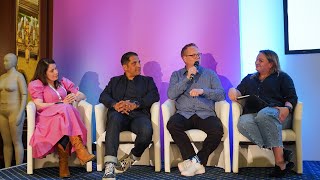
Fashion leaders from Epic Games, VF Corp, Bonprix, and M&S discuss scaling 3D digital product creation. They identify major blockers: funding, building digital foundations, and tool integration gaps. Real-time 3D visualization is critical but still lacks seamless web-scale rendering.
Chapters
Hey, good afternoon everyone. Welcome to our panel, Scaling DCP Strategies, and we want to pull out blockers and look at how we can extend digital assets. The aim of the panel, what I've kind of, I think I briefed the panelists, is that we really want to deliver. We're not going to solve any problems here in a huge pipeline workflow way. That's never happened on any panel ever. But what we would like to do is to try and offer some, some tactical advice. And that is my aim, to get out of these three experts some nuggets, some golden nuggets of tactical advice that, that can help everyone's journey. Um, and we do want to leave time at the end for questions. So do think about what you would like to ask the experts. Use your time well here. And yeah, we don't mind taking any madcap questions as well. Go wild. So my name is Sally-Anne. I work at Epic Games. I am the conduit between Epic Games and the Epic Games ecosystem and fashion and retail, which means I have the joy and the pleasure of coming together with lots of incredible brands most incredible brands in one way or another, help them understand the ecosystem, help them understand the opportunity with real-time 3D. And as I say, it's a joy and a pleasure and something that I've done for a very long time. And I'm here with 3 incredibly— what should I say— experts in your field, but also pioneers. And I'm going to allow them to introduce themselves and then begin the question asking.
Thanks, Alianne. Hi, everyone. My name is Safir Belhally. I most recently spent 18 years at VF Corporation, where I headed up digital innovation, so for the group, at the group level, working with the 22 brands there. I pitched and led the DPC initiative. And we started back in 2011 with a pilot at Vans and then rolled the DPC initiative to the rest of the group back in 2016, 2017. Learned a lot in the process. And it was a humbling experience, but it was an incredibly enriching experience. And I'm very passionate about this topic, and I currently teach a lot. I'm focusing on education because of the importance of that component in any transformation effort in the industry.
Hi, my name is Torben. I'm working at Bonprix. It's been 17 years now, where for, I guess, 11 years I've been doing IT projects, so a lot of digitalization topics. And since 2019, I'm in the technical product development department, and there again trying to digitize the workflows that have been very much analog with the products. And so now we're trying to do a lot of stuff in 3D, do the fitting, and hopefully also do the content production from our digital assets in the future.
Hi, and I'm Lindsay Dowling. I am Digital Product Creation Lead at M&S. I've been with the brand 17 years. That seems to be a common number here. So 17 years. I started my career as a product technologist, so kind of really talking to the teams that we're trying to convince and take on this 3D journey. For the brand, we've been really kind of focusing on DPC from 2022, where we set up the team that I lead today, and been kind of really working with the teams and the departments to deliver that solution and take them on that journey since then.
Awesome.
So we're going to dig straight in and stay with you, Lindsay. We'll work back this way. So I don't normally stalk people in our industry because people don't like that, but Lindsey, I did. And the reason I did was because I was out in the field coming together with brands, partners, consultants, studios, and I kept on having this recurring, um, they came from M&S, we worked with M&S, and there was this thread of good people, good talent, good advice, um, and the thread was leading me to M&S. And that's why I got Ben from, from the Interline to introduce us, and I think that's probably the first time I've ever done that, because I wanted to know more. And that kind of leads us to the first question. In order to scale a strategy, you've got to have a strategy, that's been successful. So, and you have been developing strategies, but more importantly, 'cause everyone, anyone can think, but it's the action that's important. How, what advice would you give when bringing that strategy to a wider team, to a wider company? Like, what are the important things that you need to remember? And it's brilliant, you've done a great job on paper. How do you now bring it to life?
Yeah. Crikey, yes, thank you for stalking me. It was a pleasure. So for me, it's really focusing on the problem that you're trying to solve. It's an emotional topic, right? This is change. It's not just about the tools. It's not about all those solutions coming together. It's really about an emotional product development journey. So how we've managed to kind of communicate our strategy with our teams is really focusing on what problem we solve. How do we help you make better product decisions? That's really it. And actually, that can connect with so many people. So that's— it's kind of running— that running theme underneath is helping them on that journey. And it's being focused on the outcome rather than the what. It's about the how. So we've got that team of people that are really in the business to take people on that journey. We've got Camilla in the audience who's actually one of our transformation managers. And she's the person that's shoulder to shoulder with those teams, helping them on that journey, explaining that strategy and bringing it back, bringing those problems back for us to help solve.
Torben, what about you? I know you've had great experience of bringing to life different strategies.
Yeah, I mean, for us, we kind of started thinking the whole idea end-to-end. So to think about how can we start from a product idea. So you had the product managers that you need to get on board. And I agree that you need to show them what they can get from you. And then they will hopefully bite, and you can get them to actually want to get those 3D assets from you. So yeah, a lot of discussions, a lot of creating products, showing to them, and also learning together with them.
And Sophia, you have implemented a strategy, a POC. How do you then do that next push, or what advice in the space of going from POC to the productization, the commercialization of that siloed, let's say, experiment?
Yeah, I think it starts with choosing your POC very wisely. It helps. But making sure that you can show value in a very obvious way, but also inspire others. It's not about pushing change for the sake of change or transformation for the sake of transformation, but it's about enabling people to do things that they couldn't do otherwise, that they couldn't do before, right? So it starts with listening, 'cause I think, as you said, it's important to understand what the problem, what's the problem that we're solving with this, right? And really getting in a, being in a position where we listen, we understand deep down what every team in every one of the brands in the case of a group is trying to do. And seeing how with the transformation effort that you are proposing, you can actually help them solve that problem, but you need to listen first. And then positioning yourself as an enabler, not a change agent necessarily. So you know, communicating, and it comes down to the way you tell the story, you communicate what you're trying to do. It's basically making sure they understand that you are on their side helping them do things better and also communicating the fact that it's not about doing things, it's not about saving money and time, right? Eventually it's about designing and creating better product and experiences. Because otherwise you will, you know, if the intent is to save money, you've lost your audience.
Yeah, it's the— I'm sure we've all read the habit books. It's the laws of habit, the 4 laws of how do you push through that human habit. And it's make— I'm reading— make it— because I know them off by heart— like, make it obvious, make it attractive, make it easy, and make it satisfying. Which I love. I love that. And I love the fact that for me, because we come from an interactive real-time space, interactions in real time does all that, like games do all of that. So, but you do get blockers, they're everywhere, and you've got to push through them because you believe in it. Tell us about some of the blockers that you've encountered, you know, what they look like, where they came from, and maybe, you know, how you pushed through.
I guess the first blocker is really the basic, building the foundation, having the time to be able to digitize your assets, digitize your fabrics. That's the first thing that you need to convince someone, probably upper management, to give you some money because this will take time. And as you said, you don't directly get a return on investment for that. That's nothing there. And I guess the second blocker maybe comes to your 4 habits. It's like, once you can show that for product management, for example, they have the same goal finally to have a happy customer. So this is where it comes together. So if we can have a consistent product delivered to our customer, everyone will be happy. And 3D enabled us to get away with the blocker of not having enough standardized products, so that we can now do a lot of standard pattern development, which will eventually result in a very good and fit-consistent product for the customer.
I guess one of the barriers come to mind is that 3D can look really intimidating. I guess it is quite intimidating, right? Our focus when we really started out on our journey was to make it simple, coming back again to your habits. So for us, it's not been about teaching every designer or user kind of A to Z of the tool. It's been about breaking it down to very, very simple things that will suddenly kind of gain that traction. They suddenly see a result very, very quickly that they feel confident in. So it was about building that foundation, making sure they had all the right starting blocks to get going, giving them the very simple training, very focused on kind of those tasks that we needed them to do, and then seeing them deliver that. And what's been really nice to actually experience more recently is that those design teams that have been on that journey early on have actually now started coming back to us, "Oh, teach me how to do this. I want to learn more." So we've kind of captured their imagination and their excitement. Kind of from when they were actually really, really nervous about it at the beginning and very apprehensive and couldn't see the benefit to them to now wanting to learn more. So we're committed to delivering that training and that journey kind of over time in bite-sized chunks to build confidence. So I'd say for us, that kind of adoption piece has been really, really exciting to overcome.
[Speaker:FRANCISCO X. CORTES] I think some of the blockers we've encountered along the way, especially very early in the process when we pitched the whole initiative, was funding. Obviously, the way we communicated this transformation effort was to say, we want to enable the teams to design better product and experiences and to make the right decisions early in the process. The money that we save along the way helps pay for that, right? That's the construct. The problem is when you're pitching this to the C-suite, obviously the question of ROI comes in and then the investment. You know, it can be pretty sizable depending on how quickly you want to move. And we found ourselves in a situation where we had pitched for a certain amount and we were, basically ask, hey, what can you do with half of that? Or what can you do with a quarter of that amount? And it just doesn't work like that when you start, right? So we had to make, we had to stand our ground and basically communicate that, you know, in order to be able to build a foundation, you have to invest the amount that is, that is planned initially because otherwise it just doesn't work. So the funding is critical. And then the other blocker that I think everyone is aware of is adoption, right? The human aspect of things where you're asking people to change the way they do things. Some people have been doing this for a number of years. They don't, you know, you're asking them to learn new ways of doing things on top of doing the work that they're expected to do. And that's very, very difficult to do. So remembering that ultimately you're talking to human beings who have their own agenda, their own fears and discomforts is really, really important.
And maybe adding to that is that once you have the funding, maybe you have some people that you've already convinced. They want to do it. They want to work in 3D. And let's say you have a 10-person team and 5 want to work and 5 are very, "Oh, that's so much that we have to learn. How should we do this?" Don't focus on the ones that are the blockers. Focus on the ones that want to and try to push them and give them the space to do it actually, because eventually the 6 will come and say, "Oh," 'Look, these 5 people, they are really doing a good job and it looks fun, so maybe can I be the next one?' And then, so maybe you don't get all 10, but you probably get quite a good amount of the people. So it's maybe some good advice, not only for this part, but don't focus on the blocking people, focus on the one that can get you to the front.
I love that. There's the, um, yeah, there's the graph of change, isn't there, where you know, you've got your champions and then you've got your technology interested and they make up the 20. And then you're successful and you're told to scale and do more and more, but you've got to scale and do more and more to the 80% who were never interested to begin with. And that's really hard and it's kind of bridging that gap. And knowing more about bridging that gap is definitely where something that I want to get from you guys. But before we do, I'd love your thoughts on failure, 'cause I know that we've had a talk on failure that I didn't get to go to, so help me out here. You can't always win, and, you know, when the POCs, the explorations can't always yield in the way that you want them to, how do you bring people back from that moment, the team itself, but also the wider company in the— you told them, that this is something we should do and it didn't prove itself out. What's your advice when you've got to come back from failure?
It's a hard one and I didn't warn you.
Yeah, it's a—
that came from the blind side. No, but I think it's, again, it's about communication. It's about looking into what went wrong, trying to find explanations. Trying to see if these explanations bring you to a solution, at least for certain parts, and then probably readjust and retry, and don't give up. That's the main thing. Always stand up one time more than you fall down.
I personally love when things go wrong, because it means you're learning something. I always tell the team, like, let's celebrate when things don't go quite as we planned, because it means actually we're not blindly running ahead with something. It's allowed us to reflect and do better. So I am such a big believer that it's an important part of the process. We're always honest. I think I'm quite a vulnerable leader. I will always share when I don't feel comfortable or things go wrong and be honest with the leaders that are around us as well and say, we might not get this right, but trust us and believe in us that we're going to learn something and we'll come back and do better. I think it's such a personal journey. So it's about having the right people around you and being honest and being vulnerable when you can.
I agree. I think leading with humility is a way you can really create space for failure. And, you know, if you come in communicating that you are working as a team, that you're aligned on a mission and not, working to convince a team to do something that they don't want to do in the first place, you change the dynamic, right? And you put yourself in this growth mindset that hopefully everyone will understand. And it's adopting, I think there's something about adopting the the explorer mentality, right? Where you don't quite know, you know what you're going for, but you don't know exactly how to get there, right? And I have an admiration for these explorers who would spend weeks, if not months, on a ship, just trusting that something would wait for them. Maybe not the United, maybe not America, But, you know, it's the mental and psychological resilience that you need to have as a leader and the humility you need to communicate is truly inspiring. Yeah.
Was there more?
No?
You looked expectant. No? Okay. So extending digital assets that we're, you know, I think I feel as if I talk a lot now, and I'm very happy about it, about extending digital pipelines rather than what a digital pipeline is, and what the opportunities of 3D are. It's about extending and pushing and scaling. And so lots of teams are kind of working at that scale. But I think it is interesting sometimes to— to be able to quantify to where, where are we scaling to? And reminding everyone, and I'd love to hear from each of you where you were scaling to, and it might have changed. It may have been when I begun, I was scaling to here, now I'm scaling to here. And I feel as if a lot of people are put off talking about their finale, talking about their finish line, because everyone went crazy about the metaverse and just went to the end. And so now we're all a bit shy about talking about where, like, what is finished for you? I'd love, like, help us understand what's finished, where you are moving to, what the aspirations are, why we are bothering.
Yeah, I think it's really hard for people to commit to a North Star, right? And really, put something behind it. And that's actually something that we've spent some time doing. We were very much focused on solving a very real problem within our product development teams about taking them through that, making better product decisions, being able to see their ranges in a new way. And more recently, we started to talk about the future because we really needed to lead us to understand that this actually is so much greater than just changing a design process and just introducing a new tool. This is fundamentally how we're going to develop products in the future. And then start to talk more about those end-to-end opportunities. As a team, we've always been committed to learning and looking into the future, not getting too focused on kind of the immediate problems to solve, because ultimately, those— future opportunities may come and bite us on the ass later down the line. We've built the quality wrong. We've set off in the wrong direction. So I think always keep an eye on where you want to go with that North Star. Make sure that you're testing and learning about those future opportunities so you understand what you need to build to get there. And then paint the picture when you're ready, because I can guarantee suddenly people will grab onto what you paint and deal with any— misunderstandings about what it is and what it isn't. And I think communication is so key around it and being really clear about what your mission is. I feel like I've meandered around that, so I'm going to stop.
Yeah, you mentioned end-to-end, and this is something that we always, wherever we speak, wherever we are, when we speak with people also in the company, that's our mission. And it was more or less from the beginning. So we wanted to have the asset to be able to be better in each step, but ultimately used for all the steps. So it's always growing, constantly growing. We don't throw anything away. And so that's not only the samples that we are not producing, but it's also the work that someone put into the digital asset. So, yeah, to push that through, and in the beginning it was clear that we cannot achieve this within 2 years or 3 years' time. And now, bit by bit, it's coming together. And I don't know, hopefully in 1 or 2 years, we can sit here and say, okay, now we've got X% in the webshop that's coming from the first idea of the product manager in digital, and it goes digitally to the webshop.
I have to agree with Lindsay about the, you know, the challenge of putting out a North Star and making sure that it's something that everyone gets behind. But I think that's the key, in my opinion, that's the key, or in my experience also, that's the key challenge in this whole effort. If you're able to inspire your teams and show them what they can do with the approach that you're proposing that they couldn't do otherwise, and if you're able to go about initiating this transformation in a way that's collaborative, For instance, building teams that kind of adopt in parallel, adopt these new ways of doing things in parallel, showing along the way what can be done as opposed to what must be done, and inspiring the teams to say, oh, you know what? I want to learn that because this way I can do that. That will most likely make it easier to get the momentum and the critical mass to be able to start driving these initiatives at scale. Obviously, you know, if you're gonna do that, try to make sure you're not adding extra complexity by trying to streamline things that should not be streamlined. You know, this was one of the biggest challenges we had where we wanted to align all of— for instance, at VF, we had Vans, North Face, Timberland Dickies. We also had Jeanswear. And we wanted them to commit to a pipeline that was the same because it would make things a lot more complicated if, you know, different brands used different tools and different pipelines. Well, it didn't work like that. You know, we needed to listen to them and it was more complicated, but that's what the brands wanted. So also being very strategic about what can be streamlined and understanding that if you're not, you just have to deal with the complexity of that.
I am— I've changed what I want the North Star for the industry to be recently, in that I very much bought into the end-to-end. You can't get more than end-to-end. I felt like that was everything, but I've recently evolved my thinking and I want more. I want more than end-to-end. I want that asset to have all the information you want that you need, including, simulation, weights, materials, distributors, where you get it from, and I want that to move end to end. And I know that I've moved the bar high, so much higher than it was, but that's what I want and that's what I'm going to push for for the next 10 years. So please join me. It's nearly April Spritz time. I know you're all excited, I am. Are there any questions? We'd love to hear thoughts, questions, comments. Oh, oh, there are. Okay. Can you offer any insights about virtual try-on at scale, i.e., for customers rather to get fit right on avatars at the product development stage? Torben?
Yeah, we had more or less the same question on our talk, so where we stand with it. Yeah, so far we are not at that stage. We did some trials about 2 years ago. I've seen a very good example from FastLED. I don't know if they are here in the room. So there are certain technologies around, so I would suggest to explore them, have a look at them. It's already good what they— or great what they can do with AI. And you get a nice picture of yourself with the product on.
Yeah.
It sounds like the virtual try-on is kind of the holy grail of DPC application at a consumer level, right? If we are able to show that you can literally visualize how a garment would fit you, you as in your individual, you know, person, then it's a lot easier to justify the effort, the effort of building these assets and things like that. And I agree, there are technologies that exist, they're not quite there, but, you know, I think it'll get there pretty soon and we'll be able to celebrate that.
And I'm a champion of, there are lots of different technologies and they're all great and I love being able to see how people are developing in that space. You know, it's a very ripe space. There's so many— I feel as if there's so much stuff that's just about to come to market. And I think what's important is, you know, the at-scale bit. And for it to be at scale, it has to be integrated. Like, it has to be out of CLO into your digital fit, out of V-Stitcher into your digital fit. And that's all about integrations. And so I think that there's great software that will be a great wrapper, like applications that will be a great wrapper. And I think that you'll— you should have a choice, like everyone should have a choice. And we just have to make sure that all those integrations are there so it can be done at scale. And, you know, and we're getting there. Which DCP tools have you found critical to success, and what's still missing for you?
No, okay. Yeah, so for us, it's basically we start on a 2D tool. We use CAD Assist for this. We are using V-Stitcher to get the simulation right. And well, now we would need something to also go into CGI, but maybe that's another blocker, and it's probably Same for other companies. There's again a different department that we need to talk to. How do we get our images into the webshop? So even if we would have nice images that we can probably already get, we would still need someone to do this. So, but for us, one of the next TPC tools would also be something to render the images at scale, of course, and with different presets.
I'm not getting paid to say this, But for me, it's been real-time, real-time 3D, real-time visualization, whether it's OpenGL in browser or it's in the computer with Unreal Engine, Twinmotion. It's very— when we started understanding the need to make the right decisions to scale our DPC efforts within the organization, it became obvious that real-time 3D was the way to get there, just because of the time aspect and the visual quality, the visual fidelity. Because eventually and ultimately, your assets are being judged by their likeness to the physical product and the behavior compared to the physical product. And so if your pipeline is committed to that visual fidelity, then you have to make make the right decisions when it comes to visualization?
I think for us has been— if we come back to that problem that we're trying to solve, that decision-making moment, for our process, a virtual store has actually been the magic. Enabling teams to kind of build their ranges with that customer view in mind has been the real sweet spot. for us, because actually it solves the problem that we're trying to solve. So again, it's about focusing on what your users need, or what's the business process that you're trying to break through, or break down, or make better. So for us, that's been a real exciting thing. It's not perfect. There's still lots to solve around it, and all those integrations, and automations, and— the smoothing and the greasing. But for us, that— for the user, that's been really key.
Okay, I've got— am I getting a big hand sign that is stop? So I'm so sorry, we will happily answer that question in person. Whoever posted it, come and chat with us. Thank you so much, guys. Please, there's another day if you want to come and say hi. Do come and say hi to the gang and have a wonderful Aperol Spritz out on the terrace. See you all there.










