Using 3D to Reduce Waste | Centric Brands | PI Apparel
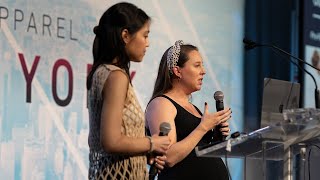
Centric Brands' three technical designers explain how 3D design cut waste in their kids division by reducing physical samples and prototypes. They've converted nearly 100% of selling samples to 3D renders and shortened design cycles, but struggle with accurate fabric representation and getting manufacturing partners on board.
Chapters
Good afternoon, everybody. My name is Mara Dondero. I am a director of technical design of— and director of technical design and 3D at Centric Brands. With me here is my colleague Evelyn Moy, who's our most senior 3D designer, and also Emily Reinaga, who has helped us put this presentation together today for everybody. And she is our 3D senior— our most senior 3D technical designer on our team as well. So Evelyn, Emily, and I, we all work in the kids division here at Centric Brands. For anyone who's not familiar with the company, Centric Brands is a leading global apparel and accessories company with a portfolio of iconic— several iconic and licensed brands. We work with many of the brands, retailers, and software companies who have been in attendance in the past 2 days. [FOREIGN LANGUAGE] So over the past 8+ years or so, our teams have been through a very interesting journey of digital transformation. Like many here, our implementation plan was on a safe and steady path, thoughtfully implemented and into our day-to-day workflow, limited disruption. If there was, it was controlled in a sense. Everything had a backup plan. Oops, sorry. Here we go. Sorry, I didn't practice the slide click. Yeah, there we go. Perfect. Okay. Everything had a backup plan, and we were able to utilize samples, traditional CADs, the traditional tools that we were used to having in the office. So, um, little did we know we were all about to enter the biggest disruption, which was the pandemic. So as a result, our 3D team implemented at a timeline that was expedited in a way that really wowed us all. We were all very excited. So then we quickly adapted to the development of the product lifecycle without our safe and traditional tools we were used to heavily relying on when we were in the office. We learned how we could utilize 3D technology to continue to design, communicate, and make decisions confidently in a time of complete unknowns. Having this opportunity to speak today has actually given Emily— or Evelyn and I the chance to reflect on our journey over the past few years and identify areas where we reached our goals and then also where we lost sight of the impact 3D could have on our overall product lifecycle. So as we began to explore each key department, we noticed a common theme. Both our successes and our missed opportunities within 3D had a direct relationship to reducing waste and overproduction within our day-to-day. So then we asked ourselves, what is waste? What is overproduction? So according to Merriam-Webster, waste is to use or expand— expend carelessly, extravagantly, to no purpose. Overproduction is the act or instance of producing too much of something, which I'm sure we can all relate to in some way. So when we looked at waste and overproduction, we noticed there's several different viewpoints of what resonates with people in the industry and how people are really identifying this idea. So we broke it down in terms of how it relates to our day-to-day, and it became clear that there are two categories for us. There's physical and then there's non-physical, some easier to identify, obviously, than others. For example, physical waste and overproduction can easily be viewed by materials used on garments, physical samples, daily working tools such as paper, foam core boards, ink. The list could go on in detail of what we use. When talking about non-physical aspects of this area becomes a little grayer to identify. So when we dug into it, we found for us this resulted in cost, time, ideas, and training all fell into this bucket for us. So, so what are some of the ways that technology, 3D technology, can help reduce and eliminate our overproduction and waste. We'll walk you through each of our key departments and explore how utilizing 3D is currently reducing waste within our process and where we see the opportunity to continue to do so.
So this is our general workflow within a design season, and as you can see, 3D is integrated quite early on in our design timeline. This is extremely helpful for us because it allows us to realistically visualize all aspects of design. So for example, in the development stages of design, we can use 3D to truly scale the prints and patterns before we send it off to factories. Which reduces the amount of handlooms we would receive. And another example would be if we were introducing new silhouettes, we can easily finesse details on the 3D model before passing it through to sampling, preventing us to have to go through multiple rounds of fit samples. And here we have an initial concept which looks great in a 2D CAD, But when we threw it on a 3D body, it just didn't turn out exactly what we had in mind. And so we ended up just rejecting the style. But because we were able to reject it at an earlier stage, we saved on samples, we saved on shipping, we saved on labor, and ultimately cost. So in addition to utilizing 3D on the design level, we also use our 3D renders as a merchandising and sales tool. This is exponentially useful for us because it offers, it offers an opportunity for the sales team, for our licensors and our customers to take a peek into our designs at a more realistic standpoint rather than looking at it on a piece of paper. By presenting the 3D designs on a virtual platform, we have cut down on the physical waste of printing paper and using foam core boards for presentations, and we also cut down on the overproduction of producing physical selling samples for these meetings. And I'm sure many of you can relate to the overabundance of samples that are just sitting in our closet somewhere. Another big win that we have noticed is that having accurate 3D renders helps us manage the expectations of what buyers are seeing and buying and merchandising for their stores. With that said, it reduces the possibility of buyer's remorse, and which that would leave us with an overproduction of unwanted stock $1,000, as well as wasted time of re-strategizing how to use up that excess inventory. So in addition to our successes, there are areas where we see the opportunity to improve our 3D use. One of the biggest challenges that we have been facing since the beginning of our 3D journey is the question of Can 3D technology truly replace physical samples? Whether this question is asked internally or externally, it is without a doubt the one obstacle that prevents us from moving full force into 3D. An important and valid feedback that we have been hearing is that it is tough to see what material is on the 3D render, especially when it is on a darker color. So to help with this challenge, we would typically provide swatches of fabrics for any in-person visual presentation. However, we don't always receive the approved fabrics before these presentations to use. And then of course, this also produces a lot of physical waste. And this also encourages our customers to rely on the physical swatches in front of them as opposed to looking at the digital presentation on the screen. Besides that, color is in itself quite difficult to manage. You know, just between all the different programs and all of the different monitors and even if you're sharing your screen virtually, color can be a little bit off. So it is really tough to deal with that. Does anyone else have color issues here? Yes, I feel you. So one step that we are taking toward— that one step we are taking to combat this challenge is by getting a realistic scan of our fabrics that captures the true physics and color of the fabrics. Although we are still working through the color challenges, the scanned fabric maps could help with showcasing the true texture of each fabric. And hopefully this will decrease the reliance on fabric swatches at that stage of the design lifecycle. So overall, this is an area where we find we could utilize 3D to further reduce the amount of physical waste and overproduction, but we haven't quite found a unified platform or buy-in between our sales team, our licensors, our customers. So we're still figuring that part out. Another opportunity that we have been thinking about is how can we as an industry pioneer a change in the buying process from a customer's perspective. Since 3D is so heavily developed in the design lifecycle, we feel that there is not enough focus on how to integrate 3D from the retailer's perspective. So just food for thought, and please do share your thoughts with us at the end. How can we generate more interest from the retailers? And how do we get retailers to be more involved in this technology that we're trying to push forward?
So moving into the technical design side, on the screen here we have a brief overview of our 3D technical process. We begin by designing— by establishing 3D blocks for our design team, and they use that as their creative foundation. These 3D assets are then used to collaborate with design throughout the initial development process. As Evelyn mentioned, by utilizing 3D, our designers can see their designs early, expect— expediting the design process and making more calculated decisions upfront. Our goal, like most, is to develop more accurate information upfront in the process, resulting in more accuracy on your physical samples and the garment details that you're providing. So this has allowed us to capitalize both on some physical and non-physical waste and overproduction throughout our process. Um, with this, a couple of our wins I can go through here, which with the use of 3D, like most, we've been able to decrease the overproduction of fit samples. Um, with physical samples, it can be common to see several iterations, each taking up to 2 weeks at least if not more, at least for us. So by replacing those initial fit development steps with 3D samples, we can begin viewing multiple style iterations within a matter of days, opposed to weeks or potentially months, saving on shipping, time, and cost of multiple samples in this area. This has also allowed our team to focus more on creating a better fit and fine-tuning the small the smaller details of the garment that are so often overlooked. So as many are also probably familiar, pattern adjustments in 3D are seamless between a 2D pattern and a 3D garment. This allows our designers to settle on design choices in real time without having to repeat the entire process of sampling and design— creative design to make minor changes within minutes. We are immediately reducing wasted efforts and time put into the development of a style. We've also noticed that the time of onboarding entry-level employees has actually also been reduced when using 3D as a learning tool. So a strong foundation of technical design skills are still imperative to, you know, be successful within the industry. However, when an entry-level or even seasoned technical designer sees the decision that they made in real time. That aha moment has been achieved in a matter of moment— minutes, opposed to weeks to months to when they see that sample. In this case, wasted time is eliminated in the training process and the unknown cost of what that uninformed decision would make. Most importantly, knowledge is gained real time from our employees. We've also been able to take advantage of the grade and size range capabilities within the 3D software. So this allows us to fit in the entirety of our size range in 3D versus seeing a base or just jump sizes and physical samples. This gives us a more comprehensive look of our fit and its entirety before it's introduced to a customer. We've had the chance then to improve customer feedback on sizes which typically we wouldn't see a sample on in the technical department. Allowing us to reduce the overproduction of samples, which in this case, those samples are typically only used for a matter of minutes just to make a quick decision or provide peace of mind for somebody within the company. So while we've had many successes, there's also areas where we still see we can push forward and continue to develop and explore. Our biggest opportunity is to have all production samples created in 3 3D. While we can successfully fine-tune fit and overall aesthetic through 3D, we're still challenged with the tool to effectively communicate construction to our vendors. In terms of overproduction, we continue to overproduce samples to improve and focus on only quality and construction of a garment. We can also begin onboarding our overseas teams and vendors and understanding the technology more thoroughly. With this, allowing fittings and pattern adjustments be done consistently in a virtual platform, allowing these digital assets to be accessible to the production team as a tool to use for going forward. This will allow the level of precision of our garments to increase and create clear communication between ourselves and our vendors. We're increasing the accuracy of design and fit intent with our overseas team with the goal to reduce waste of the inefficient communication that happens daily. So moving on from tech design into our manufacturing and production areas. So as we begin to explore this side, we notice that, at least for us, our 3D tools and processes are heavily geared towards the initial development. This makes the area of manufacturing and production a white space for utilizing 3D in a really meaningful way in what we're doing. So they certainly gain the benefits that we've just highlighted once it gets to this point. However, currently we've had a hard stop, I would say, in our development process with the actual 3D asset once the production process really begins. In a company of our size, the implementation of 3D does become challenging in this area, particularly because of the wide range of variables that we face. So, for example, we have multiple countries that we're producing in, multiple factories, and mass quantities, which I'm sure many can relate to one or many of those challenges as well. From our perspective, we're not really then saving or on overproduction or waste in this area. We're kind of just repurposing what we saved and putting it into the production manufacturing process. So we're finding this to be— this is because we have a lack of integration of our 3D assets and tools past the development stage. So we really see this area as potential. We know that innovators are the core of change, and taking risks and making investments in 3D can help. We've all done this in some way or shape or form in the development area, so So now we're really asking ourselves, how are we to engage our manufacturing teams to take this next step with us?
So lastly, we come to the marketing area. Now, this would be the natural direction to integrate and build our 3D assets. However, we have encountered our own roadblocks. There are times when our marketing teams would ask us for our 3D renders to use for e-com on a retailer's website. However, it's only being utilized as a backup option when the physical sample is not available. So we really hope to build that true collaboration in this department so that we can evolve our 3D assets in a meaningful way. Our goal is to promote using a unified platform, as I had mentioned earlier. To process and edit our 3D renders and turn them into photorealistic images. As a result, e-com assets such as samples, models, studio time could be reduced. However, we are finding it challenging to identify a retailer or brand to partner with in this— in pushing this initiative.
Forward.
And we know that trust takes time, but by showing that 3D can be a reliable marketing tool and can offer a quicker outcome, we believe that confidence within the product can still be maintained.
So as we all know, 3D is an integral part of the fashion industry now, and it's growth is essential really for the future. This is how we're utilizing 3D to reduce waste and overproduction throughout our own product lifecycle. But we've also had challenges to continue to push forward this initiative outside of our own departments. There's no question that utilizing— the utilization of 3D will reduce waste and overproduction in various ways. But the question again is, how do we do this in a meaningful meaningful way and expand it past the quick wins that we're also used to talking about. So we encourage others to look at their own process and do the same. However, how can we still push ourselves and others to take a leap of faith to the next level? How do we promote and engage critical areas of the industry to consistently embrace 3D as a true end-to-end tool? We hope we were able to provide some thought-provoking ideas today and encourage all of you to further your conversations and push the boundaries of 3D within your own organization and within the industry as a whole.
Any questions?
I don't know. I don't know.
Oh, hi. Oh, oh, oh, I'm sorry. You had a question?
Factory, maybe they're working with that contact. So that's what I'm very interested in. How are you working with— do you find yourself having to work with, like, larger, more vertical manufacturers that are already producing it? And how are you working with them?
And is that whole process really interesting? So I would say right now we're finding that to be one of our biggest challenges. So we work with so many different factories, so We're trying to find one source overseas that can really, I guess, champion that 3D and kind of control those assets, and then have it sparse out to multiple locations. But of course, then that kind of sparks the idea of, well, once it gets there, how do you ensure that they're still using those assets, which goes back to an age-old question of, how do you know that they're still using the pattern that you gave them? So— I think it kind of relates back to issues or challenges that we've been having within the industry, but just shifting it from one asset to the other. So, I mean, it's certainly from my perspective, I feel like one location is the best place to kind of manage that. However, we have not successfully been able to do that to this point yet. So that's kind of our next step. Step of like, how do we integrate that and how do we get the buy-in from that team to see the potential of how it can really make their lives easier or, you know, help control the information that's going out to these factories? Yes. Um, where did—
if you can give some examples of where you started and what your wins were and the percentage of your 3D versus physical samples currently?
So I would say percentage of 3D versus physical for selling samples is 100%, if not 99%. And a lot of that has been pushed forward because of the pandemic. So I mean, of course, before we relied on both and we kind of were working both ways to give everybody that comfortability. Then we really had no option. And through that, we didn't really go back. But then, you know, we do get the comments like Evelyn has mentioned of, you know, a little bit more accuracy and understanding the product more. So that's where we're trying to find how do we introduce tools that aid those physical— those 3D assets that we have without making new garments and putting that in. And I'm sorry, what was the first part of your question?
I guess the first part is just how did you— what product category did you focus on? Because I know you did kids, but what was the easiest so that you were able to gain that traction for the aha from the rest of the company to say, yes, let's go forward with this?
Right. So we work on a really wide variety of categories. Tailored goods, so tailored kids jackets, pants, shirts, dress shirts obviously are pretty simple. So we did start there. We started on our core items that were more replenishment-based because we figured, you know what, they're used to seeing these every day. So if we can gain the trust of them seeing them in a 3D asset, something that they're used to seeing every season, not something that's new, it's like they start to get comfortable with that idea. So we do a lot of replenishment items. So I would say we started more in that category, but in the tailored goods, and then even with uniforms as well. We work on a lot of some sportswear, which is actually kind of the last thing that we've added in, just because of the more variables that are in there. But yeah, I would say we started in our core product to kind of gain that trust from people who are viewing the product outside of the people who really believe in it, right? So, anybody else? Mm-hmm. We do, yes. Yeah, even for our tailored goods, we fit in 3D, and then eventually if something is bought, we'll get one physical sample. But I would say it's— for us, it's pretty accurate. Again, we're just looking at the fit. The construction really and the quality ends up being the focus of the garment, which in a way is good because sometimes it is overlooked because people are so caught up on like, "Quarter of an inch. Is that pocket straight? You know, what's going on here?" So we get to focus our attention somewhere else, I guess. Anybody else? Oh, you have a microphone. Yes. [FOREIGN LANGUAGE] I would say big picture supportive, yes, but of course they're not involved in the day-to-day, so I mean that To be transparent is a little bit of, you know, we're at a standstill for some of that. People know that we're doing 3D, obviously, and I feel like this is a common theme. You're doing it, but then it's like, to what level? You know, how can you bring it to that next step instead of just saying you're doing it? So that's— we're a little bit of a standstill for that. Thank you.
Thank you.
Thank you.










