Why Fashion Needs Neurodiverse Creators | PI Apparel
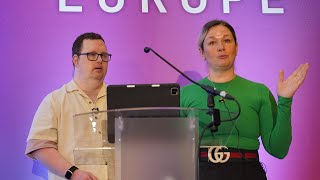
In this live presentation, Jess and her brother Sam Guglia (a fashion designer with Down syndrome) introduce NDV (Neurodiverse Voices), a digital‑fashion initiative aimed at creating space for neurodivergent talent in the fashion industry. Jess recounts Sam’s personal journey—from limited post‑college options and warehouse work to learning Clo3D, creating digital garments, and securing a full‑time role on a digital sample‑making team. The talk highlights how technology can be made accessible, the importance of bespoke roles that fit a person rather than forcing a person into a predefined role, and practical workplace adjustments (quiet spaces, clear communication, task lists) that enable neurodiverse employees to thrive. They share examples of supportive organisations (WorkFit, Fairshot, Spectrum Designs, Differently Enabled) and offer concrete advice for employers and software makers, including training, bite‑sized learning, and free‑license considerations. The session ends with a call to action: reach out for consulting, attend a round‑table, and continue the conversation about inclusive hiring in fashion.
Chapters
Hi everyone, thank you for joining us this morning. I'm Jess and I'm here today with my brother Sam. I've already pre-warned the sound engineers that I have got quite a loud voice, so I'm going to try not to boom too much at you. So would you go ahead, Sam?
Hello, my name is Sam Guglia. I am a fashion designer and digital fashion designer. I use Clo3D.
So we're excited to be here with you today. We're going to share our story and a way that we've used Sam's experiences to create a new project, which is called NDV, which stands for Neurodiverse Voices. It's a digital fashion initiative focused on creating space for neurodivergent people in the fashion industry. So we kind of use it as more of a— although these are Sam's designs and we kind of co-create together, it's also a project with the idea of starting a wider conversation around hiring neurodiverse people. So we want to talk about the untapped workforce, and that is people who are creative, passionate, and eager to work, but often shut out due to outdated models of employment, stereotypes, or lack of support. Many of these people are neurodivergent, meaning their brains work differently. This includes people with Down syndrome like Sam, with autism, ADHD, dyslexia, and more. So together we have created NDV, And these are some of Sam's designs to show what's basically what's possible for people. It's more than just a fashion brand, it's a call to action. It's about showing rather than just telling how powerful inclusion can be. And a prime example of this is how much fun Sam's having at this event, something he would have never normally had access to. And just if you've come across Sam and he's given you a business— his business card, you can see the real impact of being included in a space like this and able to do a job in the way everybody else does it, but people like Sam are often left out of. So, our creative background. I'm sure my mum would be horrified that I've shared that picture of her, but we won't tell her, she's not here. So creativity has always been part of our childhood. My mum was a textile designer, our sister Lucy, who a lot of you already know, and I have always been into fashion. So when Sam was born and he was old enough to get involved, he joined right in drawing, crafting, creating. It wasn't as easy for Sam though, because is while Lucy and I were able to go to university and study fashion at degree level, Sam only had a kind of very limited set of options for him to create and continue on his journey with fashion. So he studied fashion and textiles at the amazing Harrowood College, which is up there, and was able to learn how to use sewing machines. He took part in fashion shows, but when he left, there was just no opportunities for him to be able to work in that field.
I work in a warehouse. I packed boxes. I like having a job at the Teammates, but I still wanted to be a fashion designer.
So his passion never faded. He wanted to be involved with whatever we were doing. There's some of his early work at the top, some designs he made for my sister, which she put on her graduate fashion show. But packing boxes at a logistics company wasn't exactly Sam's dream. However, it was the only job that was basically available to him. So taking his journey forward, I've— what would I say— not fought with, but pleaded with my parents to get him an iPad Pro so that he could sketch a bit more, he could add colour more easily, and it would give him that freedom to design in a sort of more expansive capacity. But sometimes he would struggle with getting out of his head the designs that he wanted on paper, so he'd often ask me for help. So either finding templates that he could draw on top of, or I would often draw them for Sam, and then he would create designs like this, some prints, patterns, menswear, womenswear, etc.
I had a lot of ideas in my head. I wanted help to show them.
And around this time, my sister Lucy, who is not here but usually is at these events, introduced me to Clo3D. I fell in love with it, the speed, lack of waste, creativity. And while I was using it, I kept thinking, is this something Sam could use? Is it going to be too prohibitive? Because as Ineke will attest to, because she was the one that taught me Clo3D, there are sometimes barriers even to people who have sort of less mental barriers than, say, Sam might. And I was concerned, you know, could he use the tools, but how could we get him to use it? So At first I was just giving him screenshots of avatars to draw on because I thought, oh, that'll be a nice way for him to kind of make them look more like, um, real people with the clothes on. And then one day I thought, okay, I'm just going to bring my laptop around, we'll see what he can do. And I got him started, and that was just with basic, um, pre-made kind of garments that I would give him, and he would add his own prints, change the lengths, you know, etc. Um, and he picked it up really quickly.
I like clay, it's fun to use. You can make clothes and see them straight away. I started with basic designs, then I changed colours, I added my own prints.
So around this time the pandemic hit, so I wasn't able to help Sam anymore to show him how the tools worked, etc. So I thought this was going to basically mean we would have to put it aside until Everything had opened up again, but actually he just kept going and he would send me messages asking for different things he wanted me to send him. So, "Can you make me a dress like this?" and then I'll continue to make edits. And over time, this has actually developed into him having a much better understanding of pattern cutting. And I think something that people don't really understand about people with Down syndrome is there is no limit to their ability to learn. They're just going to learn things a little bit more slowly. That's it. So it's not that he couldn't ever do it. It's more that you just need to give people a chance to have a go.
I kept designing, I tried new things, I changed the shape of clothes, I mixed patterns, I made new outfits.
So as a proud older sister, I bragged about him to my boss, and she was so impressed she hired him as an artist in residence, and that was to work specifically on an NFT.
I got a job. I worked with the VHM team and I made an NFT using my digital designs. It was called Limitless. I met Victoria Modesta. She is very cool. I told her about my designs. She gave me feedback. I made it better.
So throughout this process, that opportunity led to Sam having his first full-time job as part of the digital sample-making team, and his confidence, creativity, and skills grew enormously, just proving the point that if you take the time, give people the support, that they can continue to grow their skills and develop and progress in just the same way anybody else would.
I liked being a part of the team. I did meeting and shared my designs, I felt proud.
So what is neurodiversity and what does it mean to us? I'm sure everybody's aware, but just to kind of COVID that, neurodiversity means brains that work differently. So that includes ADHD, autism, Down syndrome, and many more. These differences can also offer strengths. For example, when I really need to do something, my ADHD really helps me to hyperfocus. Specifically with clothes, I can use hours and hours and hours and suddenly look up and be like, oh my God, it's, it's been 6 hours and I need to go and do something else. But sadly, many people with these brains are told that they can't or shouldn't try specific careers. Fashion is a prime example of that, and Sam is a perfect example as to sort of the barriers and people that aren't allowed in. We think that needs to change. So there is support for definitely obviously people with Down syndrome, but I think that there's also support across the board for people with neurodiverse brains. So we went to WorkFit, which is specifically set up by the Down Syndrome Association, and they will support people to get into jobs. They'll guide them through all of the necessary rules about how not to lose their benefits and support them with training the people they're going to work with. So doing this, getting him into Modern Mirror where he was working, I started to see how if you change the employment model, you could actually unlock a much wider range of talent. And so when we were working with WorkFit, they were, first of all, very impressed that Sam could go and do a job like this, but also so keen to support him in getting into this role and training our teams to understand how best to work with him. So rather than taking an employment model where somebody comes in to do a specific job with a set of skills you're looking for, you're giving the person a chance and then saying, "Right, what skills do you need to be able to do the things that you want to do?" I learn new things.
I use the clothes every day. I've made new friends.
So Sam brings way more than just his creative abilities. He brought a huge— I mean, I would always joke that in terms of HR, Sam's a great person to have in your team because he always brought so much joy to people. Whenever we had meetings, people would always say, when Sam presents his work, it's my favourite time in the meetings. And his team, his presence in our team just made everything a lot stronger. So we co-create with NDV. So Sam will come up with ideas, he puts things together, then he passes the files to me and I will go into them, make sure that there's not a hand poking through a piece of fabric or something that wouldn't work in reality. And then I kind of put in our colour palette and make any adjustments, but most of the actual kind of structure and design work is Sam's. So these are some of Sam's designs. So when it came to his job, his full-time role, we created a bespoke role. So what do I mean by that? Creating roles for a person rather than creating a role and hiring a person. And now I know you're going to find many hiring teams that say, but we need someone to do a specific job. But that's just creating and sustaining these barriers for people like Sam, meaning that they're just never going to get those opportunities because we're looking for somebody who can do X, Y, Z. So true inclusion means creating roles that fit the person, not just fitting people to roles. This allows people to thrive. And to be honest, this doesn't— isn't just for neurodiverse people either. When I worked at Modern Mirror, we all had the ability to craft a role that we could show our strengths off best in, rather than just fit into a specific role and then work with that. So getting Sam into the job, we created a personal profile for him, worked with the team, we outlined what kinds of things Sam needs to be supported in his job, and that made a huge difference.
My team helped me. They gave me time. They believed in me.
And in turn, Sam inspired the whole team. So what can you do as an employer or as a team leader? I think all these slides are available, so I'm not going to read all of it, but offering small adjustments, creating quiet spaces, flexible seating options, clear communication. Avoiding sarcasm or implied messages, or I know as British people we use the most amount of idioms that people just don't understand. So things like that that aren't helpful to people who have a neurodiverse brain. Breaking down tasks, being patient, and being kind. And ask what the person needs, don't make an assumption. I think in my experience it's quite hard for people to admit in that workspace that they have specific needs. But when they do, it means you can work with them and you can adapt and you can create support systems that help them. So for Sam, one of the things that the Down Syndrome Association pointed out to me, which I didn't even know, is that most people with Down syndrome are exceptionally good at following a set list of tasks. So if you give Sam a list of how to do something, he will follow it rigidly until you have to say, 'We need to do something different.' So that's great if you've got something that needs to be done, say you're opening a file, you need to do something with it, you want to save it, and then move on to the next one. That's something Sam can do.
I like first steps. I like to know what's happening. It helps me to do a good job.
Yeah, and as I've put on the slide, just being kind and being patient with people really helps, and allowing people that space to actually say, oh, I've just recently been diagnosed with ADHD, and because of that, I want— I need to be able to do X, Y, and Z. Here's a prime example. When we were going to the airport, my dad very kindly offered to take us there, but turned up early because in his neurodiverse brain, he has autism, he would turn up early thinking like, that's how I want to do things, they need to be ready. For me, as somebody with ADHD, I had timed my departure perfectly to the minute, and the minute he turned up and was urgently rapping on the window, that threw everything out. So I forgot half the things I needed to bring, and I was thinking to myself, I need to ask my dad for accommodations because this just isn't helping. And he'd also done it to me a week earlier, so I also need to understand that when he says he's going to turn up on time, that means 20 minutes early. Okay, so who's currently doing it well? These are just two examples of companies that have made a point of hiring people from diverse backgrounds. Fairshot is an amazing café. If any of you are in London, look them up, go and visit them. They have a wonderful system where they take people in, they train them up, they give them the skills to be able to work in the workforce, and then they help them find jobs beyond the café so that nobody works there permanently. It's like a skills development system and they've got people into— I think there was a girl with Down syndrome who is now working as a representative for Verve Clicquot, which I thought was absolutely brilliant. So she's— even though she admitted she doesn't even drink, but she likes to represent Champagne. And then Spectrum Designs is a— I think this is a US-based company working with people on the autism spectrum. So there are already people doing it, there are good examples out there. If you know of any that I haven't put up, I would love to know because we like to promote people who are doing it well. And then how to start hiring differently. So not every role for somebody who wants to work in fashion obviously has to be a designer. We know it's like the Holy Grail sometimes, There are so many jobs in fashion. Sam, although obviously design is his passion, he would have been happy with any fashion job, and it to the point that at one point he was wanting to just fold t-shirts in Gap or something like that because it gave him access to fashion, and he's very good at folding. So if you need to pack your bags later and you need some help, Sam loves a good folding session. So, um, yeah, admin, logistics, creative support, uh, just giving somebody a role in a fashion business can be life-changing. Um, it helps with their confidence Sam, I've just seen change so much since he's been able to access and be able to share his designs and have a facility, a programme that helps him to show that off. So alongside his design work, Sam is also, because he's a busy guy, an ambassador for Differently Enabled, which is an amazing brand created by the wonderful Craig Crawford, who's here. This has meant that he's not only been able to design but also to help with research and development, so with scanning, um, giving feedback, but he's also been able to walk the catwalk, which is again another lifelong dream that he loved.
I love working in fashion. It is my dream, and being a model is amazing.
Okay, so yeah, what, what I've just put down here is some ways for you to think about hiring differently. We are obviously quite sort of well-versed in this now, so I'm always happy for anybody to reach out and kind of put ideas out or just want to talk through something, or we can come and talk to your teams to kind of boost them up with an idea of what kind of thing you can do. Where to find us at the rest of the event. We are going to be doing a roundtable at 2:45. Yeah. And we're just going to— we want people to come and ask questions and talk and want to reach and ask more and get to talk to Sam, who, when he's not in professional mode, is very bubbly and open to chat. So thank you for listening to Sam's story. We hope it's inspired you to think differently about hiring. As I say, we're open to chatting, consulting, or sharing more.
Thank you for listening. I love fashion, I love my job, and I want more people like me to have a chance.
So as I say, we would love to come and talk to you. We're happy to come into your workplace, or we can do presentations online. Or if you just want to chat, as I say, you can drop me an email or a message and keep an eye on our socials because for NDV we will be doing more collections and sharing them and it's going to keep growing. But coming here specifically for this, I wanted to talk to people about just, just opening your mind about the kinds of people you could be hiring because I think inclusion, we use the word, we say it in such a way that We've sort of lost meaning as what it actually is. Like, just include people, that's all. It's not— it doesn't have to be this huge scary policy, whatever. Just include people. As I said, you see Sam has come to this event and he is having the time of his life being able to be a fashion professional, speak to other people, share his business card, and do what he sees everybody else do. And that is true of all people with Down syndrome that I've met. They all just want jobs, they want a chance, they want to be able to contribute in a workforce. And as I said, that often can be working in a logistics company or on a reception or at a hairdresser's sweeping up hair, and they still will absolutely love those jobs. But why shouldn't they get to do something in a field that they want to do it in? And that's what we're passionate about. So we have finished a bit early because apparently we're talking very quickly. So time for questions. If you have any questions or you want to say something as a result of hearing what we've said, or you want to ask Sam anything. You can do it on Slido, or we've got the microphone, and there's only a few of us, so I don't think it matters too much if you want to use the microphone or just stand up and say one. Yes. Oh, thank you. Yeah, yeah, yeah.
These are amazing things, but maybe also in Italy, I don't know if you know any of these projects or how this would be accessible also to Italian neurodivergent people.
So in my experience, I found there's lots of charities who want to support people with those specific needs and can kind of offer assistance. I don't think it's as widespread as we would like it to be, which is why we're doing what we're doing. I don't know of anybody else trying to do what we're doing, so I think it's really, it has to come from each of us as individuals going back, talking to people we work with, explaining to people what you've seen and heard and how you've realized that there's actually, um, so much more skill and talent out there that can be tapped into. So it's difficult, as I say, we have to really work from the ground up in trying to get, get ideas into people's minds, and which is why we wanted to do NDV. To just start a vehicle of conversation and to get people thinking about it so that hopefully we do start getting more support and more ways to kind of get people into these roles. But it is a challenge, an ongoing one for sure. Any other questions? Yes.
Hi, thank you so much for sharing. It's definitely given me a lot of food for thought.
Excellent. Yeah. Yeah. Yeah. Right, so perfect person to ask. I used to be a teacher, so I think this is also why this for me feels quite easy to do, because, um, I've always had to think like that— how to convey information to people in such a way that everybody can access it. Um, from a personal point of view, I'm going to say I would love to come and help you do that, because I think It's not as easy as just saying 1, 2, 3, or go here. It's about asking each individual, like, okay, if we're going to put a training together, what is your preferred method of learning? Like, do you find it easier to come to a presentation? Do you find it easier to watch small videos? Like, maybe doing a kind of survey and getting people's ideas. And then I know it's always— you don't want to make sort of 4 sets of resources, but you can make one resource that meets all of those different ways that people learn. I mean, I know personally I've always looked like I'm being really rude in presentations or lectures because I need to write or sketch in order to listen. So it's not that I'm not listening, I have to do that, otherwise I'm going to be like, "Oh, look at that painting up over there," and "That's that," and "I wonder what that person had for lunch," "Oh, and I like their top." So it's definitely down to individuals, but you can have a slightly more blanket approach when you know how people learn best. So as I said, it unlocked for me when the people from WorkFit said, you know, people are really good, Down syndrome people are really good at following specific lists. Now, getting them to divert from that list later, a bit more challenging. But I think you have to kind of go with an individual basis, but then you can personalise for each person. So you could even— what's what I'm going to say— sensitively, like, group certain people together for the ways that they learn best and then do it that way. I mean, I know when I learned Clo, I was trying to teach myself, and it was in 2019 when the only videos available were just one-click videos. There was no words, no music, nothing. And I was like, how on earth am I supposed to get how this works? So that's why I booked on to do the Amphi Summer School, because for me, I need to ask someone questions. I need someone to say, oh, actually, this is why it works like that, or, um, do it this way because that's going to be faster. And especially with things like Clo3D, I think, or any of these 3D softwares, once you're in it and you know how to use it, you start finding little hacks and ways that things work. Um, but then when you sit with other people and you do things together, they're like, oh, I didn't know you could do that, or, um, that kind of approach. So yeah, I would say certainly putting people in groups, I think, works quite well because when you're with other people, you— somebody else might ask a question that you want the answer for but you haven't thought of yet. But equally, yes, I would love to talk more on it, and I can definitely offer support and guidance on how to go about it, because I know it's, again, it's a sensitive thing to ask people, oh, tell me, tell me everything about you and what makes you different. But it's why I'm happy to always go around and tell people. I didn't know I had ADHD until about 2 years ago. So for all the kids I used to support as a teacher, I'd be like, this is why ADHD is a good thing to have, and blah blah blah. And then later I'm like, I want to go message them all and say, Oh, by the way, this is why I understood you, because we're both the same. But yeah, I think if you can create a safe space for people to be able to tell you what they need, then— and I listened to your panel yesterday, and I think you definitely do that. So I think the next step would be quite easy in just personalizing things for people.
Okay.
Any other questions? Yes.
Hi, thanks very much. [Speaker] I have a question about with software companies. I know specifically you're using Flow.
[Speaker] Yeah.
[Speaker] Have you had any sort of like good or robust conversations with any of the 3D software companies that sort of show you that they're also considering actually considering creativity around their development of software?
[Speaker] So, I would say thus far I haven't heard any of that.
[Speaker] I'm just suggesting.
[Speaker] Yeah. It's interesting because I think these sorts of things naturally lock people out of them unless they're willing to try and like really push through those barriers of learning. So like I said, I had to go and be taught in person in order to really get into the software, and I already knew pattern cutting and all those things. Um, we spoke to someone actually yesterday, one at ZMotion, and they were saying they were quite open to talking about accessibility and what we could do to make it easier for someone like Sam to learn their software. We've tagged Clo, we've spoken about it, they are aware that Sam uses it, but nothing has ever sort of come about that. So, and we also need to have a conversation about free licenses because apparently they can sometimes give those out and we're still paying. So, but yeah, I think it is, it is important that, like I said, we're still starting these conversations now because I think people have got very good at being inclusive around the more obvious things. Or the more sort of widely spoken about things, but they're not willing to take it to that level of people who have a much higher barrier to learning. And I know that that's, you know, I'm sure nobody ever expected Sam to be able to use Clo3D or understand other software, but it's kind of like, I think you said yesterday in your talk that when you can do things in bite-sized chunks, people have a chance to do it. But again, I don't feel like any of that software has been designed to allow that. But then what software is really, unless it's something that is specifically designed for people with learning disabilities, and then 9 times out of 10, it looks like it's something for kids, which is, you know, we're talking about adults here, not, not children. They don't, you know, need to see big buttons and bright colors. You just need to give people a chance. But I mean, in saying that question, that makes me now think I'm gonna reach out to them and start asking what their plans are and how, because we, we've just done this on our own and I was like, okay, great. Sam didn't need any of that, but why shouldn't we, yeah, allow other people to do it? I mean, I know that Clove, for example, have a, um, there's like a Ginny, which is like a more kid-friendly version, but we just put Sam into Clove and he was great with using it. So yeah, I mean, I, as I say, again, this is all just very early on in having these conversations about letting people with sort of more learning needs access these things. So yeah, it's definitely something we need to talk about and plan more with.
Maybe the question should be like, why isn't it?
Yeah, absolutely. Yeah, why haven't you made it available to people? Why shouldn't people have a chance at using these things? Why are we assuming that only certain people should be allowed to interact with certain topics, discussions, software, jobs? So yeah, it's a big hill to climb up. But we're starting at the bottom and we'll go slowly. And I climbed Kilimanjaro, so I should be able to do it. But worst experience of my life, if anybody is thinking about doing it. Most traumatic thing I've ever done. Um, any other questions? No? Okay. Oh yes, Mike.
I have a question. I just want to say to everybody here, I think Jessica summed it up. It's just planning. When you hire someone new, you plan to onboard them. You plan all of that. You have to ask people living with disability or neurodiversity how they want to be addressed, where they find their challenges, what they're most proud of. And that's what we've done as we've worked with Sam. Yeah, very clear on that. And then you just let them go like any other employee. They're no different. And this is the thing that we as society are just starting to understand. That's just it. Someone has brown hair, Sam sometimes has green hair, sometimes he has blue hair.
Most of the time we normally have blonde hair, both of us.
It is what it is, and as long as you understand how and how they want to be addressed and how they want to interact and what they want to do, they soar. Like any employee, like any employee, there's no difference there.
Yeah, it's empowering people.
Up and helping everyone understand that, because I think the most important thing that's happening in today's society is we're now talking about this and addressing it and teaching each other. And that's all we can do.
Yeah.
Thank you. Thank you both. Thank you, Sam. Thank you very much. Mr. Roxburgh, you should see him otherwise.
And as I say, when he's not in professional mode, he's way more bubbly, but we're being professional. As me and my sister always say, Sam's Sam's the most professional of all of us in our family. Yes, ballroom dancer, model, fashion designer, oh, actor. He's acted in many things. So yeah, Sam's diverse skill set is about as diverse as my ADHD job jumping. Um, yes, thank you everyone for coming. I really appreciate— even if one person comes away today with a different idea, then we've done our job. And if you want to come to the roundtable, please do. Thank you.










