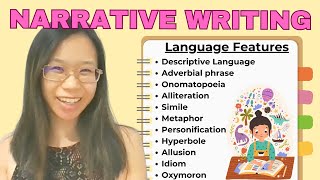
Winnie teaches how to strengthen narratives with language features like similes, metaphors, personification, and hyperbole. She defines each device, shows examples from a story about Amber, and explains why they matter: they help readers visualize, stay engaged, and feel the depth of your writing.
Chapters
Hi everyone, this is Winnie or Miss Tang. Today we are learning to include language features in our narrative. This is because we want to help our readers understand and visualize our characters, setting, and plot of our story. We also want to engage our audience so that they continue reading. Our success criteria today includes using descriptive language, adverbial phrases, onomatopoeia, alliteration, similes, metaphors, personification, hyperbole, allusion, idioms, and oxymorons. Are you ready for a challenge? Your challenge is to see if you can spot these language features throughout the narrative that I have written. In my previous videos, we have written the orientation, the complication, the resolution, as well as the cliffhanger. So they are all hidden in there. Fun fact, this narrative that I'm writing is actually the prequel to the book that my friend and I are writing called Amber's Pesky Plastic Problem. This narrative that we are writing right now is what happens with Amber before our book begins. I can't wait to share with you in some future videos our process of planning, drafting, writing, editing, revising, and publishing our book. In a narrative, we will need to include some descriptive language, and this will include things like adjectives, adjectives, verbs, and adverbs. An example from the story is, Amber had a round face, stocky frame, red curly hair, and emerald green eyes. She quickly shook her head. Descriptive language would be great to use to describe a character when you are introducing them, as well as the setting and what is happening in the story. Adverbial phrases. An adverbial phrase is a group of words that modify the meaning of an adjective, verb, adverb, or a clause. So, They will describe the how, so the manner, the place, the time, and/or the purpose. So how something is happening, when it is happening, where it is happening, and why. An example from the text is, "After cheer practice, Amber left the change rooms." Onomatopoeia. Onomatopoeia are words that describe the sound effects or what the sound is. For example, crack, bang, the sound of thunder boomed from inside the vortex. You can have alliteration. Alliteration is when multiple when two words in a sentence have the same sound or letter at the beginning. For example, the title of the story that I have just written, Amber and the Browbeating Bully of Bubbleville. You can have similes in your story. A simile compares two different things, and they must use the words like or as. For example, one glance at Viviana and Elizabeth had them quickly and quietly sneaking away like a burglar in the night. So the meaning behind this is their characters felt so afraid that they wanted to leave as undetected as they could. You can also include metaphors. A metaphor compares two different things and uses language such as is, was, am, and are. For example, she was the queen and they were her subjects. So the meaning behind this is that she had a lot of power and influence over other people. So we're talking about the character Viviana here, and they would obey her every demand. You can also include personification. Personification is giving something non-human or things human behavior and characteristics. So for example, the leg cast, which is a thing, was singing Viviana's praises. Now, things can't sing, but we are trying to say that there were a lot of messages on Viviana's leg cast that were complimenting her and praising her. You can have hyperboles. So hyperbole is an exaggeration used to emphasize a point. For example, "It will be the best day ever!" So the meaning behind this is the character is trying to exaggerate to show their excitement. You can have allusion in your narrative as well. An allusion is a reference to a known piece of information in pop culture, and it's generally common knowledge, so a lot of people will know about this. "Amber felt the weight of the world lift from her shoulders." The meaning behind this is to the weight of the world is to carry the burden of many problems, and this is actually an expression that comes from the Greek myth of Atlas. You can have idioms in your narrative as well, common phrases which are not meant to be taken literally. For example, Amber was on cloud nine. Now, no one can climb on clouds, and there's no nine clouds, so the meaning behind cloud nine is that she was extremely happy. You can also have oxymorons in your narrative. An oxymoron is two words or phrases that have opposite meanings. For example, there was a definite possibility Amber was going to be late. So the meaning of definite is something that will clearly happen, will definitely happen, whereas possibility is something that may happen. So an oxymoron is if you place two words together next to each other that have opposite meanings. And there you have it. There is a whole list of language features that you can include in your narrative. I will be sharing my Ultimate Guide to Narrative Writing in a link in the description down below. See you in my next video. Bye!