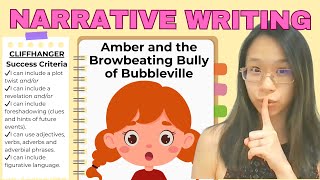
In this instructional video, presenter Winnie (Miss Tang) teaches writers how to craft effective surprise cliffhangers that keep readers engaged across a series. She explains the purpose of cliffhangers for series continuity, outlines success criteria—plot twist, revelation, and foreshadowing—and provides a bank of plot‑twist ideas (hidden villain, suspicious gift, returning enemy, family secret, overheard secret, betrayal). Winnie then demonstrates a worked example using her Amber/Pollution Monster series, where a discarded plastic bag becomes a sentient threat, incorporating adjectives, vivid verbs, adverbs, and figurative language. She challenges viewers to compare “good,” “great,” “amazing,” and “fabulous” cliffhanger versions, invites comments on whether the cliffhanger makes them want to read the next book, and teases future resources: an ultimate guide to narrative writing and a deeper look at language features. The video ends with a call‑to‑action to engage with the content and watch the next video.
Chapters
Hi everyone, this is Winnie or Miss Tang. Did you know that there are 2.2 million books published every year? That's 158 million books in the world as of 2023, that is. That's millions of stories, narratives, books in our whole world. When authors write books, most of the time they don't just want the reader to read one book, they want the readers to read their entire series. Series. That's why at the end of Amber and the Browbeating Bully, I snuck in a top secret special cliffhanger to make sure that everyone who reads it will want to read the new Pollution Monster series. The first book in the Pollution Monster series is called Amber's Pesky Plastic Problem. Today we are going to learn the secret formula for including a cliffhanger in your story. I'm going to show you how I've written mine. At the end of the video, let me know if this makes you want to keep on reading. Does it make you want to read the Pollution Monster series? Does it make you want to read Amber's Pesky Plastic Problem? Or do you think it will be boring? Let me know down in the comments below. Today we are learning to include a surprise cliffhanger. This is because we want to keep our readers wanting to find out what happens next in our story. We want to give our audience a moment to pause and think about what could happen next. And we also want to include a twist, a revelation, and/or some foreshadowing of what could happen next. Our success criteria today for our cliffhanger includes: I can include a plot twist. So this is an unexpected turn of events. And/or you can include a revelation, which is a very important piece of information which is unveiled or veiled. Or you can include a revelation, which is an important piece of information which is revealed, which could change the future events or the protagonist's perspective. And/or you could include some foreshadowing, like clues and hints of future events. We are also going to keep using adjectives so that we can build in our vivid descriptions and verbs, adverbs, adverbial phrases, as well as figurative language. In our previous videos, we have already planned for our cliffhanger, so we are going to have this ready. We have also written our orientation, our complication, and our resolution. At the end of this video, I'm going to give you a challenge. The challenge is to have a look at the good, great, amazing, and fabulous cliffhanger versions and see if you can spot what is the difference between them. Fun fact, this narrative that I'm writing is actually the prequel to the book that my friend and I are writing called Amber's Pesky Plastic Problem. This narrative that we are writing right now is what happens with Amber before our book begins. I can't wait to share with you in some future videos our process of planning, drafting, writing, editing, revising, and publishing our book. The first thing we are going to do is include a plot twist. Here are some plot twist ideas. The first plot twist idea is you could reveal the real villain. So the audience might think they knew who the bad guy was, and it was actually someone else the whole time. You could also provide a suspicious gift. So the protagonist might receive a gift that then puts them in danger. You could have a enemy who comes back. So this could be an old friend who is now an enemy who arrives and they threaten to spill the protagonist's secrets. You could also do a family secret. So the protagonist could find out a big secret that their family never told them before. You could also include an overheard secret. So the protagonist or a character in the story might overhear something, a shocking secret that they weren't supposed to hear that might change the course of the events. Or you could even include a betrayal. So this is where the protagonist's best friend or a family member turns out that they are working against them, and maybe they're working for the villain or the enemy of the story. So I'm going to start writing my cliffhanger now. Amber has just become cheer captain, so in our cliffhanger, she is going to be on her way to her first cheerleading competition. There was a definite possibility Amber was going to be late. Late to her first cheerleading competition. The cheer captain. Late. As Amber's dad sped towards the stadium, he pulled out a small, neatly wrapped gift box from a plastic bag. Then he threw the bag unthinkingly out the window. Amber watched the plastic bag drift out of the window and onto the road. Her mouth opened. Ready to say something. She knew littering was wrong. Mrs. Robinson always said so. She really ought to say something about it, but her dad had been frowning a lot over the past few weeks and she had missed his smile. Okay, now I'm going to add in some clues and some foreshadowing of what may happen in the future. After sharing with you these ideas for a plot twist, I have to tell you that I've definitely used a couple of these in the book that my friend and I are writing. The plastic bag drifted onto the gutter, through the pipes, into the ocean, until it reached the Great Pacific Garbage Patch. The vortex of trash and debris spun quicker and quicker as more plastic was sucked into the center. Green lightning electrified the gray cloudy soup of garbage. Crack! Bang! The sound of thunder boomed from inside the vortex. A moment later, a plastic bag flew out of the patch zigzagging just above the ocean like it was just getting its bearings. Wide childlike eyes and a buck-tooth grin appeared on the bag. A high-pitched giggle could be heard as the plastic bag zoomed straight towards the town of Bubbleville. And there you have it. Now that is our cliffhanger for our narrative that I have just written. I wonder if you can figure out what is going to happen next and if you can predict the events that might unfold through the the hints and the clues that I have just placed into this cliffhanger. So we have now included a plot twist, a little bit of a revelation that magic is real, and we have included some foreshadowing. We have used adjectives, verbs, adverbs, adverbial phrases, and I have also included some figurative language. All right, you ready for your challenge? This is what a good cliffhanger looks like. Here we have 'great.' Now we have 'amazing.' And now we have 'fabulous.' I will be sharing my ultimate guide to narrative writing, and I'll be leaving it in a link in the description below. Up next, we'll be having a look at the language features that you can include in a narrative. You may have spotted some figurative language such as similes, metaphors, and personification, but that is not all that there is. So see if you can identify what else was in the narrative before you watch the next one. See you in my next video. Bye!