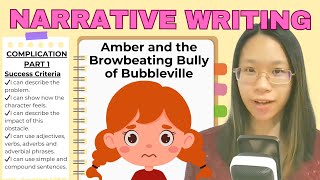
Winnie teaches how to write a strong first complication in a story by introducing an obstacle that disrupts the main character's life. Use vivid adjectives, action verbs, and varied sentence structures to show the character's feelings and build tension. She models a scene with Amber, a cheerleader bullied by Viviana during practice.
Chapters
Hi everyone, this is Winnie or Miss Tang. Today we are learning to write the first problem or obstacle that our main character needs to overcome, or the complication of our narrative. The reason why we are doing this is because when we put an obstacle, it disrupts what the, um, character's normal life usually is, and it leads to a sequence of interesting events. By creating tension and suspense in our complication, this further engages our readers and makes them want to continue reading our story. This also provides them with some clues of what may happen in the future in the story and what complications may arise. For our success criteria today, for our complication, we are going to describe the problem or the obstacle that the character must face. We will need to show how the main character feels. We also need to describe the impact of the obstacle and use adjectives to build vivid descriptions. And we'll also need to make sure we use some action verbs or verbs, adverbs, adverbial phrases so that we can provide our reader with some more information. And if we use some simple or compound sentences, this will help create the tension and suspense in our complication. In our previous video, we wrote the orientation of our story, and previously we have also planned for the complication as well. So we'll be using this planning in our writing today. At the end of this video, I'm going to give you a challenge. Your challenge is to figure out what is the difference between what a good, great, amazing, and fabulous complication looks like. So I will provide you with the examples and then you'll have to have a look and see what the difference is. Okay, now we are going to write a fabulous complication. The first thing we are going to do is describe the problem in this story. The problem is for our main character Amber. She is in a cheerleading team, she is 10 to 11 years old, and she has a bully. And her bully, or the antagonist/villain of the story, her name is Viviana, and she has been saying mean things to Amber throughout the year. Mrs. Robinson, their cheerleading coach, has encouraged Amber to put her hand up to be the cheerleading captain. So the problem is that Viviana has overheard this and now she is interrogating everyone and wanting to know who else has been encouraged to go for the cheerleading captain role. Okay, so we are going to now describe the problem and we're also going to give the reader an idea of where they are as well, the setting of the scene. So we're going to write some questions that Viviana is going to be asking the girls or the boys in the team. Did Mrs. Robinson ask you if you were going for the cheer captain position? What about you? You? Did she ask you? They were back in the school hall. Stretching and warming up whilst Mrs. Robinson gathered the rest of the equipment from the storeroom. Viviana had taken this opportunity to interrogate every member of the team. Now we are going to build the tension up, and we know that Viviana is going to every member of the team, and she is about to head to Amber now. Amber could feel the heat of Viviana's glare burn into her back. When Amber stood back up from her stretch, Viviana was standing in front of her, nose to nose. Her brown eyes narrowed in slits and her hot air blew out of her nose. Why Mrs. Robertson asked you to run for cheer captain, I don't know. So we've just described, um, using some adjectives and some verbs of what is happening. And now we are going to further increase the tension in this scene and we'll use some, a combination of simple and compound sentences. Viviana clenched her teeth and took a step closer to Amber. She lowered her voice, but Amber could still feel the silent stares from the team. Honestly, you would be terrible. Don't bother, just quit the team. We don't need you. Viviana softened her voice, batted her eyelids, and smiled sweetly at Amber. I'm just trying to help you. Oh, okay. So now we are going to increase the tension again, and we'll refer back to our planning. In our planning, we talked about how Viviana makes mean comments, and then she turns around, and then she makes nice or kind comments to other people to try to hide what been doing. Mrs. Robinson came out of the storeroom with her arms overflowing with pom-poms. Viviana ran quickly towards her. Mrs. Robinson, let me help you, offered Viviana. Thank you, Viviana. You're too kind, praised Mrs. Robinson. Okay, now we are going to show how our main character is feeling, because obviously all of this would be impacting on Amber, and now it is time for us to show how she's feeling and the impact of this. Amber's face burned and burned. She bowed her head, her red curls covering her face. No one moved. No one said a word. Viviana had never made these comments in front of everyone before. Amber's hands gripped her elbows. Throughout the entire practice, Amber tripped, stumbled, and fell. Every time this happened, Viviana snorted, sniggered, or shook her head with silent laughter. Amber blinked her eyes rapidly to stop her tears from falling out. She really wished she knew how to stand up to someone like Viviana. Aw. So there you have it. That is our first complication. We have described the problem or the obstacle that the main character faces. We have shown how the character feels. We have also described the impact of this obstacle on Amber, and we have used a whole range of adjectives and verbs and adverbs and a mix of simple and compound sentences. Okay, are you ready for your challenge? So this is what a good complication looks like. This is what a great complication looks like. This is what the amazing complication looks like. This is our fabulous. And now it's your turn to figure out the difference between the good, great, amazing, and fabulous complication. I will be sharing my Ultimate Guide to Narrative Writing for Kids when that is ready. I will leave that resource in the description below. Up next, we will write the next complication or the conflict or the rising action of our story. See you in my next video. Bye!