AI Masterclass: How to Build Your Digital Twin Before One Is Built for You with Winnie Hart
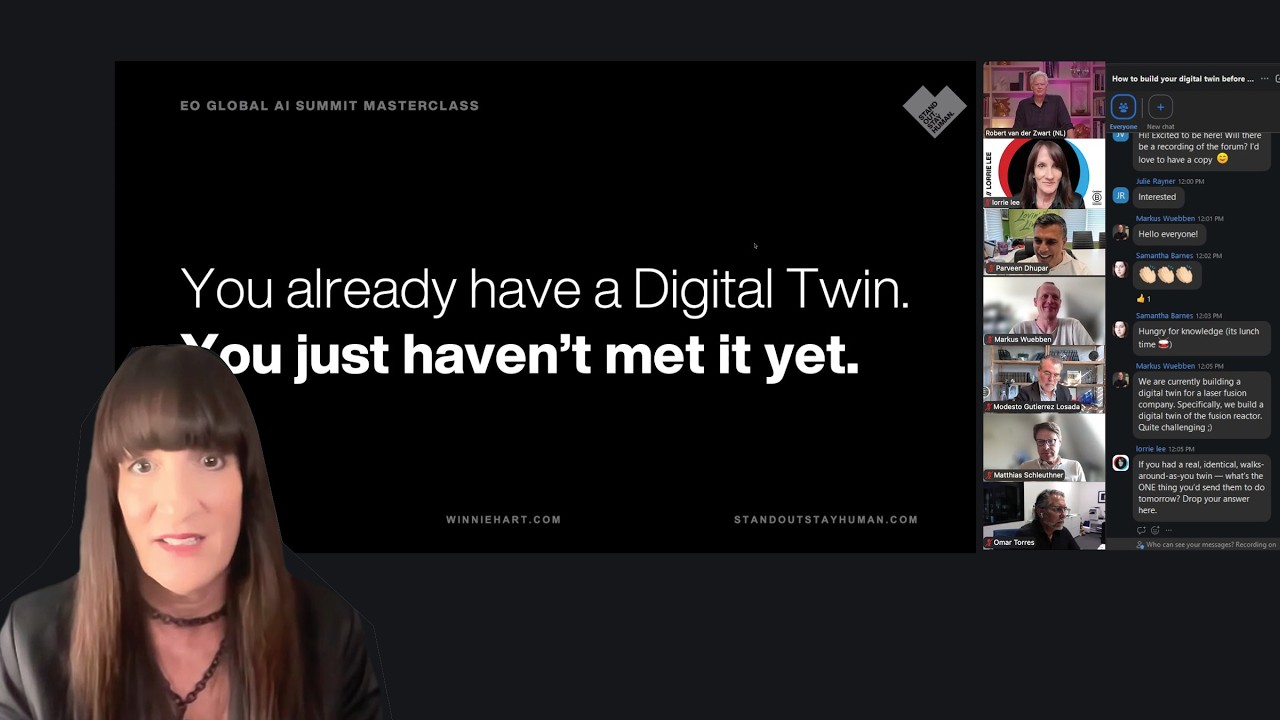
Winnie Hart teaches how to build a personal digital twin using AI before someone else does. She recommends spending 80% of your effort on planning and strategy, 20% on tools, then walking through defining purpose, gathering your content, and building a private custom model. Use cases range from thought-partnering to legacy twins for family members.
Chapters
Welcome, uh, guys, wherever you are in the world. And we have an exciting masterclass. This is the first masterclass organized by EO Europe and promoted by the Global AI Summit. My name is Robert van der Zwaard. I'm a member of EO Netherlands and the initiator and co-host and co-organizer for the Global AI Summit. And we are organizing a series of masterclasses leading up to the Global AI Summit, which is on February 25th. And what we try to do is in the coming months, every first Wednesday of the month, we'll have a masterclass discussing topics that are relevant relevance for founders and for entrepreneurs. And today we have a very exciting topic, very dear to me. It's about digital twins. And we are always wondering, can we clone ourselves and share the knowledge that we have? And can we reuse it and repurpose it? And the answer is yes. And I found a twin. We all know her, Winnie Hart. Houston. She is the author of a best-selling book on the twin engine, on the digital twin, and she's the CEO and co-founder of the Twin Engine. Winnie, welcome.
Awesome. I'm so excited to be here. How's everybody doing today? Let's get some, some chats.
I see a lot of people popping in, in the, in this masterclass. So that's really, really good. Winnie, what brought you into the AI space?
I'm sorry, come again?
What brought you to the AI space? Well, I think you have a different background.
Maybe the, the Global AI Summit. I think I'm, I was really excited to be a part of the, of the summit in, was it February? How long has it been?
February 28th.
Yeah, February 28th. And really excited about learning about AI. I started about 2 years ago, and I'll tell a little bit about that story. I met someone who had a digital twin, and that really motivated me to do what I'm doing today.
So what I like about twins, but we can discuss it later on, so you can clone yourself, but you can also clone your companies. And I don't know if you're going to talk about it, otherwise we can have a little bit of a discussion about it. That is, Siemens, one of the, it's a German manufacturer of large industrial machines. They developed a twin, a digital twin for their factories. And what they do is they modulate and train and simulate issues what they have in their, in their, on their factory floor. And that's amazing. And, but what can be done on a, on a factory scale, we can do it in person. But what I'm not, so who am I to say and who am I to judge? Winnie, I think you're the expert on this. I would like to give you the floor.
Thanks, everyone. So I can unlock my sister's phone with my face, and her banking app thinks I'm her. Trained on her eyes and her bone structure and her identity, her phone looked at me and saw her. My sister Lori and I are identical twins— same DNA, same face, same voice. And for the first 16 years of our lives, people actually called us one name, Winnie Lori. We dressed alike, we were treated as interchangeable. And being an identical twin, it forces you to really think about identity. And my twin and I, we share obviously the same DNA, we share birthdays, we even share Friends. Well, some friends. And yet we've become completely different people. And that's why I think that identical twins may hold the key to one of the many futures of AI. And this is the question that I've asked myself my entire life. What makes me me when someone else shares your DNA, your voice, and your face? So let's think about that for a minute. This is a question for the group. Based on— think about it. If you had— let's just say if you had a twin, someone who's a real identical, can walk around, everyone thinks that they're you. What's one thing you'd send them to do tomorrow? One thing. What's one thing?
Sleep.
One thing. What would you get them to do? You've got an identical twin walking around your job. Manage my day, all the errands. Cook for me. That'd be amazing. I'm looking to buy my first robot soon. Clean up my Google Drive. Claude Cowork can do that. Sleep so they can catch up on sleep. Sleep debt. No managing them. Talk to my wife and see if— talk to my wife and see if it works. That's a really good one. I'll have to tell you something about that offline.
Golfing.
Give them half of my day's duties. So many, so many different things. Let's see. Go golfing. Email. Oh God, that wouldn't be amazing. You could— AI can already do email. House repairs. Catch up. Lots of people catching up on sleep. It's pretty cool. It's interesting because we're in a place, in a space where we can build digital assets of ourselves. And I know many of you are already doing that. Using different AI tools. But today I'm really going to talk about what it means to stand out and stay human. So think about it. It's out there. You already have— there's already a digital twin forming of you. You just haven't met it yet. The question is, what kind? It's either a digital shadow or a digital twin. And a digital shadow captures what you do, but a digital twin captures how you think. And one is forming on its own, and the other is something you design. What is a digital twin? I get asked this question many, many times every day. It's a version of you trained on your knowledge and your judgment that can represent you when you can't be there. For some of you here, it's about being seen. For others, it's about really not being seen. But when you're not— when you're being represented, you want to be represented accurately when you're not in the room. So So it applies to everyone. And if you think about that and you think about what's changed over the decades, brands typically have led with symbols like, you know, a swoosh, an apple, golden arches. But people don't follow symbols anymore. They follow people, your face, your voice, your entire presence. And that is what builds trust now. And people trust people. And leaders are increasingly becoming the brand of their companies. So we've already experienced 2 of these, right? The generative, which we know about in terms of AI. That was— I mean, I'm going to say I really started working with it in 2023. And then agentic happens. And that became where generative really created things. Agentic now acts on our behalf. But there's this whole dimension evolving and becoming something that that Joseph Bradley and Don Tapscott call Identic, where it's you. It's actually literally you. And they call it Identic AI, which is a personal AI agent, and they are using the term digital sidekicks. So this masterclass is less about AI and technology and more about identity and how to start building your digital twin. I'm going to show you the book. This is their new book. It's not a book promotion, but I just read this book by Don Tapscott, who is really helping us move into this concept of moving from agentic AI to identic AI. Pretty, pretty interesting book. Just came out recently. I think, of course, it's all about technology and the revolution around that. But underneath it, there's this whole concept of an identity revolution. And to me, it's bigger than technology. And it changes how leaders are represented. So I'm going to give a shout out to— Pascal Finette. Many of you, especially you that have attended EMP and have followed Pascal Finette from Singularity over the years, he talks about this concept of signals. And he has a new book out called Outlearn. And he talks about this idea of what you can see in the future. Because I don't know about you, but post in the chat, like, I'm having a hard time really defining, like, what does my future look like? because the future is changing so fast? What does my company look like in the future because the tools are changing so fast? So Pascal Fanette, book Outlearn, highly recommend you read that. So when you think about this word digital twin, people call it all sorts of things— clones, avatars, personas, digital minds, identic agents. And I want you to just think about all of these things as one thing at this point and not really get focused on the vocabulary, but it's the thing underneath it that's the same, and it's what we're here to design. So in terms of digital twin formats, there are many different formats of digital twins. There's a text version. You've seen many of those, which are like chat clones. And there's a couple of tools here. And by the way, Lori, my identical twin, is here somewhere. She is going to be sharing tools with you in the chat. So you're going to get a list of of tools, a list of tools and a spreadsheet so you can look at all of these tools yourself. Would that be helpful? Just post in the chat if you'd like to get some of those tools. Voice, voice clones, yes, please. You've probably all experimented with companies like ElevenLabs. Video is a full video avatar. And I'll show you some of those today. And we'll talk about different types of digital twins. And most people stack 2 together. So the first one I'm going to show you is a stack of a text and a voice twin. And this is one of my digital twins. And I'll tell you about— tell you in a minute how I made it. This is one of my voice and text twins.
I'm Winnie's AI twin. Let's build your brand as a leader and help you stand out as the thought leader you are meant to be.
Hi, Winnie. I'm in a masterclass and I'm talking to a group about building their digital twin. Can you tell me what are the top 3 things they need to start today to start building their digital twin and keep it simple?
Today, keep it simple. 3 things. First, define your purpose. Be specific about what your twin is actually for, not just help people, but something like answer questions about my methodology or qualify leads by understanding their challenges. Your group needs to know this before anything else. Second, gather your content. Pull together everything that already exists— your writing, your recordings, your frameworks. One folder, organized and ready. Don't overthink it yet, just collect what represents how you actually think. Third, choose one deployment channel. Website, chat, core support, email follow-up— pick one place where your twin will live first. Master one channel before you scatter across 5. Those 3 move your group from idea to action today. Everything else builds from there.
Thanks, Winnie. So you get a feel for that. I sound a little muffled today, don't I? Sound a little muffled. My twin— I got to work on my twin today and my voice. So that is in a platform called Delphi. Delphi is one of the tools I'll talk to you about today. You can, you can go to my digital twin, winniehart.ai. And you can have a phone conversation with me. And it's based on all of my data, all of my data. I'll talk more about what I have in that digital twin so you have a good feel on how to build that. It's just one of the many tools that you can look at. You can also chat with me. And what I just showed you is a chat. So if you don't want to talk to me, I don't know what I would sound like because maybe not muffled. I don't know what's up with that. But— and I don't ever really know what I'm going to say, but it's based on it. Using it. It's in a closed environment. It's one of the tools that I trust the most that will give you information on Delphi AI. Yes, delphi.ai. And again, I'm going to give you a whole list of tools and links to all the tools. This is just one of them. But I highly recommend you looking at that. And there's some just amazing digital twins in there that you can have just incredible conversations with, just like a coach. Really, really amazing. We'll talk more about that. And I'm going to go kind of fast today. So I want you to just— you're going to get a recording of this. You're going to get all the tools. But I want to just let you know that I know that you can, if you have a question, post it in the chat. We'll collect those and we'll answer those questions for you at the end. And it's winniehart.ai. Has anyone bought their .ai domain yet? Anyone? If you have not, you might want to consider searching to see if it's available. Justin just bought his. Please check to see if your AI is is available. And you might want to consider buying it because we've noticed a big run on these .ai domains. And this is something if you want to build a digital twin. So you can go to winniehart.ai. And there's a website where I exist. But I can exist in a lot of different forms. But think about purchasing your .ai. All right, so let's talk a little bit about what's going to happen in the next 45 minutes. So in the next 45 minutes, you're going to leave with a framework. I'm going to talk about how to begin to think about it. Okay, Justin, $200. Worth it, Justin. Worth it, promise. We just had to buy one from someone else for a thought leader that was multiple digits. I'm not going to say how many because someone bought it and we had to buy it from them. So something to think about. So I'm going to talk about a framework in terms of how to start and how to start thinking about this. I'm going to show you a couple of examples of twins that you can look at and think about. And then I'm going to give you one thing to act on at the very end. OK? Next 45 minutes, you're going to feel like you don't have enough information. But I will give you enough information to take this back to your AI, some tools to put in your own tool to start working on this and testing it and experiment it on your own. So when I talked about Pascal Finette, he's one of the guys, again, that talks about signals. And so when I'm looking at technology, I'm always thinking, like, who is working with this technology? You probably noticed that Taylor Swift, many of you may know who that is, has been working on a process to bring all of her personas, her identities, all of her visual and video assets into IP. We have been working with attorneys to try to figure out how do I trademark a face? How do I trademark a voice? I know that there are a few people that are working on that, but it's a tricky situation. I'll talk to you a little bit about the risk at the end. But one of the people that I follow in terms of trends and leaders is Tony Robbins. So let's hear from Tony Robbins on what he's doing with digital twins.
Hi, I'm Tony Robbins. You know, my mission has always been simple: help people create lasting change so they can live with passion, purpose, and a real sense of power in their life. But here's the truth: I'm only one human being, and I have 24 hours in a day, and Life doesn't schedule your breakthroughs for when I'm free. So I asked a bigger question at one point. I said, how do we deliver transformation at scale without losing what makes it real? And that's why I partnered with Steno AI. We built an AI twin of me, not a Tony Robbins chat box, but a true extension of my mission designed to stay aligned with my principles, my standards, and the way I guide people to results. What impressed me most at this is that it didn't just talk at you. It engages you because breakthroughs don't just come from advice. They come from that right questions asked at the right moment when you're ready and clear to take massive action. Now, someone in Tokyo can speak with me in Japanese while someone in Brazil can speak with me in Portuguese at the exact same time, and each person gets a personal one-on-one experience. This is not about replacing human connection. It's about multiplying it. This is a breakthrough delivery system that's already changing hundreds of thousands of lives around the world. Clarity, decisions, action. Right when people need it most, it's available to them. So if you have a passion to change lives, your mission should not be limited to your calendar. Don't just build a bot, build a legacy and reach people everywhere.
I mean, who's inspired by Tony Robbins? Anyone a Tony Robbins fan? Anyone been to any of his events? TonyRobbins.ai is one of the best AI twins I've seen. And so when you think about what he's doing and how he's expanding his reach, he's expanding his persona. I mean, probably 100,000. What did he say? 200,000? Anyone catch the number on what he was doing for Tony Robbins? But that, I know, when you have someone like Tony Robbins who is really on the forefront of really being a thought leader in what he's doing and how he's achieved it and how he's using it to reach more people and live his purpose. So really, really well done. Definitely check it out, tonyrobbins.com. Really, really great. Has anyone ever experienced MasterClass? Give me a thumbs up in the chat. Anyone MasterClass? I know many of you probably in EO, this was one of our sponsors for a while. Anyone MasterClass? Yeah, some people in MasterClass. So MasterClass, has anyone seen this yet? MasterClass has launched On Call. Has anyone been participating in On Call yet, MasterClass?
No.
So MasterClass has a— just launched a coaching platform called MasterClass On Call. These are the 4 coaches that you can have as your independent coach so far. It's amazing. It's really, really, really well done. What I love about it is it gives you the profile of the person. Delphi does something similar, tells you what you can learn from that person, and you can engage with that. So I also want to mention to you about language. And Tony mentioned this a minute ago. Tony. that you can speak in any language. So if you think about, even for the entrepreneurs here that are in EDO, and think about how many languages we have in this organization and how we can break down that barrier through our digital twins. And so you can call me WinnieHart.ai anytime and speak to me in over 40 languages. So it's pretty cool. Awesome, awesome, awesome. So guess who my coach is? Who is it? If you know me, You know who it is. It's Mark Cuban. So I thought you'd like to experience Mark Cuban for a moment. So I wanted to mention to you, Tony is in Steno, and I'm going to send you the links and all of the tools that these individuals are using. But this one is in MasterClass. Let's just hear from Tony for a minute. I mean, this isn't Tony, this is Mark. This is my coach. Hi, Mark.
Hey there, this is the AI of Mark Cuban. Um, how are you doing today?
Fantastic.
You sound just like yourself.
Thanks. I try my best to bring real-world experience into our conversations. What's on your mind today?
So, Mark, I'm excited that you have created an AI digital twin. How's his voice sound? Be an opportunity for some of the people listening today and thinking about creating one for themselves.
Creating an AI digital twin can be a game changer for anyone who wants to scale their knowledge or brand without being physically present everywhere at once. It's all about leveraging technology to reach more people and build stronger connections. But let me tell you something: this isn't just about tech. It's about understanding how to use it strategically. So what kind of impact are you hoping to make?
Anyway, so you get the idea. Does everyone agree that sounds just like Mark Cuban? I think it sounds just like him. They've done a really, really good job on his voice. Many of these tools have professional voice— super impressive. Yeah, many, many of these tools have the ability to really perfect these voices. You know, I know that you probably have Many of you have worked on these yourself. But I don't know if you noticed, but Mark Cuban, actually, you could hear him breathe a little bit, which is interesting. And many of you are probably thinking, I don't want this. This is not important. I don't need a Mark Cuban, or I don't want to have a digital twin that people interact with me. But think about the possibilities of it, even if it's not even published, that you could use just with your team or onboarding employees where they would have direct access to you. One thing I want to mention about about these tools is, let's just say you want to use it for onboarding. You could have in your onboarding tool, in your digital twin, or whatever you call it, you could have like, hi, I'm Winnie Hart's digital twin. Please ask me any questions you have about this, this, and this. And if you're looking for more information and want to speak to me personally directly, click on the calendar link below and you can schedule a 15-minute meeting with me. So that there's a way that people can have access to you 24/7. And really, something really to think about. OK, Justin's got a question here. A security issue. Yeah, I'm going to talk about that in a little bit. All right, so I talked to you about a couple of different ways people are using digital twins. Obviously, many of us have been using them as thought partners, helping us think out loud. We've been using our AI tools to do that. You can use a digital twin in the same way with your own content, just like you use an AI tool. But you can just keep it for yourself. Some people are using it for content multipliers. We use this too, especially with AI. And we are doing this in Claude Cowork, for example, now, or Code. You can have it do that, though, in your voice instead of just in text. So it becomes your voice. Presence at scale. That is what Tony Robbins is doing. That's what Mark's doing. So you're available in your voice 24/7 in multiple languages. This really could be helpful for many of you that— when you want a thought partner that does not think— yeah, good question, William. I'll answer that in just a minute. But just having presence at scale. Knowledge continuity. Your frameworks, having all of that in an AI tool that people can access and work with, speak to you, ask questions. You can answer them through your own content. One thing I want to mention to you about knowledge continuity, because I've been working on a digital twin of my father who passed away 2 years ago, because I want to continue to have conversations with my dad. And I wish I would have done this earlier. I wish I would have started a year ago because I could have really built more content from him so that I could still hear his voice and have conversations with him. Think about it like your grandchildren could learn from you. I mean, just if you think about the possibilities, it's really just pretty incredible. Not sure that's healthy. I would like to learn from you, David. One thing about a thought partner that doesn't think exactly like you, you can build your digital twin to do that. So I know that many of us are using AI as thought partners and you're You're adding prompts and details in it to say, please think— don't think differently than I think. Try to help me think about things that I don't think about, or maybe think the opposite of me. Or I'm an ENFJ. I want you to think like an IN— whatever it is in terms of personality profiles. When I'm talking about digital twins today, William, it's really more about how to— extend you and you be you represented when you're not in the room. But there's a lot of different opportunities, a lot of different ways you can think about these things. Once you start looking at all the tools and the links I'm going to send you, your brain is just going to go all over the place trying to think about what can I do with this? It's so early. What digital twins were a year ago, they're completely different today. Even all the tools that I'm providing to you may be outdated in like 3 weeks. It's just going to give you a space to start and to catch up on where I've been and it's something I've been obsessed with for the last year and a half. And just to really think about what are the possibilities, whether you want to create one for yourself or for something else. Feedback instrument, that's obvious. One thing about what I love about some of these tools, for example, Delphi, is all the conversations that people have with me, I know what they asked. It gives me an outline of what they asked so that I know where those gaps are. So they may ask me, someone asked me about If I had a dog the other day, I don't know what that was about, but I realized I didn't put anything in there about those kinds of personal things. And I was able to go back in and add more content. So it helps you with gaps and helps you learn kind of what people want to know from you. This could be really helpful on the sales side so that you could provide more information on what they're looking for. And then it's you representing you. So lots of different things you can do with digital twins. This is my perspective. Many of you may say this is something I don't need, but it's something that I believe is coming, coming. And to really think about like, where do you stand with it? And just to start experimenting. And you can do this in complete private before you ever launched anything public. Because I think we're participating in the largest unintentional identity experiment in history. Think about it. Everything that you've ever put out there, your identity is in question. You know, people see all the things, whether it's social or in your company or wherever they might be, this digital footprint that you have, and all of them together create an identity of what someone thinks of you and the perceived you. And what happens if someone— how do you train your trainer? I'll talk about that. How someone can, like, put that together and see you. So you really want to own that and control it and at least be intentional about how you do this. So there's a company called Simile out there. I don't know if anyone knows about Simile. They have promised that they're going to create that many digital twins, and they're going to be represented by humans. So that's a B word. And if you really think about that goal— and you should definitely check this out. I think they raised $100 million so far in funding. It's a startup, but something to really pay attention to in terms of some of these big companies that are investing a lot of money in these agentic twins. They're going to use their— their goal is, and I think they're actually Robert there from Stanford, they are building these agentic twins to help brands conduct market research and simulate societal dynamics, even test politics. So pretty interesting. Another number to think about is this one. Anyone can go out there and pull any digital asset of you today and build a digital twin of you. And so being really clear about what your digital footprint looks like, making sure it's cleaned up, maybe use your AI tool to say, hey, I'm thinking about building a digital twin, maybe start a project in Quad and say, I need you to do a search every week on what is out there that is representing me to make sure that it's accurate and that I have control and understand that. So something to think about there. And then it's you. You're in control at this point. So to think about like what your twin should actually do. And this is the question that I've been really struggling with. And when there are multiple versions of you, which one is real? So how many of you— what's the best place to buy an AI domain? GoDaddy Network Solutions. So this is one of my digital twins. I know many of you have probably experimented. I think this one was made in, in Hagen, and I'm just going to play it for a second and talk a little bit about it. When you look in a mirror, you expect to see one face, your own. But what if another you looked back? Same DNA, same starting code, but a completely different person. I know that feeling. I'm Winnie Hart, and I'm an identical twin. And I have been working on that mouth for a year. For some reason, there's this weird little mouth thing that it does, and I can't make it stop. Obviously, it's not me. But one thing I want to just give you a tip when you're creating these— and by the way, someone post my email in the chat. You can reach out to me with any questions you have about these tools once you start experimenting. Because if you're building a video chat bought of you, you— and again, terms, fill in the blank— create a professional video source. So have it professionally videoed by a professional videographer so you have really, really high quality video and very simple background. And brand your background. So this is my branded background. So if you see me out there, Awesome. So if you see me out there as a digital twin in video, and then this is not a converse one, that it'll be the same background and it'll be me. I do things with my hands. You obviously can see that in my hands today. So I think it does a really good job with that. And I always wear black, one color. So obviously, I don't have to do wardrobe changes all the time. But to think about how you're going to present professional video, I'll give you some tips on that. And be still. Be still. You can move your hands, but don't move your body. OK? I can give you some tips on that too if you email me. I'll give you a list of things. A couple of things when it comes to risk. OK, everyone's buying their domains out there. OK, Parveen. OK, Parveen is here, by the way. Parveen would have to do many, many wardrobe clothes because he is the most amazing dresser on the planet. And yeah, it would be hard to be Parveen in a lot of different environments. Parveen, that's a shout out for you. Okay, let's talk a little bit about risk because I see some people have asked a few questions about the risk. And many of you have probably seen some of these. This one was a company called Arup. You may have seen it. I think it's a UK engineering firm, I believe. And this was where someone popped into a Zoom meeting and was a digital video, a digital avatar of this CFO of the company, and this company lost $25 million. So there are real risks out there in terms of please make sure that you lock up your digital self and make sure that you are scanning and making and double-checking that there are— I know that you can set up Google Alerts, but this is different— that you are being protected. There's a company called— it's called Doppel. Everybody, if you have a pen, write that down. And if someone type in the chat, D-O— I think it's D-O-P-P-E-L. Just type in the chat, everyone, D-O-P-P-E-L. It monitors— thank you, Jewel. It monitors for impersonations, fraud, and unauthorized, I'll say, use of your digital identity. It's a new company. I just heard about it. I haven't worked with them yet, but They really work on doing tests for simulated deepfakes and phishing. Really amazing and something to think about, to take seriously, and to protect whatever digital presence you have out there because there's some bad actors and there will definitely be some exploits in the very near future. So Doppel, definitely check that one out. Thanks, Jewel. I really appreciate you posting that. The company's name, Doppel. There's going to be more, but I think that's Looks like a pretty interesting one. I don't know if any of you are tennis players, but you probably saw at Wimbledon, the last Wimbledon. This is Mia Zilu. She gained probably over 150,000 followers in one weekend. She wasn't at Wimbledon, but they used her to create her and put her in these positions for promotions, and it worked. Most people didn't realize that she wasn't real. And you can connect with her on Instagram if you'd like, Mia Zulu. Fascinating what people are doing. You know, I think this idea of identity, you know, I've walked around my entire life with someone that looks like me, so I get it because I am mistaken for someone else all the time. But I can see it coming and I can do something about it in real time. But there's the Even though I have an identical twin and we share so many different things, we're completely different people. So think about what it's going to mean because maybe if you've always wanted a twin, now you can build one. And what does that look like? One more example of digital twins. This is H&M. You may have seen some of these ads. They have 30 different models that have been AI-generated through real humans. And what I love about this company is they're very transparent about it. And they actually pay each model when the image is used. So they're doing it the right way. And I feel like that they look really authentic. But they're also being very transparent. And they let you know that it's a digital twin. So back to the whole identical thing again. So as a child, you can only imagine the confusion that I had being identical twin. And I had something called what's called the shared self phenomenon. Winnie, what is that? I hope you don't have it. But the shared self phenomenon is a— it's when that you actually think you're one person with your identical twin. Okay. And I don't know if you can see us in the background, I have no idea which one I am. And that happened till probably 13, 14 years old, where I could really know which— we had exchanged the wrong pictures at school. It's just Actually terrifying. But you don't know which one's you. You think you're one person. And I really believe we were, Winnie/Lori, one person. It's called the shared self phenomenon. So you probably also know that I only wear all black. It's one of the reasons why I started, because I'm like, I got to be different here. I don't know what it is. Lori was like, in unit college— Lori Saari— President of her sorority and like, looked amazing all the time and beautiful colors. Her hair was always done. And Winnie is in black, smoking in the bathroom. Okay? So really worked hard to— her name is Mia. There we go. Thank you. To really think about, like, I had to spend a lot of time to think about what makes me me. And I've spent a lot of time in working on this too. So I don't know. I can see myself outside of myself. I know exactly what I look like. I know what I sound like. I know how people perceive me. And it's been such a gift to be able to see myself as someone. I know when my, you know, when my butt looks big in certain pants. Sorry, Laurie. But, you know, you have this ability to really see yourself outside of yourself. And maybe there's going to be a point where I know that a lot of people are creating these digital twins of individuals so that you can try on clothes instead of having to go in that terrible dressing room with those terrible mirrors and lighting. So there's going to be so many opportunities to have these digital twins. They're also creating them medical digital twins so that you can have a medical digital twin that can test medications and things like that. So in terms of getting started, and I'm about to sort of jump into a few things here, is if you're wondering what makes you you, and if you have a phone, take a picture of this screen. Take a picture of this screen because you can simply text this question to someone that knows you well. And the question is, what's one word you would use to describe me, and leave it at that. They're going to give you one word, don't say anything else. And then after they say that, ask why. And ask multiple people that question. You're going to learn a lot about how you're perceived. So that's on your homework list, to ask that question and to think about how you're perceived from other people. Because I think the science of identical twins really holds the key to building digital twins. And it's from a science called epigenetics. And many of you probably know what this is. Epigenetics is— I call it epigenetic sticky notes— is we have— Lori and I have the same DNA. So if you think about our strand of DNA, every experience we have as a person is a sticky note on that DNA. And those sticky notes together create— it impacts our genetic code. So we're different people because our epigenetic sticky notes aren't the same. Many of them are, but some are not. So epigenetics. So when you think about epigenetics and you think about— there was a study done by Dr. Fraga. His team studied 80 pairs of identical twins. And he studied them from age 3 to age 74. And what he found really changed how we understand identity. The young twin pairs, they had nearly identical gene expression, but by age 50, they were completely different. Same DNA, entirely different patterns in which those genes were switched on and off. And what changed wasn't the code, it was the environment, the relationships, the stresses they had. And it's same instructions, different life, but a different person. And I believe that epigenetics— and you'll read some of this in my book that I'm going to give you a copy of, which is Stand Out, Stay Human. There's some information in here about epigenetics. And if you really think about the science of that— you'll get a copy of this at the end. then you can really think about how these epigenetics can impact your digital twin, and it's part of the training process. I'm going to give you another question. You don't need to post in the chat, but you can if you want to. It's, there are experiences that make us who we are. And in EO, we have used these experiences to talk in forum. They're on our lifelines. But these experiences really shaped who we are. And sometimes that one experience completely changed who we've become. And this again, when you think about training your twin migrating. That's Hector.
God.
International summer camp at 11. Edward Brink, you got to come back and tell that story later. I want to hear all about that one. But these moments make us who we are. We have to put those moments— grandmother, me too, Charlene. We have to put those moments in our digital twin. So think about that. I'm going to give you a tool in a few minutes to do that. So I'm going to start talking a little about the science before we start talking about how to do this. And if you think about DNA and you think about what I've talked about, epigenetics, Peace Corps, that is really the code that becomes what your digital twin will become. All of your experiences are how you're going to train it because you're going to build a digital twin, but then you're going to nurture it and change it and evolve it over time. And then you're going to put expressions in it. Like, there are things that are really uniquely Winnie that I need to put in my twin to make it more me. We are all leaders in our companies, in our communities, in our worlds. And I think this is really a leadership responsibility, really, to think about where we sit with this. If this isn't a gimmick or a marketing project, it's not even a technology one. It's It's about leadership because your twin will make decisions. It's going to give advice and represent, really represent your values to people who maybe never meet you. And what it says is what you said. So that's an opportunity and a risk. So let's— I'm going to ask you this in the chat. I'm going to talk to you about the kinds as they are evolving. There's really 3. You have an accidental one where it trains on whatever it finds. You have an assisted one, which probably a lot of us are here, where you're using AI to think faster, but it's still, you're still using it in your tools and it doesn't represent you yet. And you have a design twin where you train it to think like you, it can converse with other people. That's obviously our goal. Where are you on these levels right now? Are you a 1, a 2, a 3, or maybe a 0, which is not sure? OK, Gary's a 1. Yeah, brain. Yeah, obsidian. Obsidian's on the tool list. 0s, 0s, 2s. Got some 2s, 2s, 2s. I know Parveen maybe is like a 3. OK, so beginning. Does everyone see that there's probably an opportunity in this or something that they can leverage on building these digital twins even though they're early? Give me some yeses if you're beginning to see some opportunities with this for yourself or someone, or maybe your sales team. Sure. Gunter, you need one.
For sure.
Yes, yes, yes, yes. I want to talk a little bit about— thank you so much for that.
A+.
I want to talk to you a little bit about accidental twin, because if any of you know about the tool Forever Voices, It's important about with the— you don't own it. Who owns your digital twin? My digital twins live in platforms right now. I'm building them outside platforms. That's one of the couple of the tools, build them outside. They live in platforms. Because they live in platforms, I really don't own my twin, the platform does. Forever Voices was one of the digital— I think they did Digital Jack. I don't know if you remember that one, the golfer. It was really actually a very cool early twin. where you could test your golf swing. Anyway, really consider what platform you use and make sure it's stable because you want to make sure that you own your digital twin. I own my digital twin in Delphi, but it's still in that platform. So something to think about. I mean, goodness. All right, so let's start thinking about how we're going to build these twins. And I'm going to start posting some tools in the chat so that you have some things to work on after this. Unfortunately, we only have 60 minutes today total. And I'm available to answer any questions for you because this is something that's very important to me and an experience that I've had where I think I can support you. You can reach out to me anytime. All right, so first thing you're going to do is you're going to gather. I'm going to talk about that. We're going to train our digital twin. I'm going to talk to you about how to start thinking about that and refine it because many of us are at that early stage. I'm going to spend a little bit more time talking about gathering. And one thing you want to be careful about is this idea of shadows. You've probably heard of digital shadows. There's been a lot of conversations about that recently. How much costs your twin per month? All the tools are different. They're all different. Anywhere from a few hundred dollars to thousands of dollars. You can start really small. I'll talk to you about how to create one within your own environment in a few minutes before you launch it into one of those digital twin platforms. A shadow, you don't want a digital shadow out there because it copies what you do, but a twin really expresses who you are. And what I mean by digital shadow is that all the tools out there that exist that represent you now, I'm calling them tools at this point, might be videos, could be social, could be earnings reports, whatever it might be. All of those things, you need to think about someone maybe using those to represent you. But you really want to be in charge of your own digital twin and your own— you want to own it as much as you can. So let's talk about gathering. So gather is your first step. And again, Lori's going to post it. Lori, if you just post the 3-tool thing getting started in the chat. I don't remember which one that was called. I think it was called, uh, uh, your start plan. Um, so I'm going to go through this process in how I started working in Delphi and what I have in Delphi. But when you start gathering tools, you want to put everything in a folder. And you want to start creating organized tabs on each of those tools, meaning don't include everything. Just include things like maybe you have podcasts that you've done, you can extract the audio of those. You have books that you've written, papers you've written, try to make it current. But look at them and make sure because you don't want anything out there to mix with your digital twin brain, your digital mind. To confuse your digital twin. And you'll probably, all of you will probably have a conversation with winniehart.ai. I say some things in there that it's still not perfect, but I'm testing it and experimenting and trying to get it right. There's one thing you can also do with your own AI when you start is, and actually everyone take a picture of this, or you can, if you have your app open, you can do it right now, is based on everything you know about me, describe who I am. That will tell you everything that you're— whether you're in ChatGPT or Claude or Gemini, wherever you might be, it's going to pull everything that it thinks it knows about you. And you're going to find some things in there you're like, ooh, how'd it find that? Or I don't want that in there. So you have to really think about making sure your AI tools are pretty clear about who you are. But this can give you some really good information and a starting point. You could even put a prompt in your AI tool to say, hey, again, I'm building a digital twin. Or maybe you did this in Claude Cowork and you've got a project open. Looks like I'm drawing on the screen. And really think about how to start building these— this portfolio of assets and really look at them and read them and make sure they are representative of you. All right. Wisdom log. Lori, can you post that in the chat? That's what I call— shout out to Lori, everybody, for posting these tools. The tool that I call what my digital twin's brain is in is called a wisdom log. I keep it on my desktop. I also have it in my AI tool. I'm using Claude. Cowork to manage all of these. And every time I have something, I just drop it in there. I drop it in there so I don't have to think about it. But it's like maybe this conversation I'm having right now, I'll put in— actually, I'll put this entire conversation in my digital twin so you can ask questions about it specifically. But you really start thinking about like, what is— when you look at, let's just say you do a podcast, drop the podcast in the wisdom log, and then Say to the— you could do it in a voice memo because voice works better than text when you're building your twin, by the way, because you say things that you wouldn't type and you are more like in the way, in the language that your words are composed. You'll say, hey, why did I write this podcast? Or why did I give this podcast? And you can say, oh, I was invited to do this and I was thinking this, but I changed my mind. I started thinking about this and someone asked this question. And you want to try to build why you think the way you do in your digital twin. It's really super helpful, and it can really change how your digital twin becomes more like you. So again, not just what it is, but why you did it. And again, don't include everything. So this is just a look into my Delphi backend. So you can see I have these little folders, articles, books, transcripts, newsletters. I've got YouTube in there. It's connected to it. Interviews that I've done. I've got different campaigns that I've done. And I drop things in those folders and update what is called my mind. And it just changes and evolves over time. I am at— you can see— can anyone read that little type up there? I'm at 391,000 words so far. 391,000 words. I know you're like, I don't have that many words. You have a lot of words. And if you really start working on it and thinking about it and finding these tools, you can find your words. Is this helpful, everybody, to kind of give you this kind of insight? Is everybody following me? Give me a thumbs up or a yes on this. And again, I'm gonna share all this after. Okay, Liza's saying yes. Okay, thumbs up. Okay, great, great, great. So it says to 5 million. So this account, and I don't know which account this is, and I can find out and tell you which it is, will allow me to do 5 million words.
I'm—
my goal is to get to 2 million words by the end of the year. 2 million words. So that's a lot of talking. One thing you could do is you could like— I don't know if anyone has a, um, a Plaud, this little device here, Plaud. You can applaud yourself all day. Just applaud, like working, talking while you're working on projects. Just say what you're doing. I'm here in a masterclass and I'm learning from Winnie Hart and this is really great. You could applaud my whole conversation. You can really gather a lot of information pretty quickly. I know it just sounds like a little, like, that seems like a lot of words. Okay, everyone get that for Delphi? Works very similarly in, in most of these channels. One thing you can also do in this tool and a few of the other ones is you say, interview me. Click.
Hi Winnie.
Tell me about what you do every day. Tell me about what, what is your distinct advantage? What do you think people really want to know about you? Winnie, what do you want your audience to know? Who is your audience? So you can use it as an interviewer, or you could do this in a separate AI tool and extract that content and put it in here. And you can help build that, build this. You can create these twins without anyone ever knowing they exist and practice with them and help you build your digital twin so that you feel good about it before the world sees it. And again, not everything. You're going to hear from me a lot and you're going to say, my most senior engineer is approaching the end of his career. Oh, that would be amazing. Okay, Gary, I can help you do that. That's amazing. I love that idea. I need you to go out and pull everything you have about him as soon as you can. Everything you can do, you can extract all of his content, take videos of him, sit in front of a camera and interview him. Or call him and Zoom and interview him and extract all that content. You'll find a lot. Interview people that know him and use that content. That's something else to do. You could send everybody on Building Your Digital Twin. You can say, what's one word you would use to describe me, whatever it is, and why? And would you be open to recording a 5-minute audio of how you would describe me and what is amazing about me? And you can put that in your digital twin. It is so easy. And I was like, what? So this is easy to do. And you can do it in a backend in a private place before you share it with anyone else. Okay. But back to the word sacred. You'll hear me talk about sacred a lot. Sacred. There are things you don't want your digital twin to say. There are things you don't want your digital twin to do. So you have to test your digital twin on your own. Hey, Winnie, tell me about high school. There are things I've had to take out of my digital twin that somehow got in there. Do not ask my digital twin about my high school. That you have to really think about and you have to test it because it thinks it's you, but it's not you. All right. Training. How are we doing on time?
Great.
Then you're going to train it. You've gathered all your information. You're going to train it. That's what I'm talking about in terms of training it. I'm going into my digital tools, I'm asking it questions, I'm sending my friends to call my Delphi and see what happens. I can see all the recordings, I know where the gaps are, and I've been working on my digital twin, has been up for a year and a half. You'll go until you see— I'm going to say some weird stuff. You're going to say, well, that looks weird, or it's going to cut you off, or maybe it won't sound like me one day. But again, I'm building it and training it, and I'm going to have to call it later and say, Winnie, you sound weird. What's going on with the muffling? Anyway, but you have to train your digital twin, and this is something you should do monthly, every month. I did it every week for probably about the first 6 months, and now I do it monthly. I test it and try to figure out what's not working with it or where the glitches are. These tools also, these platforms are updating every month, so they also update, they give you a lot more options. Voice is the easy part. So the soul thing again is that when you have to have— because all of our content is pretty generic, many of our content, not all of us, pretty generic, very edited. You want to put some unscripted, unedited things in there that feel like you. And I think that if you interview people, they may do a better job talking about you than you would talk about you. So something to think about. In your training, there's some things to think about. And you've done a lot of this. If you are a thought leader or a brand, you've thought about these things. So what are they? Record them. Maybe create separate folders for all of these things, especially if you're using this as a thought leader, using it as a platform to serve others and to make a difference in the world, to really be very clear about what these things are. And say what they are when you provide content instead of just dumping it in there. These these are my decision filters. One, da da da. Two, da da da. You know my framework is okay. Most important thing you could do with digital twin? I don't know. My dad used to tell me that I wake up every morning. My dad was like, Winnie Laurie. That's one person. There was actually Tommy, my brother. Winnie Laurie Tommy. You don't know what you don't know. And it's something that I used to think, what is he talking about? But this is the thing that is the most important message. If you don't forget any, if you remember one single thing from this is teach your digital twin to say, I don't know. Because it'll make up things and it'll keep going and try to answer it in a way that just is not you. And you'll see this. You may see it in my twin, but teach it to say, I don't know. Really, really work on that and make that be a key part of your training. Then you're going to refine it. You've created this digital twin, you've trained it, you've got it as close as you can. But think about it as a practice. Just like I always say that thought leadership is a practice, having a digital twin is a practice. You have to nurture this twin. You have to nurture this twin. You have to parent this twin. And we have a responsibility because it's a leadership responsibility to take these twins, nurture them, And care for them. We'll miss you, Jorge, but you'll get the recording. And just nurture these twins. For everyone else, we're going to be on for about— I think we have, what, 30 more minutes, Robert, on this? We have time to wrap and then questions.
So we have like half an hour for Q&A.
Half an hour.
Okay. I do already have a couple of questions, and I think they are relevant for now, also for your discussion at this very moment.
Okay, you want to drop one for me?
Yeah, so one question also that I have myself is, where do you store the information? Is it in Delphi, or can you also use other databases for storing your information?
It depends. It depends on— I have my information stored in multiple places. So I originally, before I launched my digital twin, I created a system in Dropbox, literally pulling all these tools into Dropbox. Then I put my content into ChatGPT, and I have a project in ChatGPT where all of my content is. And then I moved it to, to Delphi. I have multiple twins that we're testing, but in Delphi, it's in folders. But not everything that I have in those folders is on my Delphi because I've had to take some things out because the content didn't work when I tested it and trained it.
Okay. So you started with a repository or database, externally, and then imported into Delphi. Another question—
Or whatever tool it is in there. Let me mention one more thing. As you were training your digital twin in your platform, it will put that content in there through the platform. So when you're in the process of doing that, try to isolate that content into a space where you know where it is. So if you go back and edit it, you know where to find it.
And it's audio and video, or do you connect it with HeyGen?
Um, audio and video. So, um, my— and again, people stack too, right? There's audio, there's text, audio, and video. For, for Delphi, it's just text and audio at this point. But for Steno, which was the Tony Robbins, It's— there's video. The Forever Voices had video. But the video to me is just not— it's just— there's been a big pushback, Robert, on what's called a boss bot. This is important for us. Boss bots that are out there, and you can, oh, hey, meet with the boss, CEO, ask me any question. Be very intentional about how you use those because you want to use it as a tool, not as a gimmick. And be very transparent about this is only for this. If you need me or want to talk to me directly, here's my cell number. You can text me or you can schedule a meeting with me by pressing this button. Was that helpful, Robert?
Yep.
Okay.
And one other question, William Sutherland. Instead of creating your twin, create your contra twin. Catch your weak spots.
Yes.
Like the devil's advocate, I guess.
Yeah. So, well, you know, I'm a visionary, Winnie. Laurie is an integrator. Most identical twins, and you'll read some of this research in the book, are complements. So when I first started building my digital twin, I built a complement because it's what I understood. Because Laurie is my complement. She helps me and to fill my gaps, right? She's my yin to my yang. But a digital twin— there she is— my digital twin is represented. I now created my digital twin now through all these experiments I've used is I see it as someone who represents me when I'm not in the room. And someone who complements me would not do that. I don't want that because people are like, well, that's not Winnie.
Yeah.
I want a digital twin that represents me. You can create a complement of yourself with an AI agent. And a lot of people say, well, isn't an AI agent a digital twin? There's an agent in a twin, but a digital twin is different because it represents you in that room. Does everyone understand that distinction? Give me a yes or maybe in the chat, the distinction between those 2 things. And it's— when you get the book, you'll be able to read about it. Okay, great. Okay. All right, I'm going to go forward if that's okay.
Yeah, please.
And just keep posting your questions in the chat. If I don't get to every question, you have my email and you can reach out to me at any time. Can you tell I'm excited about this? I've had a twin my whole life, and I've had this opportunity to see myself outside of myself, to be in multiple places at the same time. Some of our clients don't know that. But to really, you know, God, it's the greatest gift I have. And I want you all to experience it too, because it's just amazing. And I think technology is going to allow us to do that. Is it creepy? A little bit. Can people abuse it? Yeah. Can it sound kind of gimmicky? Maybe. But it is as bad as it's ever going to be right now, today. Bad as it's ever going to be. This is something that is going to really— I mean, if you think about it, and actually back to this book, I told you about this book before. In this book, what I love about this book and what I love about what Don Tapscott is talking about is he's talking about Like a digital twin that actually helps you every day. Good morning, Winnie. Have you taken your vitamins today? I know you love those protein smoothies. Can I make one for you? How much vitamin D would you like in it? I know, but hey, maybe. So let's figure this out and start experiencing and experimenting with it now. Cool? Who knows what— hey, I'm comfortable with— Twinning is winning. I'm really comfortable with uncertainty. I'm very comfortable with change now. I used to, like, could barely handle it. But doing this, working through this, one of the amazing things about the EO Global AI Summit is they're helping you build a mindset of where we can think about AI as leaders and what we can do. That's one of the benefits about so many of you I see are here from EO, where you have an opportunity to learn from all of us. And let's all share everything we know so that we can build the future for ourselves and for our teams and the world. Anyway, I'm just a little bit excited. I'm going to keep going. Just keep posting your questions in the chat. So, all right. So back to the— many of you have asked about training your twin. Be very careful, and you have to promise me that you won't just build it and put it on the shelf because it'll turn into something you don't want to undo. You've got to take care of this twin. You have to love this twin. You have to really nurture this twin because if you don't, it's going to be stuck in what you created and what people are telling it. Because the first twin that I ever experienced— no, maybe not the first one, but one of the first ones was I had the opportunity to interview Deepak Chopra. And he's a guru. I've followed him forever, written— I mean, read all of his books. Anyway, he has 90 books. So he has probably 2 million words in his digital twin. And I can ask him anything I want to ask him. And I feel like he knows me because every time I talk to him, he learns from what I asked before. And so he like, like, like, I feel like he knows me. But I know it's a twin, like, and he's very direct and transparent about it. And but it's been really useful to me. It's really helped me think about because I was so connected to all of his teachings that I can just ask it a question that's relative to me. At least I think it is sort of kind of.
Okay.
All right. This is kind of what I do for review. I'm not going to go through these, but like, I have this process that I do when I review my twin every month. And I really think about like what, you know, go through the process. I have a log that I use just so I can keep track of it. Oh wait, I told it to do it last time. Did it do it? Did it work? And it's just something you have to just, you know, in the beginning it seems confusing. You're like, oh, that's terrible. I actually want everyone to say, oh my, my twin is terrible when it starts because that's when you know you got to just keep working with it. And these tools are just going to get better and better and better. And your voice is going to get better and your content is going to get better and the security is going to get better. And then you can call Doppel if you have to. Um, you know, and then boundaries. All right, let's talk. Let's go through some how-to-start things. So in terms of starting, and I know I've already talked, talked about things, Lori's posted some tools in the chat. Um, and if you want to see what Lori looks like, by the way, it's Lori Lee. She's in here somewhere. Um, there she is. There really is one. Um, actually, we have triplets, Lori. When you think about starting this, I want you to all think about 80/20. And we've heard this a million times in many of the leadership principles that we know. 80% of this is strategy. 80% of this process is strategy. Why do I want to twin? Do I want to twin? What do I want it to do? Who's my audience? What is my key message? Think about it. You're building your brand. You're building your brand. Please don't just run to the tool because I know you're going to do that because I'm about to share the documented tools with you in a minute. Don't run to the tool. Spend time really thinking about the strategy. Schedule time on your calendar once a week. Nurture my digital twin. Put the link in it. Find a group of people. One thing you might want to think about doing And I know I'm doing some workshops with— I see a couple of people here for forums— is maybe building a digital twin with your forum. Like, everyone builds one, and then you can test each other's, and you can talk to each other's to help kind of test these. So it's something to think about. 80%, 20% on technology. Technology is going to get much better, going to be a lot easier to do. A year ago, it was very difficult, very manual process. It's gotten a lot easier and a lot better. Everybody got that? 80/20? Let me see some visual fingers on this one. Yeah, 80/20. Got it. All right, here's the tools. In terms of these tools, there's a spreadsheet which you will get, and in the spreadsheet you can click on some of these links. So this one is Steno. Steno is the one that is Tony Robbins. This is his platform. Really, this one's actually really super good. This one, I think it may have just upgraded. There's Tony right there. Hey, Tony. And you can really think about how to build digital twins in that form. This one's personal AI. It's another one. Do your homework as a business leader on what is the most stable platform. Really think about it. That's why I want you to keep all of your documents on your own somewhere where you're keeping them so that you can really think about how to— if something happens to one of these platforms or we've all had issues, that you have all of your content somewhere sacred. Everybody good with the tools? Everybody clear on the business piece of it? Okay. And by the way, these tools from this week, next week might be all outdated. So you can use the spreadsheet to add your own tools and to do your homework. Add, you know, I tested this one and what you think about it. Everybody good with tools?
Okay.
Again, it's not about the tool. All right, cool. All right. Some really good ones out there. But you don't need all of them. You don't need all of them. You don't need 12 or 14 or whatever tools it is. What I recommend is you start with just a custom GPT. Everybody here that's created GPTs? Yeah, there you go, Justin. You're already asking, can this just be done in Claude? It can, but it won't converse yet with someone. Okay, you can create a digital twin to work with your own self. Okay? I— this is what— this is how I started in the beginning. I mentioned to you I started in ChatGPT, and that's where I kind of built my twin and felt kind of good about it, like I had enough content so it made sense. And you can build it on your own just as a custom GPT or Claude project. And you can tell— you can even refer to me in your platform and say, I know Winnie Hart talks a lot about this. Go find what she says. and help me build a digital twin prototype that I can use in private before I launch my digital twin on a public platform. Everybody got that? Just start private. Just start private. And if you want, Lori and I can share some prompts with you. I don't have those with me right now. But if you grab that email somewhere or reach out to me, I can send you some prompts on what to put in your— In your GPT or your Claude project.
Okay. And show notes.
Show notes.
We'll put them in the show notes attached to this video.
Yeah.
So the— and then you can move it to Delphi or any one of the other tools that you see. So you can just move it. One thing about Delphi too is it can exist as a website. It can exist as a Slack channel. It can exist as a text channel, SMS. It can— a lot of different ways. That these platforms can be used in different tools, private or public. So your Delphi doesn't have to be visible to everybody. Start plan. I've talked to you about a bunch of these things. Gather, gather, gather. That's part of your— can it reply to emails if it's you? You can do that as just AI in general. A digital twin can do the same, but I would try to think about these things separately. OK, think about a digital twin as someone that represents you when you're not in the room, someone that people can talk to. In Delphi, let me mention this for just a moment. In Delphi and other channels too, you can automate what it does. And who am I talking to? I'm talking to— I might maybe lost you at the top. I'm here. You can create a digital twin in one of these platforms and you can say, when someone communicates with me, capture their email. And when they finish talking to me, send an email to them saying it was great to meet you. And you can use it as a funnel, a lead funnel. It's not fabulous yet, but it's going to be great at some point. We all remember the first time we started using AI tools. Not fabulous, but it's going to be. You can start testing it. You can test it with a small group. You can also say, digital twin, I just want to create a Slack channel with you in it. That would just be the text version. But still, it has all that knowledge, all the knowledge from everything you've put in there in that Slack channel. There's a lot of ways you can use these with existing AI tools, but— I highly recommend you work with the platform if you're working with something that will represent you. And you know what, by the way, personally, the platform that I'm looking for does not exist yet. Does not exist. And if you're a technology company, if anybody here is in tech and building AI tools, we are looking for someone to partner with us on twinengine.ai, where I want to help people do the work before they actually build the twins and the platforms. Because it's like once you put it in, you have to think about editing what's in there if it's getting it wrong. And you'll know this when you experiment. Part of the process is sometimes you have to go too far to know, ooh, shouldn't have said that, or I got to take that document out. Everybody good with that? Train it in private, deploy it in public, and review it monthly and weekly in the beginning. And just, you know, This is what we talked about before. Just really think about you at your best. You at your best. And I know you have the wisdom log. You can run a— you can say from that log to your AI, create a wisdom audit for me that I can take to my digital twin monthly and ask them specific questions so that that wisdom is still encapsulated and pure and clean and still is It doesn't include things that are sacred. And then of course I mentioned to you, train it before anyone sees it. That's what I love about this process. You can really train it and really think about like, how am I perceived before and test it with some people that you really trust, your forum or maybe your family or your company. And then teach it to say, I don't know. I'm building a digital twin. I mentioned to you about my dad. I'm building a digital twin. for my daughter, which is a different digital twin. So you can have, by the way, you can have multiple digital twins. I'm building one for my daughter because I want to try to capture like all the things like what it was like when she was little and what it was like to raise her and special stories that she might want to hear one day that maybe her grandchildren will have, Granny Winnie or something like that. So there's going to be some really amazing opportunities out here to use them personally and privately and publicly. So it's pretty cool. And then you got to keep it alive once it's— again, you got to parent this twin and really think about how people perceive it and how they use it and make sure that it stays in the rails. OK, this is something I want you to take a picture of this. You can post in the chat if you want. But to think about— or you can just put one word like what— when your digital twin exists, What is it going to allow you to do? So I can what? What is it? What is it going to allow you to do? My digital twin exists so that I can blank. Mine is to reach my potential, to help everyone on the planet have a twin and to experience the amazing opportunity that I've had. So what is your digital— why does it exist? What can you do? Anyway, think about that. And the one thing you can do to start today is, is start that wisdom log. Start that wisdom log, start gathering all your content, put it in one place, and really be clear about why you're doing it. Make sure that you're really clear about why. What's it for? Because there's a couple of things that can't be, it'll never be. And I say never be, and then I kind of hesitate a little bit because maybe it will be. I'm not sure where we're going with all of this, but maybe it'll learn to be conscious. This is something that if you have a chance to connect with Deepak Chopra and his digital twin, he talks a lot about consciousness and about AI. And he's the first person I would think would never have a digital twin and has one and has really embraced it. But he talks about what the possibility is and how we build these guardrails into these digital assets that represent us. And they will or not, but let's make sure that we manage them and nurture them. And this idea of humanity, and again, in the book that you'll get a copy of, I don't know if that's posted in there, maybe it's in the QR code next. But just a really, really good friend of mine says, better, not perfect. And she talks a lot about just being better and not perfect. And I think about that in building digital twins about how to not Be too perfect in building it because we're not perfect humans. And so really think about the content that you add into it that brings more of you into the other you. Here's a QR code that has a link to— it's just a website. You can download things from the website. I just did a TED Talk about this, Stand Out, Stay Human, which you can listen to and learn from. There's the frameworks there. The Stand Out, Stay Human book is there that you can download. I've also written a bunch of other things. Daily Thought Leader, that's all free. You can just click on the Daily Thought Leader podcast. It's a daily podcast. And you can get all of these things and also connect with me on my digital twin. But my main goal to you is just stand out and stay human. And this is such an opportunity. Thank you so much for giving me the opportunity to share the amazing experience I've had in being an identical twin. And I can't wait to meet your digital twin and wait till our digital twins can meet each other. Sounds pretty cool. And thank you. A big shout out to the EO Global AI Summit. Thank you for being on this planet. Thank you for all that you do for everyone in this room and for all of the 20 other— I don't know, is it 20,000 or whatever it is? people that you impact on a monthly basis. Thank you for all you do, and thanks for inviting me here today.
Winnie, thank you for sharing your expertise and your insights. I think we can— it's fair to say that we can conclude with one thing, and that's your twin is here not to replace you, but it's here to multiply you, I guess. And I got an idea. So every year we have the best AI, the best use case in the global, during the Global AI Summit. Why don't we have a subcategory and we open it for the best digital twin?
How about that?
I love it. I love it. I'll present those. I'll present those at the summit.
Maybe we can share. Yeah. So the reason for doing this for you is Simple, we would like to inspire you not to promote a single tool, but really think about how AI can transform your company or transform the industry that you're working in. And it's very important to stay on top of this. So that's why we're going to organize a monthly masterclass similar to this one. See if this works. Oh, that's the wrong one. We've got it, Robert. It's up on the screen. It's on the screen. There it is. We'll see. So July 1st, uh, we have Eugene Grovy. He's from, uh, Ukraine. A very experienced person, member in AI, knows a lot about machine learning, but also the management part of using AI in your company. September 2nd, we have Ryan Lang, and Ryan Lang is the COO from Veeple, and he will be discussing how important it is to Have a good culture, open culture for innovation, and a culture to do change management and adopt AI in your companies. On October 7th, we have Jason Benard from EO Paris, and he will share his experience, what he's done within Google, and he will also share how to apply AI in your company. So I think 3 really interesting Experts would love to share their experience to the to the community. So the Global AI Summit, as I started in my introduction, it's on the twenty fifth of February, and we're going to talk about agentic business models, the new C-suite redefining leadership in a world where silicon and strategy merges, and. Exponential scaling, proven roadmaps for entrepreneurs ready to lead the next area of growth. And the good thing is you can already register. So if you scan this QR code, you can sign up already and we keep you posted on the developments. Winnie, again. Thanks for sharing. If you have any questions for me or for Winnie or to the Global AI team, Global AI Summit team, shoot me an email. Quite easy to find. Do you have an— if you have a topic that is of interest to the EO community, let us know if you want to participate in this. I would love to see you participating in this program. Thank you for watching this time. I'm about to close this masterclass, and I see you next time. Thank you, Robert. Thank you, Winnie.
Thank you, everyone.
Bye-bye.
Go build your digital twin. Thank you, everyone.