#27: Let’s Embrace Reflection with Guest, Melissa Aguirre of MelMarie Yoga
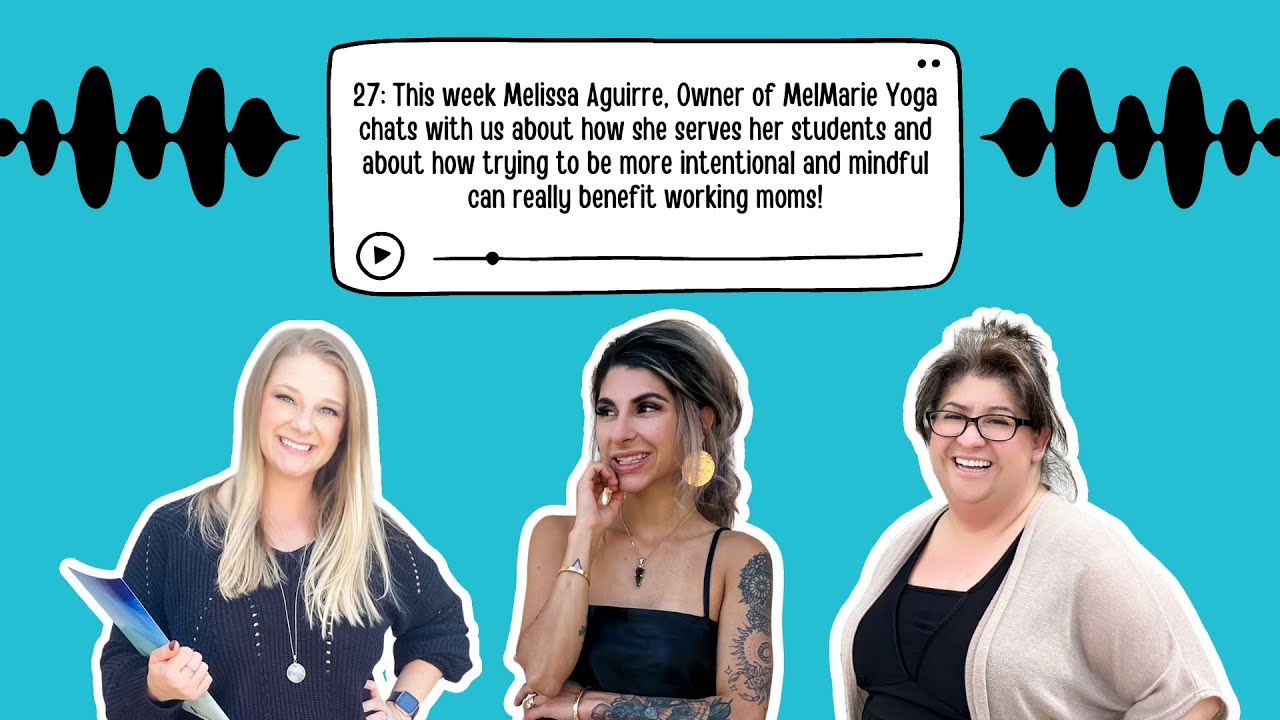
Melissa Aguirre, a yoga therapist and owner of MelMarie Yoga, talks about opening studios as a military spouse, building resilience through the pandemic, and teaching somatic techniques like forward folds and Emotional Freedom Tapping to manage anxiety and stress. She emphasizes self-advocacy and meeting people where they are.
Chapters
Hey there!
Are you a local mom business owner? If so, we've got some exciting news to share with you all. The doors to our Working Moms of San Antonio business owners community are now open! Join us now in our supportive new community for local networking events, customizable social media templates, classes and workshops, business resources, and to be a part of our exclusive referral directory. We love to help our working mom business owners grow. So visit workingmomsofsanantonio.com/membership, or just click the link in the show notes to join us. See you in the community.
We're Erika Radis and Marie Lifschultz, a San Antonio area realtor and lender, but most importantly, we're working moms.
The goal of this podcast is to provide support and a sense of community to San Antonio area working moms like us.
So join us in trying to find a balance between career, family, and everything in between. Welcome to this week's episode of the Working Moms of San Antonio podcast. We're here with Melissa, and she's the owner of Melmarie Yoga, and we're going to turn it over to her so she can introduce herself a little bit more and talk about what she does.
Well, thank you guys for having me. I have lived in San Antonio since 2015. And we moved here from North Carolina. My husband's in the military. And when I tell people we've been here this long, they're like, how? And I can promise it wasn't a simple thing. We did do a geographical separation because in 2017 I opened up a yoga studio. And then by 2019, I had 3 studios in San Antonio. I owned Bernie Yoga, Melmarie Yoga, had a private studio for my one-on-one clients. And then I also opened the first yoga studio on a military base in 2019.
Wow.
So we were—
thank you.
Yeah, we were thriving and we got orders and I was like, there's no way I can just drop this. So he went to Florida and did that. We did a geographical, you know, back and forth for like 2 years and during the pandemic. So that was insane. I'm a mindfulness expert and yoga teacher. Well, really a yoga therapist. And I always joke that You know, you may be into this work or mindfulness stress reduction, but it doesn't omit challenge or hardship in your life. And it's actually an opportunity to develop through curriculum that life gives us. So that was a season of building a lot of resilience for sure. But yeah, then we were able to get him back here. He's medical, so, you know, he came back, but we are here now and I did close my physical locations. And unfortunately, during the pandemic, they shut down the studio, but now it has evolved. The studio originally was a volunteer effort that Melmarie Yoga and the USO partnered on, and then it evolved to now the Vogel Meditation Center, which is part of the DOD, and it's a legitimate studio on Fort Sam for the military. And so it's cool to see like this effort now it's in the hands of them, but it's evolved and it's something that is, you know, it didn't just die. So very thankful for that. But yeah, closed everything down because it was just a wild time. But my specialty and what I do is I lead yoga teacher trainings. And part of what the— or part of why I chose to shut down my studios was because so many studios in the yoga community here were struggling. And because my specialty is education, my thought is I could just partner and rent and support these other studios. Be in my mastery and build, help rebuild and support the San Antonio yoga community. And that's what I've done. So I'm at different studios, you'll see me around town, and, um, I do a lot of work with the military, but, uh, specializing in education and program development all over.
Oh, I love that. It's incredible. Thank you so much for your husband and your service. We greatly appreciate it. Like, it's something that we all hold dear, being military city, you know, that it means a lot to us. But how you opened your business and then allowed it to evolve as it did. So that's incredible.
Well, yeah, in our community too, it's really hard for military spouses to really put roots down anywhere. And oftentimes they're— and I think it's not just military. I know for women who, you know, if you're married to someone who either moves around a lot or, you know, oil field, right, whatever the, the profession is, it's like if you feel like you're not going to be here long, what's the point? But it can often lead to a lot of depression, a lot of disconnection. And what I learned was the power of negotiation. I always tell women who want to pursue entrepreneurism, opening a business, is to negotiate and to, you know, ask for what you want. And when I opened my first studio, I had said to the landlord, like, "Look, this is our situation. My husband's in the military. We need to have a military clause on here. If he gets orders, that I can get out." And, you know, that was the security blanket for me to have the courage to say, "All right, let's go. Let's create this and see what happens." And then now here we are and, you know, San Antonio has been so good to me. So that's great.
That's a great tip. I mean, I think as women, we don't ask often for what we, you know, what we want. We're afraid to ask, you know, for the things that, that probably men would not think 2 seconds about asking for, you know what I mean, when it comes to our businesses. And so I love that. I think that's a great tip that, you know, as women, we need to get out there more and ask for what we want because It's really no different.
It's very true. And I've seen this a lot in my, even my work, like partnering with different nonprofits, the military, the importance of using our voice. And one thing that helps me, because, you know, if you meet me, I'm 5 foot tall. I'm a tiny human. I'm like, Erika, it's okay. I'm all about the cozy. And so my softness can oftentimes be misunderstood or my lightheartedness just not taken serious. And something that has helped me is I believe that confidence is a byproduct of clarity. So before I go into something, I really get clear about like, what are the things I'm going to be asking and what is the reason I'm asking what I'm asking? So, because I feel like women have this tendency where we feel like we have to overexplain ourselves. And so instead of talking in circles, when I say this is what I want to do, or this is what I need, or this is how I'm going to do it, And if I get any pushback, I already have what I'm going to address. And then being able to know when to leave the table.
Also, I think my husband would agree that we talk in circles sometimes. He's like, why are you repeating yourself? Because you didn't understand the first time. I feel like I try my best to say, and sometimes I can be accused of being hurtful or blunt, and I'm not trying to be. I just want to make sure that it's clear. These are the items I want or need or whatever the situation is, and I want to make sure it's understood. So I repeat myself and make the person I'm speaking to repeat it back to make sure we're on the same page.
Cheers to that.
I always laugh too.
People tell me I'm difficult with my latte orders or when I go to a restaurant, but I'm so specific. When I'm like, 140 degrees, 7 pumps, right? You can't mess this up.
I'm helping you.
Why are you— Why is that difficult? It's just being clear. And that's— that this actually highlights that program, right, that has been fostered in our culture. And I think that the more women who can exhale out and say, okay, if, if it comes off as too much, like, and not get hung up in it, right, just identify, like, we're in a cultural shift as well. Like, what is the future I want my daughter to live in? And I want her to belong and be accepted and loved, but not for a lie. Like for herself. So it's up to us in a way to pave that.
Yeah.
Yeah.
Do you feel like you've always— like that's always been your personality, or do you feel like you've had to learn to be like that over time to kind of get the things that you need?
Definitely learned. Uh, definitely was not. No, this did not come natural at all. In fact, it's— I always say that you have to know what you're not to know who you are in a way, because There's been a lot of times, like, I started my career very young. So I mean, I dropped out of college and got married. I, I did everything kind of backwards and really young. So I was 19 years old in Fayetteville, North Carolina, passing out business cards as a yoga therapist. Right. And, but I've made a lot of mistakes early on in my career because I felt misunderstood or I wanted to be, to belong. I really think belonging is such a foundation for women. Like, I wanted to be at the table, so I would forfeit a contract or like something that I knew needed to be handled before I said yes to something because I didn't want to miss the opportunity. But every time that I did that, I walked away with a really hard lesson. And I think by 2017, and really, I don't think I got the hang of it until 2020, probably. Where it was like, okay, I've had enough. It's not worth exchanging myself for, you know, this perceived accomplishment or this perceived whatever, because at the end of the day, people were making money off of me that I wasn't getting. People were getting, you know, riding my coattails into things that— and then not acknowledging how much I put in for that. And so I've really learned, yeah, it's from experience for sure. And that's why I think we shouldn't shame like our regression, because there's always regression before we progress.
Right.
Well, it's growth. It definitely shows growth. I mean, I never apologize for what I was 10 years ago. I had to go through that in order to be who I am today. So mistakes made, it's learned. So it's just a growth process. And a lot of people think they need to feel bad about it. Nope. I'm not supposed to be who I am at 43 at, let's say, 19 when I started this journey.
You know, yeah, definitely. Well, I'm really curious about the mindfulness part of what you do. I'm someone that suffers with anxiety and I work in a high-stress job and I know that being, um, mindful, more mindful would benefit me. And so what is that like, sort of teaching people to be mindful? How does that work and how can that benefit moms who are just like me who are stressed and all over the place.
Absolutely. So mindfulness, it's really about being present to what's meaningful right now. And there are so many different practices and techniques within the domain of mindfulness. In fact, in the West, yoga is a mindfulness practice, right? If we kind of look at how the Western integrative medicine and all of that views yoga. So when we talk about mindfulness, I really invite people to reframe it as it's not something you do, it's who you are. And through, you don't need to go to a yoga class, you don't need to find that 30 minutes of your day. It's looking at what you already do and starting to be more intentional, starting to be more reflective and honest, noticing it or creating space between, you know, impact or an experience, a circumstance and our reaction to that. So how do we create more space where we're more reflective? It's also a connection to our body. Most people are very disembodied. They're not connected. And an example of this would be like, you go, you eat at this restaurant all the time, and every time you eat there, you don't feel good after, you know, you have an upset stomach, but you keep going back to that restaurant, right? And yeah, same food. Or it could be even like you have a cramp or something going on in your body and you're not, you just, you're just like, ignore, ignore, ignore. So this disembodiment that we have, or even feeling our gut feelings, right? If you're around someone and you feel bad every time you're around them, that's your body saying like, this is not a match. This is not who you are. And instead we go, we push it down. So it's really a process and practice of awareness. And there's a lot of different ways to cultivate that awareness and practice presence. I want to mention one really big dis— or misunderstanding about mindfulness is that you're supposed to empty your mind and be completely at peace when you're doing it. In fact, mindfulness is a process of using contrast, using struggle to become aware. So it's when your mind wanders and you catch it and you come back. It's when your kid is screaming screaming and you take a breath in and you meet them with this breath out, right? Like it's, it's in those edges that we actually train our nervous system. And then in time it becomes your default and it's not something you have to remember to do. It's just how you walk through life.
Wow. That sounds like an amazing way to walk through life.
I know. Yeah.
I mean, all we are, it's kind of weird. Like we're walking meat suits with a nervous system, right?
Like it—
Yeah. Meat suits, I like that. Our neural patterns, right, inform so much of how our brain operates and receives information and how we process that information. It comes through a filter that's based in neuroplasticity and neural pathways. So when you talk about anxiety, for example, really your anxiety is your body trying to rise up to face something that feels unsafe, right, or unknown. And it's just learning, you know, not demonizing these things we struggle with that makes us human, but rather really being in relationship. Like, oh, there it is again. How can I source, inner source safety within myself? Or what physical thing? Because with anxiety, for example, you want to do things that are sensory, physical. Because if you just tell someone to calm down or tell yourself to be calm, it doesn't work because we got to get in the body. A lot of this stuff, a lot of mental stuff, is a physical thing. So, well, isn't that deep?
The deep breath that you just explained, I know that when I get frustrated or something and I need to calm myself, inhaling, obviously more oxygen to your body is a calming effect. So I've learned when I, before I, I get upset with my husband, my children, whatever the case is, deep breath, and then I go in with a, I mean, and I'm hopefully calmer than I would have been had I not done like truly take a deep breath in, open up my lungs, diaphragm, and let it out. And that helps quite a bit. So it's just that, you know, learning those tips and tricks on how to manage, like you said, different parts, you know, when you have anxiety or upset or you're coming into a situation. I'm a worrier. I worry about things that I'm 10 years, like, okay, that's not gonna happen. Like my boys growing up and getting married, like I'm worried about that today.
Like, you can't do that.
It's not happening yet.
I'm the same way. Yeah, I wish I was. Like I come from like a family of worriers.
I don't know if that kind of thing can be genetic.
But it feels like it is.
Like, I just—
maybe you grow up in a household where everybody's worrying all the time, and so you feel like that, like your natural state is just worrying all the time. But that's kind of where I'm at as well. I worry about things that I really have no control over. Um, in fact, it just happened recently. Like, I, I— we had talked about it before we got on here. I had been on vacation, but it wasn't a vacation because work was going crazy and all these things, and None of it was in my control, but I was kind of anxious and tense the whole time. And probably I would have just, like you said, made room for a little bit of information there where it's like, hey, this is not about you. You can't do anything about this. Maybe I would have relaxed a little bit more on my vacation.
Yeah.
Well, we model, like, as parents, we model to our kids. So what was modeled to us, right? If everybody dealt with hardship through tripping out or worrying, right? It's of course going to be a way that we face challenge or, or just a lot of commotion, right? And this is why for ourselves, I always say for ourselves first, because, you know, nothing's worse than, you know, I'm thinking from a kid's perspective, looking at mom and she's telling me to do all this stuff, but she doesn't walk it at all. You actually can lose a lot of trust with your kid, right? When you're like, do this, but you don't embody it. So if you just practice it for yourself first, And then naturally you will co-regulate with them. You'll model these new coping skills with them. And that's why mom, like when we talk about family, right, the parents are such the center of so much of the ways the kids are going to cope and deal with stuff. So yeah, it's totally— and I can share with you guys, so just real quick hacks for— so if you're anxious, obviously the exhale. But if you forward fold, it takes your head below your heart and it downregulates your nervous system. So if you take your head below the heart or find child's pose or any type of forward fold, it relaxes the nervous system. If you're feeling depressed or fatigued, if you open your armpits, like armpits open, backbend, that's going to actually reenergize your body. Inhales reenergize the body.. And so when we are in those negative feedback loops, using somatics such as the examples I gave, I'm big on tapping. I'm obsessed with Emotional Freedom Tapping as well for myself. And it's funny because my daughter does it. She sees me do it. So she'll do it too. But EFT or any type of techniques that allow the body to be involved in the coping process that disrupts those negative feedback loops or like getting in the shower when you're just feeling blah, like shower or sunlight, like something somatic. That's a really powerful way to get right into it.
I think it's when we forget that, we forget to do those little things that help us calm down or help us think clearly, um, because we have so much going on. I think just with, you know, having to work and, and, and life balance, and we're, we're expected to be all for everyone, everything for everyone. And I think that it's a lot of pressure, and we don't give ourselves grace enough to step back and say, you know what, it doesn't have to be perfect. Like I had to, I used to compare myself. I have my siblings, I have some, my sisters are quite a bit older than I am, good 10, 15 years older than I am. So when I got married and had children, I'm like, I go to their house and they're all, it's clean and it's spick and span, everything's put away. I'm like, how do they do it? Like how do, you know, I can't, I cannot, and I felt like I needed to be like them. I'm like, I can't even keep the dirty clothes in the laundry basket. Like how are they keeping the counters clean? Like, it was— it was— and I, and I forgot. I'm like, well, I have a, uh, you know, a, an infant and an 18-month-year-old. Their children are 13 and 15. Like, they're able to do what they, you know, to help out at home. When I was trying to compare, like, why does their house look so clean and I can't keep mine up? So I think we just— and I had to step back and say, you know what, it's a, it's a lived-in home. It's, you know, it's safe and we're here and deal with it.
So I love that. Yeah, it's so true. I think that a lot of women can resonate with that because especially in the day of social media too, right? And the, the way things are put out there. But the always, if we come back to like our energy and our spaces and our home, and a lot of the reason we may bully ourselves that it's supposed to look a certain way, it could be also that programming from the external. It's not really ours. And this is what I mean by mindfulness being a reflection tool. It's reflecting and going, is this mine or is this somewhere else, someone else?
Do I really believe this?
Do I— is this really me? And asking those questions, because then we can discern what is a program, what is a narrative that we're subscribing to unconsciously, to what is our conscious truth.
Yeah.
Do you—
so do you have—
are these the kind of conversations that you have, like, with your students and your clients? Like, I mean, do you have a lot of clients that are women that are dealing with all of these, or moms that are dealing with all of these kind of crazy external things that we all deal with day to day?
Absolutely. Yeah. So I do a lot of mindfulness coaching. I'm a mentor. So I've trained hundreds of people to be yoga teachers. In fact, if you go around San Antonio, a lot of the yoga teachers are graduates of my school. And I mentor them through the training process because Yoga teacher training, for example, from the outside it can look like, okay, you're going to do this to get your certification to be— to teach these poses. And again, with my background in yoga therapy, mind-body medicine, and mindfulness, it's a lot of on and off the mat. And I believe it's imperative that if we're teaching something, we're embodying it ourselves. So the teacher training journey for a lot of people is really a process of self-discovery. Discovery, and it can bring a lot of stuff up for us to reorient back into our alignment. And so I do a lot of one-on-one coaching with them and having these conversations. And even with moms, for example, you know, they say, well, I can't do my yoga, or I can't do these things because I got the kids in the room. And in fact, that's why we have our remote module teacher training program, which is livestream, but it's online, and it's based off of your calendar, and then you get one-on-one with me. Which makes it even more magical because we get to deepen into a lot of things personally through the experience. The baby's in the room. When you let your children be in your self-care practices and spaces, even if they're going crazy. I remember when my daughter was 3, I had a coach and she— I was tripping about how like I bought a sauna and I was like, I just want quiet. And actually when you're in the sauna, it amplifies the sounds around. I don't even know. It's like, oh, this is so annoying. Because my daughter, it was just so loud. So I was kind of like, I can't do this. And she said, be a monk at a Metallica concert. And like, you train the highest, like what you train the most when you can witness and reorganize, right? So this ability, so I really applied that. And I always share that with people because one, when you allow your kids in there, you're modeling. Like last, literally last night, we, as we're filming this, right, the full, the blue moon, the full moon in Pisces. Last night. And it was so funny because I did, you know, I do, you know, a little relaxation meditation, did my thing, came out, my daughter was actually listening to meditation music too. And I was like, what are you doing? Like, she's 7. She's just like playing on her iPad, had the meditation music going while she was like doing whatever school app that they use. But like, oh my gosh, like she picked that. And, you know, but maybe it's because she saw me go in and do my meditation. Maybe she, you know, we model. It's because she sees how mom does self-care practices, and there's many times where she's been right next to me and I, I listen to things, or so she naturally does that too. So we're teaching our kids, and then also we can use them to build resilience, and I mean that, right? They can be that tool to help us redirect.
So, no, that's so true. I mean, I can't I saw like some meme or something or some kind of a post that said something like, you know, you give your kids a hug and sometimes like you need it more than they do, right? Like, I can't tell you how many times that I've been so stressed and I will tell my kid, like one kid, like, just give me a hug real quick. And you know, that connection, all of a sudden, like, I just don't feel as bad anymore, you know? So sometimes, you know, they need the hug and sometimes, you know, you do. And so I believe, I believe in what you're saying, you know, that they can be a tool to help you kind of regulate yourself as well.
Absolutely.
Well, I think if you see, like, I, I don't know about, uh, Frank, Erika, but I know for Roger, my husband, like, I could be going like, oh my God, the noise. You had mentioned like it's loud. I'm like, I cannot focus and I feel like I'm, I'm coming apart. And he can sit there like, I don't hear, what's wrong? Like, it doesn't affect it. It affects men differently. And I like that you said that you can utilize your children to learn how to focus and calm yourself or, you know, and use them, you know, because I mean, I— we had a— when we bought our home that we're currently in, it had a sauna, which is the most weird thing when I bought this house. And we ended up tearing it down. But you're right, when you're in it, it's very loud. And the boys were really young when we bought our home, and I just like, I wanted it gone. So it was just weird that you had mentioned that. I'm like, we— so I have pictures and we just tore it down because I could not stand being in that little space. With the kid jumping all over the place.
Oh yeah, against the window, like their face like up against the window.
You're like, get away.
And but what— so in yoga, this, this concept of like witnessing and redirecting, like using that, like when, when like she's playing and she's being loud or she's, you know, whatever, and I want quiet. This is called paitiyara in yoga. So it's withdrawal of senses. And we train this on the yoga mat. An example on the yoga mat is when you are let's say you're in a down dog or you're in a stretch and you take a breath in and then all of a sudden you hear a noise outside or you notice something, you judge yourself, right? Your ability to go, oh, and then come back to the sensation or the present moment. So it's like that stimuli that they're creating because you want kids to be kids, right? And I, trust me, I want my space to be as like zen all the time, but with children, like we need to let them have that space to be kids. Or if, you know, she's like, you know, whatever. Really, it was just her being loud with toys and like, just shh, or jumping around. They just— we have a rule at night, so I always make her, um, I'm always like, all right, before we shower, we start, you need to get your wiggles out. So we do a get rid of the wiggles. So she gets to like jump around. We do frog— she does frog jumps, or like a down dog, planks, like, so, and it's become this fun thing. But I, I had her do it once because one night I was just like You are so energized. I need you to calm, right? But it's the reason they're doing that is because they have— they haven't exerted all that energy. It's just energy, right? And so how can we direct them? But going back to the mind wanders, so, oh, that's the kid toy. Oh, that sound. And then coming back to my breath, that's how we train those neural patterns, actually. And so we need these external stimuli, or if you're in a meditation practice The whole point of meditation is that your mind wanders, so you bring it back to develop that neural pattern for presence. So if your mind is not active during meditation, I don't know if you're a human. Your mind is meant to— your mind doesn't stop, right? So it's debunking these things and learning to co-create with them to actually edify our vitality versus making it another reason things are hard or I can't do it.
Yeah, I'm so glad that you said that because, you know, in the past, I've tried meditation, I've tried different things, and I felt like I was doing it wrong because like I can't focus fully always, you know what I mean? Or, and so I was just like, well, I just must be bad at it. And I just, this isn't for me, you guys.
Like I can't sit still long enough and I can't stop thinking. So there's been unfortunately a horrible socialization of yoga and mindfulness in the West because it's so performance-based. It's so look what I can do or look how I appear. Versus actually understanding like why we're doing the techniques in the first place, where are they derived, and what was the process of the derivation of that. It is a lot more inclusive than the West has propped it to be. And that's my mission with all the work Malbory Yoga does. You know, we bring it to the military, we bring it to first responders, we bring it to a lot of different pathology so autoimmune, chronic pain, healthy aging, all different bodies, all different lifestyles. You know, I do mostly work with women because, you know, statistically more women are into meditation, mindfulness, and yoga. Yeah, but I would say about 30% of my clients are men, you know, so there is a big interest. I do see with men, like, they're starting to be this interest of self-regulation and human performance. And we know with all the research out there how much yoga and mindfulness meditation can affect the body. So, you know, people are leaning in more and more for health. However, it is accessible to all people. And I think that if you ever have an experience with yoga, for one, or anything— mindfulness, yoga, meditation— number one, if the teacher tells you that you're doing it wrong or you have to do it a certain way and you're not good, like, makes you feel that way, because that's not true. Of course, there's very small, you know, things for safety, like making sure your knee is stacked above your ankle.
Or—
but if your knee can't because you had knee surgery and all the scar tissue, then maybe they should have you just go on your back and do it. So there's a different—
there's always a mod— there's moderation.
Yeah, yeah, yeah.
Or if they tell you that, um, or if they ever say like you can't— I don't know, if you ever have an experience like that where you don't get agency with your body, I would find a new teacher or a different class. And then also look at mindfulness and yoga as ice cream in a way. It's like there's a lot of different flavors. You may love mint chocolate but hate pistachio. Like, go, you know, try different flavors and find what you like. And just if you don't like it or it doesn't feel right, doesn't mean you're bad. It just means you didn't like the flavor, you know?
Yeah. Do you—
well, so my experience with yoga has always been like in a gym or something like that versus like a true yoga studio. Do you feel like there's a difference in those kinds of— I mean, obviously there must be because people that do stuff in a yoga studio, that's all, that's like your whole jam, right? So there is maybe a difference in quality versus going to like a, I don't know, like a, like a, you know, like a whole gym situation than, than a studio.
It depends. Like I know that there's gyms that offer restorative yoga and restorative yoga, restorative yoga. I would more so look at the description of what the class is going to be because yoga does what yoga does. And I mean, even when I, in 2011, 2012, I started teaching with CrossFit stuff. Like I was doing yoga for CrossFit. I taught for, I was at UNCA in Asheville, North Carolina. I taught for their health and fitness. Like, so yoga gets put into the fitness world and it is because it can definitely strengthen it. It helps with a lot of mobility. You can sweat. But this just goes back to, there's a lot of different flavors. And I would not say that gym yoga is worse or better than studios. And I know that some people might be like, studios are just a different experience. They're juicy, they're cozy, they have a different energy. Right. I think it's more of the place you would experience, but yoga, yoga does what yoga does. You know, there's ways to intelligently sequence things where it's more inclusive, more intentional, more impactful. But at the end of the day, breath, body, mind coming together. If you're doing it at home on YouTube, it's, it's a doorway into these deeper things. So I don't think there's a wrong. I think it's more about what you find, what's right for you.
Right.
I think it's your goal of what you're trying to get out of it. Right. I mean, I don't know a lot about yoga. I've never, I don't think I've ever done it other than the breathing techniques I find helpful. Um, I'm a musician, so I would use different breathing techniques to help build my lung capacity. That someone taught me at a very young age, and I've done it ever since. But I know there's different ways of what you need to get out of it. If you're doing it for fitness reasons and other— you want to sweat, and sometimes you don't. Right. So I think it's just where— what's your favorite flavor today?
Exactly. I love that. And even with breath, right, if you're wanting to optimize breath capacity and you know, even just presence with the musical instrument, yoga can actually help with that. But it might not be, you know, it might— you might just need to find what class description would work for those things. I love that. Yeah, like, what, what is your intention? What do you want? And then I think that if you're just going into it, recognize that you're trying different flavors of ice cream. You may love it, you may not. If you don't love it, look at something else. Try, you know, it's finding your places or finding the YouTube video or any of that.
Well, we always ask our guests what their favorite things are about what they're doing. And so we wanted— you're doing a lot of different things, but I want to know what some of your favorite things are.
I think so. I'm going to share my favorite thing personally and then my favorite thing more of like for others. My favorite thing for myself is being in this line of work of mindfulness, yoga, stress reduction, mind-body medicine. It has given me the mental and emotional sobriety in my life that I could not imagine if I didn't do this every day. Like, this is such a gift to get to guide people and share this work, but it helps me. So there's this element of it keeps me accountable. It keeps me in this process of continuing to learn how incredible the body is and how this is a self-regulating organism and how there's so much to inner resource for myself. So I feel like I'm in a constant, like, love experience with myself. And then when I have hard moments, I can sit there with that duality and darkness in me and mother it, like, be in it but not be afraid of it. It's just, it's awesome for myself. And I see this with people who become yoga teachers or just become, like, get into this stuff. It's like you really get to be in these gems. For the work that I do with the world, I am a creative, right? So I'm an author of a poetry anthology. I was actually San Antonio's best poet in 2019.
Oh, wow.
Yeah. And if you come to class with me, you'll hear it in the cadence of my voice when I teach. I'm a poet. I have a nerdy book on the chakras and medicine. So I'm an author, but I'm a creative. We just had an oracle deck come out. We have a whole docuseries launching on YouTube right now. Like I'm always into creative projects because I like to pioneer things. I like to go where no one's been and like kind of poke it and push the envelope and see what we can shift and change. Um, it was kind of even a joke when I did all this work with the military, you know, like the yoga studio. And then I worked with the soldier medics and brought a yoga program in and we have impacted the US military where they're now scaling yoga into basic training and AIT schools. But because I don't belong anywhere in a way, I kind of, you know, I run, I do my own business, but I do a lot of volunteer work so I can work around red tape. Our school is also part of higher academia with Northwestern Health Sciences University. So we're like, again, trying to pave these paths of being in higher academic, academics to like the military, to these places that like to give yoga a home. That's something that I love. So When I train people, I really listen to what their passion is and where they dream to bring this or what their gifts are. And I really help them mold this to be relevant to their interests. Like an example would be we had an esthetician, like her bringing this stuff into her esthetician practice, to someone who works in Bexar County Prison, creating a mindfulness program for Bexar County Prison incarcerated fathers, to all types of, like you name it, like we play. And so I love witnessing my graduates and trainees like doing these, these amazing things, but I'm definitely like seeing the impact and then the ripple of that over the years and within integrative medicine. Yeah. I like to play and like create and poke and watch then people pour in to like maintain what we start. So that's my favorite. I like love this stuff so much, obviously. Oh my gosh.
I love that. I love that you're just kind of like pushing the envelope because that's how things change. I mean, that's the only way things change. So I think that's amazing that that's what you're doing because that's how we get to new places.
Well, it's endless opportunities, right? You have endless opportunities to help people. And that's it. I was just going to comment. I absolutely love your vocabulary. So I knew she was an author. I knew it. She has awesome words. We need to put those down. Those are like 3-star words. Woohoo.
Thank you.
Well, I, I just, I believe in the bigness of people. I believe in their magic. I believe, um, in my, in my truth. Like, I meet people where they're at because I do believe in something called mental privilege. And I kind of made this up, but what this is, is that we have to understand that people perceive the world through the lens that they have, that have been conditioned, right? So if I tell you that you could— you hate your life, you hate this, like, just make these choices and it'll change your life. It doesn't work if there's all these negative feedback loops, right? So you have to meet people in their consciousness. You have to meet people where they're at. But the root of it is I believe in their bigness, and I trust that if, if they're just held and supported and they're met, so much can unlock in the mind from a perspective standpoint. So much can unlock in their reality and the way they're in relationship with things, especially when we take our power back. Like the example with mom guilt, for example, or being a working mom. There are a lot of programs in the world that tell us we have to do all these things and be this type of woman and look this way. And like the list is bogus, right? It's like, you know, it's oppressive. But when we start to untangle ourselves of why do I believe in this? Why do I think this? And then who am I really? Because you're the best mom because you're your best self.
Yourself.
Like, you are so perfect for your children. Like, you, even in your imperfection, like, you are giving them the lessons they need for their highest good, even in your quote-unquote faults. Like, that's inspiring their soul growth. And when we start to reconcile and then be honest, we liberate a lot in our lives. And I just believe in people. Like, I, I think we live in a tough world. It's horrible, the things that people go through. It's unfair. There's a lot of struggles. But I think that we just need a remembering, like a radical remembering and coming home. And my prayer is that I can pollinate that little by little in everything I do to help people come back home to themselves. And because magical things happen when we start to call our power back and take authority, take responsibility and agency in our life.
Yeah, Melissa, that's your next— that's your next poem right there. Yeah, right. I love that. I love it. Yeah, there you go. I mean, it's just trying to be— I mean, everybody, you try to do the best you can and know it's so in your, you know, it's okay. Um, and I think a lot of times we forget that our faults are okay too, you know. I, I really do truly feel— I think it's what— men make mistakes all the time, and I think as women we think we have to be perfect, and we're not. It's a growing aspect of it. You have to learn from— I, I get And I hate making mistakes and there's a lot of things changing in what I do for work. My guidelines change daily and things change and I have little control over any of it. But I always know if I make a mistake, I had a learning opportunity and I think I've had to train myself for the last 20 years of what I do. That's just an opportunity to learn.
So that's what I mean with my daughter. We've learned this with Mario Party. So that's been a journey. But yeah, there's no such thing as win-lose. Lose. It's win-learn.
Yeah.
And like, you get better at the game or you get better at things in like that learning experience. Because when we shift that, we don't have much to lose. We think we have a lot more to lose than we really do, you know? It's like, let's alchemize this.
Yeah, right. Yeah.
Well, Melissa, I just want to thank you for being on here with us. I feel like we've only just scratched the surface and all the things we could learn from you.
Yes, definitely. We gotta have you back on.
Yes, but I do feel like I've learned some kind of key tips in maybe trying to attempt to relax in my life a little bit. And also I feel like at the same time I got a little pep talk for being a good mom.
So I'm here for it. Anytime you need a pep talk, listen, Melissa. Yeah, give me a call. Absolutely.
Great.
And then lastly, I'm just going to thank our listeners for tuning in to this week's episode of the Working Moms of San Antonio podcast. And we will just catch you guys next week.
See you guys next week.
Thank you.
Thanks so much for tuning in to the Working Moms of San Antonio podcast. Be sure to follow us on social media at our respective Instagram accounts or join our Working Moms of San Antonio Facebook group. Those links can be found in our episode description. If you have an episode topic suggestion or question, please email us at office@workingmomsantonia.com. Erikadisagent.com. And be sure to subscribe to the podcast and leave us a review. See you next week.
More from Erika


I don’t want a prenup, I just want you!" 📜💍 …until you realize you just agreed to 50% of zero! 😂


In Texas, a 17-yr old is legally considered an adult in the criminal justice system



What Every Parent Needs To Know Before Your Child Talks To The School (Texas Law)

Is Your Marketing Strategy Tasting a Little... Muddy?#podcast #podcastclips #podcasts #


