Empowering Vote: Paula McGee’s Vision for San Antonio! 🇨🇱
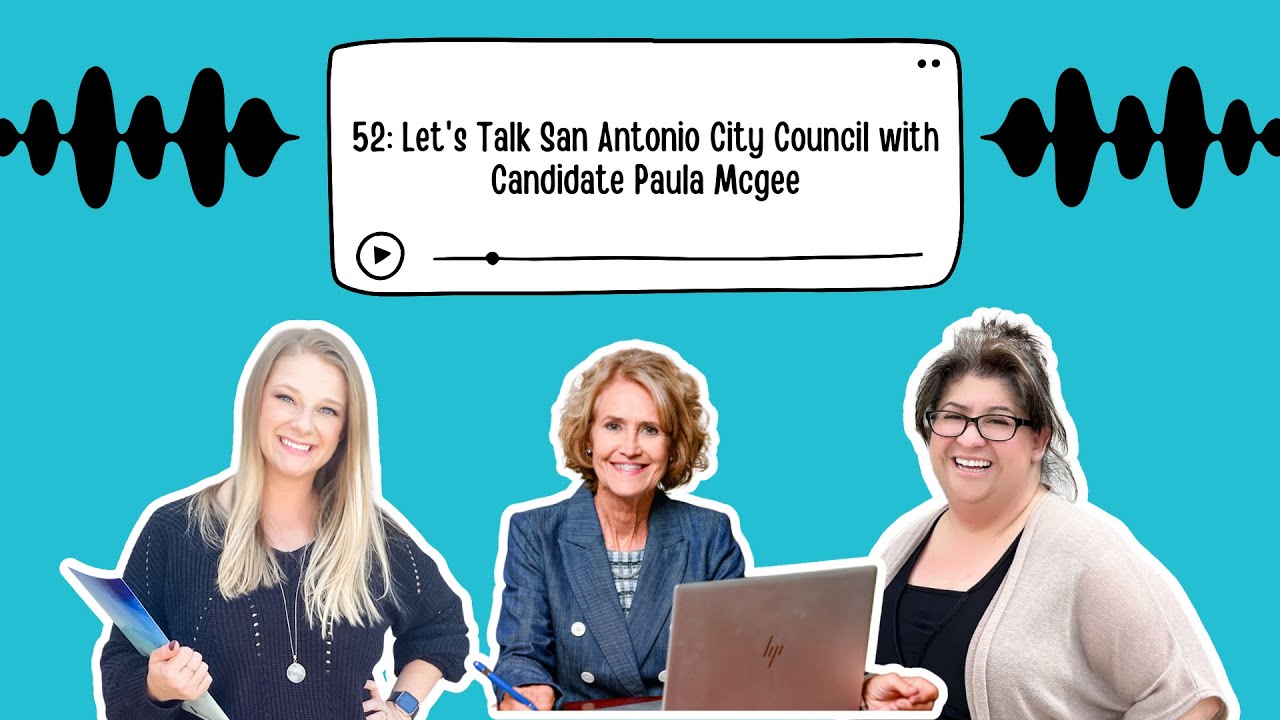
In this episode of the Working Moms of San Antonio podcast, hosts Erika Radis and Marie Lifschultz interview Paula McGee, a candidate for San Antonio City Council District 8. McGee shares her personal background—39 years as a San Antonio resident, a lawyer, former zoning‑commission and ethics‑board appointee, and a lifelong community volunteer—and explains why she decided to run for office. She outlines her platform: prioritizing public safety (including education about the SAPD’s SAFE Officer program), improving infrastructure and city services such as streets, sidewalks, drainage and trash collection, and ensuring transparency and accountability in the city’s $4 billion annual budget. McGee discusses the importance of voter turnout in the May 3 municipal election (early voting April 22‑29), noting historically low participation (10‑12 % of registered voters) and the impact of a four‑year term versus the current two‑year terms. She describes grassroots outreach tactics like “Voting Circles of Influence” and urges listeners to volunteer, donate, and spread the word via her campaign site electpaulamcgee.com. The conversation also touches on San Antonio’s rapid growth, housing shortages, traffic, and the need to preserve the city’s culture while planning for the future, as well as clarifying the limits of city versus state/federal responsibilities.
Chapters
Welcome to the Working Moms of San Antonio podcast. We're your host, Erika Radis and Marie Lifschultz, a realtor and lender here in San Antonio. But most importantly, we're working moms just like you.
This podcast is all about creating a space where we can come together, share stories, and learn from each other. We love connecting with local moms in business Hearing about their journeys and how they're balancing it all, because let's be honest, it's not always easy, but it's so worth it.
Before we dive in today's episode, we're excited to share some big news with you all.
Our business community and coworking memberships are officially open. Whether you're looking for a supportive community of moms in business or need a beautiful space to work and grow, we've got just what you need here at Working Moms of San Antonio. You can visit the link in our show notes. Or workingmomsofsanantonio.com/membership for more info.
Now onto today's episode. Grab a cup of coffee, settle in, and let's get started.
Welcome to this week's episode of the Working Moms of San Antonio podcast. We have a guest here with us, Paula McGee. She is running for city council, I guess representative for District 8.
Yeah.
And so we've never had a city council— We're excited.
So excited.
—runner here. And so I'm excited to turn it over to her and she can tell us a little about herself.
Well, thank you so much for this opportunity to visit with you. It was fun meeting you last week. I'm very excited about what you do here for working moms. I am running for, to be the next city councilwoman in District 8. And I'm excited about doing that because I love San Antonio. My husband and I have lived here for more than 39 years. We've watched a lot of change, but it is, this is a really important time. We have a lot of issues facing our city. And so I feel that I have a lot to offer to serve at City Hall. So anyway, I'm going to use what I've done in my life. I'm not a young person running for city council, and so I'm going to use my life experience as a wife, a mom, a grandmother, a lawyer, a community volunteer, and it's all about public service for me. So I'm looking forward to hopefully serving the folks that live and the businesses that, uh, exist in District 8. That's awesome.
Yeah, that really is. Tell us a little bit about how you kind of came to the decision to run. I just feel like that's such a big choice, you know? It is a big choice.
Um, it's something that I've thought about for many years, honestly. I, um, some time ago I had my first opportunity to serve. I've, volunteered in the community just like, you know, most of us have with different organizations, church, et cetera. But I was appointed to be on the zoning commission when I lived in another district actually, because it's been quite a few years. And I found it to be so interesting, such a great opportunity to kind of serve within the city, but also use knowledge that I had as a lawyer. To contribute to the decision-making that was going on there and had an opportunity to really see the entire city because issues coming before the Zoning Commission relate to properties all over the city. And so that was really kind of what planted the seed in my heart to do this and a kind of a desire to do it. And after I served on that, then Mayor Ivy Taylor appointed me to serve on the Ethics Review Board. And that's another board and commission within the city of San Antonio, a completely different area, but another citizen board. And so those two things really caused me to consider whether or not this would not be a good thing. That I was equipped and prepared and ready to do. It's certainly not something at my age that most people would endeavor to do. I'm not a politician. Yes. So, you know, putting yourself out in the public to do this, to serve, is a big commitment. So there was a lot of prayer, talking to my family, friends, people that have known me for many years to to see whether— sometimes other people can see things in you that you don't see yourself. So there was a lot of encouragement that I got to do it.
So what's a great way to use your gifts and talent, you know, a way to serve? I mean, if you have a servant's heart, that's a way— it's a way to give back.
I think so. I, um, my parents instilled that in me from when I was little. My mom was a, a nurse in the public schools that I went to, and my dad was My dad was an engineer for NASA. I grew up down in the Clear Lake area, south of Houston. And they were always very involved in the community. You know, my dad was actually a city council person in our little bitty town. And so they were just always very other-centered. And so they would take me along. And so it's just something that has always been a part of me, I think, giving to other people. Not just living for myself. So yeah, that's great.
It is. Um, Miss Paula, is there some goals, like if, if, if you were to, to, to win the race, goals that you have in mind for your district?
Yeah, that's a really good question. I, there are issues that as I have talked to people in the district, because you know, when you undertake something like that, you have your own ideas about what you think., is needed, but it really is about being a spokesperson for the, the residents within the whole district. And so, I, I do believe that the issues that seem to be the most important to me are what seem to be coming up as I talk to others in the community. So public safety, I think is at the forefront of a lot of people's minds and hearts. I mean, I just tell people that if we don't feel safe in our homes, in the community, or jogging on our beautiful trails, then the rest doesn't really matter. So prioritizing public safety and making sure that our police and fire have the resources that they need to keep us safe. That's really important to me. I want people to know about the SAFE Officer program. Do y'all know about that? I don't know. I don't know anything about that. Yeah. So within San Antonio Police Department, this is something that has been there for many, many years, but lots of people don't know about it. So there are officers within SAPD that are assigned to your neighborhood and your neighborhood based on where you live. And they are really your first connection into the police department. So on a non-emergency basis, if you saw something, a lot of people, you know, we tell people, "If you see something, say something," but oftentimes people don't know who to say that to. And that would be the SAFE officers. And so—
For example, if it wasn't an emergency. Right. Okay. Right.
So let's say that you're walking in your neighborhood and over a period of time you just notice that some house just doesn't look right. Like there's cars there that shouldn't normally be there, or you have a neighbor that you should be seeing that you haven't seen. And there's, you know, maybe an accumulation of newspaper. There's just evidence that something's not right there, but it's not really something to call 911 for. Right. You could call the SAFE officer and say, you know, this just doesn't really look right here. Could you look into it? And they will. They'll go do a drive-by. And if they find out that there is something amiss, then they will bubble that up. Into whatever is appropriate. You know, maybe it's an elderly person that you are concerned about their well-being. Yeah. Then you could let the SAFE officer know and they would, they would invest, send investigators to look into this. So it's, I learned about the SAFE officers just recently and I know how much they helped us in our, on our little cul-de-sac with an issue that wasn't something to call 911 about, but something that did not seem right. And so I just want to educate and inform people about the existence of that service within the police department so that we can all begin to kind of take responsibility for what part of being safe that we can do for ourselves. And so that's kind of a real practical Well, that makes sense.
I mean, I, I, in, in my area of town, and I, I am ashamed to say I cannot recall what district I'm in, but it's okay. I'm in the medical center and we have a lot of, um, migrants or people who might be walking around, right? And I, I don't know who they are and sometimes they look like they need help but maybe not 911, right? So I, yeah, it would've been something.
Exactly. Exactly.
Who do you call? Like you just, hey, he's been sitting on the ground for a while. He doesn't look, he needs help, but he doesn't look okay. Like he's not, doesn't need medical care, but we don't know what's going on.
Exactly, exactly. And so I carry around in my wallet, and I've put it in my cell phone, the SAFE officer's name and number. And so you can go on, you can go online to San Antonio Police Department and input SAFE, which is S-A-F-F-E, Safe officers. And then it'll bring up— you can find yours by inputting your address.
Oh, did you know that? That's great.
It'll tell you who it is and it will give you their number. I love that.
Thank you for sharing that because I wouldn't know about that. Yeah.
It stands for San Antonio Fear-Free Environment is what's SAFE. So anyway, that's just kind of a practical thing. But of course, public safety is a big— concern, I think for everybody, um, in our city. We just kind of sense that there is rising crime. Um, and so that's a, that's a number one issue, I think for me with, and a motivator to run. Um, another issue is just to address basic city services. So infrastructure, what is that? You know, it's streets and sidewalks.
Yeah. And I'm like, they say it all the time and I don't really ever know what that means. Construction.
Yeah. That's what it is. Yeah. That's what it is. And so we, we all know that it, it honestly seems like roads are under construction. We're always under construction, always over the city. Yes. All over the city. And some of the projects just kind of seem to go on and on.
Well, like my, my husband and I have this conversation quite often. I'm like, why don't they finish one before they start another? Like, I don't understand this. Like, why are we everywhere on 1604?
I know. Well, the answer to that is that when there are resources available through TxDOT or even if they're federal highways dollars, then the city takes them when they can and work is begun. And so it really is a funding issue that has caused all of this to be under construction, it seems like it one time or another. But with respect to city streets, and we have we have streets maintained by the city, then we have streets maintained by the state, have streets that are, can be improved by federal money. So it kind of depends on who is responsible for it. But in any event, we want those projects to start and finish and not be adversely affecting for any, you know, longer period of time than is necessary, the neighborhoods and the businesses around those.
Well, this is not just the streets, you, it's time consumed on the roads that you, that you spend away from your family if you're commuting. Right. It's damage to your vehicles. My windshield quite often because of the construction. And I can't tell you how many flat tires I've gotten because there's construction going on and I've gotten something in my tire. Right. So it's not just the road itself, it's all the stuff that goes along with it.
It is. It is. And so that's just kind of a, I, I am, a person that thinks that the city government should do what the city is supposed to do. And streets and drainage and trash and all those things are city services and we all pay a lot in taxes. We do. So we want to make sure that what we are paying, we're getting our money's worth. And so it's not really rocket science. I view city council as really being customer service in many ways to connect people to their government and help them to navigate through all the different departments of the city to try to get help for them for the concerns that they have.
Yeah, your platform seems very common sense, which I like.
We like common sense.
Yes. Yes. Well, I, I think that is something that I do have is common sense. The longer you live, the, well, the more you have that.
I hate to say though, sometimes you look at things like, why did we spend money on that? I need the whole, the pothole fixed. Yeah. Like, don't, I don't need a statue. I need the pothole fixed.
Yes. And I mean, I have in talking with, we're doing block walking now. Yeah. So we're kind of going through different neighborhoods, which I find very enjoyable. Some people might not, but for me, as a candidate, it really puts the pursuit in perspective because it really is all about trying to help citizens and residents within the district. And what they seem to confirm is that they just want to have the services that they are paying for, and they do want common sense reintroduced back into the decision-making that goes on. And I think that voters want to know that their money is being used wisely. Absolutely. I think there is a lot of frustration with just not knowing because our city budget is massive. Yeah. I mean, the enterprise of the City of San Antonio has a $4 billion annual budget. And so average citizens don't know where their money is being spent by this, their government. And so transparency and accountability and stewardship are, um, something that's really important to me and what I wanna, uh, help people understand where their money is being spent and be a part of really shining a light if we can, on where it is, what is being— what it's being spent on back in the fall. So the city budget process for each calendar year really is a July to September examination and a preparation of what the annual budget will be. So last fall, our current council Manny Palaise was a part of, and they did this in all the districts. They would have kind of town hall meetings so that people could come and ask questions. And I thought, I'm going to be a candidate. I should read the budget. Yep. I thought it was almost incomprehensible. It was like 600 pages long. I could not follow it and really discern. I couldn't tell how much of it was being spent on behalf of District 8. And so that was just very revealing to me. Yeah. And so I, I think trying to ask a lot of hard questions at City Hall, and I know that in the next few years there is going to be more examination of, they call it, it's not really a zero-based budgeting, but Councilman Mark White has proposed, and it has been passed by the council, in about, I think it's 3 years, they will begin to really look more closely at every single department and make sure that that department and the expenses there are what they should be now, because sometimes, you know, that The budget just sort of evolves from year to year and grows and, well, it should be audited, I would assume, on a regular basis because needs change.
Budget should change. It should be reevaluated at any, right? I think of when I think of San Antonio being run, it's, it's, it's a business. Yes. It's a big business. It is. And as a business owner, I review my budget annually and I go through it and see where do I, where can I cut? Where can I add? Where do I need to increase my budget in if it's marketing?, and take it away from something else, or where do I need to put the expenditures? Right. And I would hope that our city was doing that as well.
Well, governments are a little bit different. Yeah. And bureaucracies can be a little bit different. And so they aren't always managed and run as the massive business enterprise that they are. Um, but just because they haven't done it as well does not mean we cannot start to handle our affairs that way. I mean, families, have to make difficult choices about, you know, the resources that we have and where we're going to spend our money and where we're going to invest our money. And we can't have everything that we want. We have to prioritize the most important. And I think that that's what our city should be doing also.
Yeah, I agree. No, I think that's— I love the fact that it's common sense. And if you can make any kind of impact, that would be one thing I would— Yes.
Anything. Yes. Yes. I've always been a person that asks a lot of questions. My husband says that always, he tells people, always pay attention to her because when she says, I have a question, you know that I listen first, but then I start asking my questions. So anyway, it's all about the facts.
Well, hopefully with the questions you might have ideas of solutions as well. Yes. Yes.
Yes. So anyway, so infrastructure, public safety, and then transparency and accountability. Kind of big for me. That's awesome. A lot of voters.
I love it. For me too. Real quick, I'm just gonna have you pull that mic just a little closer to you. Yeah. Like kind of— Sorry, I kind of sat back.
Oh no, don't worry.
Oh no, you're good.
We'll cut all that part out. No worries. Okay, cool.
Last week when you were here, you and I had a conversation about how this upcoming election is one of the more important ones. Yes. And so I'd love for us to talk about current voter turnout and why it's so important for people to get out there and vote more than ever. Get out and vote.
Yes, it is extremely important. This is a very important election. Of course, excuse me, Election Day is May 3rd. Early voting starts on April 22nd and runs through April 29th. It is right in the middle of Fiesta this year, and that is not going to be good for voter turnout. Municipal elections are not always very— people, there's a lot of distractions in May. We have people graduating, people are planning their vacations, there's Mother's Day, there's just a lot of distractions in May. And because there are not always big issues that are on the ballot and it's just our city council and mayor, Oftentimes people just think, oh, it doesn't really matter. And so voters—
It does matter.
It actually matters more than your big— It really does. And so part of what I want to be about is just encouraging people about the importance of it, that it is coming up. This year in particular, it is very important because of the charter amendments that the city passed in November, the council members and the mayor, all of which are on the May ballot, will be serving for 4 years instead of 2. And that is extremely important because we need to make sure that we're picking the right people because they're going to be there for a while. Longer than usual. Longer than usual. And In addition to that, it is just a time when there are a lot of big issues coming before our city. There's a lot of conversation about the sports and entertainment district downtown, moving the Spurs to a downtown arena. That is a big issue. So it is, it is important for people to be informed We will— there's 27 mayoral candidates. So people will need to be paying attention to try to examine them, listen to what their issues are, why they're running, what they— the leadership that they want to provide for our city for the next 4 years. There are 4 council districts that because the Those current council members are running for mayor. We'll have 4 brand new council members. District 8 that I'm running in is one of those. Manny Palais is running for mayor. So there'll be at least 4 new council members, a new mayor out of the 11 for the next 4 years. So it's a really critical election and hopefully people will be engaged in it to vote, but also be informed about the choices that they're going to make.
I always felt that a 2-year term is difficult to see change, like, in just in general. So when you have someone for 4 years, there's stuff that they're implementing, you're going to see change, or if it goes that route. I always felt like 2 years always not long enough. So you have to make sure if they're going to be there for 4 and you don't like the change, You gotta get out and vote beforehand. Yeah, but it's very important. I think a lot of people go into thinking the, you know, vote— voting in just having your, your opinion out there is good. That's good enough there. And making a decision is always good, but they think federal government is more important. But what affects you directly is your, your local government.
It's so important. Absolutely. I, I think that, um, I heard somebody say once that, you know, local government has the most impact. Yes. —your day-to-day lives. Yes. —Day-to-day life, right. And so city councils, school districts, all of those things really make a difference in the quality of life that we have. And also, it is the place where change can really begin. And so a lot of people might think, oh, we need to change things at the national level, but it is really a grassroots, I think. Beginning often that— I agree. That causes us to start.
Because it's what affects your livelihood. It affects your day-to-day thing. The, the trash, the, the roads. Yeah. Safety affects you daily. So, and the federal government doesn't fix that. No. No, they don't. Government.
Yeah. No, they don't. And just sort of a reminder that, um, our local elections are nonpartisan. So that's, that's one of the reasons why it's in May is it can be nonpartisan. There occasionally is conversation about, you know, should it move to November in order to encourage greater voter participation in that election, but that would introduce the partisan dynamic to it. And so I— it is a nonpartisan election, so I think that's as it should be. Yeah, I would agree with that.
Yeah, yeah, that makes sense. When you shared the statistics of the people that vote locally, I was surprised. It's really low.
Yeah. It's really low.
Will you share that with our listeners? So it's, it's typically somewhere around 10 to 12%. Yeah. In a municipal election of the registered voters. Right. And that's not even, that's not even everyone. I mean, no. So it is a very, it's a very, uh, small number.
And that, that's cool. Which is a shame. Like total, uh, or is it per district? Like, So 10% in the district.
So let's say in District 8, um, I haven't seen the most recent statistics on it. They might be a couple years old, but it's, I heard somebody quote that it's about 150,000, uh, residents in District 8. Okay. So if, um, 10% of that. Yes. I know. Yes.
So that's what I'm saying. When she said that the other day, I was blown away. Right.
So 15,000 people. Are making, are gonna make a decision for your area. Yes. On who represents you and who speaks for you and your values in the decision-making at, uh, City Hall. We need to vote. Yes.
Yes. Have you voted ever in a local election? Yes. I never have. I know.
Oh, okay. I try to.
I, I bet you do this year. Yeah.
Now I'm gonna, you know, now I'm gonna, Paula. I have for sure. I have to say like, in high school, I don't remember them like pushing it. No, I don't remember. I mean, we had government economics, but no one really took the time. And my, my parents voted, but not— I mean, as children, we never went with them. Like, so I, anytime I vote, if the boys are available, I've taken them with me, especially when they're little. I like to get a little bit to show them, because I, as when I turned 18, I didn't understand, oh, you're voting, like what it meant. I mean, I knew what it meant, but like at the end of the day, the impact that you are having. Yeah. You have to be able to, I mean, I can't, I say I can't sit here and complain what's happening if I didn't take the time outta my day to go, hey, this is what I want. Yeah. This is who I want to represent me. Exactly.
And that's what I've told people for years that, you know, if you don't vote, then you shouldn't complain. Yeah. Because you, you voted by your, you know, acquiescence and absence. Yeah. So, Yeah, I love it when I go and vote and I see little children there with their parents because yes, it does take time out of your day and all of that. But think about it. I mean, I think a lot of times people believe that, oh, my vote isn't going to really make a difference. But if there's only 15,000 people voting, yes, a few people one way or another can really sway an election. So it, you can, you can make a difference.
Yeah. So it is like I said, I think just in, in general, I, I didn't, I didn't have it where someone like, hey, you should go and vote. You should, this is why you should do it. I know we learned about it in school. Mm-hmm. Very short period of time. And I think I took it in the summer, like to get ahead. And it wasn't something that just was really, hey, this is something you should be doing and why.
So several years ago, um, I, some of my friends and I decided, you know, we're gonna try to organize our friends to go and vote. Yeah. And so we created what we called Voting Circles of Influence. Somebody, some called it Voting Circles of Friends. But basically I reached out to 25 of my friends and said, okay, the election is coming. I am going to send you emails. This is when everybody communicated by email, but we were doing it a different way now. Back then I said, okay, there's a lot of issues that are really important in this election. Over the next 6 weeks, I'm going to give you an update on candidates, on ballot issues. There was a lot going on at that time. If I send it to you, will you find 10 other friends to forward it to? And will you ask them to find 10 friends to do the same thing? And then when it came— and they said yes. And so it was just kind of like this expanding circle. When it came time for early voting to begin, then we kind of ramped it up. I would remind people that early voting was coming and they would remind their friends and they would remind their friends. And we all reached out to our circles until— to make sure that they did vote. And then we stopped. If you told me you voted, then I stopped bothering you with text messages or emails. But until I knew you voted, I kept saying, "Okay, you've got 2 more days of early voting, and then it's Election Day. Make sure you go and vote." And I honestly think we made a difference in that election. Yeah. Because we, I think we had at least 5,000 people in those circles across northern, the 8, 9 districts, 8, 9, and 10. So anyway, it's something just very simple. Just tell your friends, make sure they know the election is coming and then hold 'em accountable for voting.
So anyway, yeah, it's kind of odd that we have to do that though, you know. Like, I, I personally, I'm like, do I need to make it a priority? Like, it has to be something that's important to me, and I have to— I think it's sometimes because people don't understand what's being voted on. Like, they don't really understand all the things that the peoples are running for, and I don't recognize the name, and I don't— or that is, I, I've seen that person on the news, we'll just— there's that one, right? You know, and taking the time to really understand what each candidate is standing for. Right. And who they are.
And that takes work.
That takes a lot of work.
And who they are, because I mean, honestly, a lot of us that are doing this, we know what the issues are because the citizens know what the main issues are. It really comes down to who do you trust to actually represent you and who is going to really address those issues. And so In District 8, there are 6 candidates. We're all really different, and I think that's good for voters. There's a lot of really different candidates running for mayor. So educate yourselves and decide who it is do you think can address the issues that are important to you, who will do that, who do you trust to do that? Because we know what the issues are today, but how quickly do things change? Yeah. And so we don't know what the big issues are going to be for San Antonio a year from now. Truly. You're right. You're right. And so we need to have people there that are leaders and that are gonna work together to provide sound, uh, decision making.
Yeah. For the community. Our city's growing so fast. I mean, we're both in real estate, so we see, like, I, I even during, during COVID I mean, if I did, let's say 10 units a month, out of those 10, at least, at least 2 to 3 of them or for someone out of town that doesn't know, doesn't know the, you know, stuff. So we're growing and we're still growing, and having good people in place will continue to help us grow the best way, right?
And we all know that that is probably an overarching issue for all of these things. We are the 7th, maybe becoming the 6th largest city in America. And so The secret of how great San Antonio is, is no secret any longer. I mean, people are coming, cannot stop that. And so we have to plan for the increased traffic. We have to plan for the housing shortage. You know, we have to address the housing shortages. Of course, it creates issues related to public safety. I mean, it affects everything. Um, and we have to anticipate that because if you're not addressing it now, you're way behind and the cost to address it later are even that much greater. We've watched other cities not do that well.
Well, and we're going, it's just, and it's not, it's not a gradual growth. It's all of a sudden there's a whole bunch of people here.
Yes. Yes. And you know, some of us wanna keep it the way it's always been and we wanna grow. Um, in a way where we don't lose the culture and the history and all that makes San Antonio special. We want to preserve that. So we have to be mindful of managing the expansion and growth of the community in a way that preserves that.
So I agree. I think it's great. I mean, this is our first time ever talking with someone who's running in government. Yeah, in government and understanding some of this stuff and hearing you clearly explain your, your take and your goals. I think that's amazing. I hope— I wish other people would do that, where it's just for the person who's not, um, day to day into the issues of a, of a city, you just hope it gets better. Yeah, like you really— I, I would probably think at least 90% of people don't understand what a council person would do.
Well, and I think a lot of time what I have, have learned as I've been talking with just, you know, people in the neighborhoods and all, is that A lot of the issues that are of grave concern to us that we hear about on TV and read about online and are not really the issues of the city. They're important issues to us, but they might be better addressed or they are more appropriately addressed by the state. Or the federal government and not the city. So a lot of it is, I have found that I have had to educate people, you know, the city does not make decisions about our immigration policy. That's at the federal level. Doesn't mean that we are not aware. Of course we are all aware and have our concerns about that. But the city does, you know, trash and parks and potholes and those kinds of things. And so it is a lot of education for people.
But that's what's on the news right now, and that's what people are concerned about.
Yes. And that is what gets people emotionally connected and concerned about government.
It would be great if the news covered, hey, this pothole has been here for 10 years. Can we get it taken care of?
We've laughed that, you know, some of what I hear from time to time is that people have problems with issues and they get frustrated with 311, which is kind of the number that you call if you need the city services about whatever, you know, stray dogs or trash pickup or whatever, and that, uh, there's sometimes a delay, um, in that. And so, um, sorry, I completely lost my train of thought. Oh, you're fine. No, don't worry, we can edit that out. I forgot what I was going to say. I completely forgot about where I was going with 311.
Well, I know that people do get frustrated about it because I've called them like, okay, you're on hold. I just hope if I call 911, they answer. That'd be great. I want to make sure that continues to happen.
Yes. Yes.
So anyway, I just think this is normal people's expectations sometimes. Again, I think it comes to the education of here locally, educating what you're there for and what you can do and making people understand that it does affect your day-to-day life. And that immigration is definitely an important topic and it's a hot topic right now, but that's right now. And those things do affect our day-to-day life. Like we wanna make sure we have enough police officers available. Yes. And, and firefighters. And because we have more people locally, whether it's via, uh, people moving here or, or, or immigrants here or whatever the case is, that we have those resources available. And that's something you can address.
Absolutely. And we want our, and we want our police and firefighters to have all of the resources. Absolutely. All of the equipment that they need in order to stay safe while they're keeping us safe. I had the opportunity to do a ride-along with SAPD about a month ago, and it was fascinating. It was on a Friday night, and I was so impressed by the professionalism of all the officers that I met. Their care and concern. We had a homeless lady that we needed to— that the officer needed to talk with, and the kindness that he showed for her. It was just a real glimpse into those brave people that are our first responders, and so very proud of them, and— but we need more of them.
Firefighters. I see quite a bit more, um, social media about recruiting and about things, you know, camps and stuff like that, and then reaching out to the youth. And I have to say, my son, it's caught my son's eye.
That's so interesting that you brought that up. So the officer that I was doing a ride-along with, he told me, he shared, you know, was with him for like 7 hours. And he, so he was telling me a little bit about his story and how he became a police officer, and he actually took one of those classes. I think it's— I don't know, it's like— it's— well, police academy is when you want to be an officer, but they have kind of a youth program where people who are interested, young people who are interested in serving as police officers can kind of go. And I don't know if it's a camp or whatever, but in any event, that is where he first got the bug for doing it, and that it has grown into this. And has been an officer for, I think, 7 or 8 years, but it's just a passion that he had to serve in that way. And I think that's a calling. I think you— that's not for everyone to be able to do that. And you just think of the families of those first responders too, to allow their loved one to serve like that. And know that they don't always come home. Yeah. So anyway, very grateful for all of them, really.
Well, Paula, I have to say, this has been so interesting. Yeah. I loved having you on. Can you tell our listeners how they can get more information about you and your plans?
Yes. So I have a website. I'd love for them to go to it and learn more about me and the issues and why I'm running, and it's electpaulamcgee.com is the website, and they can learn more, they can volunteer. We need a lot of volunteers to help with our campaign. We're looking for people to block walk. We can use people to, on the phone. I mean, we can put to work anybody with any skill set to help us. It takes a lot of people to do it. We, of course, are always looking to raise money. Campaigns are expensive. Not everybody can give, but if anybody is inclined to do that, they can donate through our website. There's a secure link there, but mainly volunteers and spreading the word about my campaign and my desire to serve. Perfect.
Well, hopefully this podcast can do exactly that.
I hope so. I'm so grateful. Thank you so much for your interest in, uh, and all that you do here.
And we'll commit to, you know, reminding our friends and family to vote when it comes to, yes, yes. Our, during fiesta time and help. Yeah. They're sober when they go and, and vote. Great. Yeah.
It'll be a challenge for everybody.
We'll definitely make sure that's something I, I, I will commit to doing and making sure that my family goes out and vote and encourage them to do that. Cause it can make a big difference.
Thank you. Erika's gonna hold you accountable. I know.
Hold me accountable.
And you her. Okay. Yeah.
I need it. Yeah, for sure. Well, thank you again for being on. Thanks so much. And I'll also thank our listeners for tuning into this week's episode, and we'll catch you next time. See you guys next week. Thanks so much for tuning into this episode of the Working Moms of San Antonio podcast. We hope you loved today's chat and found a little inspiration to take with you into your week. If you have a podcast topic suggestion or a question you'd love for us to cover, definitely send us an email at hello@workingmomsofsanantonio.com. We'd love to hear from you. And until next time, see you in the community.
More from Erika


I don’t want a prenup, I just want you!" 📜💍 …until you realize you just agreed to 50% of zero! 😂


In Texas, a 17-yr old is legally considered an adult in the criminal justice system



What Every Parent Needs To Know Before Your Child Talks To The School (Texas Law)

Is Your Marketing Strategy Tasting a Little... Muddy?#podcast #podcastclips #podcasts #


