Episode 47 Let's Find Functional Organization with Angela Aitken of Finding Function Home Organizing
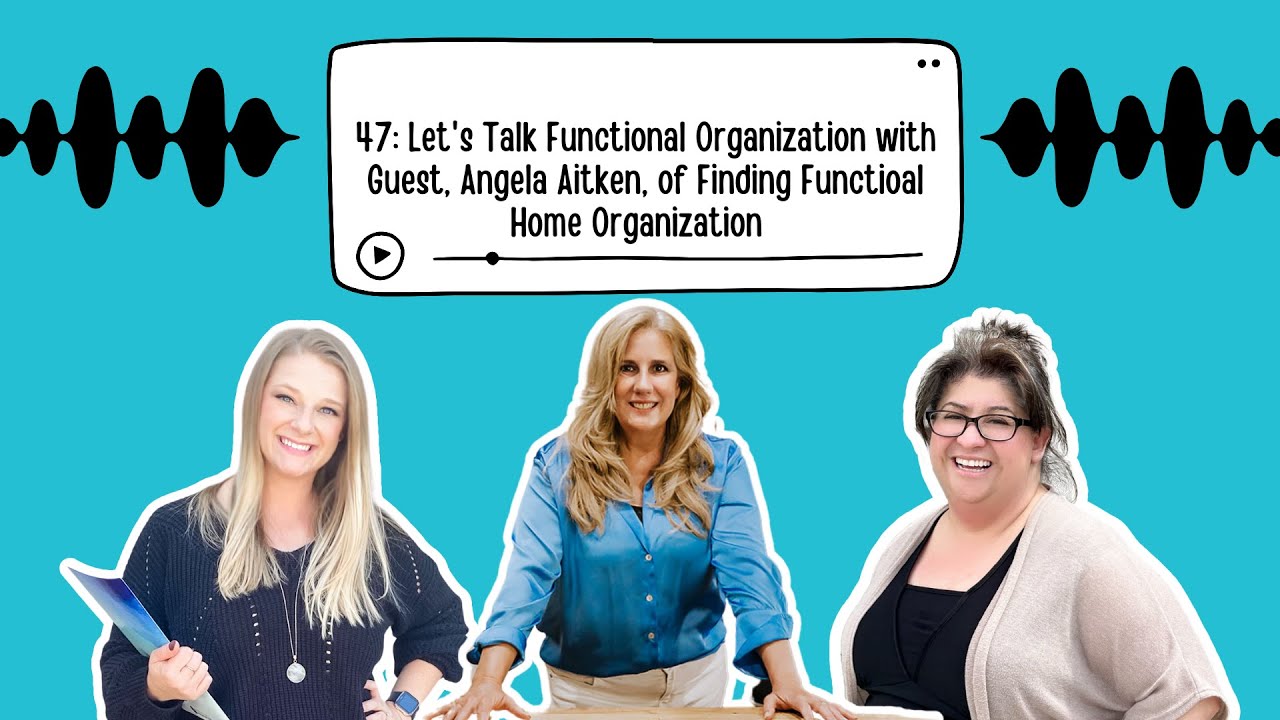
In this episode of the Working Moms of San Antonio podcast, hosts Erika Radis and Marie Lifschultz interview professional organizer Angela Aitken of Finding Function Home Organizing. Angela shares how she transitioned from a previous career into professional organizing, the certifications and associations (NAPO, National Association of Productivity and Organizing) that legitimize her practice, and the psychological considerations she incorporates, such as working with neurodivergent clients and varying levels of hoarding. The conversation covers practical organizing strategies—decluttering, choosing containers, scanning and filing paper and digital documents, managing email subscriptions, and handling donations or haul‑off logistics. They discuss how to evaluate and hire an organizer, emphasizing personality fit, insurance, ethical codes, and scope of work, especially regarding hoarding severity. Angela explains her client workflow: initial phone consult, on‑site assessment, goal setting, budgeting, and ongoing maintenance visits. They explore organizing challenges tied to life transitions like moving, downsizing, inheriting items, and managing sentimental objects (e.g., wedding dresses, heirloom china). The hosts and guest emphasize habit‑stacking and small‑bite‑size routines for busy moms, illustrating how consistent micro‑actions (e.g., cleaning the car while pumping gas, daily mail triage) build lasting order. Angela promotes her services and encourages listeners to start with a 10‑minute project, celebrate wins, and reach out via her website or Facebook.
Chapters
Welcome to the Working Moms of San Antonio podcast. We're your host, Erika Radis and Marie Lifschultz, a realtor and lender here in San Antonio. But most importantly, we're working moms just like you.
This podcast is all about creating a space where we can come together, share stories, and learn from each other. We love connecting with local moms in business Hearing about their journeys and how they're balancing it all, because let's be honest, it's not always easy, but it's so worth it.
Before we dive in today's episode, we're excited to share some big news with you all.
Our business community and coworking memberships are officially open. Whether you're looking for a supportive community of moms in business or need a beautiful space to work and grow, we've got just what you need here at Working Moms of San Antonio. You can visit the link in our show notes or workingmomsofsanantonio.com/membership for more info.
Now on to today's episode. Grab a cup of coffee, settle in, and let's get started.
Yes, welcome to this week's episode of the Working Moms of San Antonio podcast. We have got Angela with Finding Function Home Organizing.
Good morning.
Yes, and we are gonna talk about all things organizing, which, who doesn't need that?
I love this. My favorite topic. Favorite topic in the world.
It's my favorite topic too, and I get to do it for a living now, so I'm really excited.
Yeah, so Angela, tell us a little bit about how you got into home organizing.
So I have always been an organized person, and I have always organized for my friends and my family. But when I retired from my main career, I was at loose ends. It was obvious that I was not going to be a good housewife. I was losing my mind. So I decided to take one of my favorite things to do and monetize it.
I love that.
I love it.
And it really worked out well. So I did a lot of research. I joined the appropriate associations so that I could get the education that I need to really call myself a professional organizer without just making up my own credentials. So, I joined the National Association of Productivity and Organizing and am able to get great classes through them, from residential organizing, moving people, and a lot of psychology classes about how to deal with people who are neurodivergent.
Oh, that's interesting.
So, ADHD, OCD, things of that nature, because what— what works for me is not going to work for anybody else. Absolutely, yeah. So a big part of being a professional organizer is spending time with your client and making sure that the system that you're setting up is going to work for them long term.
Yeah, why do it if you're not going to continue to do it, right?
I have to say, I felt like if you weren't naturally organized, then too bad. Yeah. That's just not your personality and there was no way to get around it.
It's a skill that can be learned if you are working with someone that understands what works for you. I work with children as young as 3 years old, you know, very small little tiny time frames. Every 45 seconds we take a break and check in. And then I work all the way up to people who are downsizing into tiny houses from very large houses and, and all things in between. Got it.
Yeah, I swear I thought it was— if someone wasn't an organized person, it wasn't something you could fix.
You couldn't—
it You know what, that's just life. That is the way it is.
It's absolutely a learned skill.
I grew up with my mom, everything had its spot. Everything had a place. Like, you didn't take it out, it had to go back to the spot. And I figured, let's just— she made me organized.
Yes.
I didn't have a choice. That's just the way life was.
Well, and you're right. A lot of people who grew up in very organized homes, which I did, it was ingrained in us at such a young age that we've just never lost that skill. But if you grew up in a home that was not organized, it worked for your parents and that's fine, but you want a little more organization, you can learn the skills. Got it.
Yeah. I feel like when I was younger, I mean, my house was very organized and clean, but like my mom would be a little bit more relaxed, like about my bedroom.
Right.
And so I didn't really get like clean and organized until I had my own apartment. And I was like, hey, no one else is going to do this, pal.
You've got to kind of take charge.
That's exactly right.
And that's when it happens for a lot of people. They move out on their own and all of a sudden they're and they're like, oh, I can't, you know, this is terrible. I'm gonna, I can't live like this. I'm gonna have to learn some skills.
Yeah.
I think it was probably the one biggest challenge of once I moved out, moved out very young, got an apartment and had a roommate and that roommate was not organized. Yes. Oh. And I'm like, favorite person in the world, I'm going to kill you. Like, this isn't going to work.
Yep.
And my husband comes from a family who was not a very organized, I mean, they, had stuff everywhere and I was used to having stuff in its spot. Like I like my counters clean and nothing on it. It makes me feel good. And that's just not the world you grew up in and it's okay. And I remember our first year in marriage, I'm like, I'm gonna let the dishes sit until he's ready to do it. And I thought I was gonna lose my mind cuz he's like, it doesn't bother me. I'm like, how does it not bother you?
Yeah.
How does this not bother you?
The dishes are gonna keep sitting, Marie.
They're gonna keep sitting and we are gonna keep— They're not gonna go away.
It was a conversation I learned, like I had to have with him and there's some, I had to bend on some rules.
Yes.
Like some things that I just, needed to let things go.
Yeah.
My husband is a stacker, so he will stack things up. He'll stack the mail up, he'll stack papers up. And to me, that is just a delayed decision. If I'm going to hold this paper, I'm going to make a decision about this paper now. And so we— I'm not going to say argue, but we intensely discuss his habit of stacking about twice a year, and then we get better. But it's really common for for a very organized person to be living with a very unorganized person. And it can be a real point of stress.
It is.
Yeah.
Yes.
Do they talk about in these classes that you've taken, like in terms of the psychology of that, like why that is?
You know, they haven't really addressed it in other than sometimes opposites attract.
Yeah.
And what you generally have is a very organized person is, um, you know, even in their emotions and their daily life, they're really scheduled.
Right.
And an unorganized person is much more happy-go-lucky and we'll go where we want to go. And it—
Oh, they're fun.
And they're great fun. As a very organized person, I was like, my, my husband called me one day and he goes, we're going to Tahiti next week. And I'm like, what? But, you know, great trip, great fun. But I have to let him have that. Bon voyant spirit in the marriage.
Got it.
Yeah, I think, well, my husband's pretty organized as well. He's former military. And so I think that's just what it is. Um, and so I can't complain in that regard, but like in terms of like, you know, having that fun, like sort of spur of the moment personality, I know I do not have it. Yeah. I am not fun. I'm not either. And it's taken me, I'm 36 now. It's taken me like the last, like few years to sort of just be like, I am okay with this. Like I used to kind of try to go with the flow and be like, or act like I could go with the flow, right? It was never real. And I was like dying inside.
Yeah.
And you're really stressed out because you're like, ah, but so now I just don't even pretend. I'm like, I'm not fun. And if you're looking for that, like it's not here.
So I've been able to voice, I'm now 45, so I've been able to voice like, hey, this really stresses me out. And I've been able to put like, I just, with the boys, with my husband, like, hey, I, I like the counters clean. If you don't want me to freak out in the evenings, just put your stuff away. Like, I won't, I'll be cool and I'll be relaxed on other things. Like, I give the boys some leeway with their bedrooms. Like, it's your space. If it's the way they know where you're, you're not looking for stuff for school in the morning. I don't want to be like late. Have your stuff together. And if it's in a pile, it's in a pile because that's your space.
That's right. Yeah, that's right.
The minute you're late, we're going to fix this. Yeah.
Well, since we're all sharing our ages, I'm 57 and I did not learn how to have that give until I turned 50. And then I retired about— I was a single mom forever. I didn't have room in my life to have that give. It had to work on a schedule. So it's really only been since I have married my current husband that I have been able to loosen up a little bit and understand that the world is not going to collapse if I forgot to turn on the dishwasher.
Right.
You know, the world is not going to end.
Even just the idea of that is making me anxious right now.
I know, I know.
I know.
That's funny. But I think, I mean, I remember when the boys were really little. Yeah. I felt my schedule was non-negotiable. Yes. They had a bath time, they had a sleep time, and if, if I didn't keep to it, life would be horrible the next day. Like it was just, you learned patterns that just did not, there's certain things I didn't flex on.
Right.
But as they've gotten older, there's things I, I can be relaxed on. There's, you know, you just change.
You do.
So, and we learn.
We all learn. We all learn. And quite frankly, as we go through different stages of life, we need different things in our lives.
Absolutely.
That's true. Yeah, that's a good point. So I've never had a professional organizer come in, although God knows I would love that so much. So what does it look like typically, like when, when a, when a potential client would reach out to you? Like, how does that go?
So it's really a very simple process. We're going to talk on the phone and we're both going to assess on the phone. Whether our personalities mesh enough. And then we will schedule an appointment. I will come in, I will look at the space. We will talk about what their end goals are and how much time they can devote to this, not only to get it clean, but do they have an hour a week where they can sit and work and do a reset on things? Because it doesn't stay perfect all the time. You have to do resets. We'll talk about their budget and decide, do they want all new containers? Can we use the containers they already have? Because containers are not the answer to organization. You've got to declutter before you go do it.
Instagram says otherwise.
I am well aware that Instagram says otherwise. But if you are just shoving everything you own into a container and putting it on a shelf, now you can't see it. And guess what? You can't find it. So then you go buy it again.
Yeah.
But Angela, it looks pretty.
It does. It does look pretty. And, and I— my vanity is beautiful. It has all of the wicker baskets in it and they're all labeled and they're all organized. But it took me about 6 months after I did that to really pull them down and say, I don't need to buy Band-Aids again this shopping trip. We have Band-Aids. So you really have to figure out what the client is used to. Do they need clear containers? Do they want pretty containers? What's going to work for them?
You know, when I was really a younger mom, when the boys were little, people would— I get hand-me-downs or people give me clothing. And that was the worst thing that I could do because I would put them in containers because they didn't fit into that size.
Yes.
And I put them away and I'm like, and I find 2 years later, I'm like, I had 9-month-year-old clothes, like, right here. Here I spent money not realizing because it was put away in a nice container. In the shelf, and I didn't go— I didn't have time to go pull it out of the shelf and look to see what I had, right? So it was— that was one of my most frustrating things. I would love the, the hand-me-downs or whatever. If I kept it from Tyler to Aaron, you know, thinking they might be the same size at one point, then I just wasted space. I just kept stuff for no reason.
Exactly.
And a lot of people do that. Another thing a lot of people collect and go with is, as we age and our parents are aging, especially if you have boomer parents, they have tend to have a lot of knickknacks. They have multiple sets of china, all of this. And one of the things that's really prevalent right now is people our age speaking to our parents about what we would really like to inherit from them. So that— I'll tell you my personal experience. When my mother died, we inherited all of multiple things, and I moved them all into my house. And then suddenly I didn't feel like I was living in my own home. I felt like I was living in my mother's home. So, this is a big trend in organizing right now, is as you are aging, have those honest conversations with your adult children. Do you need a different set of china for every holiday? And most people our age are gonna go, "No, thank you.
We don't." Yes. It's a conversation I had with my mom. She handed me down these like Christmas plates, and they're beautiful. They're gorgeous. You know, I've never taken them out. They live in their box, and it's just another thing that we have, and we are right now in the process of moving. And so we just packed up our home. Right. I literally forgot they were there until I put 'em away to move to the next house.
Right.
So, but she was like, what, you don't want these? You know what I mean? And it's like, so then I took 'em and it's like a whole thing.
And there's a lot of guilt involved in it. Yeah. There's a ton of guilt involved in it.
You do. So like, I, I lost both my parents very close together, uh, within the last couple years. So we, I inherited quite a bit. Yes. And I was, I was actually very proud of myself. I'm like, don't need it. Like it, it, it's gonna be Goodwill or someone who could use it. Like, it wasn't something I needed to take. I don't need additional furniture in my home, even though my dad sat in that chair for 20 years. Like, I don't need it.
So that is a great way to look at it, because somebody needs it.
Someone needs it, yeah.
Somebody needs it. We don't need it in our home, but somebody really needs that. And most professional organizers will have a haul-off policy. Like, if you want to donate things, like, my haul-off policy is, if it will fit in the back of my giant SUV, I will deliver it to the charity of your choice, so that way it doesn't just sit there for months and not get delivered.
Oh, that's nice.
That is really nice. Yeah, I think it's just something, um, my husband's one, he puts a lot of emotion into, into things.
Yes.
So we have multiple tools from— he, he was raised by his grandfather, so multiple tools, very good tools that he has a lot of that he has sentimental feelings towards because he remembers when he used that tool in building something with his grandfather.
Right.
And so we've had now 20 years of marriage conversations like, hey, that one tool that's been there for 15 years that you haven't really needed, maybe we can look at either maybe upgrading it or using that or getting rid of something else so we can free up some space. So he's getting better at it, right? He has a— he's very much sentimental when it comes to things.
Yes, and that, that happens quite often. And a professional organizer should not come in and make you get rid of all of your treasures. Oh yeah, no.
Yeah.
So a lot of people think that's what's going to happen, that we're going to make them get rid of everything. But what we are trying to do is find a home for things that do not add anything to your life. If you can't use it, if it is a weight that you've moved to 3 different houses, you know, things of that nature. That's what we're trying to clear for you.
Yeah.
And my, my thought process was, in speaking with my husband who doesn't like to let go of anything, right? And, and he's true, he does use the items eventually. It's just how often, and does it— do we need to take up the space?
But I—
we've— the conversation like, hey, remember when we cleaned out my parents' home, right? We had— I don't want our children, our boys to have to do that if something happened, was to happen to one of us. Like, it would be very difficult to get through the things and how long it would take them. Like, someone else going through your stuff is very difficult.
Yes, it is. Yeah, it is. I mean, and it, it's, it's heartbreaking when you put that on your family members after you've passed. And unfortunately, we don't know when we're going to pass. So if you can start decluttering at a reasonably young age, you're not passing on— clutter can actually cause people to become depressed, especially if it's a grieving situation and now they've lost their parent or their parents and now they've got all of this to clean up. They don't know where to start and it can be a very difficult process.
I remember going through photos. Yes, that was one of the hardest things to do because I'm like, I don't want to get rid of it. I don't know who this is. Like, there's photos of people that I, I didn't know what— you know, they were. And but I had a hard time. I— they're still on a top in a tote at my house. I'm like, it's in an envelope of unknown people because I couldn't— I didn't have the heart to throw it away. Like, I didn't know what to do. And I remember taking it to my aunt and she's like, well, I think that's so-and-so. And she's 84. Like, she didn't know. And yeah, like, I don't know what to do, but I don't have the heart to throw them away. Yeah, it has to be someone that meant something to my parents. So it's just—
yeah, but they meant something to your parents.
Exactly.
Not to you.
Exactly.
And if your aunt can't identify them— and that's where we start with old photos, we ask family members, do you know who this is? Do you— do, do I know? Did I ever meet this person? If honestly, if, if they were not in your life, you can't find any of their relatives to pass the pictures on. You don't need to hold on to them.
But it is— it's hard. It's hard. That's other things, stuff I could get rid of. The photographs where I remember, like, oh my God. But it was actually very therapeutic. My siblings and I, we sat around the table.
Yes.
We were like, okay, here's one with you in it, here's one with you. And that was a lot of fun, actually.
It was.
But it was the photos that stuck in the middle, like, we don't know who these people are. But none of us had the heart to go, we don't need them, and toss them, right?
Yeah.
Yeah. So I still have them.
That's interesting. I feel like we, myself and my husband, both like moved around so much that we're not really like attached to anything. And it like offends my parents that I am not like attached. I mean, I, if stuff, and I'm like sort of, I don't know. And I've got like an anxiety-ridden personality. It's the way I just, I run on caffeine and anxiety. And so if stuff starts building up, I'm just like, fuck this. I'm gonna throw everything away. Like it's all going in the trash.
We're gonna start over.
I'm like, I don't even like the kids' sock drawers. I can't tell you how many times, and this is so wasteful and horrible. But I can't tell you how many times I've looked in these drawers and I've just been like, nope, we're throwing it all away and I'm buying all new socks for everybody.
Like, you're doing a purge. Yeah, you're doing a purge. And sometimes I am also like that. I have cleaned out many a sock drawer in my own home. And when my daughter was young, there was this whole thing about wearing mismatched socks. Oh, so we knew that it was a thing for a while. Yeah, we never had a pair of socks that matched. And about every 6 months I'd be like, No, I'm not. I'm not going to do this.
I can't deal with this.
Socks are cheap. They're easily replaceable. They're out.
Yeah.
And so a good purge sometimes can really make you feel awesome.
It does. It makes you feel really good. I had my son go through. He's in the last— he's lost quite a bit of weight and he's really— his body changed. I'm like, you don't need all these clothes. Pick out the shirts you're using that you want. He still kept some, but like just fill up a bag and we'll take it to Goodwill. Like, I'm not gonna even go through it. Just do it. Right.
Does he like to hold on to stuff?
It depends. It's some things he's better at it. And my son Aaron, he doesn't really care. But it's when it comes to certain things, my father's stuff that he won't let go. And I'm like, Tyler, that's an extra large. You wear a medium. Like, that's not gonna fit you ever. Stop wearing it. Like, it's big.
And in that situation, have him pick out his favorite one.
Yeah, favorite one, yeah.
And then the rest, can go. I just recently purged my closet. I have been traveling around the world for 2 years with my professional wardrobe, which I am never going to need again. And they don't fit anymore. So, I recently purged out my closet. I let go of 72 clothing items.
Wow.
I mean, it was a big purge. And I took them down to Haven for Hope and Dress for Success. Oh, that's great. It— I feel so much better. And when I walk in my closet, I don't go and get shaky and feel overwhelmed.
Yeah, I think that's the— I have— I, since, since my parents passed and have— I have all their— had all their stuff at my home, slowly going through paper. Paper is a horrible problem of mine, right? I have receipts, I have my husband's business paperwork, I have my own paperwork, I have this over here, and it's, it's so much. So what is Is there a tip on how to organize paper? Paper.
There is, there is a tip.
How do you do that?
If you can scan it, that's the best thing to do. Scan it and put it directly into the folders. I use a scanner on my phone, the Adobe Scan app's on my phone. It's perfect. I don't have to have another piece of machinery in my office, and then I can file it directly into the folder where it's business taxes, personal taxes, receipts, whatever it may be. So I am a big advocate of scanning things and putting it in. The other tip with paper, honestly, try to only touch it once, twice at the most. Don't stack it up because then it becomes an overwhelming task and you're like, I'm going to need 3 hours and I don't have 3 hours, so I'm just going to put more paper on top of it. Get off of any mailing list that you can get off of.
Oh, good point. Yeah, you know, junk mail.
You get the junk. And that works. And that's for electronic mail too, because you can have just as much electronic clutter as paper clutter. Unsubscribe from all of those things that you signed up for once to get a 10% discount on the item you're going to buy one time.
I'm so guilty of that. So guilty of that.
We all are. And then you get it on an email and on a text. Yeah. So just as you are going through, take 10 minutes when you're checking your email and say unsubscribe, unsubscribe, unsubscribe.
So, Angela, is that part of some of the, the services you provide? I had never— until you just mentioned that, like organizing your, your electronics. Yeah, like that part of life.
Absolutely. That is something most professional organizers will, will help you with.
I have never thought about that. I mean, I, I do it annually. I think I go through my Gmail, I'm like, okay, I don't need any of the stuff, like I got to get rid of it. And I, I save emails because I get documents sent to me. I have stuff from things that I've scanned to myself, so I have it and I put it into folders that way. But I don't— I've never thought about just going and purging.
Right. So if you are scanning it and putting it in a file, that's enough. You can access that piece of paper again. You don't need it also in your email.
Got it.
And, you know, you will walk into a client sometimes and they've got 12,000 emails. Because they don't want to open them because it's just overwhelming and good things get lost in that 12,000 emails. So if you can move it into a folder, go ahead and get rid of it. But as you're checking your email every day, I just bought my husband some Hey Dudes for Christmas. I'm getting a Hey Dudes email every day and a text every 2 days. So as I saw the email, I'm just like, unsubscribe. And then I do a search at the top for Hey Dudes and delete everything I've gotten from Hey Dudes.
Because you're not going to need it.
Because I'm not going to need it.
Yeah. So that's good.
Had never— I mean, because the little red dot on my phone when there is a message, it drives me bananas.
Yeah.
Even on other people, I'm like, how do you have 12?
Don't look at mine. Don't look at mine, Erika.
It drives me nuts. It drives me crazy. So I check email every day, but I hadn't gone back and cleaned out stuff. Like, I've scanned stuff and I kept it in email, even though I know I have it in a folder just in case.
But batch it up. You can delete multiple items at one time. And it's a great way to clean out your iPhone.
I guess in my head, it's easy to search in my email for something versus remembering if I get more organized with my electronic folders where I put it.
You don't have to be overly— don't go into too much detail with your electronic folders because then you can get 5 folders deep under one folder and then you're spending too much time looking for it. So we try to set up very simple folder systems for our clients.
Yeah, I think that's good.
Yeah, that's great. I need to get more organized in my folders.
Same here.
I hope I'm inspiring everybody.
Yes. Yeah, me for sure. So we've talked in the past a little bit about how, and especially in our group, there's many people that do the same thing. There's many organizers out there. So I'm curious, like, what would you say are some questions that if I was going to go try to seek out an organizer, like, what would I be asking these people?
Well, there's a couple of things, and I really think you need to make sure first and foremost that your personalities mesh. If you are somebody that needs a drill sergeant, I'm not your girl. Yeah, we need to find somebody that's a drill sergeant for you. But very simply, you need to ask what their educational background is. Are they insured? Do they hold any educational certificates? Insurance is a big one because we are coming into your home. If we happen to fall off a ladder in your home and we're not insured, then your homeowner's insurance is going to have to pick that up. So we ethically should all be carrying insurance.
That's a good point.
So those are, those are, and we climb on ladders and we go under faucets and it's not a clean, pretty job. We get really dirty when we're doing it.
That makes sense. I mean, if you go into, I mean, I've seen some homes, we've seen homes that, you know, they're not the cleanest, or they have—
sure, as realtors and mortgage— yeah, you do see it.
You have people who hoard, and it might not be safe. I've seen homes where it's very difficult to even walk through, right?
That was going to be my next question. Do you work with, like, hoarding clients?
So I will work— there's 5 levels of hoarding. Oh, um, 1 through 5. I am very comfortable working with a level 1. It is outside my scope of confidence to go any higher simply because when you get into the 2s, 3s, 4s, and 5s, there is so much psychological damage that needs to be worked with. And you should actually be working with that client while they're seeing a therapist. Right. And the higher you get with the biological hoarding, then you really have to have some certifications on how to sterilize things, how to clean things. How to dispose of things. There is a group here in San Antonio that does work up to level 5s, but that can take months.
Sure. And these levels are just based on like how much stuff is physically there?
It's how much— it's how much stuff and what kind of stuff it is.
Oh, okay.
So a level 1 is not going to have rotten food on the floor, or they're not going to have a bathroom that's not working. But When you get up to a level 5, that's often what you used to see on the show Hoarders.
I see. Okay.
So it's, it's just, it's, it's— you sometimes have to wear a hazmat suit and things. And I am not certified to go in that deep. And I'm very cautious not to work outside my scope of competence.
Yeah, because you might be able to—
I don't want to do any damage.
More damage than good. Yeah, right.
You don't want to do any damage. The other thing you should ask for is if the organizer follows the code of ethics set out by NAPO. And there are some very stern points in that. For instance, if you hired me to clean out your mother's home, your mother has to be in charge of making those decisions, even if you want her to get rid of something. If she flat out refuses, I cannot ethically get rid of that.
Oh, do people ask that?
Absolutely.
That's wild.
Absolutely.
Oh, how uncomfortable that would— What a position to be put in.
I'm like, I'm sorry, I can't. You can talk to your mother. I am not going to remove this.
You know, I don't know why I'm surprised, because in real estate they ask us to do all kinds of stuff like that where it's like, hey, can you just tell them this? It's like, no, I legally cannot tell them that. They have to make that decision.
People get mad. Yes. And I'll tell you, another group of people that I really work with are people who are moving.
Yeah.
We had a saying in my family, don't take old dirt into a new home.
Yeah.
Which meant we're not going to take a broom, we're not going to take a mop, but we're not going to take any of our clutter. So people who are getting ready to sell and getting ready to move, I often go in, help them declutter their house. Number one, it sells better. Yeah, you can't see stacks and stacks and stacks, everything. They don't have to pack it. They don't have to move it. They don't have to unpack it then.
Yeah, I think it's hard for people. I have a friend who is— they've lived in their home 15+ years. And they've outgrown it. And the husband's really into— she really— he really wants to move. We need a bigger home. The kids are getting bigger. They need their own space. And I can see my friend's face just like, like the thought of just decluttering. He's like, we just got to declutter. But like, you don't understand. It's all the memories that you've built in that home. And I can see the pain in her face. She's like, I— like, you got this. Like, don't get yourself overwhelmed. Take it slow. No one's rushing you. But the thought of decluttering, getting rid of things, I think was just overwhelming.
It can be, especially in a situation like that, and that's another reason that people look for a professional organizer. They don't know where to start. They're afraid to start because they're afraid of having to address the memories that whatever these items hold to them.
It's hard to get rid of that teddy bear that they don't use anymore, but it was the one they had in their crib, right? That kind of stuff, it's difficult.
So maybe you keep that one teddy bear, but you don't keep the other 12. That I have a doll from when my baby, my daughter was a baby that she got in the hospital. Somebody gave her a little terrycloth doll. It's a rag. We have sewed it up so many times.
We have one like that too.
The stuffing is gone. I'm never going to get rid of that. I am going to hold on to that. But I did not hold on to the 4 other ones that we bought to replace Old Emily. Her name is Old Emily.
Old Emily.
Poor Old Emily. We had Old Emily and we had New Emily and then we had Newer Emily Emily and so forth and so forth. And so old Emily lives in my closet. She's had to recently have a little brain surgery because her stuffing was coming out of the top of her head. And so I fixed her up and she has a happy life in my closet.
There you go.
It was, um, I know that when we were trying to— this past year I was trying to declutter, get rid of clothes and stuff, and I have clothes that are brand new, right, that I was trying to like, I can't just give these away. This, this cost us money. Maybe I can make money back. So I was trying to I was— I started at Poshmark, right? I started to try to sell some stuff and then trying to keep that organized on top of declutter. I'm like, that— this is horrible. Like, I'm gonna take this box and just donate it. Like, it became to be too much.
Yeah.
Because I, I want to hold on to it, not because I, I want to keep it, I want to sell it, right? And hoping that it might sell one day. But you have to actually have space set up to do that.
You do. And you then you have to monitor it.
Yes.
Um, I I always cringe when I have a client say, "I'm going to put it on Facebook Marketplace." No, please don't have a stranger come to your house to look at this $5 toy truck. You know, online is a little bit different if you have the time to devote to that. I also just got rid of some clothes that still had a tag on them that don't— they don't fit. I'm hopefully never going to fit in them again. And I just have to tell myself that Somebody needs this. There is somebody at Dress for Success that needs to go on a job interview and they need to look professional, right?
Yeah.
So if you can kind of look at it as you're putting good out into the world.
Yeah.
Because it gets overwhelming. You're wanting to get rid of it and you have every intention to, but you can't get rid of it because someone might buy it or it's online or whatever the case. But keeping that organized, I'm like, okay, this isn't my wheelhouse.
Well, and that's exactly right. So somebody buy, you have to list it.
Yep.
Then you have to monitor the listings. Then you have to figure out how you're gonna get the money, how they're gonna send you the money, and then you have to mail it. So if you've got a $75 sweater, how much time are you gonna spend, probably more than $75 worth, trying to sell this on Poshmark?
Yeah.
Yeah, we talk about that all the time in terms of a lot of things that we do. You're always reminding me like, but what is your time worth? Right. You know, and I'm like, I don't know, you know?
Yeah, yeah.
Well, you should know that.
Well, I remember it was a long time ago, someone had asked me and I was debating overtime or actually having someone come in and professionally help me keep my house clean when the boys were really little. And I was working extensive overtime. My husband, I'm like, I just can't keep up with my house. Like, I felt embarrassed. I was really embarrassed. Like, I, how do people do this and work and do all this? I was working 55, 60 hours a week at that time. And someone I remember, it was a coworker, she goes, what is your time worth working X amount of hours overtime that we're required to do and your time cleaning the toilet? Pick.
Right.
I'm like, wait a minute, that's, that's a lot of money. Someone else can come clean my own toilet for me.
So let me take that a step, a step further, because not only is it monetary, But the stress and the angst that you're having over your house not being clean and not having time to clean it, that adds to the monetary value of it. How much stress is it creating you versus how much money are you actually going to pay? I'm embarrassed. We're empty nesters. There's two of us in our house, and I have somebody come twice a month to do the big things that I don't have time to do? Because if I am going to do that, then I'm not going to be at a client's house helping. I'm not going to be doing my accounting. I'm not going to be doing this.
Got it.
So when you're thinking about what am I monetarily worth, also please think about what emotionally I'm worth. Am I going— is this stress going to cause me to snap at my kids? Is it going to cause me to cry? Is it going to— whatever it is. Yeah, yeah, you know, it's all of the above. Whatever your vice is, is it going to push you to that level? And at that time, get some help.
Yeah, I've been struggling with this, something I'm like, I'm like, oh, I need help at the house just to keep up with everything. But I remember her name was Belen. We love you, Belen. When she would come over and I'm like, I felt so good. I'm like, she's been here.
Yes.
The house smelled great. I was the best feeling in the world. The beds were made, the sheets had been changed. It was, oh my God, it was heaven. It is so wonderful.
It is. And to me that it is worth that expense so that I don't— we have dogs, we have a little bit of a fur problem. Same. But, oh, well, you know, it's one day that I don't have to vacuum the whole house because Eleanor's shedding her coat right now, her winter coat. And it's to us, it is worth it to spend that money so that we can both devote that time to other things.
I think it's just where you put your time and money.
Yep.
You know, it's just where either here or there.
Yeah.
It's just hard. You have to have someone talk you through it and walk you through it. And that's what you're creating, Angela.
Yeah, that's what I love to do.
Since we have just packed up our whole house, I'm curious for myself, maybe in the future and clients, What does your like moving process look like when you help somebody do that?
So the first thing I really want to do is come in and help them declutter.
Okay.
Okay. There, I am not certified yet to do your packing. I'm working on that certification. There are other people in San Antonio, other organizers that will come in and pack up your old whole house and then come. I will come unpack it for you, but I cannot pack it for you. I still am. Asking people to hire a professional packer for that.
Okay.
But if you can declutter first, your packing is less, and then it is easier to unpack on the other end because it is not as overwhelming. I think in the next 6 months I'll have my certification to do packing, and then I'll come in and do it all for you. And that is also oftentimes a team.
Okay. I need—
you need to have a team if you're going to pack somebody's house up, otherwise it's going to take you weeks and weeks and weeks to do it.
Yes.
So, okay.
So that, so I mean, it really can be a professional organizer really can take you from like the initial part all the way to the next place.
All the way through.
And unpack.
Yeah.
Yes.
Holy cow.
So what a blessing.
I know, right? I'm like, that's the worst part of moving.
It is the worst.
So one of the things that I'm working with, with another working mom, with Brittany, is when she designs a kitchen for someone and it's gonna take 6 weeks to remodel their kitchen. So I will go in before they even do the design and I will help them figure out what they actually are gonna need in this kitchen so then she can produce a better design. Wow, I love that. Then I will go in and pack up what they're not going to use during this process, set up, a little area because you still have to eat while you're doing the kitchen design. Set up a little area for them where they can have their snacks, they can have whatever they need outside of the kitchen so their kids and their husbands and whatever can get to it. And then when she is finished with the design, because she's very hands-on, she's there with the contractors all the time, I will go in and unpack your kitchen.
Got it.
And put everything up for you.
That's incredible. I mean, that's a great way to actually work with each other. It is. But I had never thought about having— because we— that's something I'm I'm hoping to hire Brittany in the future to come in and redesign our kitchen and create a larger pantry because I have this horrible, horrible pantry that I cannot organize anything in and I lose stuff. And I hate those shelves that are so deep that I'm short, I'm 4'11". I can't see it. So I need something that's accessible for me and that I can see stuff.
Is it— do you have wire shelves or wood shelves?
It's wood shelves.
So I will send you a link that I use with all of my shorter clients. It is an adhesive drawer that sticks on the shelf, and then you can pull it out and see what's in the back of that shelf. Oh, absolutely. And it's one of the— it's one of the things that worked beautifully for everybody.
Well, I live in an older home, so any kind of shelving in the home is extremely deep. Right. Everything's really deep.
Why is that?
I wonder.
I don't know.
Like, why would they?
But it's true.
It is. They're all either extremely narrow or they're super deep. And through my research, I've kind of figured this out. Up until like the 1950s, plates and things were smaller. Physically smaller, so they had narrower cabinets. And then in the time of prosperity in the '50s, they started getting bigger and bigger and bigger. And also during that time, you would have 3 giant serving trays that you needed to store in the cabinets. So the cabinets got deeper, and it was actually a selling point during that time.
Oh, how interesting.
Well, yeah, because people would— family style, you would put food on— I remember growing up, you would put food on a plate and bring it to the table and you serve that way.
Yes.
Excessive.
Nobody went to the stove and fix their plate, you know.
Yeah, yeah, you have a lot, have a lot of dishes. I have a lot of stuff.
Yes, you do.
Just a lot of stuff. And I think millennials— I'm, I'm a Gen Xer, but millennials, we grew up with parents who are, I would assume, baby boomers. Baby boomers. They have a lot of stuff.
What are the gen— what are the years for a millennial?
70, 80 I thought it was '80, 1980 on. I know I'm—
oh, so that's me, I think.
Yeah, you're a millennial.
You're a millennial.
Like, I'm in— like, I'm a '79er, so I'm a Gen Xer. Yeah.
Okay, I'm a Gen Xer. Yeah, I'm a '67er.
How interesting.
I don't—
people say millennial all the time and I'm like, that's not me, but it is.
And I think it's just more, um, but I know like growing up my parents had the little knickknacks. We had little monitos everywhere. Yeah, she loved all the little figurines and all the little statues and drag, I don't know, she had tons of just little, I'm like, what, these are awful.
Tchotchkes, little tchotchkes everywhere.
And we had to dust them all, all the time. All the time. Like, I spent Saturdays dusting. I'm like, all this stuff. It was just so much. And she loved, they loved the curio cabinets. They were full of stuff.
Yes, and exactly. And it's china, it's Hummels, which are the little porcelain things. Precious Moments are a big thing with that generation.
All this stuff.
And they collected these things. Thinking, and I, I keep this in mind as I think about leaving to my daughter, they collected these things thinking they were collecting something of monetary value to pass on to their children. The absolute truth of it is they did not hold their monetary value. Yeah, you are very lucky now if you have a Hummel to get what you paid for it. Yeah, you know, they're not holding their value.
How interesting.
It's only worth what someone's willing to pay for it.
Yeah. Absolutely.
Yeah.
And our generations don't want that, so you can't really get rid of it.
Yeah, that's right. I mean, I feel like what's more popular now is like the minimalist living, you know, and that kind of thing, where some people are so minimalist I'm like, where is all your stuff? Like, where is any of your stuff and how are you even living?
Right.
Well, I think it's hard to keep organized when you have too much stuff. Like, I've been very much— I love having one of something and I know where it goes, right? If I have a my husband has a lot of tools. I'm like, okay, you have 3 of them. Where does it go? Yeah, I can't put it away if I don't know where it doesn't have a—
it doesn't have a home.
His own. Yeah, its own spot.
Yeah.
So if you have a lot of things and it's hard to have that.
There's very few things you need duplicates of. You need a lot of scissors in your house. You really need a pair of scissors in every room. Otherwise you can never find your scissors. But there's— my husband and I about a month ago because we're blended. So we blended 2 households into one., and I was cleaning out the kitchen drawers again. And there's 3 meat tenderizers.
Why?
I don't think we even have one meat tenderizer.
My husband's a very good cook. So I'm like, why do we need 3 meat tenderizers? And he goes, you never know. You never know when I'm going to need those. And I'm like, you don't need them. Pick your favorite one.
Angela's like, I do know. And you don't need it.
You really don't.
Pick your favorite meat tenderizer and we're going to donate these other two to some other aspiring chef.
That's so funny.
So you do. I mean, I remember trying to get rid of things and thinking, well, what? I might need this. I have my— I still have my wedding dress. Yes, I do too. I don't have girls. Like, who am I going to give it to?
They're not going to want— I do have girls and they're not going to want it. They're going to want their own stuff.
What do you do with it? Like, I'm like, ah, it's still— I mean, it's nice in a nice box. It's up. I can I can see it. I see it every time I go to my closet, but I'm like, what do I do with my wedding dress? Yeah. Like, why does anybody need this? Like, no one's gonna wear it. Yeah.
I don't know.
Yeah.
I don't know what to do with mine either.
Well, the thing is our, our mothers told us we had to keep that forever and ever and ever.
Yes.
Yeah. But why? I had it like specially cleaned and like all the things.
Hermès sealed and everything.
Yeah.
I don't know what to do with it.
Pretty sure I broke that seal one time though.
You know, pretty sure I did.
Yeah. Dress could be yellow. I have no idea. It's in a box.
I think mine is kind of yellowing. I mean, I got married. 11 years ago, which isn't like a crazy long time, but I mean, it's some time. And I don't, I don't think it looks as nice as it was supposed to have, you know? So I don't know what to do with it. I should probably just get rid of it. But I feel bad.
In my head, I thought, well, if I— I think my mom thought if you had girls, you would pass it on. I have no girls, so there's no reason.
I do have a daughter and she will never wear my wedding dress.
Yeah.
But I have found places that I can send this dress to, which I did, where they will remodel it either into a prom dress for somebody that can't afford a prom dress. They'll dye it, they'll do all of that, or they will give it to somebody that's getting married that can't afford a dress and then custom tailor it to them. So there are— there's a place for everything. We can find a use out in the world for almost everything you have.
Yeah, that's good.
Angel, is there like— how many times a year would you say it's good to like do a declutter session in your home? Like, what is—
generally I go in every 3 months to my clients and we help declutter, and it gets easier every time because it's positive reinforcement that, you know, the first time I go in it could take hours and hours and hours, but then the next time it may take 2 hours, and then it may take, okay, we don't even work on this space, let's go directly to this space. So it's a, like I said, it's a learned skill. So generally I started every 3 months and then it usually cuts down to twice a year.
Oh, that's good to know.
Yeah, I mean, it makes things a little bit more simple. I, I tend to purge right before school starts. Yes, for the kids.
Yep.
Because we're getting new clothes. I'm like, oh, all underwear out, all socks out, we're just getting new. Like, just, I don't care if we're done. My son's like, but these still fit. I don't care, they're old, you use them for a year, you don't need them.
Yeah.
They're not pretty, let's go.
Yeah.
'Cause it's just easier to have cleaner drawer. Like I wanna start off the school year with clean drawers. Clean drawers. Yeah.
Yeah.
Organized stuff and we start off right, hopefully. Yeah. It might stay like that for a week and that's about it.
That's how it is in my house.
Yeah. Well, and that's, I know I was a terrible teenager. My room was a pit as a teenager and it was a form of rebellion for me because that was the one thing I could control in my life. So my room was an absolute pit. But like you said, when I moved out, I was like, I can't live like this.
Yeah.
And I think it's when it becomes your own, you take more pride. Like, it's your stuff.
It's your stuff.
When you live with your parents, it's their stuff.
And it's not that cool. And you don't like it.
Yeah.
I will say my car is still a disaster. My car. It's weird.
You live in your car, kind of.
I know, but I just let it be the worst. And it's the worst right now. It's like embarrassingly bad right now. But I mean, it's weird because at home I'm very tidy, but in the car, I'm just like, "Eh, whatever." Well, I did that.
So in my previous career, I drove all the time. I drive to El Paso, down to the Valley, wherever. And my passenger seat was my office. So I really worked hard to find a good container that I could keep on my passenger seat to keep all of my things separated. And I was not above finishing my McDonald's Diet Coke and throwing that down on the floorboard. Yeah.
You know? Yeah.
So it's— It's your workspace, and I would really encourage you to think of it as your workspace and know that you think better when you're in an uncluttered space.
That's a good point.
And devote 20 minutes to cleaning it out and then 5 or 10 minutes a week after that.
Yeah, little bite-sized pieces of organizing and cleaning.
I will slow every day. I, if I get out of the car and I see something, I take 5 minutes and I take all the little trash. Bubblegum wrappers or whatever out of the car, throw it away. When I pump gas, I do that while I'm pumping gas. I have something I'm actively doing because I like my car to be organized.
I hate it.
I don't like smells. Smells. I'm really picky about the kitchen. I've taken— I made sure that I told my husband, please help. Like, I really want to keep this counter clean because we get up so early. Like, it stresses me out. It starts my day off wrong if I come into a dirty kitchen or when there's stuff on the counter and I can't set up lunches. It just, it starts my day off really bad. So we've made a conscious effort to make sure, okay, no matter what time at night we get home, the counter is gonna be cleaned off, dishes are gonna be put in the dishwasher, even if we didn't start it, right? We at least got them out of the sink and in there so the next morning the day at least starts off on the right foot.
And what you're doing is building habits.
Yeah.
And you're stacking habits, which is a great way to do your organizing if you want to do a little bite-sized piece like you As you said, do it while you're pumping gas and you've got to get gas. So take that 5 minutes that the gas is pumping and throw out what you don't need. Yeah, we really work on stacking habits with my clients. Like, okay, you're going to check the mail, you're going to walk right to your trash can and you're going to immediately dispose of all of the flyers, all of the things that you don't need. And then you're left with what you need to look at. So we put it in a specific place and we set a time every Friday at 4 PM. You're going to go through your mail.
That's good. That's a good tip.
I try not to walk into the house with any of the flyers. Like I take it straight to the recycle can.
There you go.
Like, done.
No walking.
No, that's great.
Sorry for the people that are paying for those flyers. Sorry, guys.
Sorry for all of those people who are advertising in those flyers.
Yeah.
I never look at.
Yeah, yeah, that's true. Well, this has been great. I feel like I've learned so much. Let's go clean. I know, I feel like I immediately need to go clean my car. Is there anything else that you want to share with our listeners?
Don't be intimidated by organizing. If you want to get a space organized, start with a 10-minute project, see your progress, celebrate your success, and then move on to the next one. But be sure and celebrate your successes. If you need help, please give me a call. Please reach out to me. I would love to work with you. I can be found at my website, finding-function.com, or on Facebook at Finding Function Home Organizing. And I would love to work with you. Yeah.
I love that.
I know, me too. And we'll put that information on how to reach out to you in the show notes as well. So that way it's kind of an easy click for the people that want to reach out.
Awesome.
Yay. Yeah.
Thank you so much for being on with us today.
Thank y'all so much for having me.
It's my favorite topic. Yes.
Yeah. I can tell we're kindred spirits. Yes.
Yeah.
Yeah.
And then just really quickly, I'll also thank our listeners for tuning into this week's episode of the Working Moms of San Antonio podcast, and we will catch you guys next time.
See you guys next week.
Bye. Thank you.
Thanks so much for tuning in to this episode of the Working Moms of San Antonio podcast. We hope you love today's chat and found a little inspiration to take with you into your week. If you have a podcast topic suggestion or a question you'd love for us to cover, definitely send us an email at hello@workingmomsofsanantonio.com. We'd love to hear from you. And until next time, see you in the community.
More from Erika


I don’t want a prenup, I just want you!" 📜💍 …until you realize you just agreed to 50% of zero! 😂


In Texas, a 17-yr old is legally considered an adult in the criminal justice system



What Every Parent Needs To Know Before Your Child Talks To The School (Texas Law)

Is Your Marketing Strategy Tasting a Little... Muddy?#podcast #podcastclips #podcasts #


