OCAD Advertising Investigation Thesis Master Presentations: Betagraph
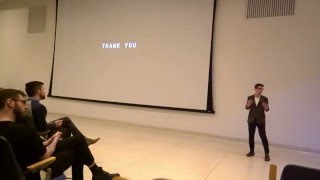
A student proposes Betagraph, a digital publication that takes current events and extrapolates them into plausible, research-backed speculative scenarios. The site clearly separates sourced facts from imagined futures, targets entrepreneurs and policymakers, and lets readers vote on scenarios and contribute data to shape what gets explored next.
Chapters
computers that are threatening and could be possibly smarter than we are. How do we even comprehend something smarter than us? Even ourselves, we're uncertain, we're in an uncertain place. Things that seem concrete like identity or gender are now more fluid. The whole world is changing right now, and it's difficult to comprehend these changes. The news media, news, regular journalism, does a great job at telling us these changes. Reporting them, for reporting anything. If you think about it, everything's unfolding, it's always happening in journalism. However, it kind of stops short in some ways. We're not certain of what's going to happen because of these things. What are the outcomes because of an ISIS attack? Regular journalism reports the attack, but obviously they can't report what might happen because of it. They can't report the outcomes. And that's useful for us to know, right? How can we decide what future we want if the world's going blank? If we don't see where all of these things are headed. So I propose a company today, part of my thesis, that tries to do this. Betagraph reports future journalism. It reports speculative journalism. And what we do is we take today's current events and extrapolate them forward. We say, what might happen when? We look at an ISIS attack and we say, what could happen If it goes further, what are the results? And why do we do this? What's the point? You do this because when you know the outcomes, you understand the stakes. You understand what's the meaning behind it. It's hard to see that when you're right in the now. We're very, we're kind of, we live on the trigger. We just do things right away rather than seeing the fuller picture. This is the website. This is Betagraph. It looks like any news website, only none of these things have happened yet. All these articles are set in 2017, 2019, they're all a little forward. How we do it is this, here's an example. We report, let's, elections are a great example because elections are the most speculative enterprise, right? You basically go in a booth and you basically decide which future you want, you decide between the two. That's a little weird because you cannot almost do eeny meeny miny moe, you don't know if their policies are going their policies aren't going to work out. You don't know who's going to be right, who's going to be able to do their plan. So here's an article we'd set a little after inauguration, we'd say Hillary Clinton's voted in. But we do, we base everything on future, we base everything on fact, we extrapolate fact. And so we write a story, but we're pairing it with fiction or futures. And the reason we need to do that, while it might seem strange to you, how the journalism, when we have to make up some details, we don't actually We know what her administration is gonna be. And the reason is because we have to have you buy into it. We have to have you read an article, but your mind should be in 2017 when you're in 2016. If we wrote in future tense, let's say, "It could be a good solution," you'd feel it's someone else's problem rather than yours. This could be your future, but it's reporting it to you, reporting a possibility. You might be able to understand if you want this future or not. It's useful to have a compass, give a direction. We're not in a prediction mode. Is, and if that doesn't work, we can't tell you north is that way. We can give you some sense of direction and uncertainty, things like elections. We can make you feel, do I want to vote for Hillary? This is how the policies go, because our reporters have done the research, and this is what I want. And what we try to do, because we don't want to end up like a lot of satirical articles do, let's say, that people see them as fact and they share them, and really they're just a hoax. So we actually separate the facts we found and our extrapolated fiction. Using these lines. You can click on that arrow and you can see where we got it from. So here we're talking about how Hillary is great with her White House staff. She's so nice and how we know that is because of her emails that were released several months ago and she was so great with her staff as Secretary of State. You can extrapolate that forward. So we see that this is something useful, right? That you're able to see the outcomes of the news, you're able to be more intelligent about it, decide which future you want for before they happen yet. We're able to be better citizens by looking into speculative greed. We want to be the site where you come to and say, you know, I don't really understand what's going on with robots. Could they really overtake us? And here are different sides. You'll know Betagraph has a good read. So who would read it, right? That's the thing. We think forward-facing thinkers. Those are people like entrepreneurs, people who have a larger bet in the future than the present. Those are like media thinkers, people who are always commenting on the unfolding present as well, policymakers, people who are wondering what's next for their nation. We're really going for the early adopters. As well, we're at a perfect time to launch because we're in an election in the States, and that's when a lot more people are forward-facing thinkers. So this becomes a question for this thesis, right? How does this become an advertising thesis? Because we need to figure out how to sell a completely different category of news. Things like this have been done similarly, but we're making a site devoted to what hasn't happened yet. This is what we need to tell people: read the future to understand the present. By reading what might happen, you understand the outcomes, you understand the stakes to what could happen. And understanding today what's going on, you can see the larger picture. So how do we tell that to people, and how do we tell it in such a way that if you don't read BetaGraph, if you missed an to the day of reading the Vatigraph, you feel like you've missed something, even though nothing we report has actually happened yet. Is there a line, is there some kind of clue that you're about to show people all this when they don't have much time? The future leaves traces. This is the line that ties together the entire campaign. It shifts your idea between present and future. It brings the future closer to the present, right? Traces are something that has happened, that happened already. They're something that passed, they're a sign that something's been here. But we're saying that the future leaves traces now. Nothing just happens. We're in the future's past. So if you can pick them up, if you can see those things, you're able to see what might happen. You're able to shape it. So we're going to show these traces, we're going to illuminate them to people all across this entire campaign. That's what we want to do. We want to illuminate the trees to show people that the future is more present than they think. Encourage them to read this new site. As well, in the attention economy, when people's eyes are the most precious resource, they don't have time. We need to capture that attention with little funds. As startups, we don't have much money. Everything needs to work. So we start with bus shelters, and we're going to post them in areas that have a lot of our demographic. In Toronto, that might be the Mars Centre, where there's perfect conflict of policymakers, entrepreneurs, and entrepreneurs and people just thinking about the future. We also post them in Canada's Regina area, a burgeoning startup market here. Here'd be the first one. Most see a simple needle. We see a $700,000 medication that could destabilize healthcare. They get graph reports what might happen. For those determined to shape what can happen. The future leaves traces. We help you see them more clearly. Here's a piece: most see an ordinary crop of corn, we see a modified wonder, able to save Africa from hunger. The future leaves traces. Most see a harmless snowflake, we see a top navigation for self-driving cars. True, we're kind of more like— us and robots are closer than you think. If you can't see a ball of air and snow, I can. So chalk. So, you know, we can't just think that people are going to look at our bus shelter That's right, we can't just think of that at all. They're not going to see that if there's a lot of noise out there. So you also cover these areas with chalk, showing the traces, illuminating the ordinary. Here's one by a pay meter. Mostly a street staple, we see an antique in the coming era of self-driving cars. Mostly a useful trash bin, we see potential soil contaminants. Poles, they're awful. Mostly a street light, You see artificial light and all the unforeseen damage on the animal world. So these things you pass by every day, we're extrapolating them, we're pushing them forward, showing you the traces, showing you what is there that you can't see yet. We make apparent what's already there, we show it to you. One of the questions I pondered working on this is who do people become when they interact with Betagraph? Who do we make them into? We make them into shapers, we make them into people who can see those traces. They see that string in the sand and they're able to unburden it. They're able to bring up— Steve Jobs was like that. He saw what computers were when they were boxes in companies, and he unearthed that strand slowly and shaped that future. We need to get other markets as well. So we're going to use the Facebook carousel. Facebook lets us tap into other communities online, other people who like pages of Wired or Motherboard, similar publications to us, and we need those readers. They make this ad called the carousel, where you can have 4 slots to put your product in, but because we're futurists and we do things kind of weirdly, we're not going to put our products there or simple steps of a recipe. We're going to attract people like this. We're going to take— send an ad— this would be to Wired readers— take a story that's been covered extensively, like the iPhone case, and we're going to use each box to extrapolate a different future that might become of it. So this is one where, you know, Apple might respond to this whole scenario and come folded by actually stating that better security is what they're about in their ad. They might make that a selling feature. Another one is that state strict legislation gets drafted very quickly, right? That, you know, Washington really pushes this issue. They don't want a company more powerful than government. I think a reader would be quite intrigued going through their newsfeed and seeing features, other stories extrapolating from one they've been very into. Meetups. Meetups are huge in the tech community, and they're a low bar to entry. People go, they network with other people, they hear speakers. And we think it's a great place to go. You know, you can just, one of you, if you have a startup, you can just go and say speak. And we want to do something interesting there. One of the most humbling traces of the future is the napkin. We've all heard the stories of people writing that first big idea on a napkin. But for that seed first there, Kickstarter has a story where they sat in a coffee shop at a café, and they ideated 4 of their movies in this one afternoon on a napkin. The biggest ideas in the world start there. So we're going to hand out napkins to people at the beginning. It says, you know, ask them weird creative questions, weird creative flashes, like how would you change school or job operates with food trucks? Most see a simple napkin, we see a canvas for a world of new ideas. This is a way of empowering the shapers. This is a way to tell them what Betagraph is and them never forgetting. And you know, people will know, and you have them take the napkin and fill it out a little bit, right? There's different ones. You can fill it out and then pass it to the other person. And they write another idea. They say, oh, I like this idea, I'm going to run with it, or I hate this, I'm going to do something else with it. Right? We're starting those traces, right? They're in the grassroots. You might leave that meetup with a startup idea, or with someone who can start something else with you. So we've gone to places where people are, where our target is. We've gone to meetups where lots of people are congregating that might like our work. But now we're going to go to a conference. The C2 conference in Montreal is a great conference for us to be at. It's a bunch— there's a huge amount of business workers, business leaders wondering about the future, wondering what's next. But as you can see, it's quite something. It's hard for someone with a small budget to compete with a Ferris wheel. Or to compete with something that looks grander than 10 people. How do we do that? So we're going to go where a lot of this noise isn't, to the bathroom. Now you might be thinking, well, what's so futuristic about the bathroom? The most forward-facing thought you have about the bathroom is when you're going to go next, and you're probably not very good at that. So what we're going to do— but the bathroom is a place where the future is unfolding. The bathroom right now is under a whole restructuring, as gender broadens, we're wondering if the bathroom is right as it should be, if it should be set up as a binary. And so, you know, your kids might not ever know what a men's room is. It might be a faded concept in a few years, and we want to explore that. So we take a bathroom and we cover it with an iPad. And we say on that iPad, most see an ordinary bathroom, we see a place that changes with our evolving mindset. How would you like to see bathrooms labeled in the the future. We take this bathroom and secretly make it unisex so anyone can walk in. We encourage people to draw the symbol they want. We kind of give them some ideas, but they can totally extrapolate off of that. It lets them do whatever they want. Draw the symbol and then walk in. Even have Braille up there. Draw the symbol and walk in. When they walk in, they see the traits of the future come alive. It says, "Our changing minds are the first traits of the coming future." That's the most beautiful trace of the future. Our changing mindsets, our evolving opinions and attitudes are probably the first trace, or the best trace, the first indicator of what the future could become. And we want to show that to people in real time. So when they walk in, they're going to see a screen of what people have drawn, of what people have showed, of the symbols they've done. So people can see that changing mindset in real time. And it can expand, it can show more symbols, it can show everything people are drawing. And show how many times it comes in so people can see this changing mindset evolve before their eyes. Additionally, we'll tell them that we'll be using this data to write an article about bathrooms and identity set 10 years from now. So they're adding, they're building data journalism for us by having that experience. They build it for us and probably everyone at that conference is going to say, hey, have you gone to the bathroom yet? The last final piece, as you've seen, we've been directing readers to BetaGraph. As a small new media publication, we're directing readers more and more. And then we have an opportunity. A lot of people are going to be making judgments on speculative journalism. What do they think? So we want to engage them in that. We have a feedback group. We're going to publish some stories under the Open Futures banner. And that lets them kind of vote if they thought the future was right, if they disagreed, if they really thought we were full of nothing. They can say that. They can state that. And we think that people reading will have good opinions. Them to share with us some of their own traces, things they've seen. You know, if they don't agree, then they might give us another fact, another study that we didn't look into. And then they can come with us and we can write a follow-up piece where they're going to get us— they're going to see how we report back into the future. They're going to get an email. They'll join in on this entire process where they're able to see it unfolding before their eyes. They'll receive updates of the articles we found, things we've researched that they told us about, see how the process unfolds. So it's not opaque. They're able to see how speculative journalism is reported, as if we're doing it in a new way. We'll show maps, we'll show all this data, and then at the end, the article will publish like this. You know, it was reported by Samuel Johnson, Stephen Katz, and 2,034 other contributors. And those contributors, those people, those co-creators, they're the first ones to share it. I don't think I'll maybe be creating a hashtag on social media, but I like nudging social media. And when you're the first one to share it, and and we're not sharing it yet, you're more inclined to share it because you're the only one who will share with your network. So we kind of make a little bit of a network effect. So we've gotten people through bus shelters, we've seen, we've shown them, we've illuminated the traces that there's mapping, that the traces are the back into our changing mind from the biggest traces. We've shown them that there's a compass for their uncertainty, and that's Datagraph. But there's one last thing. As opposed to you jobs, there's one more thing, right? Betagraph is not speculative itself. Betagraph is real. This is really happening. It's launching at the end of this month or early next month. You can sign up right now at betagraph.co to be the first one to receive it. It's launching. It's time we shape our future in a new way. Thank you very much.
Congratulations!
Who would like to go first here? I'll go first.
Yeah, I think that was fantastic. I really loved it, and it was so smart on a few different levels. I think when you look at what just happened with the Boston Globe and Trump, I was like, how timely this idea. But it's just so great that you picked up on so many different things that are happening in culture, and you can talk about these different cultural trends in this way that I think is really digestible for people. And I think people would really get behind— I mean, like, I read The Onion on a regular basis. I think satirical news definitely has its place. And when you look at what's happening with journalism, um, I think this is just a really interesting idea. I think your articulations of it were strong as well. Your copywriting was quite strong. Um, and I also, like, got into your presentation presentation, because I thought it would be really engaging, and the way that you kind of commanded the room, I thought, fantastic job.
So, it's awesome. Great work.
Oh, goodness.
Really loved the presentation. It was super sharp, very intelligent. You got Silicon Valley vibes, and so— really slick. I— just to confirm, you You created this product, this publication, on your own, or in this project.
Okay.
So what I wanted to say to that was it's really impressive that you created a product and a campaign for it as your thesis, because that's doubly ambitious. So congratulations.
You were successful.
I appreciate that. Thank you. Yeah, I'll go. I remember a couple weeks ago we met. And my first reaction was, this is so fucked up. Like, this is crazy. And I couldn't wrap my head around it. So I think where you've taken it is articulate, it's clear. I think your design chops, your writing chops are on point.
It's gonna be huge.
So, um, oh yeah, I think it's just a more productive way of journalism versus news becoming a business. Pitchfest. This is like, this is what's happening, what are we going to do about it, and what are your questions of it. So I think this really does take the muse from them a little.
So congrats. Um, I thought it was great. I loved it. I thought you did a really good job with taking us through a story and giving us a very clear setup. Um, I think you're an excellent presenter. Um, it's a little bit difficult for me, to be honest, you to critique it because I do feel like it is in a way outside of the world that I live in, in how I function in advertising and design. Although I think you did a fantastic job with the art direction. Um, and the reason that I'm going to say that is I think instantly for me it has so many applications that it's hard for me to distill it down. I think one of the great examples for me has always been the baking soda. Baking soda started out as a thing you bake with, and then it became a thing that you use to clean your fridge, then it's something that you clean your house. So I love the way that this would apply to brands, and I can see brands wanting this as a tool to— how can their product be reimagined? And there's many points that kind of hit on that, let alone as a journalism feature. So that's why it's kind of hard for me to just distill it back to what your original product and offering is, because I think it's just so exciting that it could do so many different things. So I, I I love it. It's great. Thank you.
I have a question. Who is going to write? Yeah, we have— well, right now for me, I have a budget and I have— we have some Ryerson Master Journalism students right now. Hopefully it could get bigger or better or stronger. I mean, hopefully our writers can grow with us if you do it. It'll probably be a small thing right now, just a few writers. There's been people in this space before, like Inspector Says Space. They've been one-off projects or different ways. We do a little differently, so hopefully We have a process of how it's written, and hopefully it'll get sound. One more question. You started with asking or positioning it, uh, addressing uncertainty. How do you propose to make this known as not being taken at face value? Because there's a lot of uncertainty in journalism right now. Yeah, I get very scared that people are going to think it's like a lie, or they're like, what kind of garbage are you showing up there? So I think on the actual website that's made where there's going to be like a kind of a beautiful looking disclaimer that's going to say we're about possibilities, not predictions. You come here to broaden your perspective by deepening your sense of time.
Very provocative. Dangerous.
Very dangerous. Yeah, right. Anyway, this was very much—