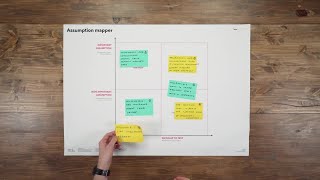
Mike from Board of Innovation walks through the Assumption Mapper, a 2x2 tool that sorts assumptions by importance and testability. Focus first on customer-facing assumptions that matter and are easy to test, then narrow down to 4-5 to guide your experiments.
Chapters
Hi, I'm Mike, I'm a senior innovation consultant at Board of Innovation and my job is to help corporates to really innovate like startups working across design, business and innovation domains. I'm going to introduce you to a really important tool called the Assumption Mapper. This tool is a real cornerstone tool in the whole innovation process. You would typically use it after you've completed the Innovation Battlefield. So you should have defined your critical features from the customer's point of view. Once you've done that, you then move into the Assumption Mapper. And this tool is really designed to help you to identify sometimes called loafers, which are leap of faith assumptions. So the real deal breaker assumptions that if are invalidated, your whole concept needs to be rethought of or pivoted or changed in some way. So it's a really important tool. It allows you to think self reflectively as a team, to delimit and de risk in terms of biases what you're putting onto the table. And it allows you to really prioritize what's the most important thing to test as quickly as possible. So how does it work? It's a tool split up into two different axes. On the left side you have your important assumptions and your non important assumptions. And on the bottom you have easy to test assumptions and then very difficult to test assumptions. And the goal really here is to isolate the assumptions that are really important to test, that are very easy to test and those are the ones you should be looking at first. So by this point you'll have a whole list of features from your Innovation Battlefield. You will then be diving into those specific features, looking at the critical assumptions within those features, and typically within five features you might come up with 50 or even 60 critical assumptions. So this is a way to filter them out, make sure that you're really focusing on the right assumptions to test as early as possible. Now there are four different types of critical assumptions that you'll be looking at. First of all, there are customer desirability assumptions. Then you've got your business model viability assumptions. Thirdly, your technical feasibility assumptions. And fourthly, whether or not it fits the corporate strategy. Now what you need to do here is to ignore the second, third and fourth assumptions and you really only want to focus on the customer critical assumptions. And this is very, very hard to do for a lot of project teams. The reason for that is they typically move towards the technical implementation first of all. So it's very easy to think about assumptions related to technical feasibility. Can we build this Is it possible? Is it feasible? Can we do this with the team we've got? You really want to park those kinds of assumptions and prioritize the customer facing assumptions. So that's why you would have used the Innovation Battlefield to look at the features from the customer's point of view. And building on that process, you now look at the critical assumptions from the customer's point of view, from the customer features, if that makes sense. So how you should use this tool, again, I would work individually. First of all, write down some critical assumptions that you can think of related to your top features of your concept and then simply stick them on the template where you think they should be. The ones that remain in the top box here in the top left, those are the get out of the building and test these now assumptions. So the real critical assumptions that are nice and easy to test, but you want to just, first of all, just stick down all the assumptions you can think of and roughly where you think they should be. The real key to using this tool is to challenge each other and to be really brutally challenging each other. Have really difficult conversations if you don't think that this assumption is here. Millennials like unexpected rewards. If you think that's not important and it's difficult to test, put it down here, take them off, challenge each other, have really difficult conversations because it's so important that you get the critical assumptions here that are most important and most easy to test. And it's not an easy discussion to have. So by going through this tool, you'll be able to prioritize which ones are most important because what you'll be doing next is defining experiments for each of those assumptions. So you don't want to have more than four or five assumptions here. The reason for that is you'll have too many assumptions to test in your prototype. Again, you have limited time, limited scope. So it's very important that you keep within that, keep within the constraints and just focus, make decisions and move on. And that's really what this tool is about. And it's about doing the minimum effort and getting the maximum output. So it's a way of filtering out all the unnecessary stuff. Just focusing on the customer assumptions, what's most important from their point of view. And then this will guide you into what you need to do next with your experimentation design. So those are some tips and tricks really focus on customer facing challenges only. Park any business modeling, any technical feasibility or any corporate strategic fit assumptions, just remove them off there. Focus, focus on the assumptions from the customer's point of view. And really don't be afraid to challenge each other within your teams. It's really important that you focus on the right ones. Okay? That's the assumption. Mapper. If you like this one and want to see a whole bunch more tools, check out borderinnovation.com tools and there are a whole load on there for you as well. Thanks a lot.