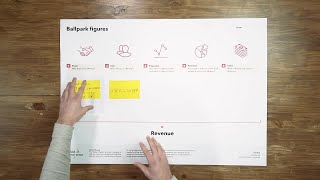
Nick walks through a lightweight template for rough business estimates without spreadsheets. Five elements: who buys versus who uses, how often, what slice of the market converts, how much value you capture. A worked example of a savings account for French millennials shows how 5 million people, 5% conversion, and €1,000 lifetime value gets you to €50 million.
Questions this video answers
Nick, business designer at Board of Innovation.
5 million people.
5% (yielding 250,000 people).
20% of signups.
€1,000.
Chapters
Hi, I'm Nick, business designer at Board of Innovation. So now I will explain the ballpark figures template. So this is a tool that will help you to make a guesstimate or a high level calculation of your business case very early on in the process. So you don't need Excel or any advanced calculation. But very early on in the process, we encourage people to just look at a couple of high level figures, to make a high level calculation, at least to get an indication of the potential of your business model. Way too often we see that people postpone this calculation to very late in the process. So a couple of weeks before they need to do the final presentation or something, they will notice that they can jump into Excel. And only at that moment they realize they're missing maybe a couple of million in revenues or they see that actually companies work in a real context. So we encourage people to do this calculation very early on so you can spot the inconsistencies or the very complex assumptions. You have to solve them very early on. So to help you out, the ballpark figures template will zoom in on five different elements that will give you a first indication of the potential revenue stream or the value of your business model. So let me show you how it works. So for now, we assume we're working on sort of a new savings account for a financial institution. It's linked to specific health goals, linked to specific customer segments, the millennials. So how will that work for this example? So first of all, we have the buyer and the user. So who buys your offering? And we will use your offering in this case with our example, we assume that will work for our clients will be the millennials, maybe millennials without children, in an urban environment. And it's always important to zoom in on very specific numbers here. So let's say one of our segments would be focusing on France. So for this specific target audience, let's say there are 5 million people that fit that criteria. So a group of 5 million people here, for this example, we can look at the buyer and the user. Are they the same or not? In this case, they would be the same. So the person who would buy the service or start using the service, the person who will buy the service will also use the service himself. While there are some business models where it's not the same. So you could have a service where you're actually selling to the parents, but then the kids would actually use the service. So it depends a little bit on your business model. So sometimes you need to make the distinction between those two clusters in this Case it will be the same. Then the third component, frequency, how often will people, how often will they use your tool? How often will they buy your tool or buy additional upgrades? Depends on the business model. For our example, we assume that we just sell it once. At least we convince people to sign up once. And depending on their health goals that they set themselves, they might use the service two or three times per week. So it's a high frequency product. It's just not something you buy just once a year and then you leave it there. Or you might even use it a couple of times per week. So it might have an impact on how you make money in the end. And the fourth component, it's the potential of this client mark and this client segment. So how many people can you convince to sign up from this bigger segment? So for our example, we assume that maybe over time, with the assets that we have available and the resources that we have available, that we can convince maybe 2 to 5% of this client market. So up to 5%. And then the last component, how will we capture value? So maybe this links to pricing or maybe how you want to reduce costs over time. So this component, for our example, let's say with this financial institution in mind, we can look at the lifetime value of a customer. So in this case could be around €1,000 that we maybe can increase. Maybe we can gain additional clients by using the service. We can maybe convince an extra client segment to sign up for the service and maybe also start using additional services of this financial institution. Let's say about 20% of clients per country we can add on top and maybe people become more loyal to the overall service, so there will be less churn, maybe 10% less churn or something. So you can explore different options here how you want to capture that value. In the end, if you combine all different elements, you will see how everything will be translated in a first guesstimate on the revenue stream. So let's show you how that could work. Just to illustrate, let's focus on France here for a moment, where we have about 5 million people that we have as a bigger target group. We assume that we can convince 5% of that target market to sign up over time. So that would be 250,000 people. We also said that within that group, 20% of them will be totally new clients for this financial institution. And also we know that for every new client we have a lifetime value of around 1000 Euro. So by combining all those different numbers, it gives you a first indication of 50 million euro that can be gained over time. This number can be way off or can be very close to what we can actually achieve. But once you have this number in place, you have a tool that you can sit together with your team to shoot at this specific number. Maybe some people don't agree. They say, no, the thousand euro needs to be 2,000 Euro or 500 Euro, or they totally don't agree that the 5 million Euro segment is big enough in France and so on. So you see the relationships between those numbers and very early on the process, you can challenge them and have a discussion with your team, maybe to narrow or to zoom in on that number where you would say, like the 50 million euro. No, that's way too high. By relooking at those numbers, we end up with a better estimate, maybe 50 million euro or something. So this is a great starting point to start your business case. We always encourage people to do this very early on in the process. The ballpark figures is a great tool to do so. So give it a try early on and see where you end up with your own team. If you want to download this tool, you can go to our website, boardinvasion.com tools. This and more examples can be found there. And we're always available for more questions than.