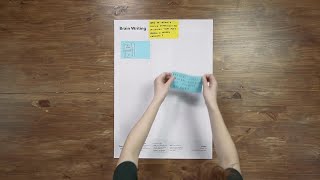
Claire from Board of Innovation walks through brainwriting, a silent ideation method where people sketch ideas in boxes on a sheet, pass it around, and build on each other's work. Spend about one minute per box, and try standing or using large wall sheets to keep energy up.
Questions this video answers
Claire (Board of Innovation)
About one minute per box.
Six minutes.
boardofinnovation.com/tools
Chapters
Hi, I'm Claire with Board of Innovation, and today we're going to talk about a tool called brainwriting. Now, brainwriting is something that you'll want to use in your solution development phase. This is after you've kind of understood the exploration of the problem space and you have a clear how might we. That you've defined. So for us, say we have this how might we. How might we recreate a saving experience for millennials that's more playful and socially engaging? So often we'll get these sheets of paper and we'll do it per person. That's kind of the first way that we do brainwriting. We'll put our how might we at the top. And perhaps if you have multiple how might we's, each person in your group can put that at the top of their page. And what we do is we like to say that before we get started, we set the scene for having a great amount of ideas. So we do this in a couple ways. First of all, make sure that your team is energized and ready to ideate. Make sure everyone is open and knows that they need to really build on each other's ideas for this activity. It's all about adding on and making things even better and putting new twists on them. Also, this uses a term called hybrid brainstorming. So what we do is actually we come up with ideas individually, and then together, we actually build on them to make them even better and come up with larger quantity of ideas. So in this phase, quantity is always better than quality, and later, we can cut out the ones that don't make sense. So to start us off, each person in my group, if I was a facilitator, I would give them a piece of paper that looks like this. They can write their how might we at the top? If that helps them remember it. We usually time box this activity, and I usually like to go by the amount of boxes. Give it about a minute per box. So say we have six boxes here. We would time this for six minutes. That helps us be a bit more constrained, which actually helps us then be more creative. Think about it like solving a problem under pressure. You always find that you come up with your best ideas last minute, right? All right, so say we were to get started. We start the timer, and our first person looks at their page. Everyone's looking at their papers, and we all start coming up with our own ideas. So I'm looking at this, and I might say, okay, I could potentially create an app, maybe. I could also maybe have a branded fitness center that's exclusive for an account holder. So I'm looking and I'm thinking and I'm adding ideas. You'll note here that this idea over here is visual and we always like to encourage visual ideas. That's because one person's interpretation may actually be different and trigger a new and different type of idea coming out of it. So as the facilitator, I would actually then ring the bell after a few minutes. So say after two minutes here. And this paper would actually be passed to the next person, person sitting next to me. So I would receive a paper like this and maybe I wouldn't know actually what those ideas are. So you're really rotating your papers around the group. So maybe I look at this as a new person coming in and I could say, okay, it looks like someone put an app here. I don't really know why they put an app there. But for me that actually triggers maybe an idea around challenging your friends to a fitness goal. So I would add that one on there and maybe I would say, oh, that's interesting that they want branded fitness centers for exclusive account holders. So actually I would say maybe we could have wellness coaches in the branch at certain hours. So that really builds on some of these ideas that the person before me had put down on their page. By the end of the activity, you'll actually have surfaced this to each person multiple times. And so you'll actually have ideas from Even maybe a third person or a fourth like this one, automatically save 10% of cost on unhealthy purchase. And by the end of the six minutes, you'll actually have lots of new ideas that you never would have come up with before if you hadn't been inspired by each other. One other great way to use this tool is actually to print out a huge piece of paper on the wall and just have people start adding to it and actually just adding onto those ideas there. So you can do this either sitting down and passing the paper, or you can do it up and standing. That always gives a little bit more energy to the activity. And in the end you can actually have a conversation around some of the ideas. So fill in what they are and even trigger more ideas as you're verbalizing them. So it's a really nice and flexible tool to start off your solution development and I highly recommend it as a beginning tool. So if you want to know more about the brainwriting tool and any other tools of Board of Innovation, check out our website, boardofinnovation.com tools. There you can find everything you need and more. Enjoy.