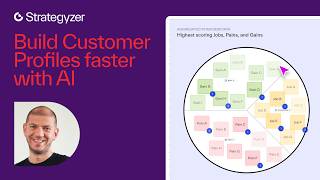
An AI canvas generates starter customer profiles with jobs, pains, and gains, then prompts teams to refine them before testing. The tool cuts through blank-page paralysis and gets you to customer validation faster by surfacing AI suggestions you review and edit.
Chapters
So when we talk about the blank canvas, blank page syndrome, it is all about this right in the face of a very empty page. Some teams have a challenge of starting out like, how do I start, where do I start from? And especially considering that they've just learned about these tools, like in our programs, they go through the E learnings to learn about these tools and then they need to do the work. Getting started can be a bit difficult and they can like fear response can emerge. They may be really worried about what they put out there. So the idea is to help them with the new AI features to get them started and have them an idea of what a good customer job pain or gain may look like. So to get started, you can either start generating your jobs, your pains, your gains as you have them in your mind, so the team can already start generating some, or you can directly ask AI to give you some examples, right? So to do that you would click on this button right in your canvas. So you don't need to go through a chat window, which is another type of AI help we have on our platform. So you don't need to converse with the AI model, but you can directly interact right on the canvas. So in this case, let's take like insurance, life insurance product and then for the customer segment, let's say that it's parents who are 30, 40 years old with children under 10 generate jobs, pains or gains. You can select where you want to start from. Let's go with jobs first, which is usually the flow of generating customer profiles. And you can specify actually if you would like to generate functional, social or emotional jobs or a mix of them. Let's go with a mix. So it will take a few moments and pop up some jobs from all the knowledge the AI has and the actual model has access to all our books, all our tools, all our videos. So hopefully this is bringing up hopeful, helpful suggestions. And the idea is that the AI data, the content that it brings up, doesn't directly get validated. The users, the teams who are actually going through the process, needs to review them and make sure that they make sense for their context. So in this case, let me quickly review Secure financial future for children. I need to accept it, to consolidate it, or delete it or edit it to make sure that the team has reviewed the content, easily adjust. Yes, let's say this is also valid. Maybe this is not valid. So I would just delete this maybe as well, it doesn't apply to me and then I'll delete that and then let's leave this out as well. So those are jobs. And I can continue with populating panes based on these jobs. So the AI will take into consideration the data that you have on the canvas and populate some panes for this specific case. The idea is that you would validate some of these and then either edit or delete some of these. And with this, you have like a first starter customer profile template in your hands and you can add your own ideas about the jobs and pains and gains that you think this customer segment has. And once the team has gone through this, having a first version of what they think the customer segment, jobs, pains and gains are, there is also a feature to have a first assessment of this. This is needed because, like, the team may not be confident about the validity of these and coaches are not always available in our programs. Like, the coach may need to be monitoring multiple teams. So this is like a pre assessment before really having a conversation with your coach or with your customers so that you get a sense of if your job plans and gains are relatively okay. So to do that, you would start this mini coach and this mini coach. Actually what it does is it takes into account all the stickies on the profiles one by one. It reviews if they have a good balance, like between functionality, social and emotional jobs, if there's a good balance of them, and if things make sense altogether, like holistically. And it would also frame its questions as like reflection prompts, right? So it wouldn't tell you, okay, this isn't wrong, you should do this, but it's more like asking you questions for you to reflect on these jobs, pains and gains. Which you could either say that this is a valid question and I would like to further specify this one, or you could simply dismiss the question because it might not be helpful for you. And then you go through these questions and make the edits you would like to make. And once you feel that you're ready with this customer profile, you can continue the process, which is basically getting to testing and getting in front of customers to talk to them and see if these really apply. So the whole point of this feature is to accelerate the process of mapping your ideas and then getting to testing as early as possible, because that's what matters.
What Charleston has just showed you is how this feature worked, which is essentially this idea of solving the blank page problem, right? Getting something that you can work with faster. We've all been in a situation where we're trying to get feedback, we're trying to move things forward, but when you've got nothing to start. It's very difficult there, right? You're very. You're able very quickly to generate a customer profile, iterate that profile and then put it in front of a customer and verify whether or not that profile resonates, right? And so it solves that blank page problem, practically. It does these two things, right? It increases speed by enabling you to move from concept to a testable hypothesis faster. It reduces the initial time you have to spend brainstorming, which is not always super productive, and gets you to testing faster. Right? And the second element, obviously, is it improves quality. If you've got something that is already resonated and is based on sort of, you know, the intelligent underpinnings of AI, right, you're able to generate better insights, right. If this is the first time you're doing this, right, or if. Or if you're thinking of a customer segment, you might not know very well what you come up with. Might not be of a super high quality, right? As Akshay was joking about earlier today, you might even go directly to ChatGPT and say, hey, give me some customer jobs, pains and gains, because you're not super familiar with that process, right? Having them directly mapped in, having them combined with our mini coach in the way that Charleston showed, we think is a really interesting and helpful combination.